
Notes from guy ton of extrinsic cardiac conduction with image
Reading File
Now let me search the library for extrinsic cardiac conduction content from Guyton.
Finding Sources
Finding Sources
Found Guyton and Hall (ISBN 9780443111013). Now let me search for the extrinsic control/regulation of cardiac conduction section.
Finding Sources
Finding Sources
Finding Sources
Finding Sources
Found the exact section. Now let me read it along with surrounding content and look for images.
Reading File
I have the main content. Let me read a bit more to get the sympathetic stimulation section and find the image reference.
Reading File
Let me read the section more carefully - I need to find the sympathetic stimulation content and also look for Fig. 9.14 (the cardiac nerve image referenced in the text).
Reading File
Finding Sources
I have all the content. Now let me find Fig. 9.14 (the cardiac nerve diagram referenced in the text) in Chapter 9 of Guyton.
Finding Sources
Finding Sources
I have everything I need - the full text and the image URL. Let me fetch the image and compile the complete notes.
Loading Image
Here are the complete notes on Extrinsic Control of Cardiac Conduction from Guyton and Hall:
Extrinsic Control of Cardiac Conduction
Guyton and Hall Textbook of Medical Physiology
Overview: The Cardiac Nerves
The heart receives both sympathetic and parasympathetic innervation, as shown in Figure 9.14 below:
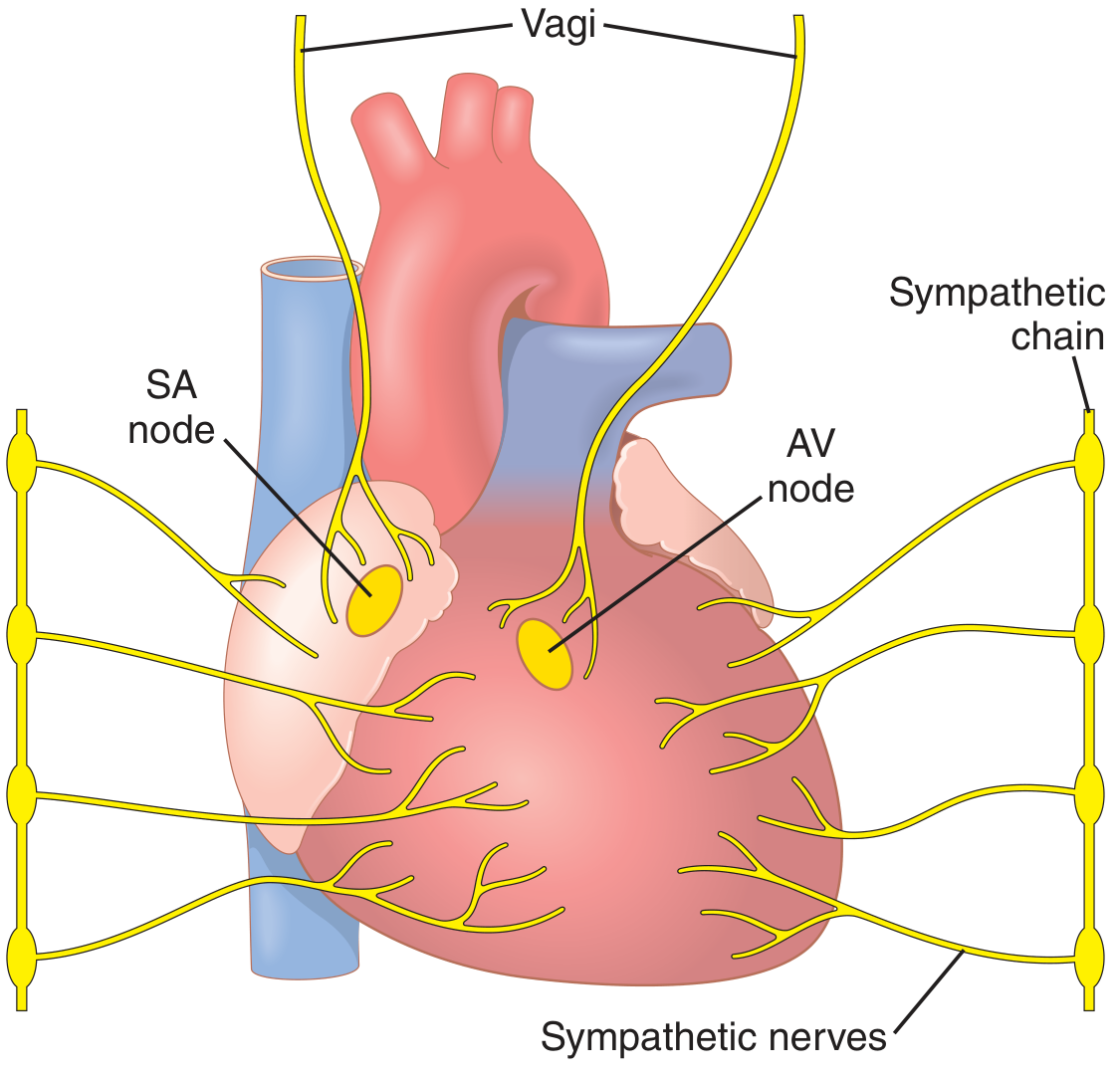
Figure 9.14 - Cardiac sympathetic and parasympathetic nerves. AV = atrioventricular; SA = sinoatrial.
Distribution:
- Parasympathetic (Vagus nerves): Mainly to SA node and AV node; some to atrial muscle; very little to ventricular muscle
- Sympathetic nerves: Distributed to ALL parts of the heart - strong representation in ventricular muscle as well as all other areas
1. Parasympathetic (Vagal) Stimulation - SLOWS Rhythm & Conduction
Neurotransmitter: Acetylcholine (ACh) released at vagal endings
Effects:
| Effect | Detail |
|---|---|
| Decreases SA node rhythm | Slows heart rate |
| Decreases AV node excitability | Slows impulse transmission to ventricles |
| Weak-moderate stimulation | Reduces heart rate to ~half normal |
| Strong stimulation | Can completely stop SA node OR completely block AV conduction |
Ventricular Escape
When strong vagal stimulation blocks the SA node or AV conduction, the ventricles stop for 5-20 seconds, after which Purkinje fibers in the ventricular septal portion of the AV bundle take over at 15-40 beats/min - this is called ventricular escape.
Mechanism (Why ACh Slows the Heart)
ACh increases membrane permeability to K+ → rapid K+ leakage out of conductive fibers → hyperpolarization (inside becomes more negative than usual).
In the SA node:
- Resting membrane potential shifts from the normal -55 to -60 mV down to -65 to -75 mV
- The spontaneous upward drift (pacemaker potential) takes longer to reach threshold
- → Rate of self-excitation is greatly slowed; strong stimulation can stop it entirely
In the AV node:
- Hyperpolarization reduces the ability of small atrial fibers to generate enough current to excite nodal fibers
- Safety factor for AV transmission decreases
- Moderate decrease = delayed conduction; large decrease = complete block
2. Sympathetic Stimulation - INCREASES Rhythm & Conduction
Neurotransmitter: Norepinephrine, acting on beta-1 adrenergic receptors
Effects (opposite to vagal):
- Increases rate of SA nodal discharge (positive chronotropy)
- Increases rate of conduction and excitability in ALL parts of the heart
- Increases force of contraction in both atria and ventricles (positive inotropy)
Key figures: Maximal sympathetic stimulation can nearly triple heart rate and increase contractile strength by up to 2-fold.
Mechanism (Why Norepinephrine Speeds the Heart)
Beta-1 receptor activation increases permeability to Na+ and Ca2+ → membrane becomes more positive (resting potential more positive).
In the SA node:
- More positive resting potential + faster upward drift of diastolic potential toward threshold
- → Heart rate increases (accelerated self-excitation)
In the AV node & AV bundle:
- Increased Na+/Ca2+ permeability makes it easier for the action potential to excite each successive fiber
- → Conduction time from atria to ventricles decreases
In the myocardium:
- Increased Ca2+ permeability → stronger cross-bridge cycling
- → Increased contractile strength
Summary Comparison Table
| Parameter | Parasympathetic (Vagal) | Sympathetic |
|---|---|---|
| Neurotransmitter | Acetylcholine | Norepinephrine |
| Receptor | Muscarinic (M2) | Beta-1 adrenergic |
| Ion channel change | ↑ K+ permeability | ↑ Na+/Ca2+ permeability |
| Membrane effect | Hyperpolarization | More positive resting potential |
| SA node rate | Decreases | Increases |
| AV conduction | Slows or blocks | Faster |
| Contractility | Minimal effect (little ventricular innervation) | Increases up to 2x |
| Main targets | SA node, AV node, atria | Entire heart (strong in ventricles) |
Source: Guyton and Hall Textbook of Medical Physiology, Chapter 10, pp. 140-141
Parasympathetic av node explain in simple
Here's the simple explanation right away:
The vagus nerve releases ACh → K+ leaks out → AV node gets "too negative" (hyperpolarized) → harder for the electrical signal to pass through → conduction slows or blocks completely.
Parasympathetic Effect on the AV Node - Simply Explained
Think of it like a Security Checkpoint
The AV node is like a security gate between the atria (upper chambers) and ventricles (lower chambers). Every heartbeat signal must pass through this gate.
The vagus nerve is like a guard that can slow down or close that gate.
Step by Step - What Happens
Step 1: Vagus nerve fires
- Releases acetylcholine (ACh) onto the AV node
Step 2: ACh opens K+ channels
- Potassium ions rush OUT of the cell
- The inside of the cell becomes more negative than usual
- This is called hyperpolarization
Step 3: The cell is now "harder to excite"
Normal resting state = -65 mV (easy to fire)
After vagal stimulation = even more negative (hard to fire)
Think of it like a spring that is already compressed - you need more force to compress it further. The signal coming from the atria no longer has enough "push" to fire the AV node easily.
Step 4: Result depends on how strong the stimulation is
| Vagal Strength | What Happens |
|---|---|
| Mild | Slight delay in conduction (longer PR interval on ECG) |
| Moderate | Noticeably slower conduction to ventricles |
| Strong | Complete AV block - signal cannot pass at all |
What Happens After Complete Block?
If the AV node is fully blocked, the ventricles don't just stop forever. The Purkinje fibers (lower down in the heart) act as a backup pacemaker:
Ventricles pause for 5-20 seconds → then Purkinje fibers fire on their own at 15-40 beats/min
This backup rhythm is called ventricular escape - the ventricles "escape" from the blocked signal and make their own slow rhythm to keep blood pumping.
One-Line Summary
Vagus nerve → ACh → K+ out → hyperpolarization → AV node hard to excite → slow or blocked conduction → if totally blocked, Purkinje fibers take over (ventricular escape at 15-40 bpm)
Source: Guyton and Hall Textbook of Medical Physiology, Ch. 10
This is a shared conversation. Sign in to Orris to start your own chat.