
pathophysiology of infective endocarditis
Reading File
Finding Sources
Finding Sources
Searching PubMed
"infective endocarditis" AND pathophysiology
Searching the Web
infective endocarditis pathogenesis pathophysiology Merck Manual
Reading File
Reading File
Searching Images
infective endocarditis pathogenesis vegetation endothelial damage bacteremia fibrin platelet diagram
Reading Web Page
https://www.merckmanuals.com/professional/cardiovascular-dis…
Reading File
Pathophysiology of infective endocarditis
Infective endocarditis (IE) is microbial infection of the endocardial surface, usually a heart valve. Its central pathological lesion is an infected vegetation: a friable mass of platelets, fibrin, microorganisms, and inflammatory cells.
Sequence of events
-
Endothelial injury or a susceptible surface
- Normal intact endocardium resists infection.
- Turbulent, high-velocity blood flow causes microscopic endothelial damage, especially with abnormal valves, congenital heart disease, prosthetic valves, intracardiac devices, or previous IE.
- Injury exposes collagen and tissue factor.
-
Formation of sterile platelet-fibrin thrombus
- Platelets and fibrin deposit at the injured site, forming a small sterile lesion called nonbacterial thrombotic endocarditis.
- Typical sites are on the low-pressure side of a valve leaflet, where turbulent jets strike the endocardium.
-
Transient or persistent bacteremia
- Organisms enter the circulation from skin infection, intravenous catheters, injection drug use, dental/oral sources, gastrointestinal or genitourinary procedures, or invasive infections elsewhere.
- Common pathogens include Staphylococcus aureus, viridans streptococci, enterococci, and coagulase-negative staphylococci in prosthetic-device infection.
-
Adherence and colonization
- Microbes adhere to the platelet-fibrin nidus through microbial surface adhesins that bind matrix proteins such as fibronectin, fibrinogen, and collagen.
- S. aureus is highly virulent and may infect even apparently normal native valves.
- Bacteria multiply within the thrombus and provoke more platelet activation and fibrin deposition.
-
Vegetation growth and biofilm formation
- The vegetation enlarges into an avascular, dense, infected mass.
- Organisms are shielded by fibrin, platelets, and, particularly on prosthetic material, biofilm. This limits penetration by neutrophils, antibodies, complement, and antibiotics.
- The result is persistent bacteremia and relative resistance to antimicrobial therapy. This sequence is described in Fuster and Hurst's The Heart, pp. 1024-1025.
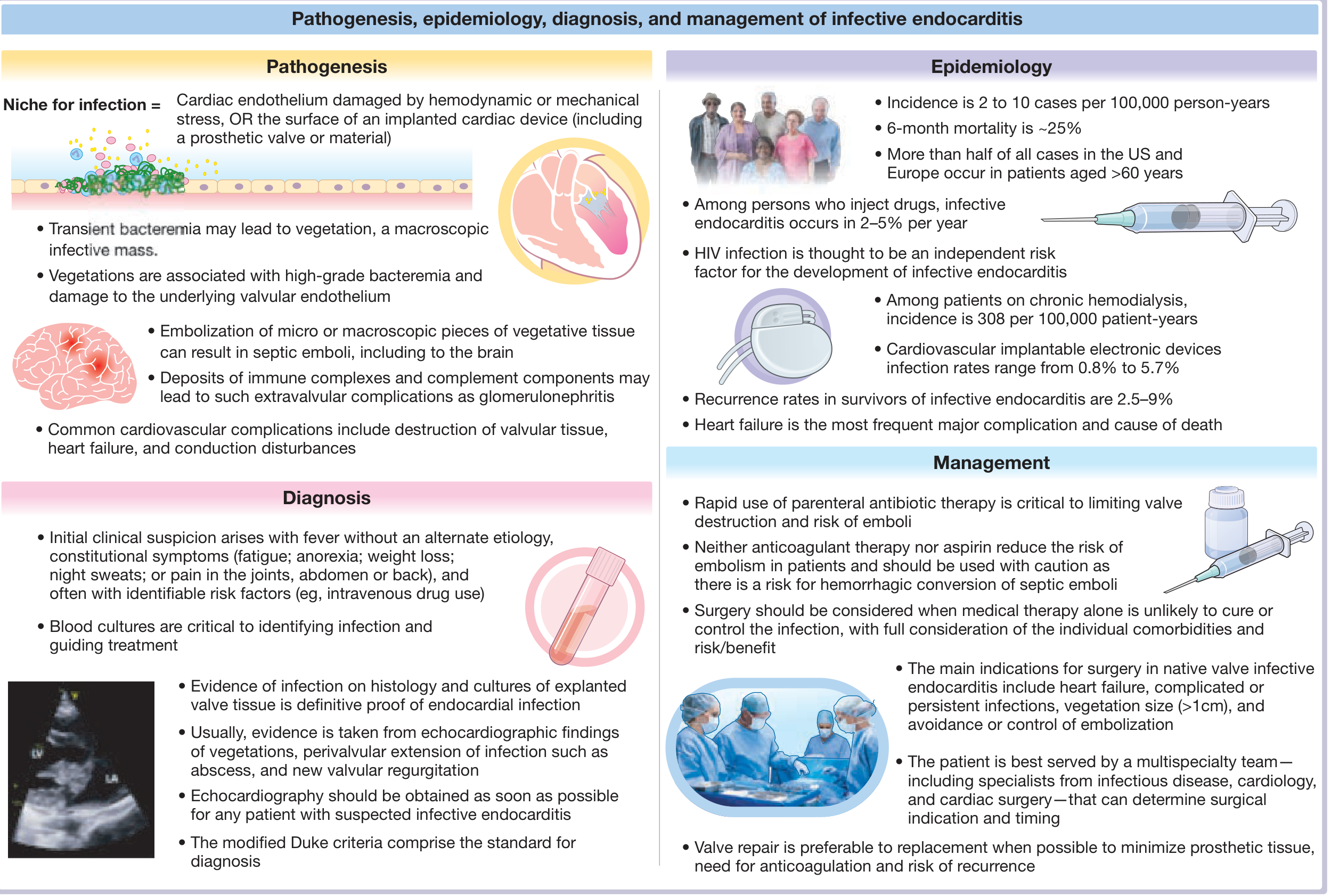
Consequences of vegetations
| Mechanism | Result |
|---|---|
| Valve leaflet destruction, perforation, chordal rupture | Acute valvular regurgitation and heart failure |
| Extension beyond valve annulus | Perivalvular abscess, fistula, prosthetic-valve dehiscence, and conduction block |
| Fragmentation of friable vegetation | Septic emboli |
| Left-sided IE emboli | Brain, spleen, kidneys, coronary arteries, limbs |
| Right-sided IE emboli | Septic pulmonary emboli, pulmonary infarcts or abscesses |
| Continuous bacteremia | Fever, sepsis, metastatic infection |
| Circulating immune complexes | Glomerulonephritis, low complement, vasculitic features |
| Persistent inflammation | Anemia of inflammation, raised ESR/CRP, weight loss |
Important clinical correlations
- Left-sided IE usually affects the mitral or aortic valve and causes systemic arterial emboli.
- Right-sided IE, often tricuspid in people who inject drugs or those with intravascular catheters, causes pulmonary septic emboli.
- Prosthetic-valve and device-associated IE is especially difficult to eradicate because biofilm enables persistent infection.
- The local destructive effects can cause acute severe mitral or aortic regurgitation, abscess formation, and heart block. The Merck Manual overview summarizes these local and systemic complications.
One-line flow:
Endothelial injury or prosthetic surface + bacteremia → platelet-fibrin nidus → bacterial adhesion and multiplication → protected infected vegetation → valve destruction, persistent bacteremia, embolization, and immune-complex disease.
Endothelial injury or prosthetic surface + bacteremia → platelet-fibrin nidus → bacterial adhesion and multiplication → protected infected vegetation → valve destruction, persistent bacteremia, embolization, and immune-complex disease.
Recent systematic reviews retrieved were focused on IE complications rather than changing this established mechanism. For example, a 2025 review on stroke-risk factors in IE supports the clinical importance of embolic complications (PMID: 39924686).
how about in paediatrics
Reading File
Finding Sources
Finding Sources
Searching PubMed
"infective endocarditis" AND pediatric
Searching the Web
pediatric infective endocarditis pathogenesis congenital heart disease review
Your credits are exhausted. You can purchase a top-up or subscribe to a plan to continue using Orris. If you're already subscribed, your daily credits will reset tomorrow.
This is a shared conversation. Sign in to Orris to start your own chat.