
30 year old female with pain In abdomen since 5 days
Reading File
This is a broad clinical scenario - a 30-year-old female with 5 days of abdominal pain. Before I can give a focused answer, I need a bit more information to narrow this down properly.
Asking for Preferences
Where is the pain located? · What is the nature of the pain? · Any associated symptoms? (select all that apply)
Now let me search the medical library for a comprehensive clinical approach.
Finding Sources
Finding Sources
Finding Sources
Reading File
Reading File
Finding Sources
Reading File
Reading File
Finding Sources
Finding Sources
Reading File
Reading File
Finding Sources
Now let me fetch the differential diagnosis diagram image and get information about investigations:
Loading Image
Reading File
I now have comprehensive information to give a thorough clinical answer. Here is a structured clinical approach to this case:
30-Year-Old Female - Diffuse Abdominal Pain (5 Days, Constant Dull Ache)
Key Clinical Context
A 5-day history of diffuse, constant, dull abdominal pain in a 30-year-old female demands a systematic approach. The duration (subacute) and character (constant dull ache rather than colicky) shifts the differential away from pure obstruction and toward inflammatory, infectious, or functional etiologies.
Priority Step: RULE OUT Life-Threatening Causes First
Before anything else, ask and assess for:
| Red Flag | Concern |
|---|---|
| Missed last menstrual period / positive urine pregnancy test | Ectopic pregnancy (can be fatal if ruptured) |
| Fever, tachycardia, rigidity | Peritonitis, sepsis |
| Sudden worsening or rebound tenderness | Bowel perforation, TOA rupture |
| Vaginal bleeding + pain | Ectopic pregnancy, miscarriage |
| Hypotension, pallor | Internal hemorrhage |
A urine pregnancy test is mandatory in any reproductive-age woman with abdominal pain - this is the single most important branch point. - Rosen's Emergency Medicine, p. 324
Differential Diagnosis
Given diffuse pain in this demographic, causes fall into three main categories:
1. Gynecological (Most Common in This Age Group)
| Condition | Key Features |
|---|---|
| Pelvic Inflammatory Disease (PID) | Lower + diffuse abdominal pain, vaginal discharge, fever, cervical motion tenderness; accounts for ~50% of gynecologic ED diagnoses |
| Endometriosis | Cyclic or chronic pelvic pain, dysmenorrhea, dyspareunia |
| Ovarian cyst / Torsion | Often unilateral, can radiate; torsion causes severe sharp pain |
| Tubo-ovarian abscess (TOA) | PID + palpable mass, fever, peritoneal signs |
| Uterine fibroids | Chronic heaviness/ache, may have heavy periods |
| Ectopic pregnancy | Unilateral pain, vaginal bleeding, amenorrhea - MUST NOT MISS |
More than one-third of reproductive-age women experience non-menstrual pelvic pain. PID and lower genital tract infections account for almost 50% of gynecologic ED diagnoses. - Rosen's Emergency Medicine, p. 232
PID can cause diffuse abdominal pain or RUQ pain (Fitz-Hugh-Curtis syndrome), mimicking cholecystitis or hepatitis. - Goldman-Cecil Medicine, p. 3314
2. Gastrointestinal
| Condition | Key Features |
|---|---|
| Gastroenteritis / Colitis | May have nausea, vomiting, loose stools |
| Appendicitis | Often starts periumbilical, migrates to RLQ; 5-day duration = risk of perforation |
| Irritable Bowel Syndrome (IBS) | Young women; bloating, alternating bowel habits, no alarm features |
| Inflammatory Bowel Disease (IBD) | Chronic diarrhea, weight loss, blood in stool |
| Mesenteric ischemia | Severe pain out of proportion to exam |
| Peritonitis | Rigid abdomen, rebound, guarding |
3. Urological
| Condition | Key Features |
|---|---|
| Urinary Tract Infection (UTI) / Cystitis | Dysuria, frequency, suprapubic discomfort |
| Pyelonephritis | Flank pain, fever, costovertebral angle tenderness |
| Nephrolithiasis | Colicky, radiates to groin - less likely with constant dull ache |
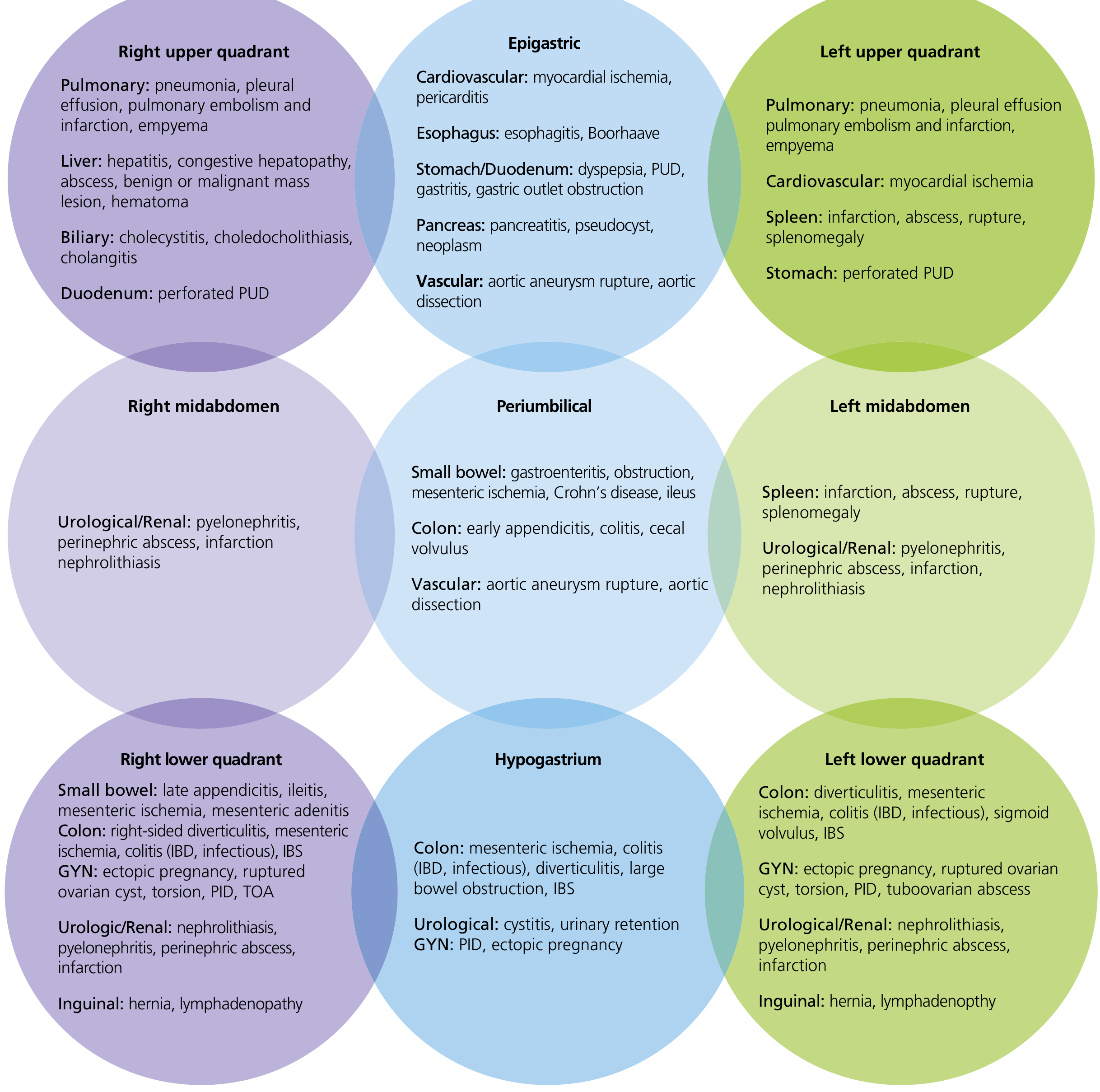
Abdominal Pain Differential by Region
History to Elicit (SOCRATES + Focused)
Pain history:
- Site, radiation
- Onset - sudden vs. gradual
- Any relationship to meals, bowel movements, menstruation, movement
Gynecological history:
- Last menstrual period (LMP) - is pregnancy possible?
- Menstrual regularity, dysmenorrhea
- Vaginal discharge (color, odor, amount)
- Sexual activity, number of partners, contraception
- Prior PID, STIs, pelvic surgeries
GI history:
- Nausea, vomiting
- Change in bowel habits - diarrhea, constipation, blood in stool
- Weight loss, anorexia
Urinary history:
- Dysuria, frequency, hematuria
Systemic:
- Fever, chills, night sweats
- Recent travel, sick contacts
Physical Examination
| System | What to Look For |
|---|---|
| Vitals | Fever (infection/inflammation), tachycardia/hypotension (hemorrhage/sepsis) |
| Abdomen | Inspection (distension, scars), auscultation (bowel sounds), palpation (tenderness, guarding, rigidity, rebound), percussion (ascites) |
| Pelvic/Bimanual | Cervical motion tenderness (PID hallmark), uterine/adnexal tenderness or mass, cervical discharge |
| Carnett's sign | If tenderness worsens with abdominal wall tensing → abdominal wall cause; if diminishes → intra-abdominal cause |
| Renal angles | Costovertebral angle tenderness (pyelonephritis) |
Initial Investigations
Step 1 - Mandatory
- Urine pregnancy test (hCG) - branch point for all further workup
- CBC - leukocytosis (infection/inflammation), anemia (hemorrhage)
- Urinalysis + urine culture - UTI/pyelonephritis
Step 2 - Based on Clinical Suspicion
| Test | Purpose |
|---|---|
| Pelvic/Transvaginal Ultrasound | First-line imaging for gynecological causes; shows ovarian cysts, TOA, free fluid, ectopic pregnancy |
| High vaginal swab / cervical swab (NAAT) | Chlamydia, Gonorrhea (PID workup) |
| LFTs, lipase | Hepatitis, cholecystitis, pancreatitis |
| ESR, CRP | Inflammatory markers |
| Blood cultures | If febrile/septic |
| CT abdomen-pelvis | If diagnosis unclear, suspicion of appendicitis, peritonitis, malignancy |
| Wet mount vaginal discharge | BV, trichomoniasis |
Management Principles
If PID suspected:
Empirical antibiotics covering N. gonorrhoeae, C. trachomatis, and anaerobes should be started without waiting for culture results - delay risks tubal scarring and infertility. After one episode of PID, ~10% develop tubal occlusion; risk doubles with each subsequent episode. - Goldman-Cecil Medicine, p. 3332
If ectopic pregnancy:
Urgent surgical or medical (methotrexate) management depending on stability and gestational sac location.
If IBS (diagnosis of exclusion):
Antispasmodics, dietary modification (low-FODMAP diet), stress management.
Bottom Line
In this 30-year-old with 5 days of diffuse, constant, dull abdominal pain:
- Get a urine pregnancy test now - it changes everything
- Top diagnoses to actively rule in/out: PID, appendicitis (even at 5 days), UTI/pyelonephritis, ovarian pathology, IBD
- Do not delay imaging if there are any peritoneal signs or hemodynamic instability
- Pelvic examination is essential in any reproductive-age woman with abdominal pain
"It is unlikely that any particular finding on history or physical examination is reliable enough to make or exclude a particular diagnosis conclusively, so ancillary testing beyond a pregnancy test is commonly needed." - Rosen's Emergency Medicine
Nothing significant found
Good - so history, examination, and initial investigations have come back unremarkable. This is a common and genuinely challenging clinical scenario. Let me look up the evidence-based approach to this.
Finding Sources
Finding Sources
Finding Sources
Finding Sources
Finding Sources
Finding Sources
Reading File
Reading File
Reading File
Finding Sources
Finding Sources
Reading File
Reading File
I now have enough to give a thorough, structured answer for this very common clinical dilemma.
When History, Examination, and Initial Investigations Are All Normal
This is a well-recognized clinical scenario. The phrase "nothing significant found" after a 5-day history of diffuse dull abdominal pain in a 30-year-old woman shifts the clinical framing from "find the emergency" to "structured second-tier evaluation and functional diagnosis consideration."
What "Nothing Significant" Actually Means Clinically
Before proceeding, clarify what has been checked:
| Already Done? | If Not, Still Essential |
|---|---|
| Urine pregnancy test | Mandatory - cannot skip |
| CBC, CRP/ESR | Infection, inflammation |
| Urinalysis | UTI, pyelonephritis |
| Pelvic exam + vaginal swab | PID, cervicitis |
| Abdominal ultrasound | Ovarian cyst, free fluid, biliary, renal |
| LFTs, lipase, blood glucose | Biliary, pancreatic, diabetic causes |
If all of the above are genuinely normal, proceed below.
Revised Differential: "Invisible on Standard Workup"
Several important conditions are consistently missed on standard history, exam, and routine labs:
1. Endometriosis (Top Diagnosis to Pursue)
- Affects ~10% of reproductive-age women; average diagnosis delay is 7-10 years
- Pelvic exam is normal in up to 50% of cases; ultrasound is often normal in early disease
- Classic features: cyclical pain, dysmenorrhea, dyspareunia - but not always present
- Gold standard diagnosis: diagnostic laparoscopy
- A pain diary correlating symptoms with the menstrual cycle is the practical next step
2. Irritable Bowel Syndrome (IBS) - Very Common in Young Women
- Peak prevalence in women aged 20-40; female-to-male ratio ~2:1
- Diagnosis is clinical using the Rome IV criteria - investigations are normal by definition
- Rome IV criteria for IBS:
- Recurrent abdominal pain, at least 1 day/week in the last 3 months
- Associated with 2 or more of: change in stool frequency, change in stool form, related to defecation
- Ask specifically about: bloating, alternating constipation/diarrhea, relief or worsening after bowel movements, food triggers, stress relation
3. Functional Abdominal Pain Syndrome (FAPS)
- Continuous or near-continuous abdominal pain, poorly localized
- No consistent relationship to physiological events (meals, defecation, menstruation)
- Often associated with psychological comorbidity (anxiety, depression, prior trauma)
- Diagnosis of exclusion - but should be considered early to avoid unnecessary invasive testing
4. Chronic Abdominal Wall Pain (CAWP) / Anterior Cutaneous Nerve Entrapment Syndrome (ACNES)
- Frequently overlooked; prevalence 10-40% in referral clinics
- Pain is superficial, localized, associated with dysesthesia
- Carnett's sign is positive (pain worsens when patient tenses abdominal muscles)
- Predominantly affects women; depression and obesity are common comorbidities
- "An accurate diagnosis can result in marked decrease in physician visits and procedures." - Yamada's Gastroenterology, p. 686
5. Rare but Must-Not-Miss Conditions
| Condition | Key Clue |
|---|---|
| Herpes Zoster (pre-rash phase) | Pain may precede rash by 5-7 days; dermatomal distribution |
| Acute Intermittent Porphyria | Diffuse colicky pain, neuropsychiatric changes, port-wine urine |
| Familial Mediterranean Fever | Episodic peritoneal-type attacks, Mediterranean ancestry, fever |
| Lead poisoning | Occupational/exposure history, dark gum line, anemia |
| Compressive radiculopathy | Dermatomal pain, spinal/paraspinal tenderness |
| Mesenteric ischemia (early) | Pain out of proportion, cardiovascular risk factors |
"When a careful history and examination and routine laboratory tests fail to reveal a cause of abdominal pain, consideration should be given to rarer syndromes." - Yamada's Textbook of Gastroenterology, p. 685
Structured Next Steps
Step 1 - Refine the History (Second Pass)
Go back and specifically ask:
- Menstrual cycle pattern - is the pain cyclical? Worse before/during periods?
- Bowel habit changes - bloating, alternating stool consistency?
- Skin changes - any new rash appearing (herpes zoster)?
- Stress, anxiety, mood - functional disorders are diagnosis of inclusion, not just exclusion
- Family history - FMF, IBD, malignancy
- Occupational/toxic exposure - lead, heavy metals
- Drug history - NSAIDs (peptic ulcer), opioids (withdrawal)
Step 2 - Targeted Second-Line Investigations
| Test | Purpose |
|---|---|
| Stool calprotectin | Distinguishes IBS from IBD with high sensitivity; elevated in IBD, normal in IBS |
| H. pylori testing (stool antigen or breath test) | Peptic ulcer / gastritis even without epigastric focus |
| Serum CA-125 | Adjunct for endometriosis suspicion (not sensitive alone) |
| Thyroid function (TSH) | Hypothyroidism causes constipation-type abdominal symptoms |
| Serum calcium | Hypercalcemia causes abdominal pain, constipation, nausea |
| Spot urine porphobilinogen | Acute intermittent porphyria |
| Pain diary (2-4 weeks) | Correlation with menstrual cycle, meals, stress, bowel habits |
| Transvaginal ultrasound (if not done) | More sensitive than transabdominal for ovarian/uterine pathology |
| CT abdomen-pelvis | If any ongoing concern for structural cause |
Step 3 - Consider Specialist Referral
| Specialist | Indication |
|---|---|
| Gynaecology | Cyclical pain, dysmenorrhea, suspicion of endometriosis |
| Gastroenterology | Suspected IBD, IBS refractory to initial management, abnormal stool calprotectin |
| Pain clinic / Psychosomatic medicine | Functional pain disorder, significant psychological overlay |
Immediate Management While Investigating
- Symptomatic relief: Antispasmodics (hyoscine butylbromide/mebeverine) for colicky component; simple analgesia (paracetamol preferred over NSAIDs initially)
- Reassurance - communicate clearly that normal results are not dismissive - they are genuinely helpful in ruling out serious organic pathology
- Avoid over-investigation: Capsule endoscopy, ERCP, and laparoscopy have low diagnostic yield for unexplained chronic abdominal pain in the absence of specific red flags - Yamada's Gastroenterology, p. 685
- Safety-net: Advise the patient to return urgently if: fever develops, pain suddenly worsens, vomiting begins, she misses a period, or develops any new symptoms
Red Flags That Would Change This Approach Immediately
If any of these appear at any point, escalate urgently:
- Fever > 38°C
- Rebound tenderness or guarding
- Positive pregnancy test
- Weight loss > 5% body weight
- Rectal bleeding
- Palpable abdominal mass
- Worsening pain despite analgesia
Bottom line: In a 30-year-old woman with 5 days of diffuse dull abdominal pain and a normal initial workup, endometriosis, IBS, and functional pain are the leading diagnoses. The most practical next steps are a detailed menstrual/bowel history, stool calprotectin, a pain diary, and gynaecological referral if there is any cyclical component to the pain.
This is a shared conversation. Sign in to Orris to start your own chat.