
Hi
Tell the topic integrated counselling and testing centre in detail in story form so that i can remember easily
Integrated Counselling and Testing Centre ICTC HIV India details functions
https://www.tnsacs.in/ictc
The Story of "Asha's Gateway" - Understanding ICTC
Chapter 1: The Village That Feared a Shadow
Chapter 2: What Is the ICTC? The "Gateway"
- Information about HIV
- Counselling (emotional support + guidance)
- HIV testing
Think of ICTC as the gateway - you enter scared and confused, and leave with answers, support, and a path forward.
Chapter 3: Who Comes to ICTC? Two Kinds of Visitors
- Client-Initiated (CITC): People like Asha who came on their own free will, worried about possible exposure to HIV.
- Provider-Initiated (PITC): People sent by their doctor - for example, a TB patient whose doctor suspected HIV co-infection, or a pregnant woman whose midwife referred her.
Chapter 4: The Three Functions Asha Discovered
1. Early Detection
2. Education & Behavior Change
3. Linkage to Care
Chapter 5: The Four Types of ICTC - Four Rooms in the Same House
Room 1 - Standalone ICTC (SA-ICTC) 🏥
- Located in: Medical colleges, District hospitals, Sub-district hospitals, CHCs
- High client load
- Full-time dedicated Counsellor + Lab Technician
- Extra counsellor added if >500 counsellings/month
- Extra lab technician for every 5,000 additional annual tests (max 3 LTs)
- Performs: Pre-test counselling, HIV testing (confirmatory), post-test counselling, EID (Early Infant Diagnosis), STI/RTI screening, TB screening, partner testing, linkage to all services
Think: "The SA is the Senior Centre" - big, busy, fully staffed.
Room 2 - Facility-Integrated ICTC (F-ICTC) 🏪
- Located below block level - at 24x7 PHCs (Primary Health Centres)
- NOT a separate building - woven into the existing health facility
- Existing health staff are trained to provide HIV counselling and testing
- Logistics (test kits, IEC materials, protective kits, PEP drugs) supplied by DAC (Department of AIDS Control)
- Also extended to private facilities through PPP-ICTC (Public-Private Partnership)
Think: "F-ICTC is like a shop-within-a-shop" - HIV services built into an already existing PHC.
Room 3 - Mobile ICTC 🚐
- A room for general examination
- Space for counselling
- Space for blood collection and processing
- HIV counselling and testing
- Syndromic management of STI/RTI
- Antenatal care
- Immunization services
- General health check-ups
Think: "Mobile ICTC = The hospital bus that parks in your village"
Room 4 - Community-Based HIV Screening 👩⚕️
Chapter 6: ICTC and the Pregnant Woman - PPTCT
- She receives multi-drug ART (triple therapy) regardless of CD4 count
- Her husband is involved in counselling
- Her newborn gets prophylaxis
- Breastfeeding guidance is given
Chapter 7: ICTC and TB - Two Old Enemies
- HIV screening for ALL TB patients at ICTCs
- TB screening for ALL HIV-positive people at ICTCs
- Whole blood finger-prick HIV test available at all DMCs (Directly Observed Treatment Centres)
Remember: TB and HIV are frenemies - one makes the other worse. ICTC screens for both.
Chapter 8: The Staff of ICTC - The Three Pillars
| Person | Role |
|---|---|
| Medical Officer (In-Charge) | Oversees the centre, clinical decisions |
| Counsellor (contractual) | Pre-test counselling, informed consent, post-test counselling, disclosure support, follow-up |
| Lab Technician (contractual) | HIV testing, EID, quality assurance |
Quick Memory Trick - "ICTC = I Can Test Confidentially"
| Letter | Stands For |
|---|---|
| I | Integrated - brings HIV counselling, testing, and linkage together |
| C | Confidential - everything is private |
| T | Testing - HIV diagnosis done here |
| C | Centre - a physical or mobile space |
The Final Summary Table
| Feature | Details |
|---|---|
| Started | 1997 |
| Boost | 2004 (ART launch) |
| Types | SA-ICTC, F-ICTC, Mobile ICTC, Community-based |
| Who can come | Anyone (voluntary or provider-referred) |
| Core functions | Early detection, education, linkage to care |
| Key services | HIV test, counselling, PPTCT, TB-HIV, STI/RTI, EID, partner testing |
| Staff (SA-ICTC) | Medical Officer + Counsellor + Lab Technician |
| Total ICTCs in India | >15,000 |
Remove the story format now n also provide image
Integrated Counselling and Testing Centre ICTC HIV services diagram
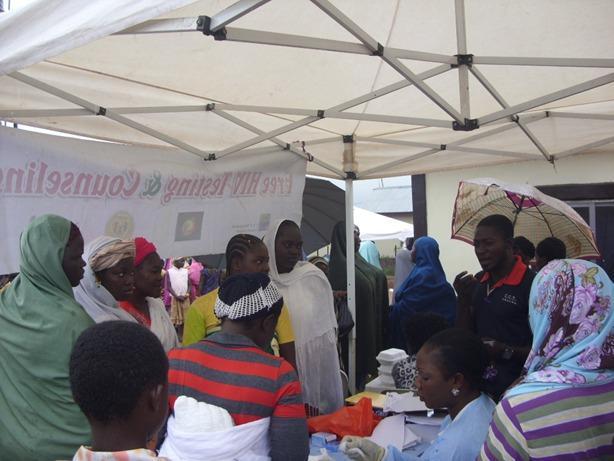
This clinical photograph captures a community-based medical outreach event focused on HIV testing and counseling in a low-resource or rural setting. The scene is organized under a temporary white canopy tent, providing a designated area for medical services. A prominent banner displays the text 'Free HIV Testing & Counseling,' indicating the primary public health objective. A healthcare worker, identifiable by blue clinical attire and protective gloves, is seated at a table covered with medical papers and testing materials, actively engaging with community members. The demographic depicted includes a diverse group of adults, both male and female, dressed in a variety of traditional head coverings and casual clothing, suggesting a culturally integrated approach to healthcare delivery. The setting emphasizes the concept of 'commonization' of HIV services by bringing diagnostic and counseling resources directly into hard-to-reach communities to improve accessibility and universal health coverage. The presence of individuals waiting in proximity to the testing station illustrates provider-initiated counseling and testing (PITC) in an informal, community-integrated environment.
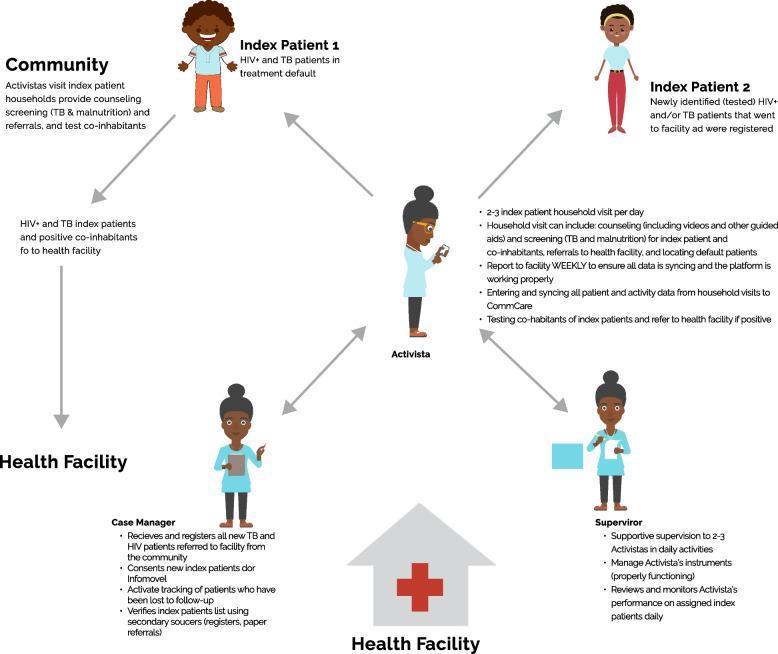
This infographic illustrates the Infomóvel program functionalities, a mobile-based healthcare delivery system designed to improve HIV and TB patient retention and care in community settings. The diagram outlines a collaborative framework between three main domains: Community, Health Facility, and the digital CommCare platform. Four key roles are identified: 1) Index Patients, categorized as treatment defaulters (Index Patient 1) or newly diagnosed individuals (Index Patient 2); 2) Activista (Community Health Worker), who conducts household visits for counseling, TB/malnutrition screening, and testing of co-habitants; 3) Case Manager at the Health Facility, responsible for patient registration, consenting for tracking, and verifying patient lists; and 4) Supervisor, who provides performance monitoring and technical support to the Activistas. Centrally, the Activista uses a mobile device to sync patient data to the CommCare platform, facilitating a closed-loop referral system. The diagram emphasizes integrated disease management for HIV and TB, linking community-based active case finding with health facility-based treatment adherence strategies.
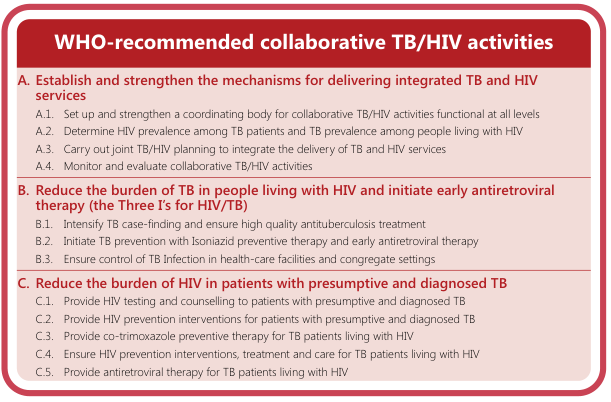
WHO-recommended collaborative TB/HIV activities <table><thead><tr><th colspan="2">WHO-recommended collaborative TB/HIV activities</th></tr></thead><tbody><tr><td>A.</td><td>Establish and strengthen the mechanisms for delivering integrated TB and HIV services</td></tr><tr><td>A.1.</td><td>Set up and strengthen a coordinating body for collaborative TB/HIV activities functional at all levels</td></tr><tr><td>A.2.</td><td>Determine HIV prevalence among TB patients and TB prevalence among people living with HIV</td></tr><tr><td>A.3.</td><td>Carry out joint TB/HIV planning to integrate the delivery of TB and HIV services</td></tr><tr><td>A.4.</td><td>Monitor and evaluate collaborative TB/HIV activities</td></tr><tr><td>B.</td><td>Reduce the burden of TB in people living with HIV and initiate early antiretroviral therapy (the Three I's for HIV/TB)</td></tr><tr><td>B.1.</td><td>Intensify TB case-finding and ensure high quality antituberculosis treatment</td></tr><tr><td>B.2.</td><td>Initiate TB prevention with Isoniazid preventive therapy and early antiretroviral therapy</td></tr><tr><td>B.3.</td><td>Ensure control of TB infection in health-care facilities and congregate settings</td></tr><tr><td>C.</td><td>Reduce the burden of HIV in patients with presumptive and diagnosed TB</td></tr><tr><td>C.1.</td><td>Provide HIV testing and counselling to patients with presumptive and diagnosed TB</td></tr><tr><td>C.2.</td><td>Provide HIV prevention interventions for patients with presumptive and diagnosed TB</td></tr><tr><td>C.3.</td><td>Provide co-trimoxazole preventive therapy for TB patients living with HIV</td></tr><tr><td>C.4.</td><td>Ensure HIV prevention interventions, treatment and care for TB patients living with HIV</td></tr><tr><td>C.5.</td><td>Provide antiretroviral therapy for TB patients living with HIV</td></tr></tbody></table>
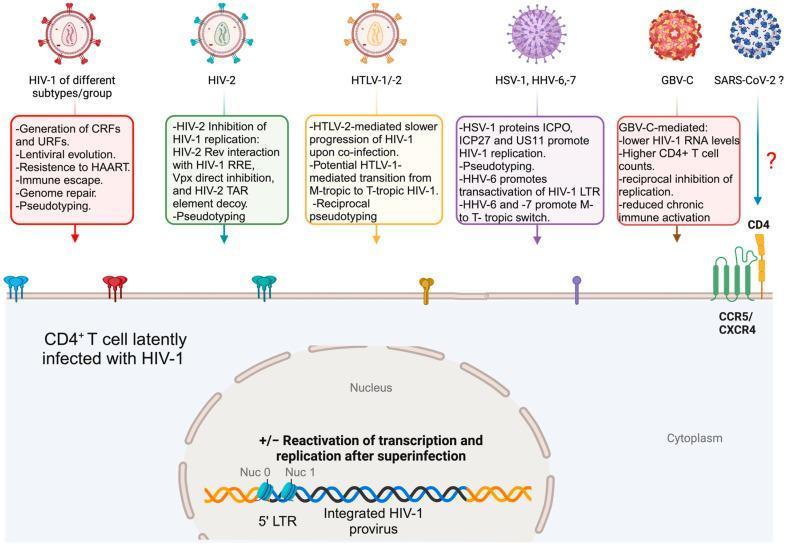
This pathophysiology diagram illustrates the viral superinfection and co-infection dynamics within a CD4+ T cell latently infected with HIV-1. The top section presents various superinfecting viruses: HIV-1 subtypes, HIV-2, HTLV-1/2, HSV-1, HHV-6/7, GBV-C, and SARS-CoV-2. Each virus is depicted with its specific morphology, accompanied by text boxes detailing clinical outcomes such as pseudotyping, generation of recombinant forms (CRFs/URFs), and modulation of HIV-1 replication (e.g., HIV-2 and GBV-C mediated inhibition versus HSV-1 mediated promotion). The central portion shows the T cell membrane featuring CD4 receptors and CCR5/CXCR4 co-receptors. The lower section focuses on the nucleus, showing host genomic DNA (yellow double helix) with integrated HIV-1 provirus DNA (blue/black double helix). The molecular architecture of the HIV-1 5' Long Terminal Repeat (LTR) is highlighted between nucleosomes Nuc 0 and Nuc 1, representing the site for potential transcriptional reactivation following superinfection. The diagram effectively summarizes how secondary viral infections can influence HIV-1 pathogenesis and the latent reservoir.
Integrated Counselling and Testing Centre (ICTC)
Definition
Background
- HIV counselling and testing services in India started in 1997 under the National AIDS Control Programme (NACP)
- Managed by the Basic Service Division, Department of AIDS Control (DAC)
- Goal: Identify HIV-positive people as early as possible and link them to prevention, care, and treatment
- Introduction of ART services in 2004 gave a major boost to ICTC services
- Currently more than 15,000 ICTCs in India
Three Core Functions of ICTC
- Early detection of HIV infection
- Provision of basic information on modes of transmission and prevention of HIV/AIDS to promote behavioral change and reduce vulnerability
- Linkage of PLHIV (People Living with HIV) to other HIV prevention, care, and treatment services
Types of ICTC
Level-wise Structure (from the textbook diagram below)
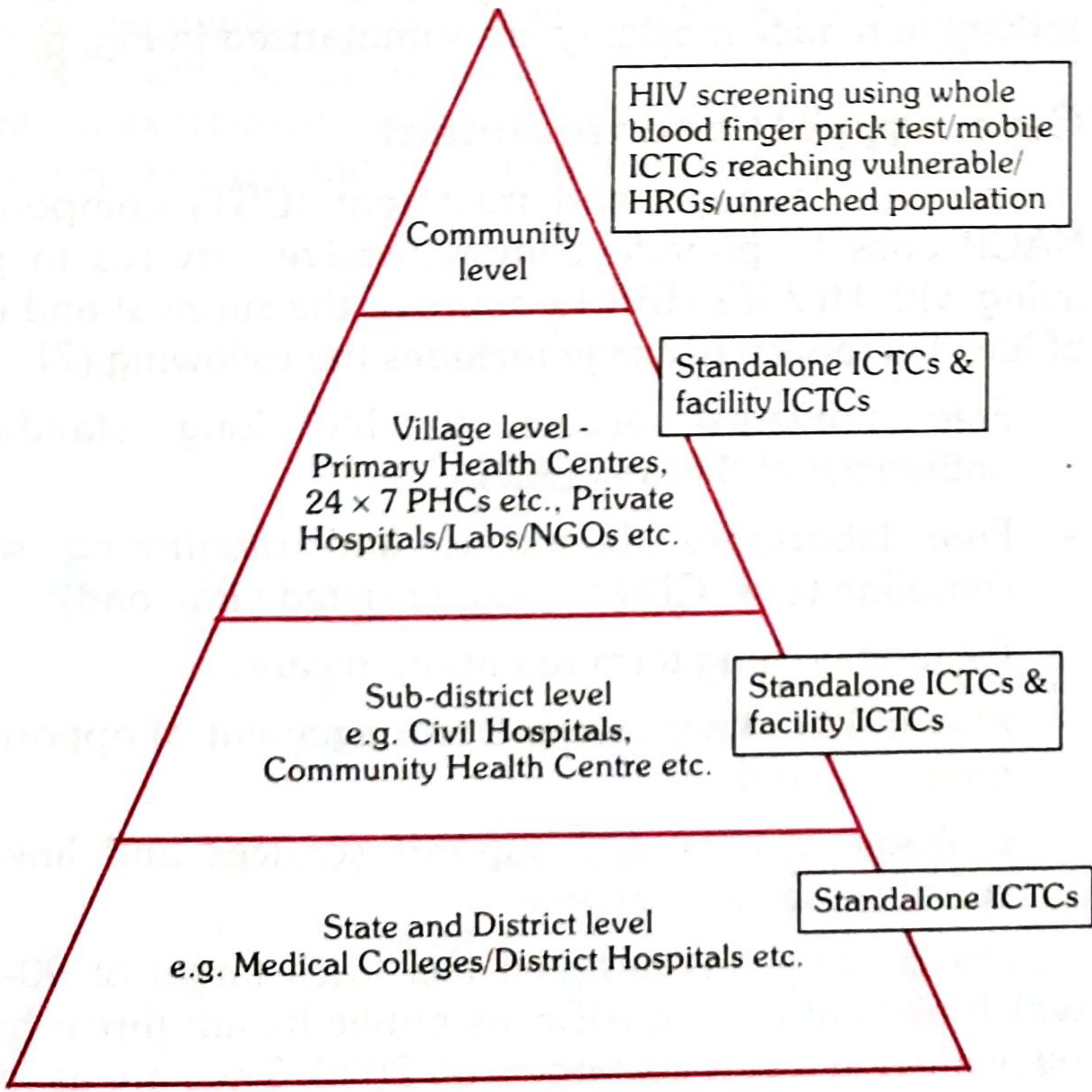
A. Fixed Facility ICTCs
1. Standalone ICTC (SA-ICTC)
| Feature | Details |
|---|---|
| Location | Medical colleges, District hospitals, Sub-district hospitals, CHCs |
| Client load | High |
| Staff | Medical Officer (in-charge) + Counsellor + Lab Technician (both contractual) |
| Extra counsellor | If >500 counsellings/month |
| Extra LT | Every additional 5,000 annual tests; max 3 LTs |
- Pre-test counselling and informed consent
- HIV testing and sharing of results
- Post-test counselling and disclosure support
- Early Infant Diagnosis (EID)
- Testing of sexual partner/spouse
- Screening for STI/RTI, TB, and other co-infections
- Linkage to care, treatment, and other health services
- Linkage to social welfare schemes
- Outreach activity
- Follow-up testing and counselling
- Follow-up of discordant couples
- Acts as nodal point for coordination, supervision, capacity building, and supply chain management of all F-ICTCs
2. Facility-Integrated ICTC (F-ICTC)
| Feature | Details |
|---|---|
| Location | Below block level - 24x7 PHCs |
| Concept | HIV services embedded into existing health facility (not a separate building) |
| Staff | Existing health facility staff trained in HIV counselling and testing |
| Logistics support | Provided by DAC (test kits, IEC materials, PEP drugs, protective kits) |
| PPP-ICTC | Extended to private hospitals, labs, NGOs under Public-Private Partnership |
B. Mobile ICTC
- Room for general examination
- Counselling space
- Blood collection and processing area
- HIV counselling and testing
- Syndromic management of STI/RTI
- Antenatal care
- Immunization services
- General health check-ups
C. Community-Based HIV Screening
- Conducted by Auxiliary Nurse Midwives (ANMs) at the sub-centre level
- Goal: Offer HIV testing to every pregnant woman in the country
- To detect all HIV-positive pregnant women and eliminate parent-to-child transmission
Staff Pattern (SA-ICTC Summary)
| Staff | Appointment | Criteria |
|---|---|---|
| Medical Officer | In-charge | 1 per centre |
| Counsellor | Contractual | 1 (additional if >500/month) |
| Lab Technician | Contractual | 1 (additional per 5,000 tests; max 3) |
ICTC and TB-HIV Coordination
- HIV screening done for ALL individuals at ICTC (irrespective of HIV status - including TB patients)
- TB screening done for ALL HIV-positive cases at ICTC
- National Technical Working Group on TB/HIV mandates whole blood finger-prick HIV test at all DMCs (DOTS Microscopy Centres) without a standalone or F-ICTC
- Provider-Initiated HIV Testing and Counselling (PITC) done for all presumptive TB cases
ICTC and PPTCT (Prevention of Parent-to-Child Transmission)
- PPTCT programme started in 2002 in India
- All >15,000 ICTCs offer PPTCT services to pregnant women
- Every pregnant woman is offered HIV testing with an "opt-out" option
- Evolution of treatment strategy:
- Up to 2012: Single-dose Nevirapine (SD-NVP)
- Sept 2012: Multi-drug ARV prophylaxis (Option B - WHO 2010)
- From 2013: Lifelong ART (triple drug regimen) for all HIV-positive pregnant and breastfeeding women regardless of CD4 count or WHO clinical stage
Key Points to Remember
| Feature | Fact |
|---|---|
| Started | 1997 |
| ART boost year | 2004 |
| Total ICTCs in India | >15,000 |
| Types | SA-ICTC, F-ICTC, Mobile ICTC, Community-based |
| Entry modes | Client-initiated (CITC) or Provider-initiated (PITC) |
| TB screening | Done for ALL at ICTC (not just HIV-positive) |
| PPTCT started | 2002 |
| Current PPTCT regimen | Lifelong triple ART (from 2013) |
Tell me about imnci in detail
IMNCI integrated management neonatal childhood illness India components strategy
https://ihatepsm.com/blog/integrated-management-neonatal-and…
Integrated Management of Neonatal and Childhood Illness (IMNCI)
Definition
- The Indian version of IMCI was renamed IMNCI - adding "Neonatal" because India included the first 0-7 days of life in the programme.
- It is the central pillar of child health interventions under the RCH-II/NRHM strategy.
Why IMNCI?
- ARI - 17% of children under 3 years (NFHS-III)
- Fever - 27%
- Under-nutrition - 43%
- Diarrhoea - 13%
- Measles vaccination coverage was also low
Indian Adaptations (IMNCI vs. IMCI)
| Feature | IMCI (WHO original) | IMNCI (Indian version) |
|---|---|---|
| Age coverage | 1 week to 5 years | 0-7 days included (neonatal period) |
| Malaria guidelines | Generic | National guidelines incorporated |
| Anaemia/Vit A | Not specific | National guidelines included |
| Immunization | Generic | India's national schedule |
| Training focus | More on sick child | Equal time for sick young infant and sick child |
| Skill basis | Yes | Yes - skill-based training |
Three Core Components of IMNCI Strategy
1. Improve Case-Management Skills of Health Staff
- Training of frontline health workers (Medical Officers, Nurses, ANMs, LHVs) using IMNCI guidelines and wall charts
- Emphasis on correct assessment, classification, and treatment
2. Strengthen the Overall Health System
- Ensure supply chain of drugs and supplies
- Improve referral systems
- Strengthen supervision and quality assurance
3. Improve Family and Community Health Care Practices
- Teach families when to seek care
- Promote correct home management
- Improve care-seeking behaviour
- Community involvement in prevention and follow-up
IMNCI Case Management Process (6 Steps)
Step 1 - ASSESS
- Take history + perform physical examination
- Check for general danger signs first
Step 2 - CLASSIFY
- Assign a colour-coded classification (not a specific disease diagnosis) based on severity:
| Colour | Meaning | Action |
|---|---|---|
| 🔴 PINK | Severe/emergency | Urgent referral to hospital |
| 🟡 YELLOW | Moderate | Treatment at outpatient facility |
| 🟢 GREEN | Mild | Home management with advice |
Step 3 - IDENTIFY TREATMENT
- Charts recommend specific treatment for each classification
Step 4 - TREAT
- Give treatment in clinic, prescribe drugs or home treatments
- Teach the caregiver
Step 5 - COUNSEL THE MOTHER/CAREGIVER
- Feeding, fluids
- When to return immediately (danger signs)
- Home care instructions
Step 6 - FOLLOW-UP CARE
- Plan timely follow-up visit
- Refer if needed
- Reassess for new problems at follow-up
IMNCI Flowchart (from Park's Textbook)
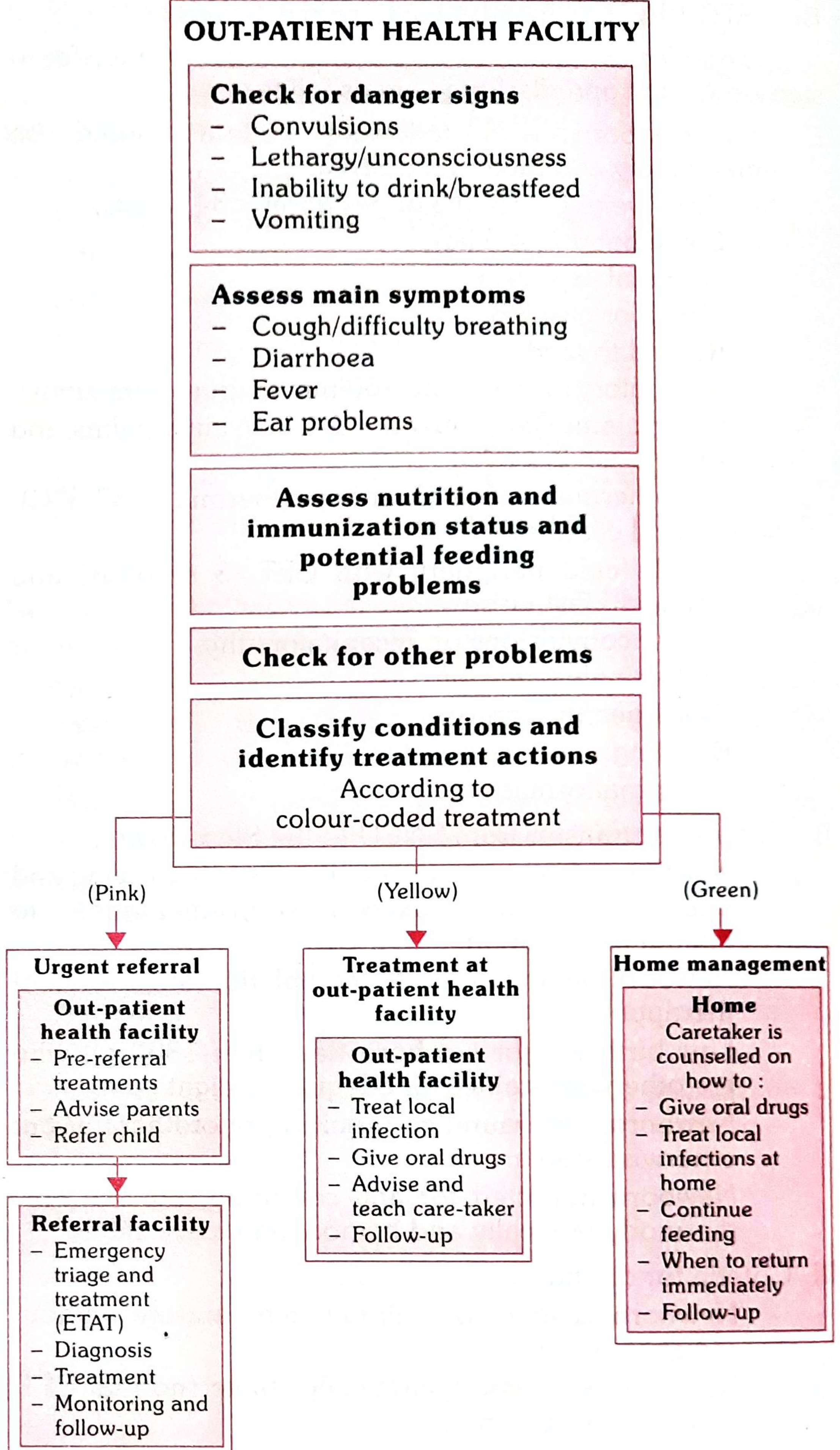
Two Age Groups with Separate Wall Charts
Group 1: Young Infant (0 up to 2 months)
- Assess and Classify the Sick Young Infant (up to 2 months)
- Treat the Young Infant and Counsel the Mother
- Possible bacterial infection / local bacterial infection
- Jaundice
- Diarrhoea
- Feeding problems / Low weight
- Pneumonia
Group 2: Sick Child (2 months up to 5 years)
- Assess and Classify the Sick Child (2 months to 5 years)
- Treat the Child
- Counsel the Mother
- Cough / Difficulty breathing
- Diarrhoea
- Fever
- Ear problems
- Malnutrition and Anaemia
- Immunization status
- Development assessment
General Danger Signs (Check FIRST in children 2 months - 5 years)
- Not able to feed or drink
- Vomits everything
- Lethargic or unconscious
- Convulsions (present now or history)
Treatment at Each Level
| Level | Action |
|---|---|
| Outpatient Health Facility (Pink) | Pre-referral treatment → Advise parents → Refer child URGENTLY |
| Referral Facility | Emergency Triage and Treatment (ETAT) → Diagnosis → Treatment → Monitoring → Follow-up |
| Outpatient Health Facility (Yellow) | Treat local infection, give oral drugs, advise and teach caregiver, follow-up |
| Home (Green) | Counsel caregiver - give oral drugs, treat local infections at home, continue feeding, return signs, follow-up |
IMNCI Variants
Pre-Service IMNCI
- Being included in the curriculum of medical colleges across India
- Provides trained IMNCI manpower for both public and private sectors
Facility-Based IMNCI (F-IMNCI)
- Integration of facility-based care with IMNCI package
- Empowers health personnel to manage newborns and childhood illness at both community and facility level
- Focuses on inpatient management of:
- Asphyxia
- Sepsis
- Low birth weight
- Pneumonia
- Diarrhoea
- Malaria
- Meningitis
- Severe malnutrition
- Master trainers: Paediatricians from tertiary hospitals and medical colleges
Implementation at Various Levels
| Level | Who implements |
|---|---|
| Household | IMNCI package delivered at home level |
| Sub-centre | ANMs trained in IMNCI |
| PHC | Medical Officers, Nurses, LHVs |
| CHC/FRU | F-IMNCI - Newborn Stabilization Unit (NBSU) |
| District Hospital | F-IMNCI - Special Newborn Care Unit (SNCU) |
Newborn Care Facilities under F-IMNCI
| Facility | Level | For all newborns | For sick newborns |
|---|---|---|---|
| PHC/Sub-centre (MCH Level I) | Primary | Newborn Care Corner (NBCC) in labour room | Prompt referral |
| CHC/FRU (MCH Level II) | Secondary | NBCC in labour room + OT | Newborn Stabilization Unit (NBSU) - 4 bedded |
| District Hospital (MCH Level III) | Tertiary | NBCC in labour room + OT | Special Newborn Care Unit (SNCU) |
- NBCCs operational in India: ~20,336
- NBSUs functional: ~2,421
Important Note on Limitations
- Trauma or acute emergencies from accidents/injuries
- AIDS specifically (though common HIV presentations like diarrhoea and respiratory infections are managed the same way)
- Chronic problems or less common illnesses (these require special/referral care)
Quick Summary
| Feature | Details |
|---|---|
| Developed by | WHO + UNICEF |
| Indian version name | IMNCI (adds neonatal 0-7 days) |
| Age group covered | 0 days to 5 years |
| Under which programme | RCH-II / NRHM |
| Core approach | Assess → Classify → Treat → Counsel → Follow-up |
| Colour coding | Pink (referral), Yellow (treat), Green (home) |
| Key target illnesses | ARI, Diarrhoea, Malaria, Measles, Malnutrition |
| 3 main components | Case management skills + Health system + Family/community practices |
Now tell me in story form
The Story of Dr. Meera and the Village of Sick Children
Chapter 1: The Problem That Couldn't Be Ignored
Chapter 2: WHO and UNICEF Step In - The Birth of IMCI (and then IMNCI)
- Its own national malaria guidelines
- Its own anaemia and Vitamin A protocols
- Its own immunization schedule
- Equal training time for sick newborns AND sick older children
Chapter 3: Why Was It So Urgently Needed? - The Numbers That Shocked India
| Problem | % of Children Affected |
|---|---|
| Under-nutrition | 43% |
| Fever | 27% |
| ARI (cough/breathing difficulty) | 17% |
| Diarrhoea | 13% |
Chapter 4: The Three Pillars - IMNCI's Master Plan
Pillar 1 - Train the Doctors and Health Workers
Pillar 2 - Fix the Health System
Pillar 3 - Educate the Family
Chapter 5: The Two Children - Two Different Charts
Child A: Baby Sona - 3 weeks old (Young Infant: 0 to 2 months)
- "Assess and Classify the Sick Young Infant"
- "Treat the Young Infant and Counsel the Mother"
Child B: Raju - 3 years old (Sick Child: 2 months to 5 years)
- "Assess and Classify the Sick Child"
- "Treat the Child"
- "Counsel the Mother"
Chapter 6: The Six Steps Dr. Meera Follows Every Time
Step 1 - ASSESS
- Danger signs first
- Cough and breathing
- Diarrhoea
- Fever
- Ear problems
- Nutrition and immunization status
Step 2 - CLASSIFY (The Colour Code System)
🔴 PINK = Severe → Urgent hospital referral needed 🟡 YELLOW = Moderate → Treat at the outpatient facility 🟢 GREEN = Mild → Send home with careful advice
Step 3 - IDENTIFY TREATMENT
Step 4 - TREAT
Step 5 - COUNSEL THE MOTHER
- How to give medicines at home
- What foods to continue giving
- The danger signs - when to bring Raju back immediately:
- Cannot drink or feed
- Vomiting everything
- Convulsions
- Becomes lethargic or unconscious
Step 6 - FOLLOW-UP
Chapter 7: The Pink Child - The Emergency
- Could not drink
- Vomiting everything
- Lethargic and unconscious
- Convulsing
Chapter 8: F-IMNCI - When the Facility Steps Up
- Birth asphyxia
- Neonatal sepsis
- Low birth weight
- Severe pneumonia
- Severe diarrhoea
- Malaria
- Meningitis
- Severe malnutrition
Chapter 9: The Newborn Care Ladder
Tier 1 - PHC/Sub-centre (MCH Level I)
Tier 2 - CHC/FRU (MCH Level II)
Tier 3 - District Hospital (MCH Level III)
Chapter 10: Pre-Service IMNCI - Teaching Future Doctors
Chapter 11: What IMNCI Does NOT Cover
- Road accidents or trauma
- Chronic illnesses
- Less common rare diseases
- AIDS specifically (though HIV children with diarrhoea/ARI are managed the same way; if they don't respond to standard treatment or become severely malnourished, they are referred to hospital)
The Final Memory Map
| Element | Key Fact |
|---|---|
| Developed by | WHO + UNICEF |
| Indian name | IMNCI (added Neonatal - Day 0 to 7 days) |
| Age covered | 0 to 5 years |
| Programme | RCH-II / NRHM |
| 3 Pillars | Train staff + Strengthen system + Family education |
| 2 Chart sets | Young infant (0-2 months) + Sick child (2 months-5 years) |
| 3 Colours | Pink (refer) + Yellow (treat) + Green (home) |
| 6 Steps | Assess → Classify → Identify → Treat → Counsel → Follow-up |
| 4 Danger signs | Can't feed, Vomits all, Lethargic, Convulsions |
| F-IMNCI | Hospital-level care for serious cases |
| Newborn ladder | NBCC → NBSU → SNCU |
Create a visual guide showing IMNCI assessment flowcharts
ls -la /tmp/workspace/ 2>/dev/null || mkdir -p /tmp/workspace && echo "created"
Janani suraksha yojana in story format n all help me to remember by cisulizing image
Janani Suraksha Yojana JSY India cash incentive eligibility categories details
Janani Suraksha Yojana JSY maternal health India institutional delivery scheme
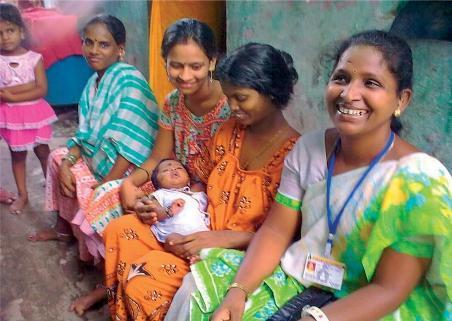
A clinical photograph depicting a community-based maternal and child healthcare outreach setting in Mumbai, India. The image shows a group of women and a young child, with a female eye care worker positioned in the foreground on the right. The healthcare worker is identified by her professional blue lanyard and identification badge, which includes a photo and text, worn over a traditional green and white patterned sari and white blouse. She is smiling, indicative of a supportive community engagement role. Adjacent to her, a mother holds an infant dressed in a white shirt; the infant is positioned supine and appears to be under observation or receiving community-level postnatal support. This image illustrates the delivery of primary health services, specifically community eye care and maternal-child health screening, by trained local health workers within residential urban environments. It highlights concepts of healthcare accessibility, community health workers (CHWs), and primary prevention in global health contexts.
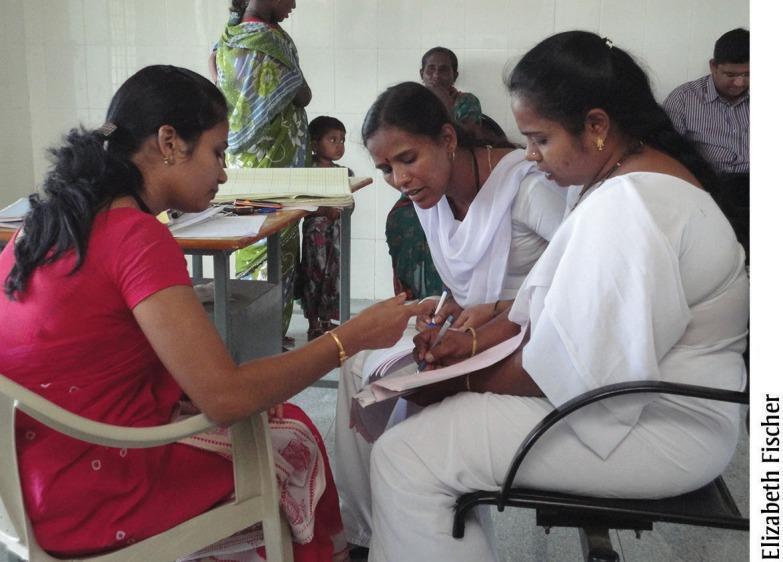
A clinical photograph depicting a healthcare training session in a primary health center in Karnataka, India. The image shows a nurse mentor, dressed in a red top and patterned garment, providing clinical support and instruction to two staff nurses. The staff nurses are wearing traditional white uniforms with white scarves. They are engaged in a case sheet audit, with one nurse actively writing on a patient medical record while the mentor points to specific documentation sections. This interaction illustrates quality improvement processes and provider skill upgrading through bedside case reviews and modeling of good practices. In the background, other individuals, including a child and a woman, are visible in the clinical environment. The photograph serves as an educational example of maternal and neonatal health mentoring interventions in rural, low-resource settings, focusing on improving the accuracy of clinical documentation and the quality of institutional delivery care.
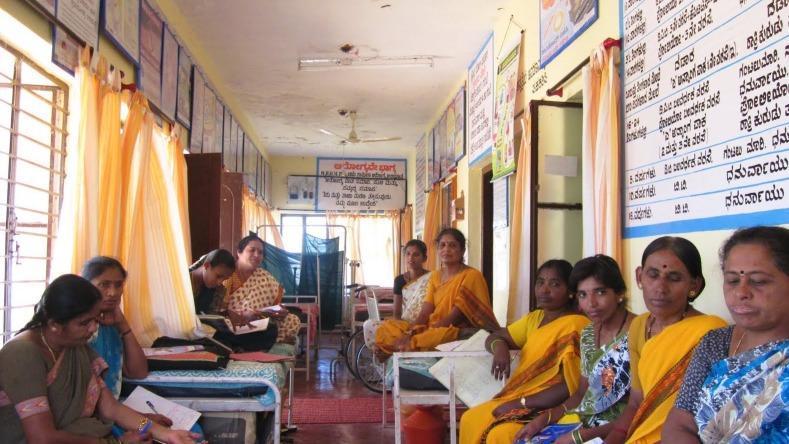
This clinical photograph depicts a community healthcare setting in India, representative of primary care delivery and Health Technology Assessment (HTA) implementation at the ground level. The image shows a group of women, dressed in traditional saris, seated within a functional clinical ward or waiting area. The environment is equipped with essential medical furniture, including metal examination beds or cots and a wheelchair visible in the background. The walls are densely populated with educational posters and health charts, many of which utilize local regional scripts (Kannada) for public health communication. This visual illustrates the infrastructure of public health centers in federal healthcare systems, highlighting the interface between medical services and the community. Key educational concepts include global health systems, public health education, and the socio-cultural context of healthcare delivery in low-to-middle-income countries.
A detailed educational infographic about Janani Suraksha Yojana (JSY) India, showing: title at top "Janani Suraksha Yojana (JSY) - Mother's Protection Scheme", a pregnant woman with ASHA worker on left side, two columns showing Low Performing States (LPS) and High Performing States (HPS) cash amounts in rupees, a table showing Rural vs Urban cash incentives (Mother's package + ASHA package), key features listed as bullet points including "Launched April 12 2005", "100% Centrally Sponsored", "BPL families focus", "10 LPS states listed", color coded sections in green for rural and blue for urban, icons showing hospital building, cash/money, and mother with baby. Clean medical education poster style with warm orange and teal color scheme.
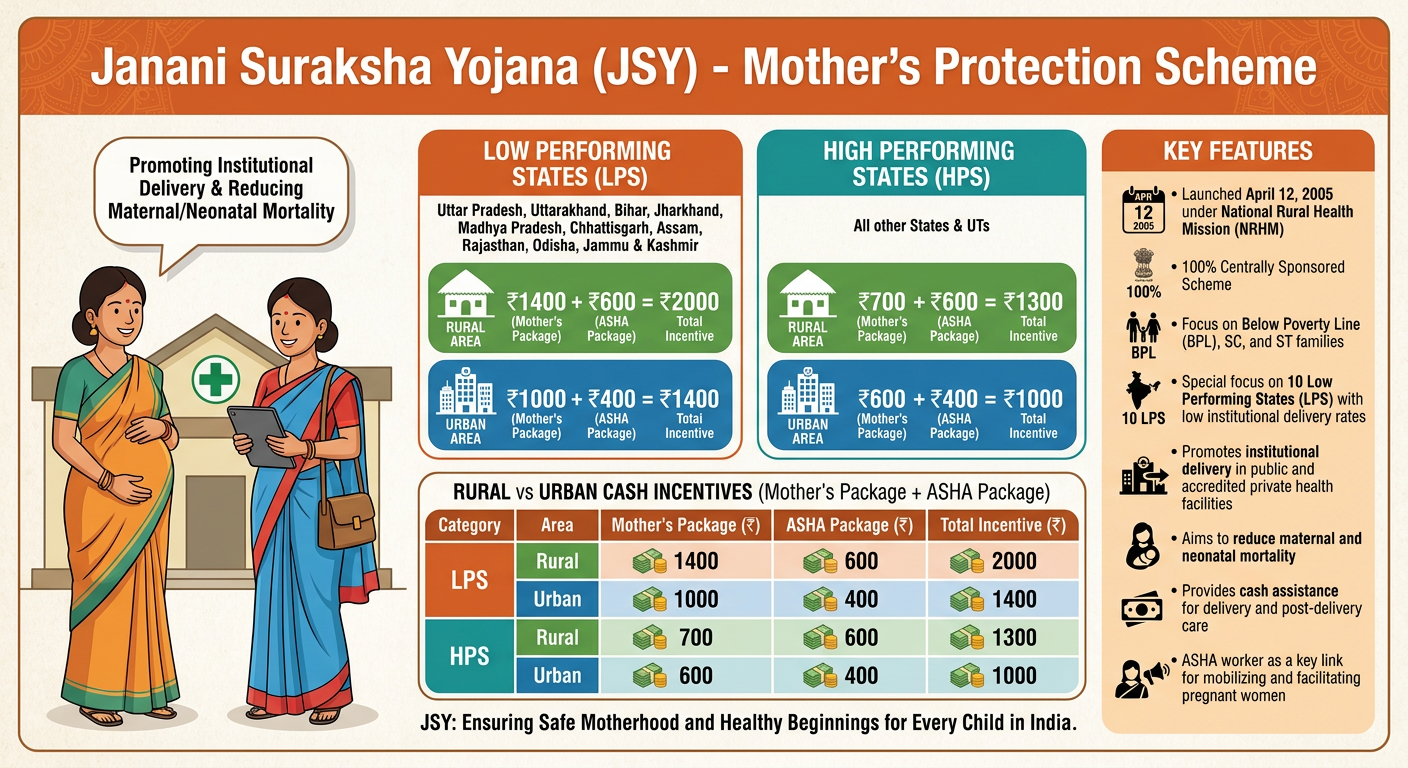
The Story of Savitri and the Scheme That Protected Mothers
Chapter 1: The Problem - Mothers Were Dying at Home
Chapter 2: The Birth of JSY - April 12, 2005
- Reduce Maternal Mortality
- Reduce Neonatal Mortality
Chapter 3: India Gets Divided into Two Groups - LPS vs HPS
🔴 Low Performing States (LPS) - 10 States
Uttar Pradesh, Uttarakhand, Madhya Pradesh, Jharkhand, Bihar, Rajasthan, Chhattisgarh, Odisha, Assam, Jammu & Kashmir
🟢 High Performing States (HPS)
Chapter 4: The Money - Who Gets What
The Cash Table (from 2012-13 onwards):
| Category | Rural - Mother | Rural - ASHA | Rural Total | Urban - Mother | Urban - ASHA | Urban Total |
|---|---|---|---|---|---|---|
| LPS | ₹1,400 | ₹600 | ₹2,000 | ₹1,000 | ₹400 | ₹1,400 |
| HPS | ₹700 | ₹600 | ₹1,300 | ₹600 | ₹400 | ₹1,000 |
Chapter 5: The ASHA - Savitri's Guardian Angel
- Identify BPL pregnant women like Savitri
- Arrange institutional antenatal care for her
- Escort her to the health centre for delivery
- Arrange referral transport (minimum ₹250 for transport)
- Do a post-natal visit to Savitri after delivery
- Ensure BCG vaccination of the newborn 7Get paid only AFTER the post-natal visit + BCG immunization (minimum ₹200 per delivery, rest as balance)
- All 10 LPS states
- All North-East states
- Tribal districts of all states and UTs
Chapter 6: Who is Eligible? - The Eligibility Rules
In Low Performing States (LPS):
In High Performing States (HPS):
Chapter 7: Home Delivery - Even That is Covered
₹500 cash assistance per delivery - regardless of age and number of children.
Chapter 8: The Caesarean Subsidy - For Complicated Cases
Up to ₹1,500 per delivery to government institutions for caesarean section and obstetric complication management.
Chapter 9: 2006-07 - The Year of Institutional Deliveries
- Scheme extended to urban areas of High Performing States
- Age and birth-order restrictions removed in LPS
- Benefits extended to all SC/ST women for institutional deliveries
Chapter 10: Direct Benefit Transfer - Money Goes Straight to Savitri
Chapter 11: The Impact - Crores of Mothers Helped
- Since inception of NRHM: 8.55 crore women benefited under JSY
- In 2018-19 alone: 100.41 lakh (1 crore+) pregnant women benefited
Quick Memory Summary
| Feature | Key Detail |
|---|---|
| Launched | 12 April 2005 |
| Modified from | National Maternity Benefit Scheme |
| Under | NRHM |
| Funding | 100% Central Government |
| Objective | Reduce MMR + NMR via institutional delivery |
| LPS states | 10 (UP, UK, MP, JH, BR, RJ, CG, OD, AS, J&K) |
| LPS Rural (Mother) | ₹1,400 |
| LPS Urban (Mother) | ₹1,000 |
| HPS Rural (Mother) | ₹700 |
| HPS Urban (Mother) | ₹600 |
| ASHA Rural | ₹600 (all LPS) |
| ASHA Urban | ₹400 |
| Home delivery (BPL) | ₹500 (all states) |
| C-section subsidy | Up to ₹1,500 |
| Birth limit - LPS | Up to 3rd child (with sterilization) |
| Birth limit - HPS | Up to 2 live births |
| Payment mode | Direct Benefit Transfer (DBT) via Aadhaar |
| Year of institutional deliveries | 2006-07 |
Epidemiology of Blindness - discuss, National Programme for Control of Blindness in India* - describe*; Preventable Blindness in India - important causes
National Programme for Control of Blindness India NPCB epidemiology preventable blindness causes 2024
cataract blindness India eye surgery prevention causes epidemiology
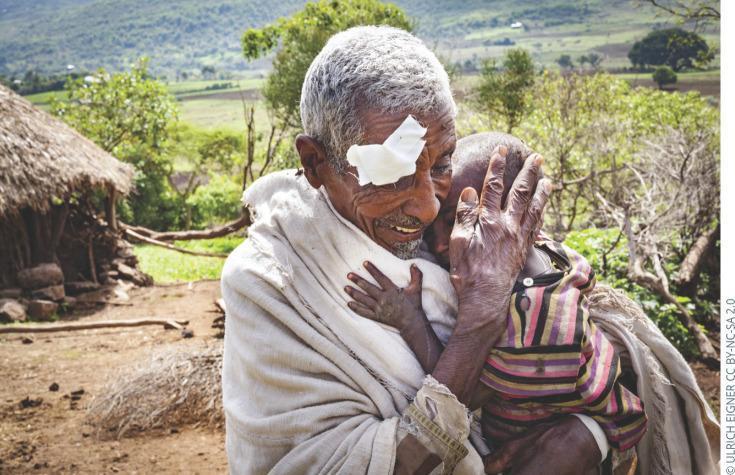
This clinical photograph displays an elderly male patient in a rural, resource-limited setting, specifically Burkina Faso, post-ophthalmic intervention. The patient's left eye is occluded with a white surgical adhesive bandage, typically indicative of immediate postoperative care following sight-restoring procedures such as cataract surgery or trichiasis repair. The surrounding facial skin shows significant solar elastosis and dermatological aging, consistent with chronic ultraviolet exposure in a tropical climate. The image illustrates the delivery of primary eye health care and specialized surgical outreach in remote communities. The background features a thatched-roof dwelling and mountainous agricultural landscape, emphasizing the socioeconomic and geographical barriers to healthcare access. This visual is used to demonstrate the impact of community-based ophthalmology and public health initiatives in preventing avoidable blindness in underserved populations.
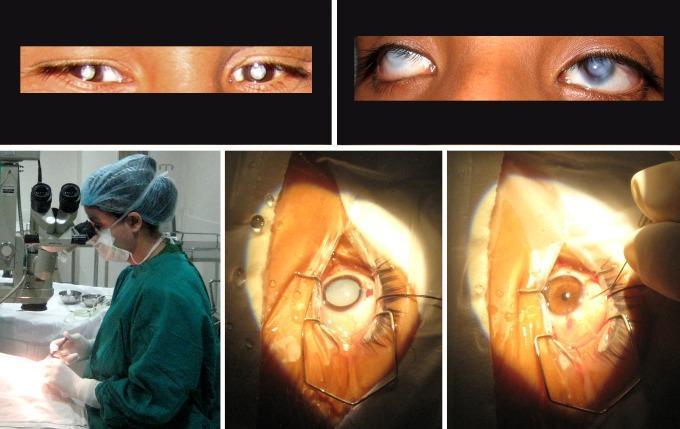
A multi-panel medical figure illustrating pediatric ophthalmological pathology and surgical intervention. The top row contains two clinical photographs of child eyes showing causes of treatable blindness: the left panel displays bilateral congenital cataracts, characterized by dense leukocoria (white pupillary reflex); the right panel depicts bilateral corneal opacities, presenting as diffuse clouding and scarring of the corneal stroma. The bottom row showcases stages of cataract surgery and intraocular lens (IOL) implantation. The bottom-left panel shows a surgeon utilizing an operating microscope. The bottom-middle panel provides an intraoperative close-up of a dilated pupil with a dense cataractous lens held by a speculum. The bottom-right panel displays the postoperative appearance after cataract extraction and successful implantation of an artificial IOL, restoring clear visual axes. This progression serves as a clinical example of surgical remediation for congenital vision impairment.
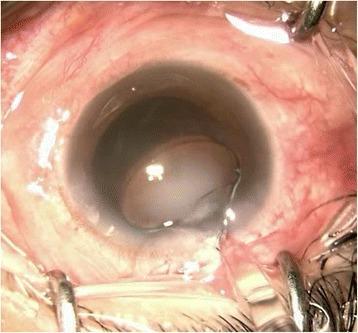
This intraoperative clinical photograph captures a human eye during cataract surgery, specifically demonstrating a rare acute opacification of an implanted trifocal intraocular lens (IOL). The image shows the anterior segment of the eye held open by surgical retractors, with a well-dilated pupil. Centered within the pupillary aperture, the implanted IOL optic exhibits a distinct, diffuse cloudiness or 'foggy' appearance, transitioning from its expected transparency to a semi-opaque white state. This phenomenon, often related to temperature fluctuations or material calcification, completely obscures the view of the posterior capsule. The surrounding iris and conjunctiva appear slightly hyperemic, typical of an ongoing surgical procedure. The photograph serves as a critical educational example of intraoperative IOL complications and material instability, highlighting the need for lens explantation when optical clarity is compromised immediately upon insertion.
https://pmc.ncbi.nlm.nih.gov/articles/PMC3562965
Epidemiology of Blindness, NPCB, and Preventable Blindness in India
PART 1: EPIDEMIOLOGY OF BLINDNESS
Definition
- Old definition (1976): Unable to count fingers at 6 metres
- New definition: Unable to count fingers at 3 metres
- Effect: Blind population estimate reduced from 1.20 crore → 80 lakh
ICD-11 (2018) Classification of Vision Impairment
| Category | Visual Acuity |
|---|---|
| Mild | Worse than 6/12 |
| Moderate | Worse than 6/18 |
| Severe | Worse than 6/60 |
| Blindness | Worse than 3/60 |
Global Magnitude
- 1 billion people globally have preventable/unaddressed vision impairment (WHO 2020)
- 80% of all blindness is avoidable (treatable or preventable)
- Major global causes of moderate-severe vision impairment:
- Uncorrected refractive errors - 53%
- Unoperated cataract - 25%
- Age-related macular degeneration
- Glaucoma - 6.9 million
- Corneal opacities - 4.2 million
- Diabetic retinopathy - 3 million
- Trachoma - 2 million
- Presbyopia (near) - 826 million
Magnitude in India
| Survey | Prevalence |
|---|---|
| National Blindness Survey 2006-07 | 1.0% |
| National Survey 2015-19 (projected) | 0.36% |
- India has 12 million blind persons out of 45 million globally
- Blindness has declined due to NPCB, improved eye care access, and socioeconomic development
Causes of Blindness in India (National Survey 2015-19)
| Cause | Percentage |
|---|---|
| Cataract (untreated) | 66.2% |
| Cataract surgical complications | 7.2% |
| Non-trachomatous corneal opacity | 7.4% |
| Other posterior segment disease | 5.9% |
| Glaucoma | 5.5% |
| Phthisis | 2.8% |
| Diabetic retinopathy | 1.2% |
| Aphakia uncorrected | 1.7% |
| Trachomatous corneal opacity | 0.8% |
| ARMD | 0.7% |
| Refractive error | 0.1% |
| All other globe/CNS abnormalities | 0.5% |
Key: Cataract alone causes 2/3 of all blindness in India. Senile cataract occurs a decade earlier in India compared to Europe/America.
Epidemiological Determinants
(a) Age
- 30% of the blind in India lose vision before age 20; many before age 5
- Children/Young: Refractive error, trachoma, conjunctivitis, Vitamin A deficiency (xerophthalmia)
- Middle age: Cataract, refractive error, glaucoma, diabetes
- All ages: Accidents/injuries (especially ages 20-40)
(b) Sex
- Higher prevalence in females than males
- Attributed to higher prevalence of trachoma, conjunctivitis, and cataract in women
(c) Malnutrition
- Vitamin A deficiency causes keratomalacia - severe blinding corneal destruction
- Mainly affects children aged 6 months to 3 years (up to 4-6 years)
- PEM (Protein-Energy Malnutrition) also associated
- Precipitated by measles and diarrhoea (cause malnutrition)
(d) Occupation
- Factory/workshop workers at risk from: dust, flying objects, gases, radiation (UV, welding flash, X-rays)
- Doctors/workers exposed to X-rays, UV rays, heat waves → premature cataract
(e) Social Class
- Blindness is twice more prevalent in lower socio-economic groups
- Poor nutrition, poor hygiene, limited access to eye care
Emerging Cause: Retinopathy of Prematurity (ROP)
- Increasing because survival of premature babies (<30 weeks gestation, <1500g) has improved with NICUs
- These babies are at high risk of ROP
- Urgent need for awareness among ophthalmologists and paediatricians
PART 2: NATIONAL PROGRAMME FOR CONTROL OF BLINDNESS (NPCB) / NPCBVI
Background
- India was the first country in the world to launch a national programme for blindness control
- Launched: 1976 under the Ministry of Health and Family Welfare
- 100% Centrally Sponsored Scheme
- Trachoma Control Programme (started 1963) was merged into NPCB in 1976
- Renamed (2018): NPCB → National Programme for Control of Blindness and Visual Impairment (NPCBVI)
- 1983 National Health Policy target: Reduce prevalence from 1.4% to 0.3%
- Current target: Reduce to 0.25% by 2025
Objectives of NPCB
- Reduce the backlog of blindness through identification and treatment
- Develop comprehensive eye care facilities in every district
- Develop human resources for eye care services
- Improve quality of service delivery
- Secure participation of voluntary organizations and private practitioners
- Enhance community awareness on eye care
- Provide best possible treatment for curable blindness at district/regional level
- Set up mechanisms for referral coordination and feedback
Strategies / Components
1. Primary Eye Care
- Village Health Guides + Multipurpose Workers trained to handle:
- Acute conjunctivitis, ophthalmia neonatorum, trachoma, superficial foreign bodies, xerophthalmia
- Equipped with: topical tetracycline, Vitamin A capsules, eye bandages/shields
- Refer difficult cases (corneal ulcer, penetrating injuries, non-responsive infections) to PHC/District Hospital
- Promote: personal hygiene, sanitation, good diet, safety
- Coverage: 1 Village Health Guide / 1,000 population; 2 MPWs / 5,000 population
2. Secondary Care (District Level)
- PHCs and District Hospitals with eye departments/clinics
- Manages: Cataract, trichiasis, entropion, ocular trauma, glaucoma
- Eye Camp Approach - highly successful for cataract surgery outreach
- Mobile Eye Clinics - bring services to remote areas
- Early detection surveys + health education
3. Tertiary Care (National/Regional Level)
- Medical colleges and institutes for complex procedures:
- Retinal detachment surgery
- Corneal grafting (Eye Banks established under Corneal Grafting Acts)
- Complex surgical management
- National Institute for the Blind, Dehradun - established for rehabilitation, new strategies
4. Specific Disease Programmes
- Trachoma Control - mass campaigns with topical tetracycline
- School Eye Health Services - early detection of visual defects in children
- Eye Donation - Eye Donation Fortnight: 25th August to 8th September every year
- Leading states: Gujarat, Tamil Nadu, Maharashtra, Delhi, Chandigarh, AP, Kerala, Karnataka
5. Expanded Scope (Beyond Cataract - Recent)
- Diabetic Retinopathy (DR)
- Glaucoma
- Ocular Trauma
- Childhood Blindness
- Keratoplasty
- Squint
- Low Vision
- Retinopathy of Prematurity (ROP)
Vision 2020: The Right to Sight
- Global initiative launched by WHO on 18th February 1999
- Goal: Eliminate avoidable blindness
- Focus conditions: Cataract, xerophthalmia/childhood blindness, refractive error and low vision, trachoma, corneal blindness
- Centres around sight as a fundamental human right
Global Eye Health Action Plan 2014-2019
- Goal: Reduce avoidable visual impairment as a global public health problem
- 5 principles: Universal access and equity, human rights, evidence-based practice, life course approach, empowerment of visually impaired
- Target: Reduce avoidable visual impairment by 25% by 2019 from 2010 baseline
- Three indicators of progress: (1) Prevalence and causes of visual impairment; (2) Eye care personnel numbers; (3) Cataract surgery rates
PART 3: PREVENTABLE BLINDNESS IN INDIA - IMPORTANT CAUSES
1. Cataract (Most Important - 66.2%)
- Single largest cause of blindness in India
- Largely curable by surgery (IOL implantation)
- Occurs a decade earlier in India than the West
- Strategies: Eye camps, cataract surgery coverage, IOL programmes, district-level facilities
- Subsidized by NPCB through PPP and government hospitals
2. Refractive Errors
- Uncorrected refractive errors - mostly preventable/correctable with spectacles
- Free spectacles for persons 40+ years in eye screening camps (from 2014 under NPCB)
3. Corneal Blindness (Non-trachomatous: 7.4% + Trachomatous: 0.8%)
- Trachoma - preventable with tetracycline, SAFE strategy (Surgery, Antibiotics, Facial cleanliness, Environmental improvement)
- Corneal ulcer - 6.5 million affected, 1.3 million eyes go blind annually in the region
- Xerophthalmia (Vitamin A deficiency) - preventable with Vitamin A supplementation
- Trauma and ocular injuries - preventable with safety measures
4. Glaucoma (5.5%)
- Primary open-angle glaucoma more common (1.7%) than primary angle-closure (0.73%)
- Slight female preponderance
- Early detection through screening - treatable if caught early
5. Childhood Blindness
- Xerophthalmia (Vitamin A deficiency)
- Ophthalmia neonatorum
- Congenital cataract
- Retinopathy of Prematurity (ROP) - emerging cause
- Measles complications
- Strategies: Vitamin A supplementation, immunization (measles), school eye health services
6. Diabetic Retinopathy (1.2%)
- Growing cause with rising diabetes prevalence
- Preventable through diabetes control + regular retinal screening
7. Occupational Blindness
- Preventable through safety goggles, shields, regulations
- Industries: factories, welding, chemical exposure
Quick Summary Table
| Topic | Key Fact |
|---|---|
| WHO definition of blindness | VA < 3/60 |
| India's prevalence (2015-19) | 0.36% |
| #1 cause in India | Cataract (66.2%) |
| Avoidable blindness | 80-90% |
| NPCB launched | 1976 (100% centrally sponsored) |
| India's distinction | First country to launch national blindness programme |
| 1983 target | Reduce from 1.4% to 0.3% |
| 2025 target | Reduce to 0.25% |
| Renamed to | NPCBVI (2018) |
| Eye Donation Fortnight | 25 Aug - 8 Sep |
| Vision 2020 launched | 18 Feb 1999 (WHO) |
| Most vulnerable sex | Females (more blindness prevalence) |
| Keratomalacia age group | 6 months - 3 years |
| Senile cataract in India | Occurs 10 years earlier than West |
Create a visual poster comparing preventable causes of blindness in India
A detailed medical education poster titled "Preventable Causes of Blindness in India" with a dark navy blue background and bright clean design. At the top: bold white title "Preventable Causes of Blindness in India" with subtitle "National Survey 2015-19 | 80-90% of Blindness is Avoidable". Center of poster: a large pie chart or donut chart showing proportions with labeled segments and percentages: - Cataract (untreated) 66.2% - bright orange segment, largest - Cataract surgical complications 7.2% - amber - Non-trachomatous corneal opacity 7.4% - teal - Glaucoma 5.5% - purple - Other posterior segment 5.9% - blue - Diabetic Retinopathy 1.2% - red - Refractive error 0.1% - green - Others (phthisis, aphakia, trachoma, ARMD) remaining percent - grey Below the chart: a row of 6 icon boxes each showing a cause with icon, name, prevention method: 1. Cataract - eye with cloudy lens icon - "Prevention: IOL Surgery, Eye Camps" 2. Refractive Error - spectacles icon - "Prevention: Free Spectacles" 3. Corneal Blindness - eye with scar icon - "Prevention: Tetracycline, Vit A" 4. Glaucoma - eye pressure icon - "Prevention: Early Screening" 5. Diabetic Retinopathy - blood glucose icon - "Prevention: Diabetes Control" 6. Childhood Blindness - child face icon - "Prevention: Vitamin A, Immunization" Bottom banner: "NPCB launched 1976 | Target: Reduce prevalence to 0.25% by 2025 | Vision 2020: The Right to Sight" Color scheme: navy background, orange and teal accents, white text, clean infographic medical poster style
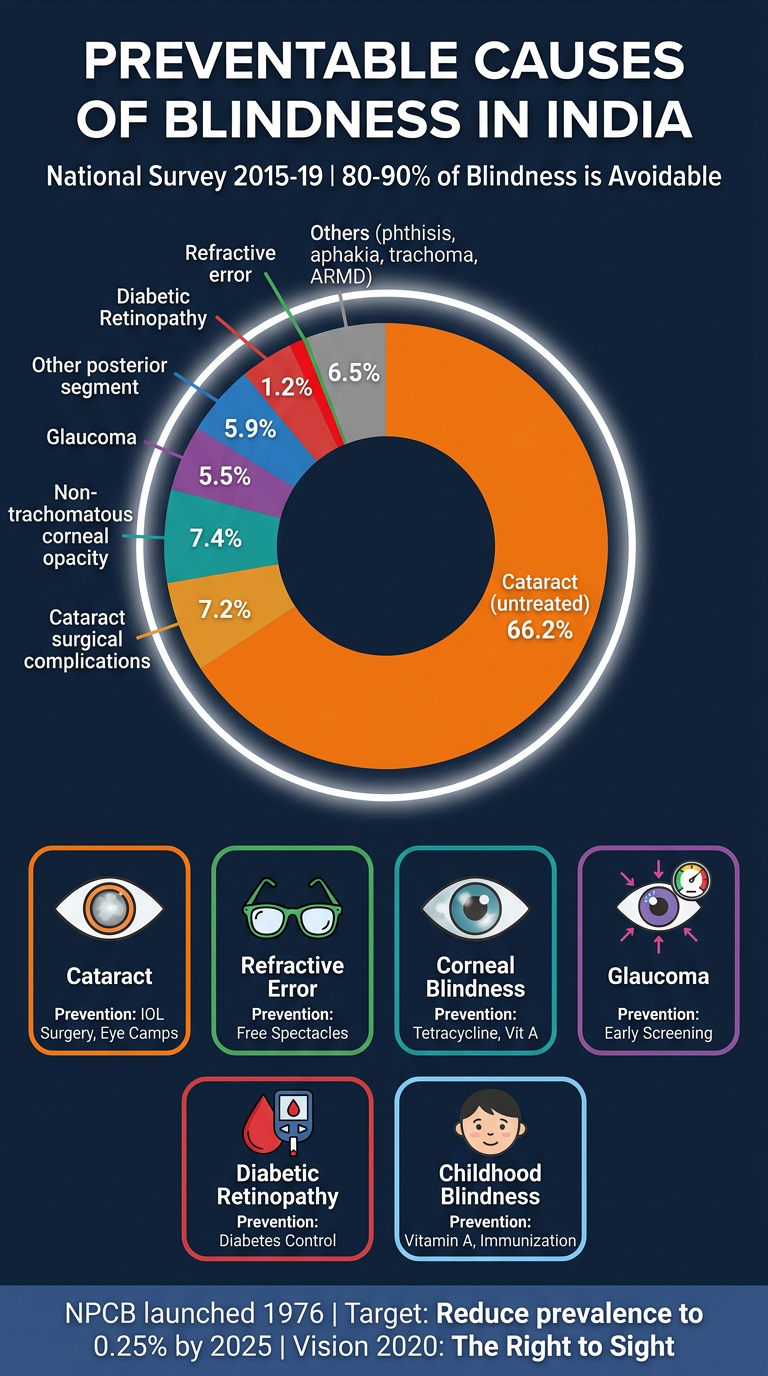
- Cataract (66.2%) dominates as the single largest cause - and is fully curable with IOL surgery
- 80-90% of all blindness in India is avoidable - either treatable or preventable
- Each cause is paired with its prevention/treatment strategy for quick revision
- Bottom banner anchors the NPCB programme (launched 1976) and the target to reduce prevalence to 0.25% by 2025
RNTCP Programme of India* - describe salient features; three regimens of treatment under RNTCP - enumerate, Changes in RNTCP as compared to NTP, DOTS Strategy - five principles
RNTCP India salient features DOTS strategy five principles treatment regimens NTP comparison
https://www.bionity.com/en/encyclopedia/RNTCP.html
RNTCP - Revised National Tuberculosis Control Programme
PART 1: SALIENT FEATURES OF RNTCP
Background and History
| Milestone | Year |
|---|---|
| National TB Programme (NTP) launched | 1962 |
| RNTCP pilot started | 1993 |
| RNTCP launched as national programme | 1997 |
| Rapid expansion begins | Late 1998 |
| 30% population coverage | End of 2000 |
| 50% population coverage | End of 2002 |
| 778 million covered | End of 2003 |
| 997 million covered | End of 2004 |
| ~97% (1080 million) covered | December 2005 |
| Entire country covered | 24 March 2006 |
| Renamed to NTEP (National TB Elimination Programme) | 2020 |
Salient Features of RNTCP
- State-run TB Control Initiative - Government of India programme
- 100% free anti-TB drugs provided across the country through PHCs and private-sector DOTS providers
- Incorporates the WHO-recommended DOTS strategy
- Decentralized organizational structure - services available at peripheral level
- Diagnosis based primarily on sputum smear microscopy (ZN staining) - X-ray plays a secondary role
- Three sputum samples collected over 2 days (Spot-Morning-Spot) → ensures >99% test sensitivity
- Standardized treatment regimens based on patient category (I, II, III)
- Drugs provided in patient-wise boxes with sufficient shelf-life
- Multi-blister combipacks - weekly supply in continuation phase to track compliance
- Pharmacovigilance system integrated for adverse drug reaction monitoring
- Nikshay portal - online platform for patient notification, tracking, and treatment outcome recording
- Focus on sputum-positive pulmonary TB (highest public health priority - spreads disease)
- Public-Private Partnership (PPP) - private sector DOTS providers included
- Expanded to cover: DR-TB, HIV-TB, Childhood TB, new drugs (Bedaquiline, Delamanid)
PART 2: DOTS STRATEGY - FIVE PRINCIPLES
The Five Principal Components of DOTS:
| No. | Component | Detail |
|---|---|---|
| 1 | Political and administrative commitment | Sustained government support and funding at national, state, district levels |
| 2 | Case detection by Sputum Smear Microscopy | ZN staining - primary diagnostic tool; 3 samples over 2 days (Spot-Morning-Spot) |
| 3 | Uninterrupted supply of good quality anti-TB drugs | Patient-wise boxes, multi-blister combipacks, proper storage and supply chain |
| 4 | Standardized treatment regimens with directly observed treatment for at least the first 2 months | Health worker watches patient swallow drugs in IP; continuation phase checked by empty combipack return |
| 5 | Systematic monitoring and accountability | Recording and reporting system, Nikshay portal, treatment outcome tracking |
How DOTS Works in Practice:
- Intensive Phase (IP): A health worker or trained person physically watches the patient swallow every dose
- Continuation Phase (CP): Patient issued medicine for one week in a multi-blister combipack; first dose swallowed in front of health worker; empty combipack returned when collecting next week's supply = proof of consumption
PART 3: THREE TREATMENT REGIMENS UNDER RNTCP
- Nature/severity of disease
- History of previous anti-TB treatment
Category I
2H₃R₃Z₃E₃ + 4H₃R₃
| Phase | Duration | Drugs | Frequency |
|---|---|---|---|
| Intensive Phase | 2 months | HRZE (Isoniazid + Rifampicin + Pyrazinamide + Ethambutol) | Thrice weekly |
| Continuation Phase | 4 months | HR (Isoniazid + Rifampicin) | Thrice weekly |
| Total duration | 6 months |
Category II
2H₃R₃Z₃E₃S₃ + 1H₃R₃Z₃E₃ + 5H₃R₃E₃
| Phase | Duration | Drugs | Frequency |
|---|---|---|---|
| Intensive Phase | 2 months | HRZES (H+R+Z+E+Streptomycin) | Thrice weekly |
| Extended IP | 1 month | HRZE (without Streptomycin) | Thrice weekly |
| Continuation Phase | 5 months | HRE | Thrice weekly |
| Total duration | 8 months |
Category III
2H₃R₃Z₃ + 4H₃R₃
| Phase | Duration | Drugs | Frequency |
|---|---|---|---|
| Intensive Phase | 2 months | HRZ | Thrice weekly |
| Continuation Phase | 4 months | HR | Thrice weekly |
| Total duration | 6 months |
Drug Code Key:
| Letter | Drug |
|---|---|
| H | Isoniazid (INH) |
| R | Rifampicin |
| Z | Pyrazinamide |
| E | Ethambutol |
| S | Streptomycin |
| Subscript 3 | Thrice weekly |
| Prefix number | Duration in months |
PART 4: CHANGES IN RNTCP COMPARED TO NTP
National TB Programme (NTP) - 1962 (Old)
| Feature | NTP (Old) |
|---|---|
| Case finding | Passive - X-ray based (secondary) |
| Diagnosis | X-ray + sputum (variable) |
| Treatment | Long-course (12-18 months), self-administered |
| Drug regimens | Non-standardized, often irregular |
| Supervision | No direct observation of treatment |
| Drug supply | Often irregular/insufficient |
| Focus | Less priority to smear-positive cases |
| Private sector | Not involved |
| Monitoring | Weak recording and reporting |
RNTCP - 1997 (Revised)
| Feature | RNTCP (New) |
|---|---|
| Case finding | Active + passive; sputum smear-based |
| Diagnosis | Sputum smear microscopy PRIMARY tool (ZN/LEDFM) |
| Treatment | Short-course chemotherapy (6-8 months) |
| Drug regimens | Standardized (Cat I, II, III) |
| Supervision | DOTS - Directly Observed Treatment |
| Drug supply | Patient-wise boxes, multiblister combipacks |
| Focus | Priority to smear-positive cases (source of infection) |
| Private sector | PPP - private DOTS providers included |
| Monitoring | Nikshay, systematic recording and reporting |
Key Changes: NTP → RNTCP Summary
| Aspect | NTP | RNTCP |
|---|---|---|
| Diagnostic tool | X-ray primary | Sputum smear primary |
| Treatment duration | 12-18 months | 6-8 months (short-course) |
| Drug supervision | Self-administered | Directly observed (DOTS) |
| Drug supply | Irregular | Regular patient-wise boxes |
| Categories | Not standardized | Three categories (I, II, III) |
| Drugs frequency | Daily | Thrice-weekly intermittent (original; now switched to daily FDC under NTEP 2016) |
| Coverage | Incomplete | Nationwide by March 2006 |
| HIV-TB | Not addressed | Integrated TB-HIV activities |
| DR-TB | Not managed | Programmatic MDR-TB Management (PMDT) |
| New drugs | None | Bedaquiline, Delamanid (from 2016) |
PART 5: CURRENT UPDATE - NTEP (2020 onwards)
| Change | RNTCP | NTEP |
|---|---|---|
| Treatment schedule | Thrice-weekly (intermittent) | Daily fixed dose combinations (FDC) |
| Diagnosis basis | Category-based (Cat I/II/III) | Drug susceptibility testing (DST) first |
| Patient classification | Category I/II/III | Drug-sensitive TB / DR-TB (based on DST results) |
| Regimen for DS-TB | 2HRZE + 4HR (thrice weekly) | 2HRZE + 4HRE (daily) |
| DR-TB treatment | Standard second-line | Individualized + fully oral regimens preferred |
| Injectables in MDR-TB | Used | No longer priority - oral regimens preferred |
| Goal | Reduce burden | End TB by 2025 |
Quick Memory Table
| Feature | Key Fact |
|---|---|
| NTP launched | 1962 |
| RNTCP pilot | 1993 |
| RNTCP national launch | 1997 |
| Full coverage | 24 March 2006 |
| Renamed NTEP | 2020 |
| DOTS = | Directly Observed Treatment, Short-course |
| DOTS principles | 5 (Commitment, Microscopy, Drug supply, Standardized regimen+DOT, Monitoring) |
| Cat I regimen | 2HRZE + 4HR |
| Cat II regimen | 2HRZES + 1HRZE + 5HRE |
| Cat III regimen | 2HRZ + 4HR |
| Sputum samples | 3 (Spot-Morning-Spot) |
| IP supervision | Direct observation (health worker present) |
| CP supervision | Multiblister combipack return |
| India's TB goal | End TB by 2025 |
Tell me in story format
The Story of Raju's Cough - India's War Against TB
Chapter 1: The Old Enemy That Wouldn't Leave
Chapter 2: The NTP - Good Intentions, Weak Execution
- Patients were diagnosed mainly by X-ray - which was expensive, unreliable, and not widely available in villages
- Treatment lasted 12 to 18 months - far too long for poor patients to stay compliant
- Drugs were given to patients to take at home, unsupervised - and most stopped midway when they felt better
- Drug supply was irregular - medicines ran out constantly
- There was no standardized regimen - each doctor prescribed differently
- No one tracked whether patients actually got cured or not
Chapter 3: The WHO Sends Help - DOTS is Born
"Don't trust the patient to take medicines alone. Watch them swallow every single dose."
Chapter 4: RNTCP is Born - 1997
- End of 2000: 30% of India covered
- End of 2002: 50% covered
- End of 2003: 778 million covered
- End of 2004: 997 million covered
- December 2005: 97% covered
- 24th March 2006: The ENTIRE country - 1,114 million people - covered under DOTS
Chapter 5: The Five Pillars of DOTS - The Soul of RNTCP
Pillar 1 - Political and Administrative Commitment
Pillar 2 - Case Detection by Sputum Smear Microscopy
Pillar 3 - Uninterrupted Supply of Good Quality Anti-TB Drugs
Pillar 4 - Standardized Treatment with Direct Observation (at least first 2 months)
Pillar 5 - Systematic Monitoring and Accountability
Chapter 6: Raju Gets TB - The Three Treatment Categories
- How sick are they?
- Have they been treated before?
Category I - "The New Sick Patient"
- Positive sputum smear (first time, new case)
- Coughing for 3 weeks
2H₃R₃Z₃E₃ + 4H₃R₃
| Phase | Duration | Drugs | How often |
|---|---|---|---|
| Intensive Phase | 2 months | H + R + Z + E (4 drugs) | Thrice weekly |
| Continuation Phase | 4 months | H + R (2 drugs) | Thrice weekly |
| Total | 6 months |
Category II - "The Relapse or Failed Patient"
2H₃R₃Z₃E₃S₃ + 1H₃R₃Z₃E₃ + 5H₃R₃E₃
| Phase | Duration | Drugs | Note |
|---|---|---|---|
| Intensive Phase | 2 months | H+R+Z+E+S (Streptomycin) | Extra drug added |
| Extended IP | 1 month | H+R+Z+E | Streptomycin stopped |
| Continuation Phase | 5 months | H+R+E | |
| Total | 8 months |
Category III - "The Mildly Ill New Patient"
2H₃R₃Z₃ + 4H₃R₃
| Phase | Duration | Drugs |
|---|---|---|
| Intensive Phase | 2 months | H+R+Z (3 drugs) |
| Continuation Phase | 4 months | H+R (2 drugs) |
| Total | 6 months |
Chapter 7: The Drug Alphabet - Quick Decoder
| Letter | Drug | Special Memory |
|---|---|---|
| H | Isoniazid (INH) | "H for Haazir" - always present in every regimen |
| R | Rifampicin | "R for Red urine" - turns urine red, used to check compliance |
| Z | Pyrazinamide | "Z for last letter" - used in IP only |
| E | Ethambutol | "E for Eyes" - can cause optic neuritis |
| S | Streptomycin | "S for Serious relapse" - added in Cat II only |
| Subscript 3 | Thrice weekly | "3 times a week" |
| Prefix number | Duration in months | 2H = Isoniazid for 2 months |
Chapter 8: How RNTCP Was Different From the Old NTP
| He saw before (NTP) | He saw now (RNTCP) |
|---|---|
| X-ray machine queue | Sputum microscopy lab - fast, cheap |
| 12-18 month treatment | 6-8 month short-course |
| Patients taking drugs at home | Health worker watching every dose |
| Drugs running out | Patient-wise box - full course pre-packed |
| No standard regimen | Three categories - nationally standardized |
| No idea who was cured | Nikshay tracking every patient |
| Private sector excluded | PPP - private doctors as DOTS providers |
| TB-HIV not addressed | Integrated TB-HIV programme |
Chapter 9: The Programme Evolves - From RNTCP to NTEP
NTEP - National TB Elimination Programme
- All patients get Universal Drug Susceptibility Testing (UDST) first
- Treatment based on drug sensitivity results - not just categories
- Daily FDC regimen replaces thrice-weekly
- Fully oral regimens for MDR-TB (injections no longer mandatory)
- New drugs: Bedaquiline (BDQ) and Delamanid (DLM) for resistant TB
Chapter 10: Raju is Cured
- A health worker who watched every dose
- Drugs that were always available
- A government that was committed
- A record that tracked his every step
Final Memory Map
| Element | Key Fact |
|---|---|
| NTP | 1962 |
| RNTCP pilot | 1993 |
| RNTCP national | 1997 |
| Full coverage | 24 March 2006 |
| Renamed NTEP | 2020 |
| India's TB goal | End TB by 2025 |
| DOTS = | 5 Pillars |
| Cat I | New smear +ve → 2HRZE + 4HR (6 months) |
| Cat II | Relapse/Failure → 2HRZES + 1HRZE + 5HRE (8 months) |
| Cat III | New smear -ve mild → 2HRZ + 4HR (6 months) |
| Sputum samples | 3 (Spot-Morning-Spot) |
| IP supervision | Direct observation every dose |
| CP supervision | Multiblister combipack return |
Visualise me everthing with a image
A clean medical education infographic poster with dark teal background titled "RNTCP - India's TB Control Journey" showing a horizontal timeline arrow at the top with these milestones clearly labeled with year and event: 1962 NTP launched, 1993 RNTCP Pilot, 1997 RNTCP National Launch, 2006 Full Country Coverage (1114 million), 2020 Renamed NTEP, 2025 End TB Goal. Below the timeline: a large central box titled "RNTCP Key Facts" with white bullet points: "100% Free Anti-TB Drugs", "DOTS Strategy", "Sputum Smear Microscopy Primary Tool", "3 Sputum Samples - Spot Morning Spot", "Patient-wise Drug Boxes", "Nikshay Portal for tracking", "PPP - Private sector included". Bottom row shows India map with coverage statistics: 30% by 2000, 50% by 2002, 97% by 2005, 100% by March 2006. Color scheme: teal and gold on dark background, clean medical infographic style, white text
A vibrant medical education poster titled "DOTS - 5 Pillars Strategy" on deep navy blue background. Show 5 tall pillars or columns side by side, each pillar a different bright color, each with a number, icon, and text: Pillar 1 (Orange) - icon of government building - "Political Commitment" - "Sustained govt support and funding" Pillar 2 (Yellow) - icon of microscope - "Sputum Smear Microscopy" - "3 samples Spot-Morning-Spot, ZN staining, 99% sensitivity" Pillar 3 (Green) - icon of medicine box - "Uninterrupted Drug Supply" - "Patient-wise boxes, Multi-blister combipacks" Pillar 4 (Red) - icon of health worker watching patient - "Directly Observed Treatment" - "IP: Watch every dose. CP: Return empty combipack" Pillar 5 (Purple) - icon of checklist and computer - "Monitoring and Accountability" - "Nikshay portal, recording, reporting, treatment outcomes" Above all pillars: subtitle "DOTS = Directly Observed Treatment Short-Course". Below: "Only strategy proven effective worldwide on programme basis". Clean bold infographic style, white text on colored pillars
A detailed medical education table-style poster on white background titled "RNTCP - Three Treatment Categories" with bold red title bar. Three side-by-side colored sections: LEFT SECTION (Blue) - "Category I" - Who: New smear positive, Seriously ill smear negative, Seriously ill extrapulmonary. Regimen box showing: "Intensive Phase: 2 months HRZE (4 drugs) Thrice weekly" + "Continuation Phase: 4 months HR (2 drugs) Thrice weekly" + "Total: 6 months" - highlighted in blue MIDDLE SECTION (Orange) - "Category II" - Who: Relapse, Failure, Treatment after Default. Regimen: "Intensive Phase: 2 months HRZES (5 drugs with Streptomycin)" + "Extended IP: 1 month HRZE" + "Continuation: 5 months HRE" + "Total: 8 months" - highlighted in orange RIGHT SECTION (Green) - "Category III" - Who: New smear negative not seriously ill, New extrapulmonary not seriously ill. Regimen: "Intensive Phase: 2 months HRZ (3 drugs)" + "Continuation: 4 months HR" + "Total: 6 months" - green Bottom drug key table: H=Isoniazid, R=Rifampicin, Z=Pyrazinamide, E=Ethambutol, S=Streptomycin. Subscript 3 = Thrice weekly. Clean bold medical poster style
A split comparison medical education poster titled "NTP vs RNTCP - The Revolution in TB Control" with a bold vertical dividing line in the center. Left half with faded red background labeled "NTP - 1962 (Old)" and right half with bright green background labeled "RNTCP - 1997 (New)". Each side lists 8 comparison rows with icons: Row 1: Diagnosis - X-ray primary | Sputum smear microscopy PRIMARY Row 2: Treatment duration - 12-18 months | 6-8 months SHORT COURSE Row 3: Drug intake - Self-administered at home | DIRECTLY OBSERVED (health worker watches) Row 4: Drug supply - Irregular, ran out | Patient-wise boxes, always available Row 5: Regimens - Not standardized | 3 Categories - nationally standardized Row 6: Private sector - Excluded | PPP - private DOTS providers included Row 7: Monitoring - Weak/no tracking | Nikshay portal - every patient tracked Row 8: HIV-TB - Not addressed | Integrated TB-HIV activities Bottom banner: "Same disease. Better system. Better outcomes." Bold clear medical infographic style, red cross marks on left, green checkmarks on right
Error calling model 'gemini-3-pro-image' (RESOURCE_EXHAUSTED): 429 RESOURCE_EXHAUSTED. {'error': {'code': 429, 'message': 'Resource has been exhausted (e.g. check quota).', 'status': 'RESOURCE_EXHAUSTED'}}
We encountered an error while processing your request. Please try again or reach out to us for help.
Generate a image of this
An error occurred (ValidationException) when calling the ConverseStream operation: Expected toolResult blocks at messages.130.content for the following Ids: tooluse_qcY4taoA3IJKKGAPJx6bZz, tooluse_MelwRLwJFxBgWKrmSniAKN, tooluse_AkrhIjUYfrrsQI8q5XbVfs
We encountered an error while processing your request. Please try again or reach out to us for help.
Chicken Pox - epidemiology, prevention, control
An error occurred (ValidationException) when calling the ConverseStream operation: Expected toolResult blocks at messages.130.content for the following Ids: tooluse_qcY4taoA3IJKKGAPJx6bZz, tooluse_MelwRLwJFxBgWKrmSniAKN, tooluse_AkrhIjUYfrrsQI8q5XbVfs
We encountered an error while processing your request. Please try again or reach out to us for help.
Chicken Pox - epidemiology, prevention, control Also provide image for this
An error occurred (ValidationException) when calling the ConverseStream operation: Expected toolResult blocks at messages.130.content for the following Ids: tooluse_qcY4taoA3IJKKGAPJx6bZz, tooluse_MelwRLwJFxBgWKrmSniAKN, tooluse_AkrhIjUYfrrsQI8q5XbVfs
We encountered an error while processing your request. Please try again or reach out to us for help.
Chicken Pox - epidemiology, prevention, control Also provide image for this
An error occurred (ValidationException) when calling the ConverseStream operation: Expected toolResult blocks at messages.130.content for the following Ids: tooluse_qcY4taoA3IJKKGAPJx6bZz, tooluse_MelwRLwJFxBgWKrmSniAKN, tooluse_AkrhIjUYfrrsQI8q5XbVfs
We encountered an error while processing your request. Please try again or reach out to us for help.
Chicken Pox - epidemiology, prevention, control
An error occurred (ValidationException) when calling the ConverseStream operation: Expected toolResult blocks at messages.130.content for the following Ids: tooluse_qcY4taoA3IJKKGAPJx6bZz, tooluse_MelwRLwJFxBgWKrmSniAKN, tooluse_AkrhIjUYfrrsQI8q5XbVfs
We encountered an error while processing your request. Please try again or reach out to us for help.
Chicken Pox - epidemiology, prevention, control Also provide image for this
An error occurred (ValidationException) when calling the ConverseStream operation: Expected toolResult blocks at messages.130.content for the following Ids: tooluse_qcY4taoA3IJKKGAPJx6bZz, tooluse_MelwRLwJFxBgWKrmSniAKN, tooluse_AkrhIjUYfrrsQI8q5XbVfs
We encountered an error while processing your request. Please try again or reach out to us for help.