
digestion and absorption of fat biochemistry notes in detaul
Reading File
Now let me search the medical library for comprehensive content on fat digestion and absorption.
Finding Sources
Finding Sources
Excellent results. Let me now read from the top biochemistry and physiology sources in parallel.
Reading File
Reading File
Reading File
Good content loading. Let me get more from the Lippincott Biochemistry book (most relevant for biochemistry notes) and the physiology books.
Reading File
Reading File
Reading File
Let me get more content - particularly the pancreatic enzymes, micelle formation, enterocyte processing, and chylomicron formation from Lippincott Biochemistry.
Reading File
Reading File
I now have comprehensive content from multiple authoritative sources. Let me fetch the key diagrams and compile the full notes.
Loading Image
Loading Image
Loading Image
Loading Image
I now have all the material needed to compile detailed, comprehensive biochemistry notes. Let me write the full answer.
Digestion and Absorption of Fat - Detailed Biochemistry Notes
1. Overview of Dietary Lipids
The average daily intake of lipids is approximately 78 g, of which:
- >90% is triacylglycerol (TAG/triglyceride) - three fatty acids esterified to a glycerol backbone
- Remainder: cholesterol, cholesteryl esters, phospholipids, and free fatty acids (FFA)
Digestion of dietary lipids begins in the stomach and is completed in the small intestine.
2. Step 1 - Emulsification
Why emulsification is needed: Dietary fats are hydrophobic. Digestive enzymes work at the oil-water interface. Increasing surface area dramatically increases the rate of enzymatic hydrolysis.
Mechanical Emulsification
- Begins during food preparation (grinding, cooking, marinating)
- Continued by chewing and gastric churning (antral peristalsis against a closed pylorus)
- Gastric contents squirt intermittently into the duodenum
- Intestinal peristalsis mixes contents with pancreatic and biliary secretions
Chemical Emulsification (in the duodenum)
- Bile salts (made in liver, stored in gallbladder) are amphipathic derivatives of cholesterol. Conjugated bile salts consist of a hydroxylated sterol ring with a side chain covalently attached to glycine or taurine by an amide bond.
- Bile salts interact with lipid droplets and the aqueous environment, stabilizing droplets and preventing coalescence.
- Phosphatidylcholine from bile also acts as an emulsifier.
- Products of early digestion (fatty acids, monoglycerides) themselves act as additional emulsifiers.
- The emulsion droplet surface is coated with membrane lipids, denatured proteins, and biliary phospholipids/cholesterol. The polar heads project into the water; the charges prevent coalescence.
Medical Physiology (Boron & Boulpaep), p. 1377
3. Step 2 - Enzymatic Digestion
A. Gastric Phase (Limited)
| Enzyme | Source | Optimal pH | Substrates |
|---|---|---|---|
| Lingual lipase | Ebner glands (tongue) | 4-6 | TAG, especially short/medium chain FA |
| Gastric lipase | Gastric chief cells (mucosa) | 4-6 | TAG - preferentially at sn-3 position |
- Gastric lipase is a 42-kDa glycoprotein stimulated by gastrin
- Both are acid lipases - important in neonates (pancreatic lipase not yet established) and pancreatic insufficiency
- Gastric lipase can hydrolyze ~20-33% of dietary fat in pancreatic insufficiency
- Products (particularly short/medium-chain FAs) signal more distal GI tract to release CCK
Lippincott Illustrated Reviews: Biochemistry 8e, p. 494; Ganong's Physiology 26e
B. Duodenal / Pancreatic Phase (Major)
Hormonally regulated via CCK (from I-cells of duodenum) and secretin, which stimulate secretion of pancreatic juice.
1. Pancreatic Lipase (Triacylglycerol Lipase)
- Most important enzyme for fat digestion
- Constitutes 2-3% of total pancreatic protein - extremely abundant
- Preferentially cleaves FA at positions 1 and 3 of TAG
- Primary products: 2-monoacylglycerol (2-MAG) + 2 free fatty acids
- The sn-2 bond is hydrolyzed slowly - 2-MAG remains largely intact
- Requires the oil-water interface (acts on emulsified fat)
- Inhibited by bile salts (which coat the droplet surface) unless colipase is present
2. Colipase
- Co-secreted by the pancreas as the zymogen procolipase
- Activated in the intestinal lumen by trypsin
- Binds lipase in a 1:1 ratio, anchoring it at the lipid-aqueous interface
- Overcomes inhibition by bile salts - allows lipase to remain associated with lipid droplets even in the presence of bile acids
3. Cholesterol Ester Hydrolase (Cholesterol Esterase)
- ~4% of total protein in pancreatic juice
- Hydrolyzes cholesterol esters → cholesterol + FFA
- Also cleaves esters of fat-soluble vitamins (A, D, E, K) and phospholipids, and TAG
- Activity greatly enhanced in the presence of bile salts
- A very similar enzyme is found in human milk
4. Phospholipase A2 (PLA2)
- Secreted as the proenzyme (zymogen), activated by trypsin in the intestinal lumen
- Requires bile salts for optimal activity
- Removes FA from carbon 2 of phospholipids → lysophospholipid + FFA
- Phosphatidylcholine → lysophosphatidylcholine
- Remaining FA at carbon 1 can be removed by lysophospholipase → glycerylphosphoryl base (e.g., glycerylphosphorylcholine)
Lippincott Illustrated Reviews: Biochemistry 8e, p. 497
Summary of Pancreatic Products:
| Substrate | Enzyme | Products |
|---|---|---|
| TAG | Pancreatic lipase + colipase | 2-MAG + 2 FFA |
| Cholesterol esters | Cholesterol esterase | Cholesterol + FFA |
| Phospholipids | PLA2 | Lysophospholipid + FFA |
4. Step 3 - Micelle Formation
After lipolysis, the products of digestion (2-MAG, FFA, cholesterol, lysophospholipids) interact with bile salts to form mixed micelles.
How Micelles Form
- Lipolytic products build up in the surface of the emulsion droplet
- A multilamellar liquid crystalline layer forms and buds off as multilamellar vesicles (MLVs)
- Bile-salt micelles transform MLVs into unilamellar vesicles
- Further transformation into mixed micelles
Mixed Micelle Structure
- Cylindrical aggregates of bile salts + mixed lipids
- Hydrophobic center contains: FFA, 2-MAG, cholesterol, fat-soluble vitamins
- Hydrophilic exterior faces the aqueous phase
- Diameter: 3-10 nm (much smaller than emulsion droplets)
Why Micelles Are Important
- Further solubilize the hydrophobic lipids
- Provide a transport mechanism through the unstirred water layer (UWL) to the brush border of enterocytes
- Micelles move down their concentration gradient through the UWL
- Lipids diffuse out of micelles at the brush border - a saturated aqueous solution of lipids is maintained in contact with the enterocyte surface
Ganong's Review of Medical Physiology 26e, p. 485; Medical Physiology (Boron), p. 1381
5. Step 4 - Uptake by Enterocytes
Short- and Medium-Chain Fatty Acids (SCFA/MCFA, ≤12 carbons)
- Water-soluble enough at intestinal pH
- Do NOT require incorporation into micelles
- Absorbed directly by simple diffusion into the enterocyte
- Pass directly into the portal blood (not lymph) bound to albumin
- Transported to the liver via the portal vein
- Do NOT require chylomicron formation
Long-Chain Fatty Acids (LCFA, >12 carbons)
- Poorly soluble in water at physiological pH
- Must be incorporated into micelles for transport
- Uptake at the brush border: by a combination of passive diffusion and facilitated transport (via fatty acid transport proteins - FATP, FAT/CD36)
- Once inside the enterocyte, are bound by fatty acid-binding proteins (FABPs)
Cholesterol Absorption
- Free cholesterol diffuses from micelles into enterocytes
- Mediated partly by NPC1L1 (Niemann-Pick C1-Like 1) transporter - the target of ezetimibe
- ~50% of dietary cholesterol is absorbed
Fat-Soluble Vitamins (A, D, E, K)
- Absorbed from micelles along with LCFA and 2-MAG
- Deficiency occurs when bile salts or pancreatic enzymes are absent (e.g., common bile duct obstruction, pancreatic insufficiency)
6. Step 5 - Intracellular Processing (Re-esterification)
Inside the enterocyte smooth endoplasmic reticulum (SER), absorbed lipids are re-esterified:
TAG Re-synthesis (Monoglyceride Pathway - predominant in intestine)
Step 1: Long-chain FA are activated to fatty acyl-CoA by:
FFA + CoA + ATP → Fatty acyl-CoA + AMP + PPi Enzyme: Fatty acyl-CoA synthetase (Thiokinase)
Step 2: 2-MAG + Fatty acyl-CoA → Diacylglycerol (DAG)
Enzyme: Acyl-CoA:monoacylglycerol acyltransferase (MGAT)
Step 3: DAG + Fatty acyl-CoA → Triacylglycerol (TAG)
Enzyme: Acyl-CoA:diacylglycerol acyltransferase (DGAT)
Cholesterol Re-esterification
Cholesterol + Fatty acyl-CoA → Cholesteryl ester Enzyme: Acyl-CoA:cholesterol acyltransferase (ACAT)
Phospholipid Re-synthesis
- Lysophospholipids are re-acylated to form phospholipids in the SER
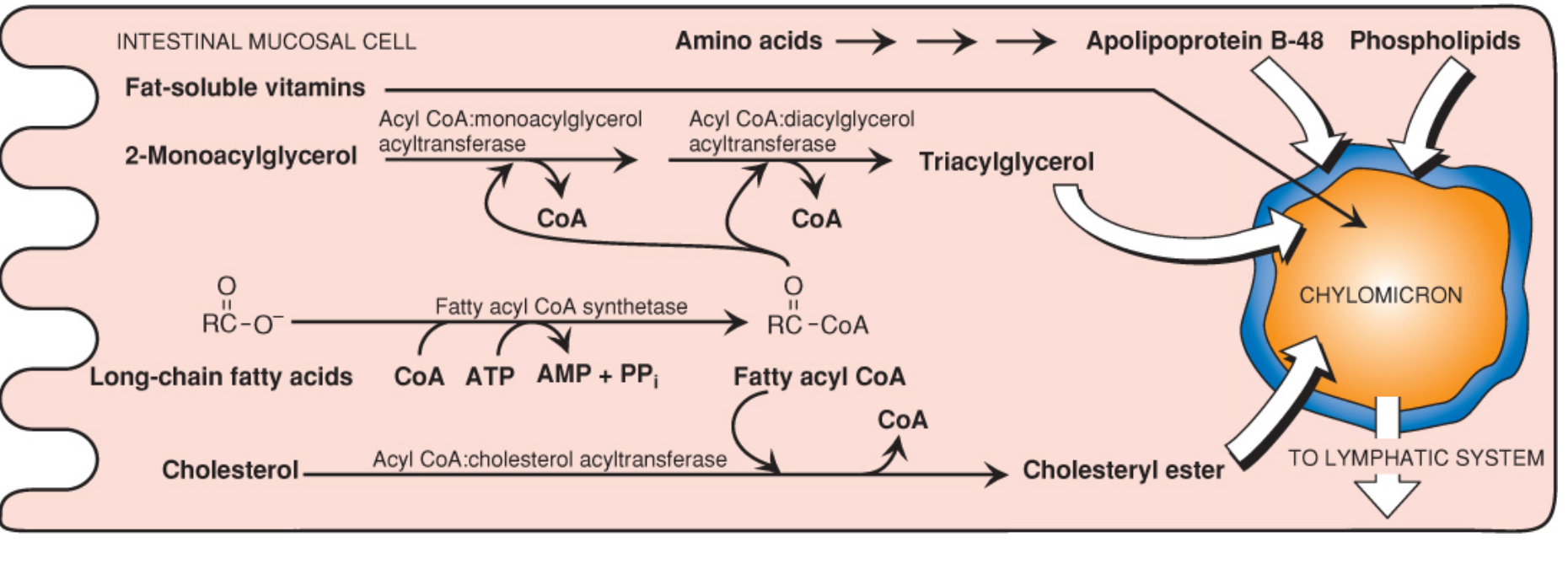
Lippincott Illustrated Reviews: Biochemistry 8e, Fig. 15.6
7. Step 6 - Chylomicron Assembly and Secretion
Chylomicron Composition
| Component | % of total |
|---|---|
| Triacylglycerol | ~86% |
| Phospholipid | ~7% |
| Cholesterol (free + ester) | ~5% |
| Protein (apolipoproteins) | ~2% |
Assembly Process
- Re-esterified TAG and cholesteryl esters are very hydrophobic and aggregate
- They are packaged as lipid droplets coated with:
- Phospholipids (outer monolayer)
- Free cholesterol
- Apolipoprotein B-48 (the structural apolipoprotein)
- Microsomal TG transfer protein (MTP/MTTP) is essential - transfers lipids onto Apo B-48 in the ER
- The particle moves through the Golgi where it is glycosylated
- Released by exocytosis from the basolateral surface of the enterocyte
Apo B-48
- Encoded by the same gene as Apo B-100 (the VLDL apolipoprotein in the liver)
- In the intestinal cell, the primary RNA transcript undergoes RNA editing: a stop codon is generated, producing a protein that is 48% of the size of the hepatic Apo B-100
- Hence the names "B-48" and "B-100"
Route of Chylomicrons
- Released into lacteals (lymphatic capillaries in intestinal villi)
- Lymph containing chylomicrons = chyle (milky appearance after a fat-rich meal)
- Travel via lymphatics → thoracic duct → left subclavian vein → systemic blood
- They are too large to pass through capillary endothelial cell junctions directly
Lippincott Illustrated Reviews: Biochemistry 8e, p. 503-504; Basic Medical Biochemistry 6e, p. 1061
8. Step 7 - Maturation of Chylomicrons in Blood
Nascent chylomicrons (just released from enterocytes) acquire additional proteins from HDL in lymph and blood:
- Apo E - recognized by liver membrane receptors (LDL receptors / remnant receptors) for endocytosis
- Apo C-II - activator of lipoprotein lipase (LPL)
This converts them into mature chylomicrons.
9. Step 8 - Chylomicron Metabolism in Peripheral Tissues
Lipoprotein Lipase (LPL)
- Located on the luminal surface of capillary endothelial cells, primarily in:
- Adipose tissue
- Skeletal and cardiac muscle
- Mammary gland (during lactation)
- Activated by Apo C-II
- Hydrolyzes TAG in chylomicrons → glycerol + FFA
- FFA are taken up by surrounding cells for:
- Energy (beta-oxidation) in muscle
- Re-esterification to TAG (storage) in adipose tissue
- Heparin releases LPL from endothelial cells (used clinically)
- Orlistat (anti-obesity drug): inhibits gastric and pancreatic lipases → reduces fat absorption
Chylomicron Remnants
- After TAG is removed by LPL, the depleted particle = chylomicron remnant
- Remnant still contains cholesterol, cholesteryl esters, Apo E, and some Apo C-II
- Apo C-II is returned to HDL
- Chylomicron remnants are taken up by the liver via Apo E-mediated endocytosis (binding to LDL receptor-related protein, LRP)
Basic Medical Biochemistry 6e, p. 1062
10. Absorption Site and Efficiency
| Lipid | Site of Maximal Absorption |
|---|---|
| Long-chain fatty acids | Upper jejunum (can extend to ileum) |
| Short/medium-chain FA | Stomach and upper small intestine |
| Cholesterol | Duodenum and jejunum |
| Fat-soluble vitamins | Duodenum and jejunum |
- On a moderate fat intake, 95% or more of ingested fat is absorbed
- During fasting, the enterocyte secretes VLDL (instead of chylomicrons) into lymphatics
Ganong's Review of Medical Physiology 26e, p. 487
11. Short-Chain Fatty Acids (SCFA) in the Colon
- Produced by bacterial fermentation of dietary fiber, resistant starch, and complex carbohydrates
- Average colonic concentration: ~80 mmol/L
- Composition: Acetate (~60%), Propionate (~25%), Butyrate (~15%)
- Absorbed via specific transporters (partly by exchange for H+)
- Provide energy (contribute to caloric intake)
- Butyrate is the preferred fuel for colonocytes
- Exert trophic effects on colonic epithelial cells and help combat inflammation
12. Lipid Malabsorption (Steatorrhea)
Steatorrhea = excess fat in the feces due to malabsorption. Common causes:
| Cause | Mechanism |
|---|---|
| Pancreatic insufficiency (CF, chronic pancreatitis) | Inadequate pancreatic lipase/colipase |
| Bile salt deficiency (liver disease, cholestasis, ileal resection) | Impaired micelle formation |
| Short bowel syndrome | Reduced absorptive surface |
| Celiac disease (villous atrophy) | Reduced mucosal absorptive area |
| Abetalipoproteinemia | Absent Apo B-48, chylomicrons cannot form |
| Bariatric surgery | Reduced pancreatic enzyme secretion |
Orlistat: inhibits gastric and pancreatic lipases → used as an anti-obesity drug; causes steatorrhea as a side effect.
13. Summary Flow Chart
Dietary TAG / Cholesterol Esters / Phospholipids
           ↓
   STOMACH: Lingual + Gastric Lipase (acid lipases, pH 4-6)
   Products: FFA (especially short/medium chain) + 1,2-DAG
           ↓
   DUODENUM: Emulsification by bile salts + mechanical mixing
           ↓
   PANCREATIC ENZYMES:
   - Lipase + Colipase → 2-MAG + FFA (from TAG)
   - Cholesterol esterase → Cholesterol + FFA
   - PLA2 → Lysophospholipid + FFA
           ↓
   MIXED MICELLE FORMATION (bile salts + lipid products)
           ↓
   DIFFUSION through unstirred water layer to brush border
           ↓
   ENTEROCYTE UPTAKE:
   - SCFA/MCFA: direct absorption → portal blood
   - LCFA: via diffusion/FATP → inside enterocyte
           ↓
   INTRACELLULAR RE-ESTERIFICATION (in smooth ER):
   - FFA + CoA → Acyl-CoA (fatty acyl-CoA synthetase)
   - Acyl-CoA + 2-MAG → TAG (MGAT, DGAT)
   - Cholesterol → Cholesteryl esters (ACAT)
           ↓
   CHYLOMICRON ASSEMBLY (Apo B-48 + MTP, in ER → Golgi)
           ↓
   EXOCYTOSIS from basolateral enterocyte → LACTEALS
           ↓
   CHYLE → THORACIC DUCT → LEFT SUBCLAVIAN VEIN
           ↓
   Nascent chylomicrons acquire Apo E + Apo C-II from HDL
           ↓
   LPL (activated by Apo C-II) on capillary endothelium
   → TAG hydrolyzed → FFA taken up by muscle/adipose
           ↓
   CHYLOMICRON REMNANTS → Liver (via Apo E / LRP receptor)
Key Biochemistry Points to Remember
| Concept | Key Fact |
|---|---|
| Pancreatic lipase specificity | Cleaves sn-1 and sn-3 bonds → leaves 2-MAG |
| Colipase | Zymogen (procolipase), activated by trypsin; 1:1 with lipase |
| Bile salts | Conjugated (glycine/taurine) amphipathic cholesterol derivatives |
| SCFA/MCFA | Portal route, no chylomicron needed |
| LCFA | Lymphatic/chylomicron route |
| Apo B-48 | RNA editing of Apo B-100 gene in intestine; structural protein of chylomicrons |
| MTP | Essential for chylomicron assembly; deficiency → abetalipoproteinemia |
| LPL activator | Apo C-II (transferred from HDL to chylomicrons) |
| Fat-soluble vitamins | Absorbed with LCFA from micelles; deficient if bile/pancreatic enzymes absent |
| Orlistat | Lipase inhibitor → anti-obesity drug → steatorrhea as side effect |
Sources:
- Lippincott Illustrated Reviews: Biochemistry, 8th ed. (Chapter 15)
- Basic Medical Biochemistry: A Clinical Approach, 6th ed. (Chapter 29)
- Ganong's Review of Medical Physiology, 26th ed. (Chapter 26)
- Medical Physiology (Boron & Boulpaep), Chapter 45
This is a shared conversation. Sign in to Orris to start your own chat.