
Allis Forceps and its uses create a image
Generating Image
Allis forceps surgical instrument - detailed medical illustration showing the classic design with ratcheted handles, finger ring grips, and serrated interlocking teeth at the tip. Label the key parts: finger rings, ratchet lock, shanks, box joint, and serrated tissue-grasping teeth. Include a clean white background with professional medical diagram style. Also show common uses in small panels: grasping fascia, holding bowel, tissue retraction during surgery.
Finding Sources
Here is the generated illustration:
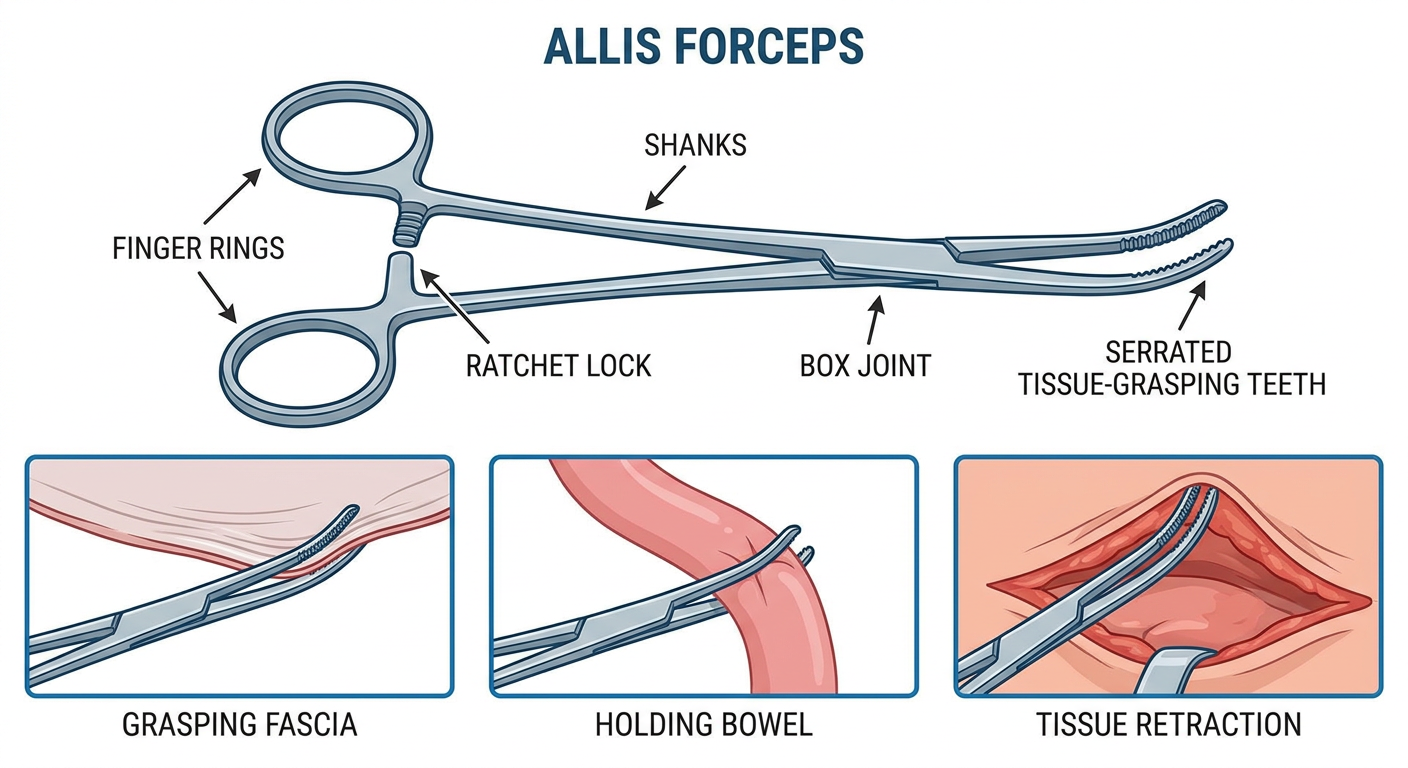
Allis Forceps
Allis forceps (also called Allis clamps) are a type of tissue-grasping surgical instrument with a distinctive ratcheted locking handle and serrated, interlocking teeth at the tip. They were designed to hold tissue securely without causing excessive crushing.
Key Anatomy of the Instrument
| Part | Function |
|---|---|
| Finger rings | Allow the surgeon to open/close with one hand |
| Ratchet lock | Locks the jaws at a set tension |
| Shanks | Transfer grip force to the jaws |
| Box joint | Pivot point connecting the two arms |
| Serrated teeth | Interdigitate to grip tissue firmly |
Surgical Uses
-
Grasping fascia and soft tissue - The most common use; the teeth grip fibrous tissue (e.g., fascia, peritoneum) without tearing during dissection.
-
Tissue retraction - Used to hold back tissue edges to improve surgical exposure.
-
Bowel and visceral surgery - Used to hold the esophagus, bowel, or bladder wall (e.g., during transhiatal esophagectomy, bladder diverticulectomy).
-
Gynecological procedures - Used in perineal repair (third/fourth-degree laceration repairs), where two Allis clamps are commonly applied.
-
Excision of deeper masses - Assists in removal of subcutaneous or deep soft tissue lesions (as noted in Pfenninger and Fowler's Procedures for Primary Care).
-
Tendon surgery - To position (not crush) tendons; Campbell's Operative Orthopaedics notes they should be used cautiously on tendon surfaces to avoid damage.
-
Urologic procedures - Used with Allis clamps to aid circumferential incision around bladder diverticula (per Campbell-Walsh Urology).
Important note: Allis forceps are considered traumatic instruments. They should NOT be used on delicate structures (vessels, nerves, bile ducts) or on the cut surface of tendons, as the teeth cause tissue crushing. Atraumatic (DeBakey) forceps are preferred for such tissues.
This is a shared conversation. Sign in to Orris to start your own chat.