
etc in kreb cycle
The Krebs Cycle and the ETC - How They Connect
Step-by-Step: The Krebs Cycle
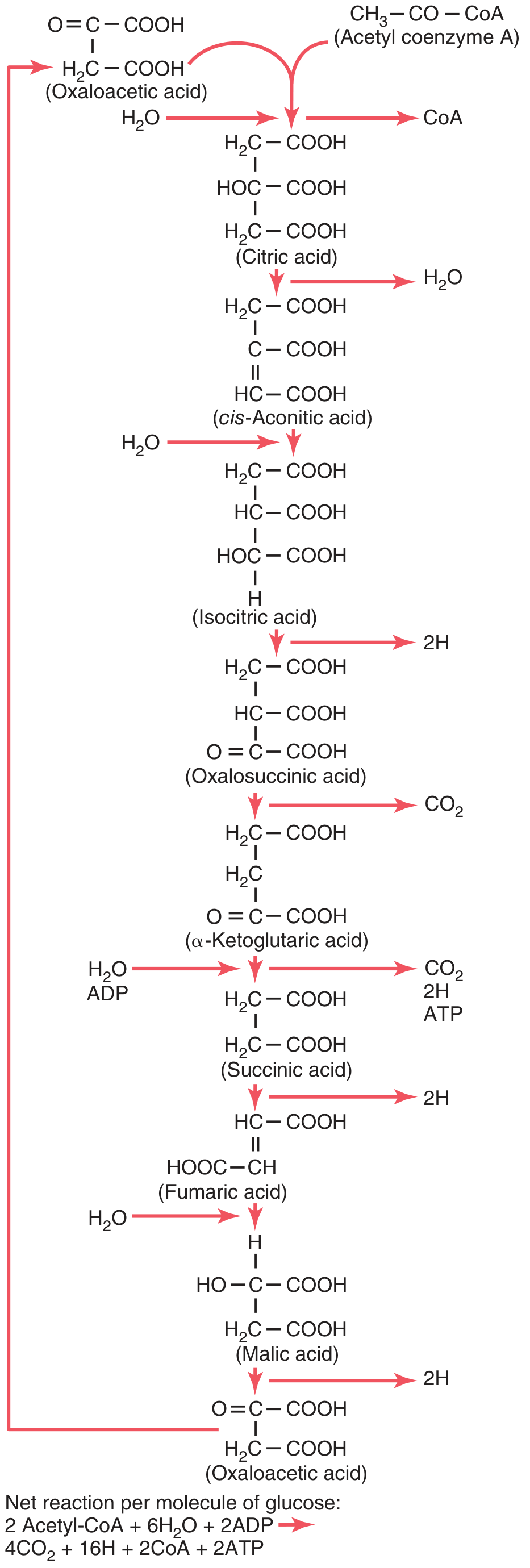
| Step | Substrate → Product | Enzyme | Products |
|---|---|---|---|
| 1 | Oxaloacetate + Acetyl-CoA → Citrate | Citrate synthase | CoA released |
| 2 | Citrate → Isocitrate | Aconitase | via cis-aconitate (2 steps) |
| 3 | Isocitrate → α-Ketoglutarate | Isocitrate dehydrogenase | NADH, CO₂ |
| 4 | α-Ketoglutarate → Succinyl-CoA | α-Ketoglutarate dehydrogenase | NADH, CO₂ |
| 5 | Succinyl-CoA → Succinate | Succinyl-CoA synthetase | GTP (= ATP) - substrate-level phosphorylation |
| 6 | Succinate → Fumarate | Succinate dehydrogenase | FADH₂ |
| 7 | Fumarate → Malate | Fumarase | H₂O added |
| 8 | Malate → Oxaloacetate | Malate dehydrogenase | NADH |
- 3 NADH
- 1 FADH₂
- 1 GTP/ATP (substrate-level)
- 2 CO₂ released
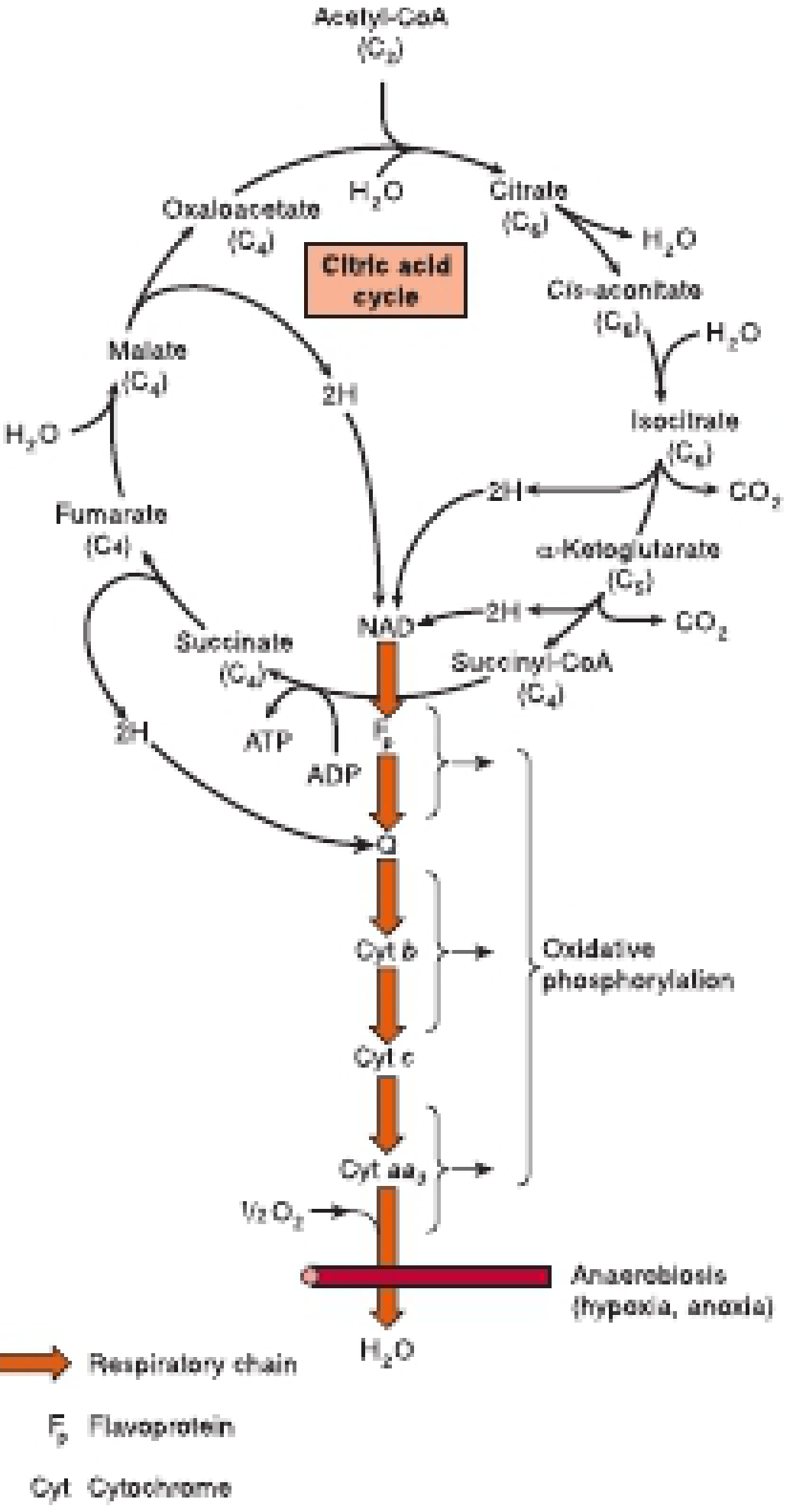
The ETC - Where the Real ATP Is Made
| Complex | Name | Accepts | Passes electrons to |
|---|---|---|---|
| I | NADH-Q oxidoreductase | NADH | Coenzyme Q (ubiquinone) |
| II | Succinate-Q dehydrogenase | FADH₂ (from succinate) | Coenzyme Q |
| III | Q-cytochrome c oxidoreductase | Coenzyme Q | Cytochrome c |
| IV | Cytochrome c oxidase | Cytochrome c | O₂ → H₂O |
| V | ATP synthase | Proton gradient (H⁺) | ADP + Pi → ATP |
FADH₂ enters at Complex II - it bypasses Complex I, so it yields fewer ATP than NADH.
ATP Yield Per Turn of the Krebs Cycle
| Source | ATP yield |
|---|---|
| 3 NADH × ~2.5 ATP | ~7.5 ATP |
| 1 FADH₂ × ~1.5 ATP | ~1.5 ATP |
| 1 GTP (substrate-level) | 1 ATP |
| Total per turn | ~10 ATP |
Key Points
- The ETC requires oxygen as the final electron acceptor (Complex IV). Without O₂, NADH/FADH₂ cannot be reoxidized, the Krebs cycle stalls, and only glycolysis continues (anaerobic).
- 4 B-vitamins are essential cofactors in the Krebs cycle: riboflavin (FAD), niacin (NAD⁺), thiamine (B1, for α-ketoglutarate dehydrogenase), and pantothenic acid (as CoA).
- The Krebs cycle is amphibolic - it functions in both catabolism AND anabolism (supplying intermediates for gluconeogenesis, amino acid synthesis, and fatty acid synthesis).
- The mechanism linking the ETC to ATP synthesis is the chemiosmotic mechanism - protons are pumped out across the inner mitochondrial membrane by Complexes I, III, and IV, creating a gradient that drives ATP synthase (Complex V).
Сахарный диабет — это эндокринное заболевание. При нём наблюдается хроническое повышение уровня сахара в крови. Это повышение прифодит вследствие абсолютного ими относительного дефицита инсулина - (гормона поджелудочной железь Сахарный диабет приводит к нарушению всех видов обмена веществ, поражетю сосудов, поражению нервной системы, а также других органов и систем. emst Существует несколько видов диабета. Каждый человек должен знать об инсулинозави-симом диабете (это сахарный диабет первого типа) и инсулинонезависимом диабете (это сахарный диабет второго типа). develop Сахарный диабет первого типа обычно развивается у детій и молодых людей. При этом диабете наблюдается абсолютный дефицит инсулина, вызванный нарушением работы под- аррежтся желудочной железы. Главный фактор, который вызывает возникновение диабета первого типа, — это вирусная инфекция (краснуха, ветряная оспа, гепатит и т.д.) на фоне генетиче-ской предрасположенности к этому заболеванию. Сахарный диабет второго типа обычно развивается у людей старшего возраста, которые меют ноб точорий, кет. Пре проопирут рабуютая относительный дефи ну- и наследственная предрасположенность. Симптомы сахарного диабета следующие: жажда, учащённое мочеиспускание днем и ночью, сухость во рту, повышенный аппетит, зуд коей s of weg 10 повышенная утомляемость, плохо заживающие раны, общая и мышечная слабость, резкое похудение у оольных с сахарным диабетом первого типа и ожирение у больных с сахарным диабетом второго типа. Это заболевание очень опасно, потому что оно имеет множество осложнений, например, — сердечно-сосудистые заболевания, атеросклероз периферических артерии. 3 of vilion снижение зрения (диабетическая ретинопатия), - комы. Earme coma. Для предупреждения развития осложнений сахарного диаоета неооходимо постоянное лечение и тщательный контроль уровня сахара в крови. Больные сахарным диабетом обяза- избежать или замедлить развитие осложнений. 2nd tema2nd tema Сердечно-сосудистые заболевания - это группа болезней сердца и кровеносных сосу- дов. Сюда входят: • ишемическая болезнь сердца — это болезнь кровеносных сосудов, которые снабжают кровью сердечную мышу, • болезнь сосудов головного мозга — это болезнь кровеносных сосудов, которые снабжают кровью мозг, • болезнь периферических артерий — это болезнь кровеносных сосудов, которые снабжают кровью руки и ноги, • ревмокардит — это поражение сердечной мышцы и сердечных клапанов, • врожденный порок сердца — это деформация строения сердца, которая существует с рождения, • тромбоз глубоких вен и эмболия лёгких — это образование в ножных венах сгустков кров, которые могут двигаться к сердцу и лёгким. Инфаркты и инсульты — это острые заболевания, которые обычно происходят в результате закупоривания сосудов. Закупоривание препятствует току крови к сердцу или к мозгу. Самая распространенная причина этого — образование жировых отложений на внутренних стенках кровеносных сосудов, которые снабжают кровью сердце или мозг. Факторы риска в развитии инфаркта миокарда и инсульта следующие: курение, нездоровое питание и ожирение, отсутствие физической активности, вредное употребление ал-коголя, повышенное кровяное давление, диабет. При инфаркте могут быть следующие симптомы: — боль и неприятные ощущения в середине грудной клетки, - боль и неприятные ощущения в руках, челюсти, спине, - затруднение дыхания - тошнота или рвота, - головокружение - холодный пот — бледность При инсульте наиболее распространенные симптомы следующие: — внезапная слабость в лице (обычно с одной стороны), руке или ноге, — онемение (парестезия) лица, руки или ноги, - спутанность сознания, - затрудненная речь или трудность в понимании речи, — затруднённое зрительное восприятие одним или двумя глазами, — затруднённая походка, — потеря координации, — головная боль, - головокружение.
What would you like me to do with this text?