
Sleep physiology mbbs 1st year
Reading File
Sleep is divided into NREM (stages 1-4, slow-wave) and REM (rapid eye movement) sleep, cycling roughly every 90 minutes. NREM is restorative with low metabolic activity, while REM involves vivid dreaming, muscle atonia, and brain activity similar to waking. Key regulators include adenosine, serotonin, norepinephrine, and melatonin. The hypothalamus (suprachiasmatic nucleus) controls circadian rhythm.
Searching sources...
Finding Sources
Finding Sources
Good - I have several excellent sources. Let me read the key sections in parallel.
Reading File
Reading File
Excellent content. Let me now read the REM/NREM physiology section and the neurotransmitter/regulation sections in parallel.
Reading File
Reading File
Excellent material. Let me now get the circadian rhythm / melatonin section and the sleep stage EEG table from Adams and Victor, plus fetch the sleep architecture image.
Reading File
Loading Image
Reading File
Loading Image
I now have comprehensive material from Harrison's and Adams & Victor. Let me compile a thorough MBBS 1st year-level answer.
Sleep Physiology - MBBS 1st Year
1. Introduction
Sleep is a naturally recurring, reversible state of reduced consciousness and reduced responsiveness to external stimuli. It is NOT a passive state - the brain remains highly active during sleep, just differently organized. Sleep is a basic circadian rhythm seen in all mammalian, avian, and reptilian species.
Most healthy adults require 7-9 hours per night. Sleep duration varies with age:
- Newborn: 16-20 h/day
- Child: 10-12 h/day
- Adolescent: 9-10 h/day
- Young adult: ~7-7.5 h/day
- Elderly (>70 yrs): ~6 h/day
2. How Sleep is Recorded - Polysomnography (PSG)
Sleep stages are defined by recording three parameters simultaneously:
| Parameter | What it measures |
|---|---|
| EEG (Electroencephalogram) | Brain electrical activity |
| EOG (Electrooculogram) | Eye movements |
| EMG (Electromyogram) | Muscle tone (chin + legs) |
This combined recording is called polysomnography (PSG).
3. Stages of Sleep (AASM Classification)
Sleep has two major types: NREM and REM.
NREM Sleep (Non-Rapid Eye Movement)
Divided into 3 stages (N1, N2, N3):
| Stage | Old name | EEG Pattern | Features |
|---|---|---|---|
| W (Wake) | - | Posterior alpha waves (9-11 Hz) + low-voltage fast activity | Alert, eyes open |
| N1 | Stage 1 | Diffuse theta waves; loss of alpha | Drowsy; slow roving eye movements; light sleep; easily aroused |
| N2 | Stage 2 | Sleep spindles (12-14 Hz, 0.5-2 sec bursts) + K complexes (high-amplitude sharp slow waves, central-parietal) | Light sleep; majority of total sleep |
| N3 | Stages 3 & 4 (Slow Wave Sleep) | High-voltage delta waves (0.5-2 Hz, >75 µV) | Deep sleep; hardest to arouse; sleepwalking/night terrors occur here |
REM Sleep (Rapid Eye Movement)
- EEG: Low amplitude, mixed frequency (similar to N1 / wakefulness - hence called "paradoxical sleep")
- EOG: Rapid conjugate eye movements in bursts
- EMG: Near-complete muscle atonia (active inhibition of motor neurons - protects us from acting out dreams)
- Dreaming is most vivid and consistently recalled in REM
- Brain metabolic activity approaches waking levels
Adams & Victor's Neurology: "Subjects are easily aroused from REM sleep but arousing a person during stage N3 is more difficult; full arousal may take minutes or more, during which time the subject may be slightly disoriented and confused."
4. Architecture of a Normal Night's Sleep (Hypnogram)
- Sleep onset → progresses through N1 → N2 → N3 within 45-60 min
- First REM episode occurs about 90 min after sleep onset
- NREM and REM then alternate in cycles of 60-160 min (the "ultradian cycle")
- N3 (slow-wave sleep) predominates in the first third of the night
- REM episodes get longer toward the end of the night (second half is REM-rich)
- Setting an alarm clock causes selective REM deprivation (as REM is most prominent late in sleep)
Proportions in a healthy young adult:
- N1 + N2 = 50-60%
- N3 (slow wave) = 15-25%
- REM = 20-25%
- REM in infancy = up to 50% (important for brain development)
5. Neural Control of Sleep-Wake Cycles
The Flip-Flop Switch Model
Two opposing systems keep each other in check - like an electrical flip-flop switch - ensuring rapid, stable transitions between waking and sleeping:
Ascending Arousal System (keeps us awake):
- Neurons extend from upper pons → hypothalamus → basal forebrain
- Neurotransmitters used: Norepinephrine, Dopamine, Serotonin, Histamine, Glutamate, Acetylcholine
- Orexin (Hypocretin) neurons in the lateral hypothalamus reinforce and stabilize arousal (loss of orexin neurons → Narcolepsy)
- Some basal forebrain neurons use GABA to inhibit cortical inhibitory interneurons (thereby promoting arousal)
Sleep-Promoting System (turns off wakefulness):
- Ventrolateral Preoptic Nucleus (VLPO) in the hypothalamus - key sleep-promoting site
- Preoptic area and pons neurons use GABA to inhibit the arousal system
- Lateral hypothalamic neurons containing Melanin-Concentrating Hormone (MCH) promote REM sleep
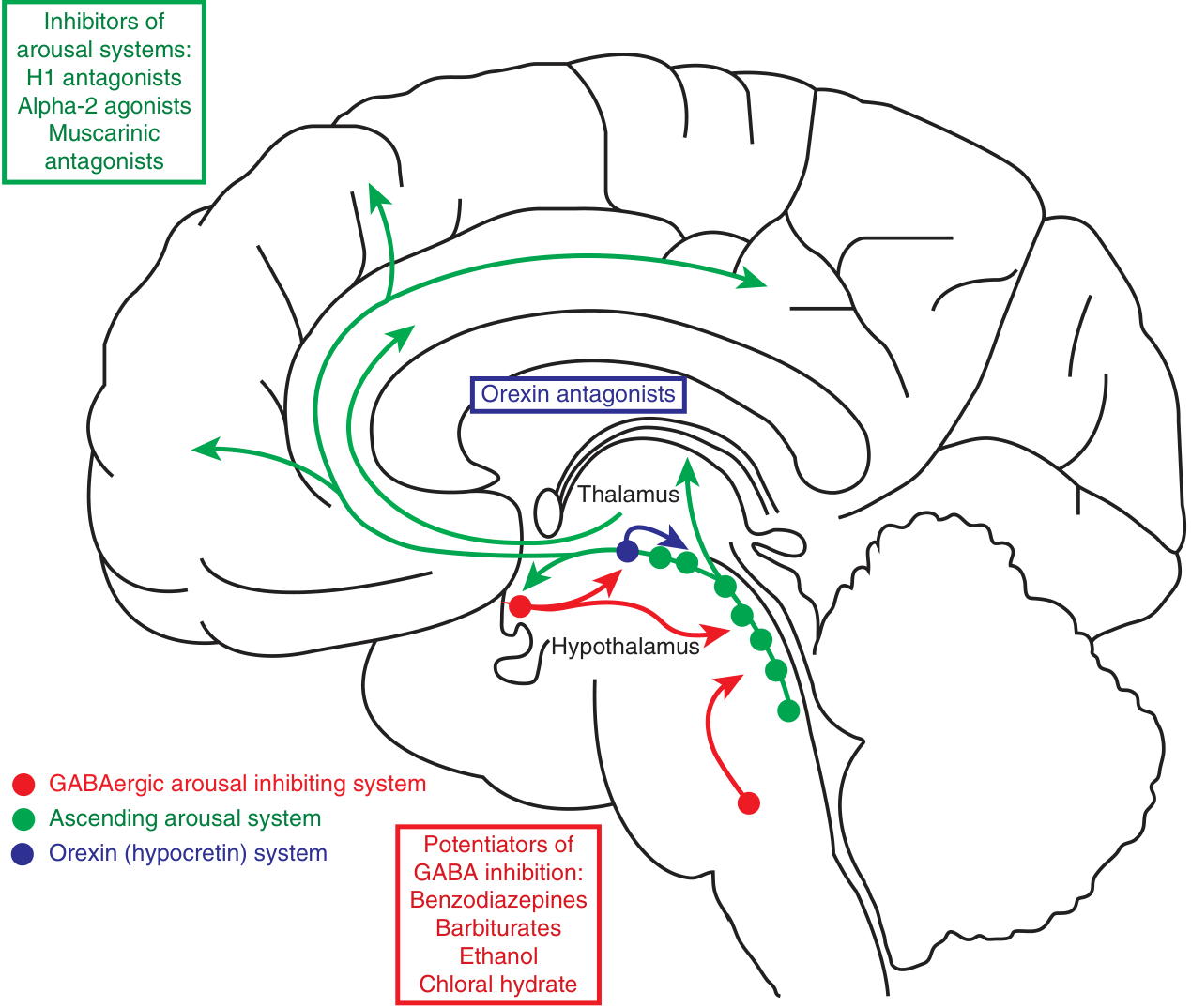
Fig. 33-2 from Harrison's Principles of Internal Medicine: The arousal (green), orexin (blue), and sleep-promoting GABAergic (red) systems
REM Sleep Switch (in brainstem)
- REM-On neurons (upper pons): Use GABA + glutamate; glutamatergic projections cause REM phenomena
- Projections to medulla/spinal cord → activate inhibitory interneurons (GABA + glycine) → hyperpolarize motor neurons → muscle atonia of REM
- Projections to forebrain → produce dreams
- REM-Off neurons (lower midbrain): GABAergic; inhibit REM-On neurons
- Cholinergic input favors REM; norepinephrine + serotonin prevent REM
- (That's why SNRIs and TCAs suppress REM sleep)
6. Homeostatic, Allostatic, and Circadian Regulation
(A) Homeostatic Drive ("Process S")
- The longer you stay awake, the stronger the drive to sleep
- Key mediator: Adenosine - accumulates in the brain during wakefulness
- Acts on A1 receptors → directly inhibits arousal-promoting neurons
- Acts on A2a receptors → activates VLPO sleep-promoting neurons
- Caffeine works by blocking adenosine receptors (A1 and A2a) → blocks sleepiness
- Prostaglandin D2 also accumulates and activates VLPO neurons
- Sleep deprivation → increased N3 (slow-wave) intensity on recovery ("rebound sleep")
(B) Allostatic Drive
- Stress, anxiety, and psychological threats activate the arousal system → insomnia
- Chronic insomnia shows hyperactivation of the ascending arousal system on PET scan
(C) Circadian Rhythm ("Process C")
- Controlled by the Suprachiasmatic Nucleus (SCN) of the anterior hypothalamus
- Intrinsic rhythm of ~25 hours, entrained to 24 hours by light (the most powerful zeitgeber/"time giver")
- SCN → outputs to hypothalamus → impose 24-h rhythms on sleep, temperature, feeding, activity
- Melatonin (from pineal gland) modulates this cyclic activity - rises in darkness, promotes sleep onset
- Destruction of SCN → complete disorganization of sleep-wake cycles
7. Physiological Changes During Sleep
| Parameter | NREM Sleep | REM Sleep |
|---|---|---|
| EEG | Synchronized (slow waves) | Desynchronized (fast, mixed) |
| Eye movements | Slow, roving (N1); absent (N2, N3) | Rapid, conjugate, all directions |
| Muscle tone | Slightly reduced | Near-complete atonia (except diaphragm) |
| Heart rate | Decreased, regular | Irregular, variable (phasic) |
| Blood pressure | Decreased | Fluctuates (phasic) |
| Respiration | Regular, slightly reduced rate | Irregular |
| Temperature | Maintained | Thermoregulation impaired |
| Dreaming | Occurs but less vivid | Vivid, complex, narrative dreams |
| Erection/clitoral tumescence | Absent | Present (useful in diagnosing erectile dysfunction - if present in REM → psychogenic cause) |
| Growth hormone secretion | Peak in N3 (slow-wave sleep) | Minimal |
Key clinical point: REM sleep atonia is mediated by GABA and glycine inhibiting motor neurons. REM Sleep Behavior Disorder (RBD) occurs when this paralysis fails - patients physically act out their dreams and may injure themselves or their bed partner.
8. Effects of Age on Sleep
| Age | Features |
|---|---|
| Neonates | 16-20 h/day; 50% REM (brain development) |
| Children | 10-12 h; consolidation into single night period by age 4-5 |
| Young adults | 7-7.5 h; 20-25% REM; prominent N3 |
| Elderly | ~6 h; N3 may be absent; fragmented sleep; frequent awakenings (VLPO neuron loss); more time awake |
9. Functions of Sleep (Why Do We Sleep?)
- N3 / Slow-wave sleep: Physical restoration, growth hormone secretion, immune function
- REM sleep: Memory consolidation, emotional processing, brain maturation (especially in infancy)
- Overall sleep: Metabolic regulation (glucose, insulin), immune response, cardiovascular health, cognitive function
Consequences of Sleep Deprivation
- Impaired cognition, reaction time, vigilance
- Glucose intolerance → risk of diabetes, metabolic syndrome
- Obesity, immune suppression, atherosclerosis
- Increased risk of cardiovascular disease, Alzheimer's disease, stroke
10. Quick Memory Tricks for Exams
- "BASK in sleep": Brain waves slow down in NREM (B-N1, A-N2 spindles, S-N3 slow wave, K-K complex)
- "REM = Rapid + Relaxed muscles + Real dreams"
- Adenosine = sleep pressure; Caffeine = adenosine blocker = wakefulness
- VLPO = sleep ON; SCN = body clock; Orexin = wake stabilizer
- First 1/3 of night = N3 dominant; Last 1/3 = REM dominant
- Sleep spindles + K complexes = N2 (the most common stage of sleep)
Sources: Harrison's Principles of Internal Medicine 22E (2025), p. 253-254 | Adams and Victor's Principles of Neurology, 12th Ed., p. 411
This is a shared conversation. Sign in to Orris to start your own chat.