
Addiomiq crisis
Reading File
An Addisonian crisis (acute adrenal insufficiency) is a life-threatening emergency caused by a sudden, severe drop in cortisol (and often aldosterone). It requires immediate treatment.
Searching sources...
Finding Sources
Searching PubMed
"adrenal crisis" AND management
Reading File
Finding Sources
Reading File
Reading File
Loading Image
Reading File
Here is a comprehensive overview of Addisonian Crisis (Acute Adrenal Insufficiency):
Addisonian Crisis (Acute Adrenal Insufficiency)
Definition
An Addisonian crisis is a life-threatening medical emergency caused by critically insufficient cortisol levels. It typically occurs in patients with pre-existing adrenal insufficiency who are exposed to an acute physiological stressor, or from sudden, complete destruction of adrenal function. - Tintinalli's Emergency Medicine, p. 230; Sabiston Textbook of Surgery
Causes & Precipitants
-
Underlying primary adrenal insufficiency (Addison's disease) unmasked by stress
-
Secondary/tertiary adrenal insufficiency (pituitary/hypothalamic disease)
-
Waterhouse-Friderichsen syndrome - bilateral adrenal hemorrhage from severe sepsis (classically meningococcal)
-
Sudden cessation of chronic glucocorticoid therapy
-
Acute stressors in patients with marginal adrenal reserve:
- Infection (most common; especially GI infections)
- Surgery or trauma
- Extreme physical activity
- Acute burns
-
Hypercoagulable states causing adrenal infarction
-
Bailey and Love's Surgery 28e; Tintinalli's Emergency Medicine
Clinical Features
Symptoms are non-specific, making diagnosis challenging. Classic features include:
| Feature | Details |
|---|---|
| Hypotension | Severe, refractory to vasopressors - hallmark sign |
| Abdominal pain | Severe; mimics acute abdomen (commonly misdiagnosed as surgical emergency) |
| GI symptoms | Nausea, vomiting, diarrhea |
| Fever | Common; may suggest underlying infection as precipitant |
| CNS changes | Confusion, disorientation, lethargy, coma |
| Hypoglycemia | Due to cortisol deficiency |
| Electrolyte disturbance | Hyponatremia + hyperkalemia (primary); variable in secondary |
Primary vs. Secondary: Key Differences
| Feature | Primary (Addison's) | Secondary (Pituitary) |
|---|---|---|
| Volume depletion | Marked | Less severe |
| Serum K+ | Hyperkalemia | Hypokalemia |
| Skin pigmentation | Present (high ACTH) | Absent |
| Aldosterone | Deficient | Present |
| ACTH | High | Low/normal |
- Tintinalli's Emergency Medicine, Table 230-3
Diagnosis
Do not delay treatment while awaiting results.
Initial labs:
- Serum cortisol, plasma ACTH
- Electrolytes (Na+, K+, Ca2+), glucose, CBC
- Plasma renin, aldosterone
- ECG (potassium-related changes)
Key thresholds:
- Morning serum cortisol >18 mcg/dL - effectively rules out adrenal insufficiency
- Morning serum cortisol <15 mcg/dL (or salivary <5.8 ng/mL) - adrenal insufficiency possible
Confirmatory test - ACTH Stimulation (Synacthen/Cosyntropin Test):
- Give 250 mcg cosyntropin IV
- Measure cortisol at baseline and 30-60 min post
- Post-cortisol <18 mcg/dL = strongly suggestive of adrenal insufficiency
- Note: If steroids must be given urgently before the test, use dexamethasone (no cross-reactivity with cortisol assays)
Algorithm:
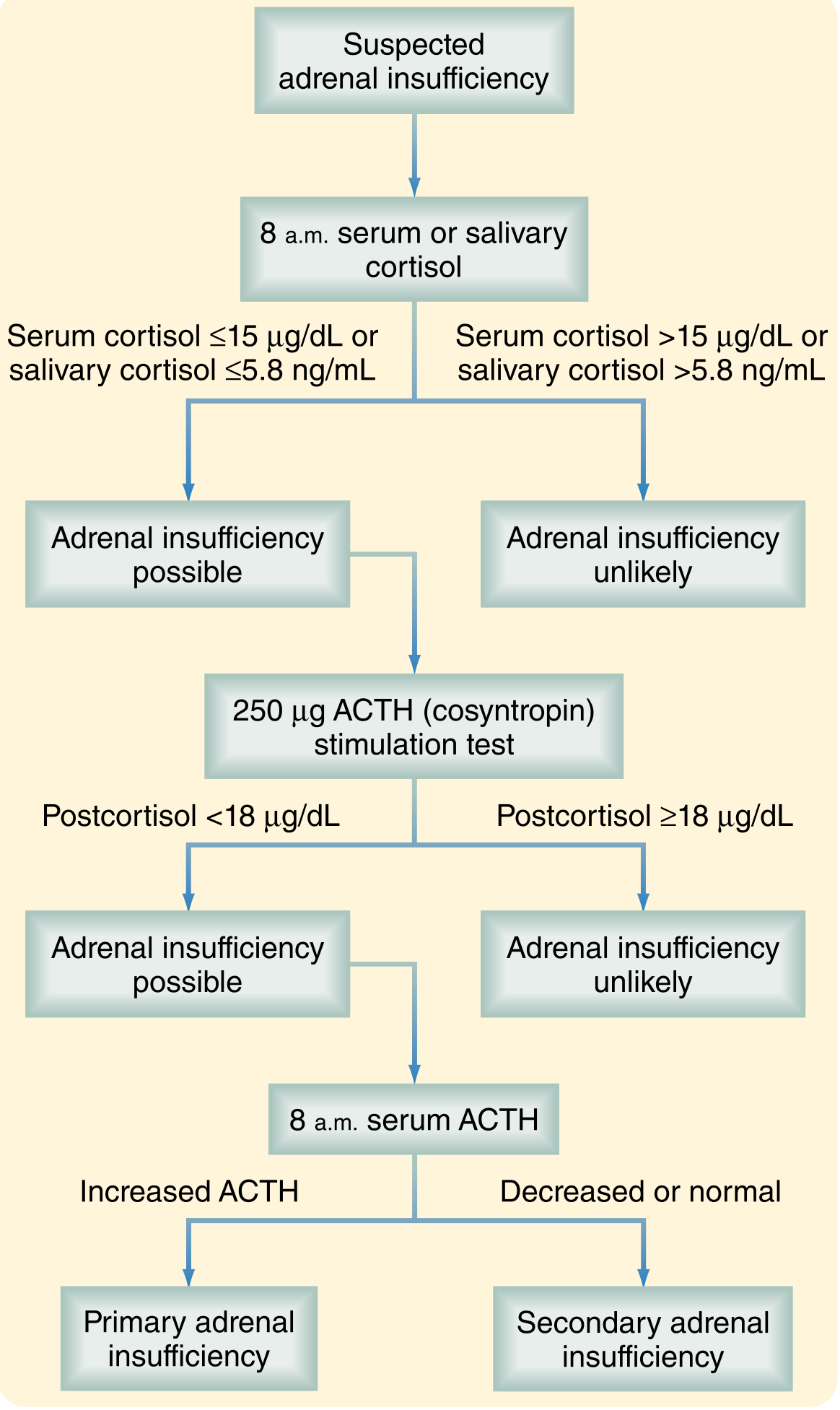
- Sabiston Textbook of Surgery, Fig. 75.7
Treatment (Emergency Protocol)
Treatment must start IMMEDIATELY - do not wait for lab results. - Bailey and Love's Surgery 28e
1. IV Fluids
- Normal saline (0.9%): 2-3 L in the first 6 hours
- Use D5/NS (dextrose-saline) if hypoglycemic
2. Steroids (Drug of Choice: Hydrocortisone)
- Hydrocortisone 100 mg IV bolus (first-line - provides both glucocorticoid AND mineralocorticoid effects)
- Followed by 50 mg IV q6h (or 200 mg/24h infusion)
- If no IV access: 100 mg IM
- Alternative: Dexamethasone 4 mg IV (preferred if ACTH stimulation test is planned - no cortisol cross-reactivity); must add fludrocortisone 100 mcg/day as dexamethasone has no mineralocorticoid activity
3. Supportive Care
- Airway, breathing, circulation
- Correct electrolytes (Na+, K+, Ca2+)
- Treat underlying precipitant (antibiotics for infection)
4. Vasopressors (if needed)
- Only after steroid therapy, in patients unresponsive to fluids
- Norepinephrine, dopamine, or phenylephrine
5. Mineralocorticoid Replacement (NOT urgent initially)
-
Fludrocortisone effects take days to manifest; saline infusion covers early needs
-
Begin once patient is stabilized and tolerating oral medications
-
Tintinalli's Emergency Medicine, Table 230-4; Bailey and Love's Surgery 28e; Sabiston Textbook of Surgery
Prevention / Patient Education
Patients with known chronic adrenal insufficiency must:
-
Take lifelong glucocorticoid replacement (hydrocortisone 15-25 mg/day PO in 2-3 divided doses)
-
Double the dose during illness or stress ("sick day rules")
-
Take fludrocortisone 0.05-0.2 mg each morning (for primary insufficiency)
-
Carry a steroid emergency card and injectable hydrocortisone for self-injection
-
Bailey and Love's Surgery 28e
Recent Evidence Note
A 2025 systematic review and meta-analysis (PMID: 40966723) confirmed increased all-cause mortality in primary adrenal insufficiency, underscoring the importance of early recognition and aggressive treatment of adrenal crisis.
This is a shared conversation. Sign in to Orris to start your own chat.