
Calots triangle
The medical-library skill must be invoked first for this anatomy/surgical topic.
Searching sources...
Reading File
Now searching the library for Calot's triangle content in parallel:
Finding Sources
Finding Sources
Searching the Web
Calot's triangle anatomy boundaries contents surgical significance cholecystectomy
Excellent results. Now reading the most detailed textbook sections in parallel:
Reading File
Reading File
Reading File
Now fetching the key images and reading the Fischer's/Schwartz's content about contents and surgical steps in parallel:
Loading Image
Loading Image
Reading File
Reading File
Excellent - I now have comprehensive data. Let me fetch the critical view of safety image and the Maingot's anatomy section:
Loading Image
Reading File
I now have all the content needed for a thorough, well-illustrated answer.
Calot's Triangle (Hepatocystic Triangle)
Historical Description vs. Modern Definition
Calot's original description (1891): Jean-Francois Calot described a triangle bounded by:
- Inferior border - cystic duct
- Medial border - common hepatic duct
- Superior border - cystic artery
Modern definition (hepatocystic triangle): The contemporary working definition is larger and more surgically relevant:
- Inferior border - cystic duct (and medial border of gallbladder)
- Medial border - common hepatic duct
- Superior border - undersurface (visceral surface) of the liver
This modern definition is now the standard used in surgical practice. The original "superior border = cystic artery" definition has been largely abandoned because the cystic artery is a content of the triangle, not its border.
(Bailey and Love's Short Practice of Surgery, 28th ed. | Mulholland and Greenfield's Surgery, 7e)
Borders at a Glance
| Border | Structure |
|---|---|
| Inferior | Cystic duct |
| Medial | Common hepatic duct |
| Superior | Visceral (inferior) surface of the liver |
Contents
The triangle contains several important structures (Fischer's Mastery of Surgery, 8th ed.):
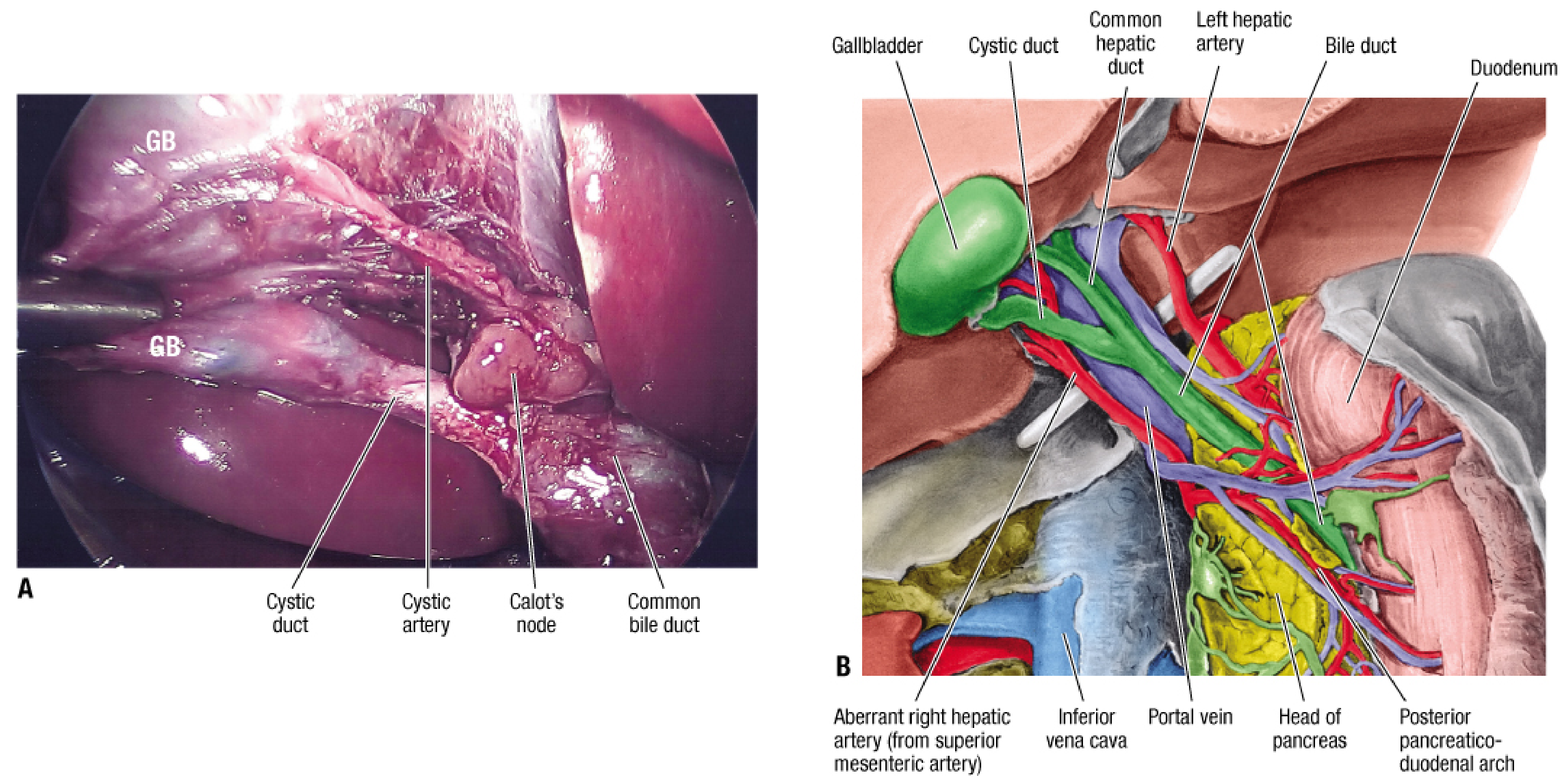
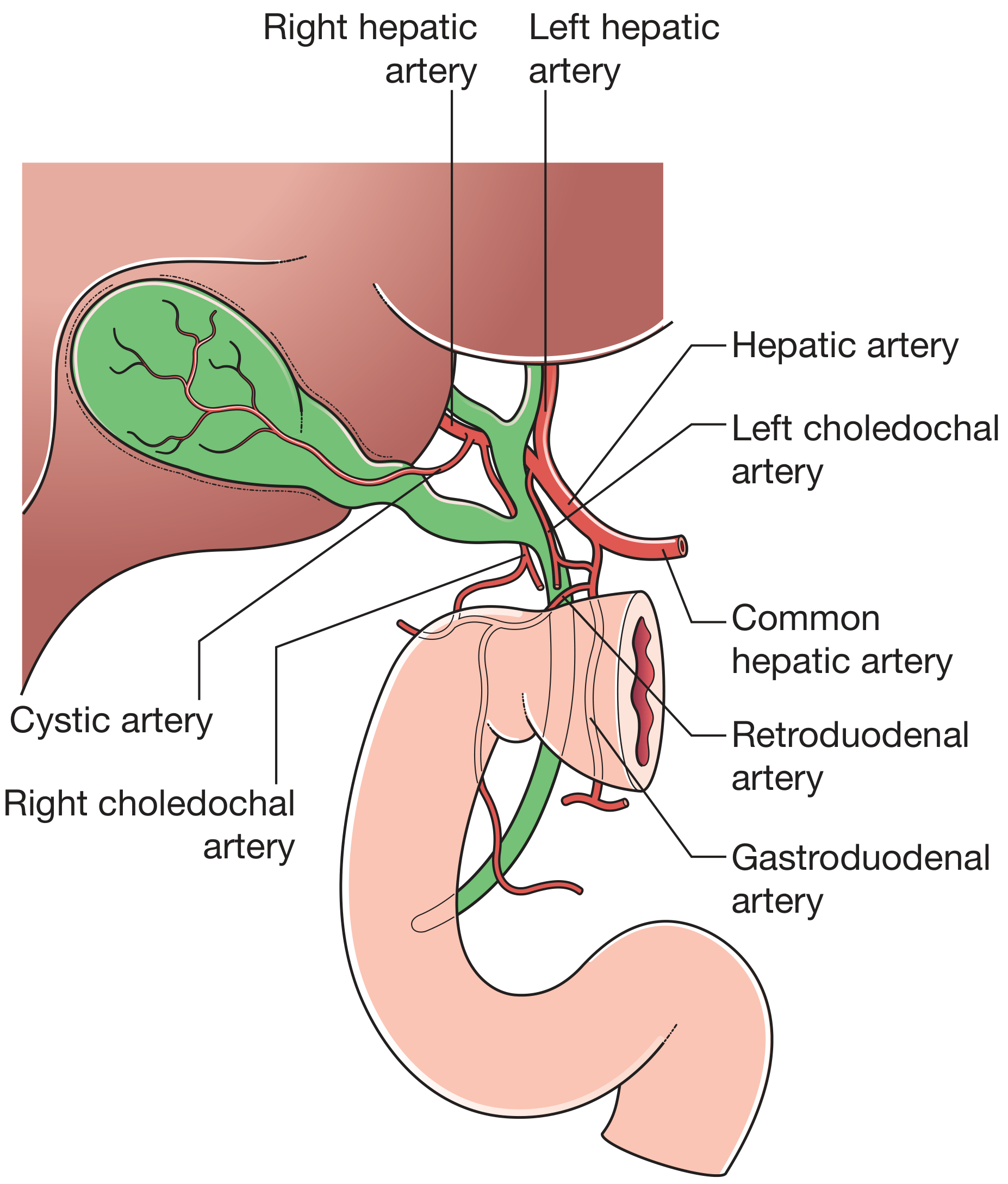
- Cystic artery - the principal content; a branch of the right hepatic artery in most cases; may be double or anomalous
- Right hepatic artery (in the superior part of the triangle, usually posterior to the duct) - can be mistaken for the cystic artery because its course briefly parallels it
- Cystic lymph node (Node of Calot / Lund's node) - lies superficial to the cystic artery; acts as a key surgical landmark to locate the artery
- Anomalous bile ducts - aberrant right hepatic ducts may traverse the triangle
- Small cystic veins and lymphatics
"It contains the right hepatic duct and right hepatic artery (usually posterior to the duct) in the superior part of the triangle, the cystic artery more inferiorly and the node of Calot. Anomalous vessels and bile ducts are common." - Fischer's Mastery of Surgery, 8th ed.
Key Anatomical Images
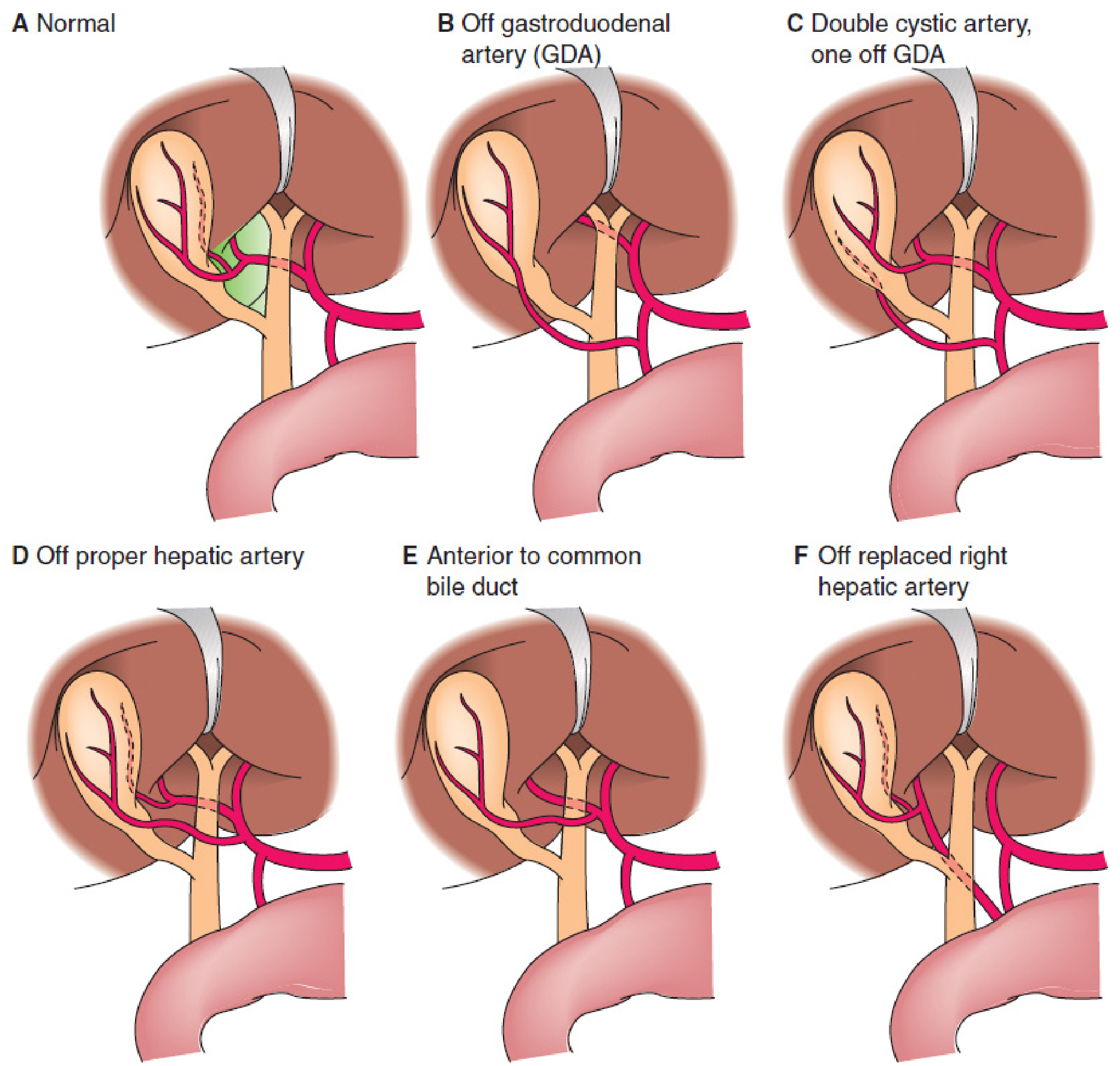
Variations of the cystic artery (Panel A = normal, with hepatocystic triangle marked in green):
Laparoscopic critical view of Calot's triangle (left panel) and the extrahepatic biliary tract anatomy (right panel):
Gallbladder anatomy and arterial supply showing cystic artery origin and related vessels:
Surgical Significance
Why it matters
Calot's triangle is the key surgical zone during cholecystectomy (open or laparoscopic). All critical structures to be identified, ligated, and divided pass through or border this space. Misidentification of structures within the triangle is the most common cause of iatrogenic bile duct injury.
Critical View of Safety (CVS)
The modern standard to prevent bile duct injury during laparoscopic cholecystectomy:
- The hepatocystic triangle must be cleared of all fibrofatty and soft areolar tissue
- Only two structures should be seen entering the gallbladder - the cystic duct and cystic artery
- At least the medial third of the cystic plate must be exposed
(Bailey and Love's, 28th ed. | Yamada's Textbook of Gastroenterology, 7th ed.)
Operative steps in the triangle
- Retraction - Fundus retracted toward patient's right shoulder; infundibulum retracted inferolaterally. This opens the hepatocystic triangle and increases the angle between the cystic duct and CBD
- Peritoneal incision - Peritoneum overlying the triangle is placed on stretch, then divided close to the gallbladder wall
- Dissection - Fat is carefully cleared to expose the cystic artery and cystic duct
- Cystic duct skeletonization - Cleaned to confirm its origin from the gallbladder
- Ligation - Cystic artery tied and divided; the entire triangle is displayed to confirm biliary anatomy before dividing the cystic duct
Anatomical Variations - Why Vigilance is Critical
The Maingot's Abdominal Operations text cautions: "The classic anatomy of the biliary tree is present in only 30% of individuals, so it may be said that anomalies are the rule, not the exception."
Key variations to know:
| Structure | Common Variation |
|---|---|
| Cystic artery | May arise from left hepatic, common hepatic, gastroduodenal, or superior mesenteric arteries |
| Cystic artery | May be double (one off GDA); may cross anterior to the common bile duct |
| Right hepatic artery | May loop onto the gallbladder surface ("caterpillar hump"), creating a very short cystic artery; can be mistaken for the cystic artery |
| Aberrant right hepatic duct | Most common anomaly causing problems - especially dangerous when it joins the cystic duct |
| Cystic duct | May insert into right hepatic duct; may spiral anterior or posterior to CBD |
In 15% of cases, the right hepatic artery and/or cystic artery cross in front of the common hepatic duct and cystic duct (Bailey and Love's, 28th ed.).
Rouviere's Sulcus - Orientation Landmark
A practical intraoperative landmark: Rouviere's sulcus runs on the undersurface of the right hepatic lobe to the right of the hepatic hilum. The cystic duct and cystic artery lie ventral (anterosuperior) to the R4U line (Rouviere's sulcus to segment IV to umbilical fissure), while the CBD lies below this line. Maintaining dissection ventral to this line minimizes CBD injury risk.
Summary: Calot's triangle - now properly called the hepatocystic triangle - is bounded by the cystic duct, common hepatic duct, and liver undersurface. It contains the cystic artery, right hepatic artery, and Calot's node. Achieving the Critical View of Safety by fully clearing this triangle is the single most important step in preventing bile duct injury during cholecystectomy.
This is a shared conversation. Sign in to Orris to start your own chat.