
Classification of breast disease
Reading File
Reading File
Reading File
Finding Sources
Finding Sources
Finding Sources
Searching PubMed
"Breast Diseases"[MeSH Terms]
Searching the Web
WHO Classification breast tumours fifth edition benign breast disease classification
Reading File
Reading File
Reading File
Finding Sources
Classification of breast diseases
1. Developmental and physiological disorders
- Congenital anomalies: amastia, athelia, polymastia, polythelia
- Pubertal disorders: premature thelarche, virginal hypertrophy
- Lactational changes
- Involutional changes
- Gynecomastia in males
2. Inflammatory and infective disorders
- Acute lactational mastitis
- Breast abscess
- Periductal mastitis / duct ectasia
- Granulomatous mastitis
- Tuberculous mastitis
- Fat necrosis
- Inflammatory carcinoma, an important malignant mimic of mastitis
3. Benign breast disease
A. Nonproliferative breast changes
Often called fibrocystic changes, with no material increase in carcinoma risk:
- Cysts, including apocrine cysts
- Fibrosis
- Adenosis
- Apocrine metaplasia
- Mild usual ductal hyperplasia
B. Proliferative breast disease without atypia
Slightly increased future carcinoma risk:
- Usual ductal hyperplasia
- Sclerosing adenosis
- Intraductal papilloma
- Radial scar / complex sclerosing lesion
- Fibroadenoma, commonly considered separately as a benign fibroepithelial tumour
C. Proliferative breast disease with atypia
High-risk precursor lesions:
- Atypical ductal hyperplasia (ADH)
- Atypical lobular hyperplasia (ALH)
Robbins classifies benign epithelial lesions into nonproliferative change, proliferative disease without atypia, and proliferative disease with atypia according to subsequent breast-cancer risk. Robbins, Cotran & Kumar Pathologic Basis of Disease, p. 947.
4. Benign tumours
Epithelial
- Intraductal papilloma
- Adenoma of nipple
Fibroepithelial / stromal
- Fibroadenoma
- Phyllodes tumour: benign, borderline, or malignant
Other mesenchymal lesions
- Lipoma
- Hamartoma
- Hemangioma
- Pseudoangiomatous stromal hyperplasia
5. Carcinoma in situ
- Ductal carcinoma in situ (DCIS)
- Lobular carcinoma in situ (LCIS)
These are noninvasive epithelial neoplasms, but are major markers or precursors of invasive breast carcinoma. Robbins, Cotran & Kumar Pathologic Basis of Disease, pp. 951-953.
6. Invasive malignant tumours
A. Epithelial carcinomas
- Invasive breast carcinoma of no special type (IBC-NST), previously invasive ductal carcinoma, NOS
- Invasive lobular carcinoma
- Special histological types:
- Tubular
- Mucinous
- Papillary
- Cribriform
- Metaplastic carcinoma
- Neuroendocrine neoplasms
- Carcinoma with medullary pattern
B. Other malignant neoplasms
- Malignant phyllodes tumour
- Primary breast sarcoma
- Primary breast lymphoma
- Metastatic tumours to the breast
7. Paget disease of the nipple
- Intraepidermal spread of malignant ductal cells in the nipple-areola complex
- Usually associated with underlying DCIS or invasive carcinoma.
Practical clinical classification
Breast disease may also be grouped by presentation:
- Breast pain (mastalgia)
- Lump or mass
- Nipple discharge
- Inflammation
- Diffuse nodularity
- Screening-detected abnormality
Most breast lesions are benign, but a discrete mass, spontaneous unilateral bloody nipple discharge, or inflammatory change requires assessment to exclude cancer. Robbins & Kumar Basic Pathology, p. 705.
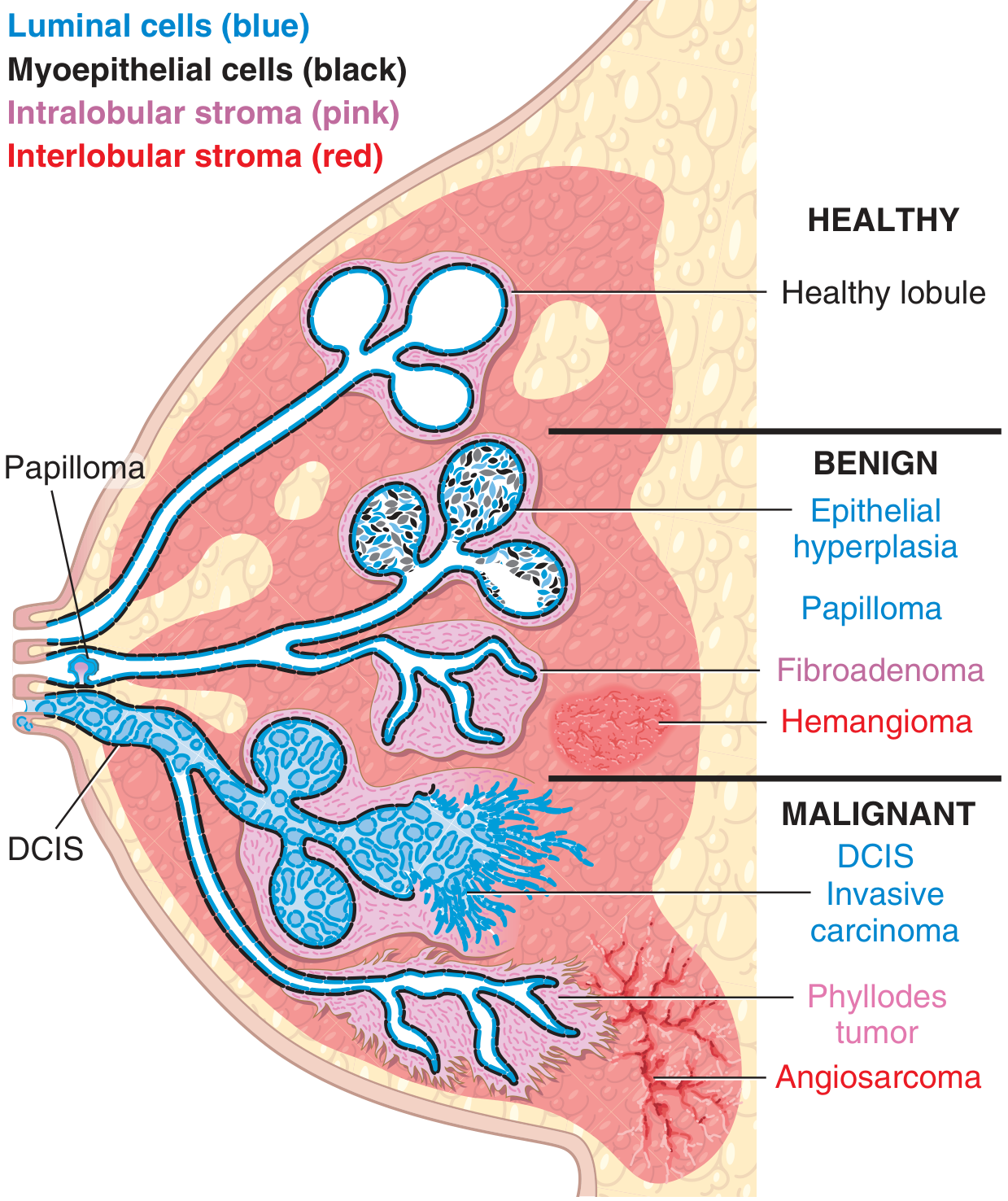
The current international tumour framework is the WHO breast-tumour classification, 5th edition.
This is a shared conversation. Sign in to Orris to start your own chat.