
Torsades de pointes
Reading File
Torsades de pointes (TdP) is a specific form of polymorphic ventricular tachycardia associated with a prolonged QT interval on ECG. The name is French for "twisting of the points," describing the characteristic twisting of QRS complexes around the isoelectric baseline.
Searching sources...
Finding Sources
Finding Sources
Searching PubMed
"torsades de pointes" AND "long QT"
Reading File
Reading File
Reading File
Reading File
Finding Sources
Loading Image
Reading File
Finding Sources
Reading File
Finding Sources
Finding Sources
Reading File
Now I have comprehensive information to provide a detailed answer. Let me also fetch the TdP ECG image.
Loading Image
Here is a comprehensive review of Torsades de Pointes.
Torsades de Pointes (TdP)
Definition and ECG Features
Torsades de pointes ("twisting of the points" in French) is a paroxysmal form of polymorphic ventricular tachycardia that occurs in the setting of a prolonged QT interval. It has three defining ECG criteria:
- Ventricular rate >200 beats/min
- Undulating QRS axis - the polarity of complexes appears to shift or "twist" around the isoelectric baseline
- Paroxysms lasting <90 seconds (self-terminating in most cases)
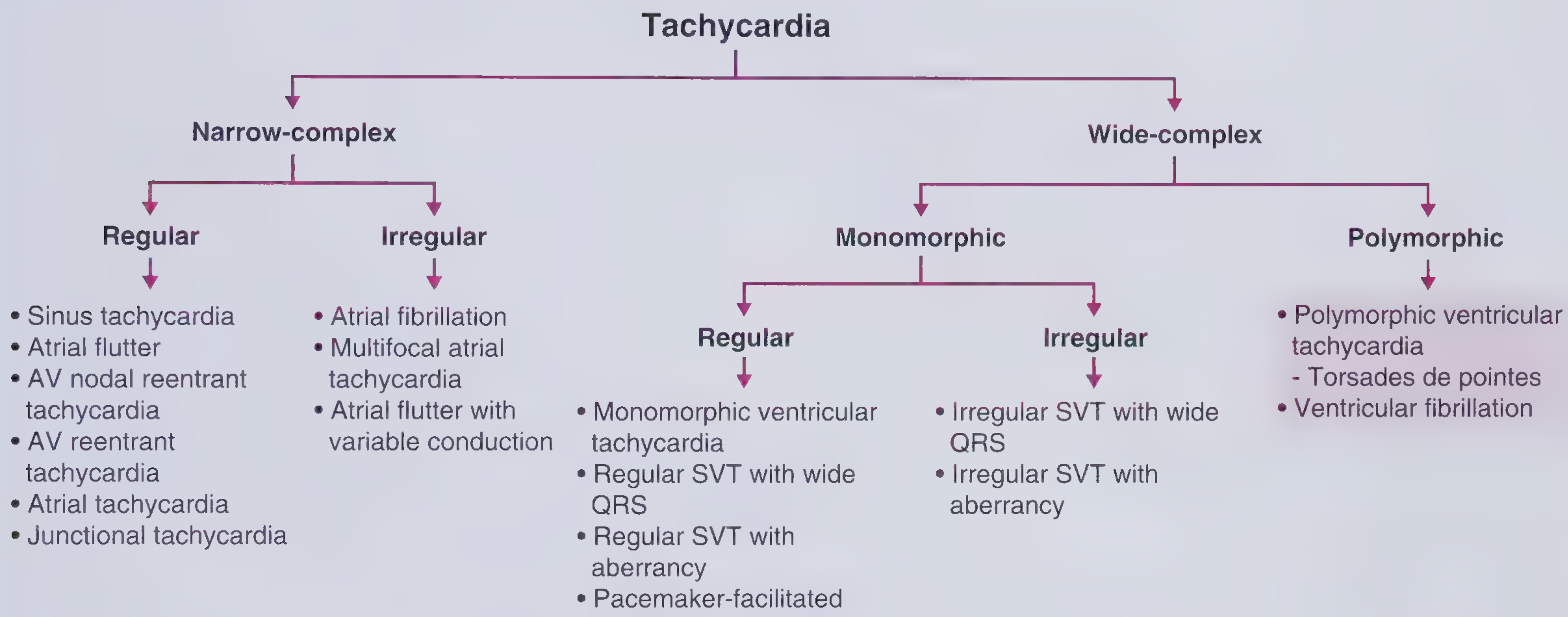
TdP fits within the tachycardia classification as a wide-complex, polymorphic tachycardia:
Pathophysiology
The underlying mechanism involves abnormal ventricular repolarization. Prolonged action potential duration leads to a reduced repolarization reserve, which predisposes cardiac cells - especially Purkinje fibers - to early afterdepolarizations (EADs). These EADs serve as the triggered activity that initiates and maintains the arrhythmia.
Key electrophysiological point: action potential prolongation is least marked at fast rates (where it is desirable) and most marked at slow rates - hence why TdP is characteristically pause-dependent in its acquired form. A long-short RR sequence (a sinus beat followed by a long pause, then a short coupling interval) is the typical trigger.
Hypokalemia worsens this through a separate mechanism: hypokalemia downregulates Na+/K+-ATPase, leading to intracellular Na+ and Ca2+ overload, which increases calmodulin kinase II activity and activates late Na+ and Ca2+ currents - further reducing repolarization reserve. - Brenner and Rector's The Kidney
Classification
Congenital (Inherited) Long QT Syndrome
- Mutations affecting ion channel proteins (most commonly KCNQ1, KCNH2, SCN5A)
- Prevalence estimated at ~1/988-1/2500
- Can be triggered by exercise, startle, or emotional stress depending on genotype
- ~25% of patients continue experiencing arrhythmias on full-dose beta-blocker therapy
Acquired Long QT / TdP
More common than the congenital form. The acquired form is pause-dependent and triggered by slow heart rate. Causes include:
Electrolyte disturbances:
- Hypokalemia (most common)
- Hypomagnesemia
Drugs (the leading cause - see below)
Other causes:
- Hypothermia
- CNS injury (especially subarachnoid hemorrhage)
- Bradyarrhythmias
- Liquid protein diets / anorexia nervosa
- Drug interactions (one agent alone may be safe, combination causes QT prolongation)
QT-Prolonging Drugs
A broad list of agents can cause acquired TdP. Risk categories include:
| Drug Class | Examples |
|---|---|
| Class IA antiarrhythmics | Quinidine, procainamide, disopyramide |
| Class III antiarrhythmics | Sotalol, dofetilide, amiodarone, ibutilide |
| Antipsychotics | Haloperidol, ziprasidone, quetiapine, clozapine |
| Antibiotics | Erythromycin, moxifloxacin, azithromycin |
| Antiemetics | Ondansetron, domperidone |
| Opioids | Methadone |
| Antifungals | Fluconazole |
| Antihistamines | Terfenadine (withdrawn), astemizole (withdrawn) |
- Class IA and IC antidysrhythmics are contraindicated in patients with TdP - Rosen's Emergency Medicine
- An important practical note from Katzung: "Although most drugs in the class cause QT prolongation, there is considerable variability among drugs in their proarrhythmic tendency to cause torsades de pointes despite significant QT-interval prolongation." QT prolongation alone may not fully predict TdP risk.
Risk Factors
- Female sex - Women are at consistently higher risk (sex hormones modify cardiac ion channels; testosterone deficiency in men treated for prostate cancer also increases risk)
- Greater degree of QT prolongation or QT alternans
- Hypokalemia / hypomagnesemia
- Bradycardia
- Underlying structural heart disease
- Polypharmacy with QT-prolonging agents
- History of syncope or prior TdP
Clinical Presentation
TdP typically presents in short self-terminating bursts causing palpitations and syncope. If sustained, it can degenerate into ventricular fibrillation and cardiac arrest. It may be misdiagnosed as seizures - particularly relevant in patients on psychiatric medications where TdP/syncope may masquerade as non-epileptic events. - Kaplan & Sadock's Comprehensive Textbook of Psychiatry
Treatment
Acute Management (Acquired TdP)
| Intervention | Details |
|---|---|
| IV Magnesium sulfate | 1-2 g IV rapidly (first-line even without documented hypomagnesemia); may give up to 4 g total; prevents recurrence |
| Correct electrolytes | Replete K+ (target ≥4.5 mEq/L) and Mg2+ |
| Increase heart rate | Target 100-120 bpm to shorten repolarization |
| Overdrive pacing | External/transvenous pacing at rate > intrinsic rate |
| Isoproterenol infusion | Chemical overdrive; beta-adrenergic stimulation increases rate |
| Discontinue offending drugs | Remove all QT-prolonging agents |
| Electrical cardioversion | For unstable patients or sustained TdP (synchronization may not be possible) |
The rationale for increasing heart rate: at faster rates, action potential prolongation is less pronounced, which reduces the substrate for EADs.
Do NOT use Class IA or IC antiarrhythmics - they worsen QT prolongation and increase TdP risk.
Chronic Management (Congenital LQTS)
- Beta-blockers are first-line (metoprolol 50-100 mg/day, atenolol 50 mg/day, or nadolol 40 mg/day) - success influenced by sex, genotype, and degree of QT prolongation
- ICD - recommended for aborted cardiac arrest; also for patients who fail beta-blocker therapy (~25% of patients)
- Left cardiac sympathetic denervation - substantially reduces TdP and syncope in high-risk patients and decreases ICD shock frequency
- Avoid all QT-prolonging drugs and relevant triggers (exercise, startle - depending on genotype)
- Goldman-Cecil Medicine; Braunwald's Heart Disease
Key Points Summary
- TdP is polymorphic VT + prolonged QT interval; "twisting" QRS morphology at >200 bpm in bursts <90 seconds
- Acquired form (far more common) is pause-dependent; congenital form may be triggered by adrenergic stress
- Women are more susceptible due to hormonal modulation of ion channels
- IV magnesium sulfate is the mainstay of acute treatment regardless of Mg2+ levels
- Increasing heart rate (pacing or isoproterenol) breaks the cycle by shortening repolarization
- Avoid Class IA/IC agents; remove all offending drugs
Recent evidence note: A 2025 systematic review and meta-analysis (PMID 41137322) specifically addressed QTc prolongation and TdP risk in methadone maintenance treatment, confirming this as an important clinical concern. A 2025 systematic review (PMID 41255343) examined QT prolongation in acute antipsychotic poisoning. These reinforce established textbook guidance without contradicting current management principles.
This is a shared conversation. Sign in to Orris to start your own chat.