
Patient with watery stools a/w blood and mucous and abdominal cramps
Reading File
This presentation - watery/bloody/mucous stools with abdominal cramps - is a classic dysentery picture. The key differentials include infectious dysentery (bacterial, protozoal), inflammatory bowel disease (UC), and ischemic colitis. Let me search the library comprehensively.
Searching sources...
Finding Sources
Finding Sources
Good results from multiple textbooks. Now let me pull the detailed content on the key topics - differential diagnosis, investigation and management.
Reading File
Finding Sources
Finding Sources
Excellent content. Now let me pull the treatment/management details and differential diagnosis from Harrison's and Lippincott Pharmacology:
Reading File
Reading File
Reading File
Excellent content. Let me also fetch the diagnostic algorithm image from Harrison's and get information on IBD as a differential:
Loading Image
Finding Sources
I now have comprehensive content. Let me compile the full clinical answer.
Watery Stools with Blood & Mucus + Abdominal Cramps - Clinical Approach
This triad - bloody/mucoid diarrhea + abdominal cramps - defines dysentery, which signals large bowel (colonic) inflammation. The key task is distinguishing infectious from non-infectious causes and identifying the specific pathogen.
Pathophysiology
Stools that contain blood or mucus indicate ulceration of the large bowel. Bloody stools in dysentery arise from mucosal invasion - organisms penetrate the colonic epithelium, trigger an inflammatory response, and cause mucosal abscesses, erosions, and the release of blood and mucus into the intestinal lumen.
- Harrison's Principles of Internal Medicine 22E, p. 1122
Differential Diagnosis
Infectious Causes (Most Common)
| Organism | Key Features |
|---|---|
| Shigella spp. | Most common bacterial cause; 1-3 day incubation; fever, cramps, bloody mucoid stools (dysentery); tenesmus; fecal-oral spread |
| Entamoeba histolytica | Protozoal; gradual onset; profuse bloody diarrhea, tenesmus; risk of hepatic abscess; endemic in developing countries |
| Campylobacter jejuni | Fever, bloody diarrhea; can mimic UC endoscopically; risk of reactive arthritis |
| Salmonella spp. | Fever, bloody diarrhea; zoonotic source (poultry, eggs) |
| EHEC (E. coli O157:H7) | Bloody diarrhea without fever; risk of HUS; Shiga toxin-producing; NO antibiotics |
| Yersinia enterocolitica | Bloody diarrhea with mucus, fever, RLQ pain (pseudoappendicitis) |
| Clostridioides difficile | Post-antibiotic use; watery/bloody diarrhea; pseudomembranous colitis |
- Goldman-Cecil Medicine, Table 285; Tintinalli's Emergency Medicine
Non-Infectious Causes
- Ulcerative Colitis (UC): Insidious or abrupt onset; bloody diarrhea, tenesmus, abdominal pain/fever; mucosal involvement; can flare after stopping smoking. Campylobacter and amebiasis can mimic UC endoscopically - stool studies are essential.
- Ischemic colitis: Sudden onset crampy LLQ pain with bloody diarrhea; usually older patients with vascular disease.
- Crohn's disease: Can present with bloody diarrhea but more commonly involves small bowel too.
Stages of Shigellosis (Prototype Dysentery)
From Goldman-Cecil Medicine, Table 285:
| Stage | Timing | Symptoms | Pathology |
|---|---|---|---|
| Prodrome | Earliest | Fever, chills, myalgias, anorexia | Early colitis, cytokine response |
| Watery diarrhea | 0-3 days | Loose stools, cramps, fever | Mild colitis with fecal leukocytes |
| Bloody diarrhea | 1-3 days | Frequent bloody mucoid stools, cramps, fever | Colitis with leukocytes and RBCs |
| Dysentery | 1-5 days | Frequent small-volume blood/mucus/pus stools, severe cramps, tenesmus | Extensive colitis, crypt abscesses, mucosal ulcerations |
| Acute complications | 3-7 days | Seizures, bacteremia, perforation, peritonitis | Severe colitis |
| S. dysenteriae type 1 complications | 3-7 days | Toxic megacolon, leukemoid reaction, HUS | Shiga toxin expression |
| Post-infectious | 1-3 weeks | Reactive arthritis (urethritis + conjunctivitis if HLA-B27+) | Autoimmune response |
Diagnostic Approach
Clinical algorithm (Harrison's 22E):
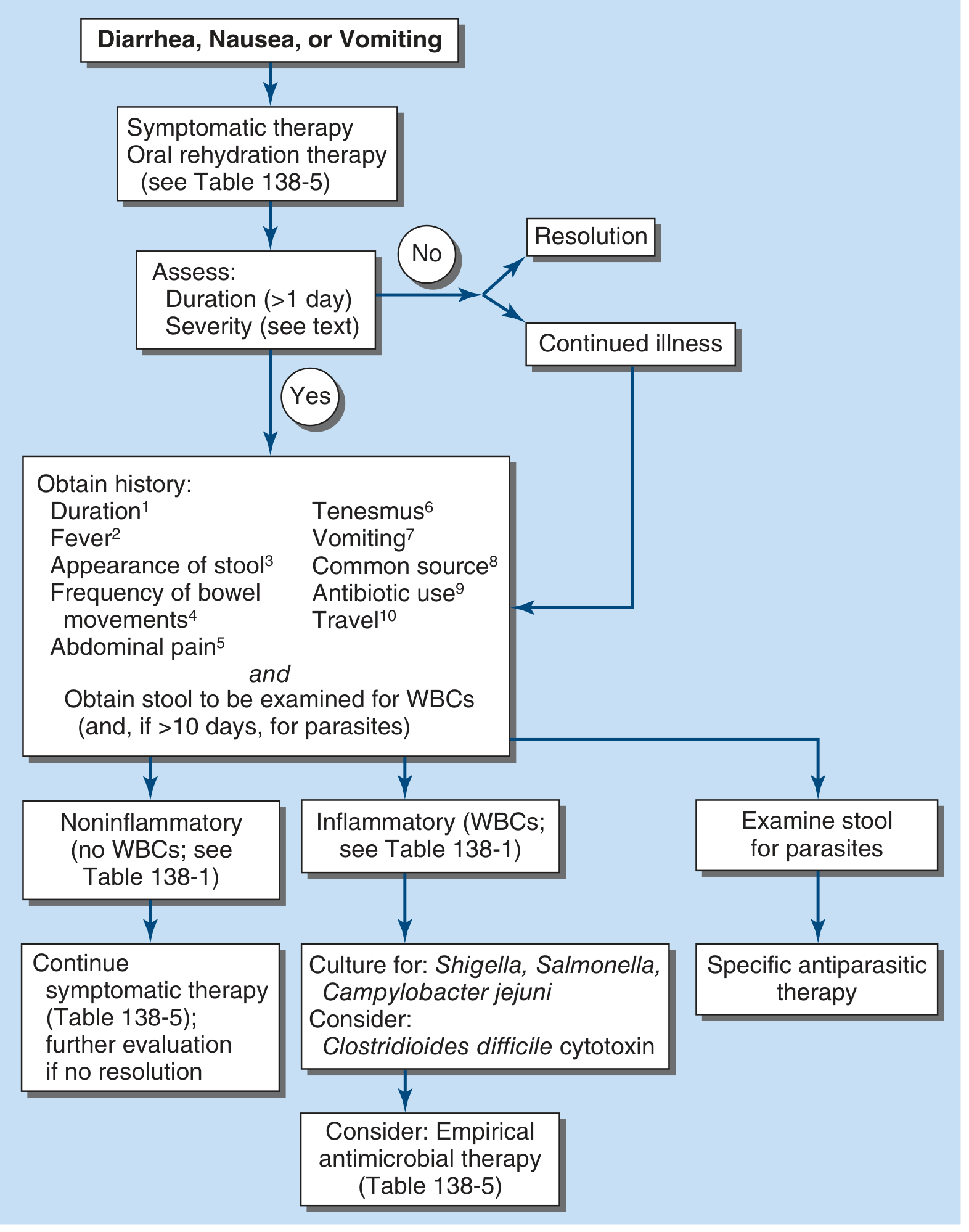
History key points to elicit:
- Duration (>1 day suggests further evaluation)
- Fever - implies invasive/inflammatory disease
- Stool appearance - blood/mucus = large bowel ulceration
- Tenesmus - suggests proctitis (Shigella, amebiasis)
- Recent antibiotic use - suggests C. difficile
- Travel history (traveler's diarrhea)
- Common source exposure (foodborne outbreak)
Stool Examination:
- Fecal leukocytes (methylene blue stain) - positive in inflammatory disease (Shigella, Campylobacter, C. diff)
- Stool microscopy for RBCs, cysts, trophozoites (E. histolytica - look for trophozoites with ingested RBCs)
- Stool culture: Shigella, Salmonella, Campylobacter jejuni
- PCR (stool): More sensitive than culture; preferred modern approach for Shigella
- C. difficile toxin assay (if recent antibiotic exposure)
- Rectal swab culture if stool culture not possible
If diarrhea >10 days: Examine specifically for parasites (E. histolytica, Giardia, Cryptosporidium).
- Harrison's Principles of Internal Medicine 22E, p. 1122
Management
Step 1: Assess Dehydration Severity
- Mild: Thirst, dry mouth, decreased urine output
- Moderate: Orthostatic hypotension, skin tenting, sunken eyes
- Severe: Lethargy, feeble pulse, hypotension, shock
Step 2: Rehydration
- ORS (Oral Rehydration Solution): First-line for mild-moderate dehydration
- IV fluids (glucose + saline): Reserved for severe dehydration or inability to tolerate oral intake
- Zinc sulfate 20 mg: Supplement with ORS - reduces duration of shigellosis
- Antimotility agents (e.g., loperamide): CONTRAINDICATED in dysentery - prolongs symptoms and bacterial shedding
Step 3: Antimicrobials
Shigella Dysentery:
| Setting | Drug | Dose |
|---|---|---|
| Adults (empirical) | Ciprofloxacin | 500 mg orally once daily × 3 days |
| Ciprofloxacin-resistant | Azithromycin | 500 mg twice daily × 1 day |
| Ciprofloxacin-resistant | Cefixime | 400 mg once daily × 3 days |
| Ciprofloxacin-resistant | TMP-SMX | 160/800 mg twice daily × 5 days |
| Severe/vomiting/unconscious | Ceftriaxone IV/IM | 1 g daily × 3 days (adults); 50-100 mg/kg/day × 3 days (children) |
| Children (1st line oral) | Ciprofloxacin | 15 mg/kg twice daily × 3 days |
Note: Antibiotics are routinely recommended for dysentery, severe illness, and immunocompromised patients. NOT routinely needed for non-febrile watery diarrhea.
- Goldman-Cecil Medicine (Shigellosis chapter), p. 3157
Amebic Dysentery (E. histolytica):
-
Metronidazole 750 mg every 8 hours (mixed amebicide of choice) - acts by forming cytotoxic compounds that bind to DNA and proteins of trophozoites
-
Always follow with a luminal amebicide (iodoquinol or paromomycin) to eliminate intestinal cysts and prevent relapse - combination provides >90% cure rates
-
Metronidazole alone leaves luminal cysts untreated
-
Rosen's Emergency Medicine; Lippincott Pharmacology
C. difficile:
- Stop offending antibiotic if possible
- Oral vancomycin or fidaxomicin (preferred over metronidazole for most cases)
EHEC (E. coli O157:H7):
- Antibiotics are contraindicated - increase risk of HUS by triggering Shiga toxin release
- Supportive care only
Red Flags Requiring Urgent Management
- High fever + toxic appearance
- Signs of dehydration/shock
- Rectal prolapse (especially in children with Shigella)
- Abdominal distension (toxic megacolon)
- Bloody diarrhea + oliguria/anuria/thrombocytopenia (HUS - especially with EHEC or S. dysenteriae type 1)
- Peritoneal signs (perforation)
Key Differentiating Points: Infectious vs UC
| Feature | Infectious Dysentery | Ulcerative Colitis |
|---|---|---|
| Onset | Acute | Chronic/relapsing |
| Fever | Common | Less prominent (unless severe) |
| Stool culture | Positive | Negative |
| Fecal leukocytes | Present | Present |
| Response to antibiotics | Yes (bacterial) | No |
| Endoscopy | Patchy ulcers | Continuous mucosal involvement from rectum |
Note: Campylobacter and amebiasis can produce endoscopic appearances identical to UC - stool cultures are essential before attributing symptoms to IBD.
- Goldman-Cecil Medicine, IBD chapter
This is a shared conversation. Sign in to Orris to start your own chat.