
Teach me how to deal with the case of breathlessness along with medications
approach to dyspnea breathlessness clinical management algorithm
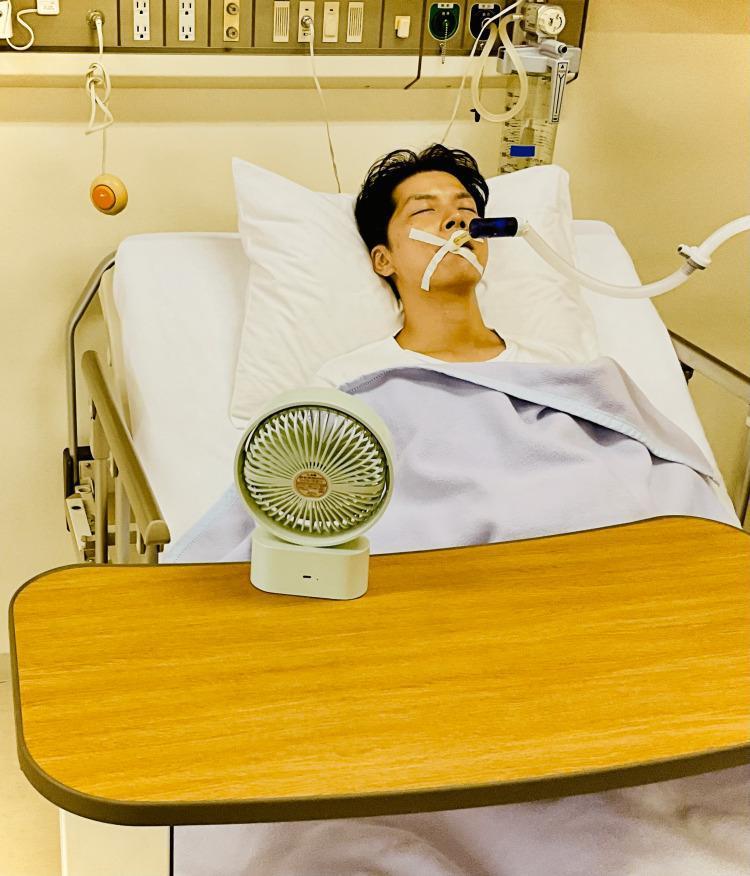
Clinical photograph of a patient in an intensive care unit (ICU) setting demonstrating the application of 'fan therapy' for dyspnea management. The patient is supine in a hospital bed, appearing sedated or with eyes closed, and is undergoing mechanical ventilation via an endotracheal tube secured with adhesive tape. In the foreground, a portable, battery-operated electric fan is positioned on an overbed tray table, directed toward the patient's face. This non-pharmacological intervention is designed to alleviate the sensation of breathlessness by providing cool airflow to the regions innervated by the second (maxillary) and third (mandibular) branches of the trigeminal nerve. The background shows standard critical care infrastructure, including medical gas outlets, electrical panels, and suction equipment. This image illustrates palliative and supportive care techniques used to manage respiratory distress in critically ill or end-of-life patients.
This medical infographic presents three clinical algorithms (A, B, and C) for managing massive bleeding in acute settings. Algorithm A details a ROTEM-guided approach for uncoagulated patients, using viscoelastic parameters (EXTEM, FIBTEM, APTEM) to differentiate and treat hyperfibrinolysis (tranexamic acid), hypofibrinogenemia (fibrinogen concentrate), thrombin deficiency (prothrombin complex), and thrombocytopenia. Algorithm B outlines management for uncoagulated patients when ROTEM is unavailable, focusing on monitoring for the 'lethal triad' (acidosis, hypothermia, coagulopathy), lab values like hemoglobin and base excess, and the administration of blood products or PCC. Algorithm C addresses oral anticoagulant overdose, branching by agent type: Vitamin K Antagonists (VKA) or Direct Oral Anticoagulants (DOACs). It provides decision nodes based on INR levels and hemorrhage severity, recommending reversal agents such as Vitamin K, prothrombin complex (PCC), or Idarucizumab for dabigatran. The diagrams use standardized medical terminology and dosage guidelines suitable for emergency medicine, hematology, and trauma surgery education.
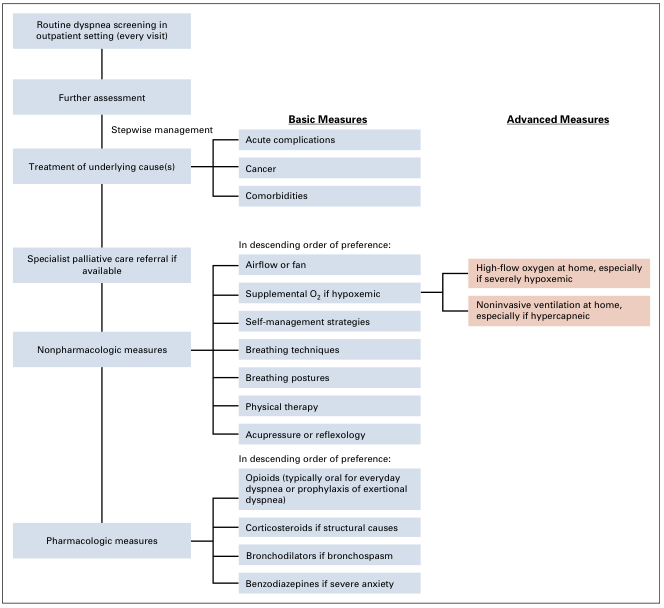
Summary : This flowchart outlines a stepwise approach to the outpatient management of dyspnea, including routine screening, assessment, treatment of underlying causes, referral to palliative care, and both nonpharmacologic and pharmacologic interventions, with escalation to advanced measures as needed. flowchart: # Nodes : • Routine dyspnea screening in outpatient setting (every visit) (rectangle) • Further assessment (rectangle) • Stepwise management (rectangle) • Treatment of underlying cause(s) (rectangle) • Basic Measures (bold, underlined heading) – Acute complications (rectangle) – Cancer (rectangle) – Comorbidities (rectangle) • Specialist palliative care referral if available (rectangle) • Nonpharmacologic measures (rectangle) – In descending order of preference: (italicized) • Airflow or fan (rectangle) • Supplemental O₂ if hypoxemic (rectangle) • Self-management strategies (rectangle) • Breathing techniques (rectangle) • Breathing postures (rectangle) • Physical therapy (rectangle) • Acupressure or reflexology (rectangle) • Pharmacologic measures (rectangle) – In descending order of preference: (italicized) • Opioids (typically oral for everyday dyspnea or prophylaxis of exertional dyspnea) (rectangle) • Corticosteroids if structural causes (rectangle) • Bronchodilators if bronchospasm (rectangle) • Benzodiazepines if severe anxiety (rectangle) • Advanced Measures (bold, underlined heading) – High-flow oxygen at home, especially if severely hypoxemic (rectangle, highlighted) – Noninvasive ventilation at home, especially if hypercapneic (rectangle, highlighted) # Connectors : • Downward arrows connect each step in the main vertical sequence: screening → assessment → stepwise management → treatment of underlying causes → specialist palliative care referral → nonpharmacologic measures → pharmacologic measures. • From "Stepwise management," branches lead to "Basic Measures" (with sub-branches for acute complications, cancer, comorbidities). • From "Nonpharmacologic measures," a branch from "Supplemental O₂ if hypoxemic" leads to "High-flow oxygen at home, especially if severely hypoxemic" under Advanced Measures. • From "Nonpharmacologic measures," a branch from the same level leads to "Noninvasive ventilation at home, especially if hypercapneic" under Advanced Measures. # Layout : • The flowchart is organized vertically, with main steps in a single column. • "Basic Measures" and "Advanced Measures" are presented as parallel columns, with "Advanced Measures" highlighted in a different color. • Sub-steps under "Basic Measures," "Nonpharmacologic measures," and "Pharmacologic measures" are listed in descending order of preference. # Analysis : • The flowchart emphasizes a structured, stepwise approach to dyspnea management, starting with routine screening and progressing through assessment, treatment, and both nonpharmacologic and pharmacologic interventions. • Referral to specialist palliative care is recommended if available. • Nonpharmacologic measures are prioritized before pharmacologic ones, with specific interventions listed in order of preference. • Advanced measures such as high-flow oxygen and noninvasive ventilation are reserved for severe cases, particularly with hypoxemia or hypercapnia. • The chart visually distinguishes between basic and advanced interventions, highlighting escalation pathways for more severe symptoms.
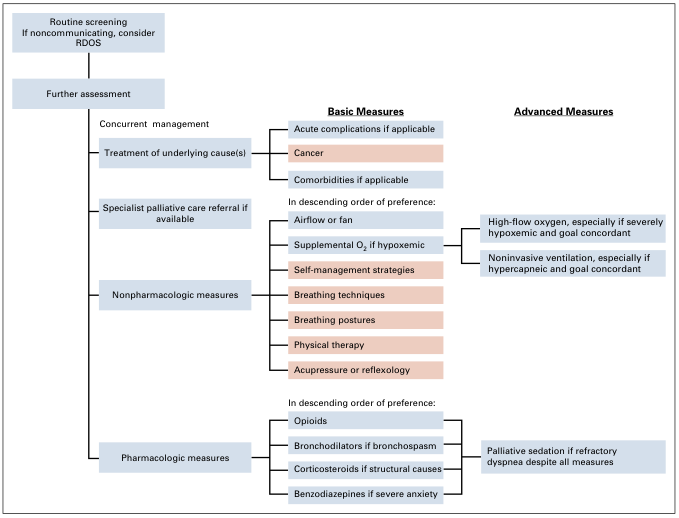
Summary : This flowchart outlines a stepwise approach to the assessment and management of dyspnea, including both basic and advanced measures, with a focus on concurrent management, nonpharmacologic and pharmacologic interventions, and escalation to advanced therapies if needed. flowchart: # Nodes : • Routine screening (rectangle): "Routine screening. If noncommunicating, consider RDOS" • Further assessment (rectangle): "Further assessment" • Concurrent management (rectangle): "Concurrent management" • Treatment of underlying cause(s) (rectangle): "Treatment of underlying cause(s)" • Cancer (rectangle, pink): "Cancer" • Comorbidities if applicable (rectangle, blue): "Comorbidities if applicable" • Acute complications if applicable (rectangle, blue): "Acute complications if applicable" • Specialist palliative care referral if available (rectangle): "Specialist palliative care referral if available" • Nonpharmacologic measures (rectangle): "Nonpharmacologic measures" • Airflow or fan (rectangle, blue): "Airflow or fan" • Supplemental O₂ if hypoxemic (rectangle, blue): "Supplemental O₂ if hypoxemic" • Self-management strategies (rectangle, pink): "Self-management strategies" • Breathing techniques (rectangle, pink): "Breathing techniques" • Breathing postures (rectangle, pink): "Breathing postures" • Physical therapy (rectangle, pink): "Physical therapy" • Acupressure or reflexology (rectangle, pink): "Acupressure or reflexology" • Pharmacologic measures (rectangle): "Pharmacologic measures" • Opioids (rectangle, blue): "Opioids" • Bronchodilators if bronchospasm (rectangle, blue): "Bronchodilators if bronchospasm" • Corticosteroids if structural causes (rectangle, blue): "Corticosteroids if structural causes" • Benzodiazepines if severe anxiety (rectangle, blue): "Benzodiazepines if severe anxiety" • High-flow oxygen, especially if severely hypoxemic and goal concordant (rectangle, blue): "High-flow oxygen, especially if severely hypoxemic and goal concordant" • Noninvasive ventilation, especially if hypercapneic and goal concordant (rectangle, blue): "Noninvasive ventilation, especially if hypercapneic and goal concordant" • Palliative sedation if refractory dyspnea despite all measures (rectangle, blue): "Palliative sedation if refractory dyspnea despite all measures" # Connectors : • Routine screening → Further assessment (downward arrow) • Further assessment → Concurrent management (downward arrow) • Concurrent management branches into: – Treatment of underlying cause(s) – Specialist palliative care referral if available – Nonpharmacologic measures – Pharmacologic measures • Treatment of underlying cause(s) branches into: – Acute complications if applicable – Cancer – Comorbidities if applicable • Nonpharmacologic measures branches into (in descending order of preference): – Airflow or fan – Supplemental O₂ if hypoxemic – Self-management strategies – Breathing techniques – Breathing postures – Physical therapy – Acupressure or reflexology • Pharmacologic measures branches into (in descending order of preference): – Opioids – Bronchodilators if bronchospasm – Corticosteroids if structural causes – Benzodiazepines if severe anxiety • Advanced Measures (right side, bolded): – High-flow oxygen, especially if severely hypoxemic and goal concordant (linked from Supplemental O₂) – Noninvasive ventilation, especially if hypercapneic and goal concordant (linked from Nonpharmacologic/Pharmacologic measures) – Palliative sedation if refractory dyspnea despite all measures (linked from Pharmacologic measures) # Layout : • The flowchart is organized vertically from screening to assessment, then branches horizontally into concurrent management categories. • Basic Measures are grouped in the center, with Advanced Measures listed to the right. • Color coding: blue for general/basic measures, pink for cancer or nonpharmacologic strategies, and advanced measures in blue. # Analysis : • The flowchart emphasizes a stepwise, preference-ordered approach to dyspnea management, starting with routine screening and assessment, then addressing underlying causes, and escalating from nonpharmacologic to pharmacologic and finally advanced interventions if symptoms persist. • There is a clear distinction between basic and advanced measures, with advanced therapies reserved for refractory or severe cases. • The inclusion of specialist palliative care and palliative sedation highlights the importance of symptom control in advanced illness.
Breathlessness (Dyspnea): Clinical Approach and Management
1. Definition and Mechanisms
- Air hunger - the feeling of not getting enough air (driven by hypercapnia, hypoxia, or elevated respiratory drive)
- Excessive effort - the sensation of breathing hard against resistance (airway obstruction, muscle weakness)
2. Initial Assessment: History
| Feature | Likely Cause |
|---|---|
| Chest tightness | Bronchoconstriction (asthma) |
| "Can't take a deep breath" | Dynamic hyperinflation (COPD) |
| Orthopnea (worse lying flat) | CHF, obesity, GERD-triggered asthma |
| Nocturnal dyspnea / PND | CHF or asthma |
| Platypnea (worse upright, better supine) | Left atrial myxoma, hepatopulmonary syndrome |
| Acute episodic | Myocardial ischemia, bronchospasm, pulmonary embolism |
| Chronic persistent | COPD, interstitial lung disease, chronic thromboembolic disease |
3. Physical Examination Clues
- Tripod position, accessory muscle use, supraclavicular retractions - increased airway resistance or reduced lung compliance
- Pulsus paradoxus >10 mmHg - COPD, acute severe asthma, pericardial disease
- Wheezes + prolonged expiration - obstructive airway disease
- Bibasilar rales - pulmonary edema / CHF
- Dullness to percussion - pleural effusion
- Hyperresonance - pneumothorax or emphysema
- JVD, S3, peripheral edema - right/left heart failure
- Pale conjunctivae - anemia as contributing cause
4. Common Causes by System
Pulmonary
- Asthma, COPD (including acute exacerbation)
- Pneumonia, acute bronchitis
- Pulmonary embolism
- Pleural effusion, pneumothorax
- Interstitial lung disease, pulmonary fibrosis
- Pulmonary hypertension
Cardiac
- Congestive heart failure (most common cardiac cause in middle-aged/older adults)
- Myocardial ischemia
- Cardiomyopathy, valvular disease
- Pericarditis
Other
- Anemia (reduced oxygen-carrying capacity)
- Metabolic acidosis (compensatory hyperventilation)
- Neuromuscular disease (reduced ventilatory pump capacity)
- Deconditioning, obesity
- Anxiety / panic disorder
5. Investigations
| Test | Purpose |
|---|---|
| SpO2 / ABG | Hypoxemia, hypercapnia, metabolic acidosis |
| Chest X-ray | Cardiomegaly, effusions, infiltrates, pneumothorax, hyperinflation |
| ECG | Ischemia, arrhythmia, ventricular hypertrophy |
| Spirometry (FEV1/FVC) | <70% = obstructive; low FVC + normal ratio = restrictive |
| CBC (hematocrit) | Anemia |
| BNP / NT-proBNP | BNP <100 pg/mL makes CHF unlikely (90% sensitivity, 76% specificity) |
| Echocardiogram | EF, wall motion, valvular disease, pulmonary HTN |
| CTPA | Pulmonary embolism |
| CPET | Distinguishes cardiac vs. respiratory limitation when both coexist |
6. Management Algorithm
Step 1: Treat the underlying cause
- Bronchodilators + steroids for asthma/COPD exacerbation
- Diuretics + ACE inhibitors for CHF
- Antibiotics for pneumonia
- Anticoagulation for pulmonary embolism
- Drainage for pleural effusion or pneumothorax
- Iron/transfusion for anemia
Step 2: Non-pharmacologic Measures (in order of preference)
- Airflow / Fan - Cool airflow directed at the face stimulates trigeminal nerve branches and reliably reduces the perception of breathlessness even without changing O2 levels
- Supplemental O2 - Helpful when SpO2 is low (resting SpO2 <88%, or drops with activity/sleep). For COPD patients with hypoxemia, it improves mortality
- Self-management strategies - Pacing activities, energy conservation
- Breathing techniques - Pursed-lip breathing (especially in COPD), diaphragmatic breathing
- Breathing postures - Leaning forward (tripod) reduces work of breathing in COPD
- Physical therapy / Pulmonary rehabilitation - Demonstrated positive effects on dyspnea, exercise capacity, and hospitalization rates in COPD; also benefits post-COVID conditions
- Acupressure / reflexology - Some supporting evidence in advanced disease
7. Pharmacologic Management
A. Bronchodilators
- Short-acting beta-2 agonists (SABAs) - Salbutamol (albuterol) inhaler: first-line for acute bronchospasm, 2-4 puffs (100 mcg/puff) via MDI or 2.5 mg nebulized
- Long-acting beta-2 agonists (LABAs) - Salmeterol, formoterol: good-quality evidence for reducing dyspnea in COPD
- Short-acting anticholinergics - Ipratropium bromide for COPD/acute exacerbations
- Long-acting anticholinergics (LAMAs) - Tiotropium for COPD maintenance
B. Opioids (for refractory or palliative dyspnea)
- Morphine is the most studied opioid for dyspnea
- Evidence from 13 studies supports morphine for dyspnea in advanced lung disease and terminal cancer
- Titrate carefully on a regular schedule with breakthrough doses available - this provides excellent relief without significant respiratory depression when used correctly
- Nebulized vs. oral opioids show no additional benefit, so oral route is preferred
- Note (2022 update): A recent RCT (BEAMS trial) did not support benefit of low-dose extended-release morphine in stable COPD - so opioids should be individualized, weighing respiratory depression risk
- Typical starting dose: morphine 5 mg oral (or oxycodone 5 mg) for opioid-naive patients
C. Corticosteroids
- For structural airway causes: acute exacerbations of asthma/COPD, or tumour-related airway compression
- Oral prednisolone 30-40 mg/day for 5 days in COPD exacerbation
- IV dexamethasone/methylprednisolone in severe asthma or endobronchial tumour
D. Diuretics
- For cardiac dyspnea (CHF): furosemide IV/oral reduces pulmonary congestion and dramatically relieves breathlessness
- Loop diuretics: furosemide 20-80 mg IV/oral depending on severity
E. Benzodiazepines
- Used when severe anxiety is a prominent component of dyspnea
- Second-line to opioids; evidence for dyspnea relief alone is inconsistent
- Lorazepam 0.5-1 mg oral/sublingual or diazepam 2-5 mg
- Particularly useful in terminal breathlessness combined with opioids
F. Anxiolytics / Antidepressants
- SSRIs (e.g., sertraline) may help in patients with dyspnea driven by anxiety or depression, particularly in chronic disease
G. Advanced Measures
- High-flow nasal oxygen (HFNO) - for severely hypoxemic patients (SpO2 persistently low despite standard O2)
- Non-invasive ventilation (NIV / BiPAP) - especially for hypercapnic respiratory failure (COPD, neuromuscular disease, obesity hypoventilation). In patients with normal systolic function and Cheyne-Stokes pattern, BiPAP in spontaneous-timed mode can normalize ventilation
- Palliative sedation - only for truly refractory dyspnea despite all measures in end-of-life setting
8. Cause-Specific Drug Summary
| Cause | First-line Drug(s) |
|---|---|
| Asthma (acute) | Salbutamol nebulizer, IV methylprednisolone, ipratropium |
| COPD exacerbation | Salbutamol + ipratropium, oral prednisolone, antibiotics if infective |
| CHF | IV furosemide, nitrates (if hypertensive), ACE inhibitor/ARB, beta-blocker |
| Pulmonary embolism | Anticoagulation (LMWH/rivaroxaban), thrombolysis if massive |
| Pneumonia | Antibiotics (amoxicillin, co-amoxiclav, or macrolide) |
| Pulmonary HTN | Sildenafil, ambrisentan, prostacyclins |
| Anemia | Iron supplementation or transfusion |
| Palliative/refractory | Oral morphine (titrated), lorazepam (for anxiety) |
9. Key Practical Pearls
- A normal SpO2 does not rule out significant respiratory pathology - a patient can have severe dyspnea with normal oxygenation (e.g., COPD with hyperinflation)
- Most respiratory distress in clinical practice is cardiac or pulmonary in origin
- BNP is your fastest screen for CHF in acute dyspnea
- Dyspnea descriptors (tight, air-hungry, effortful) help narrow the differential even before tests
- In palliation, opioids outperform oxygen for subjective breathlessness relief in non-hypoxic patients
- A bedside fan is a simple, evidence-based, free intervention that works by stimulating facial cold receptors via the trigeminal nerve