
Ovarian changes during menstrual cycle. For 15 marks with diagrams and flowcharts. Okay.
Reading File
Now let me search the medical library for ovarian changes during the menstrual cycle.
Finding Sources
Finding Sources
Finding Sources
Finding Sources
Good. Now let me read the most relevant sections from Medical Physiology and Costanzo in parallel.
Reading File
Reading File
Excellent content. Now let me read more from Medical Physiology for the detailed ovarian changes and fetch the key diagrams.
Reading File
Loading Image
Loading Image
Now let me get the hormonal cycle diagram and more detailed content on folliculogenesis.
Reading File
Finding Sources
Loading Image
Reading File
Excellent - very rich content from the textbook. Now let me get the hormonal changes diagram and also fetch the folliculogenesis diagram, plus read more detail on the corpus luteum.
Reading File
Reading File
Now let me get the detailed folliculogenesis section and the hormonal cycle diagram:
Reading File
Reading File
I have a rich hormonal cycle diagram URL. Let me fetch it along with more detail on the folliculogenesis stages.
Loading Image
Reading File
Reading File
I now have all the content needed. Let me also fetch the hormonal changes cycle diagram from Medical Physiology which was mentioned at line 2290.
Reading File
Loading Image
I now have all the material needed for a comprehensive 15-mark answer. Let me compile the full response.
Ovarian Changes During the Menstrual Cycle
(15 marks)
Overview
The menstrual cycle lasts an average of 28 days (range 21-35 days) and involves two parallel cycles:
- Ovarian cycle - follicular phase + luteal phase
- Endometrial cycle - menstrual + proliferative + secretory phases
The ovarian cycle includes four key events: (1) folliculogenesis, (2) ovulation, (3) formation of the corpus luteum, and (4) atresia (death) of the corpus luteum.
(Medical Physiology, Boron & Boulpaep, p. 1621)
Diagram 1 - Ovarian & Endometrial Cycle Timeline

The follicular phase of the ovarian cycle parallels the menses + proliferative phase of the endometrium. The luteal phase parallels the secretory phase.
Diagram 2 - Anatomy of the Ovary (Follicle Stages)
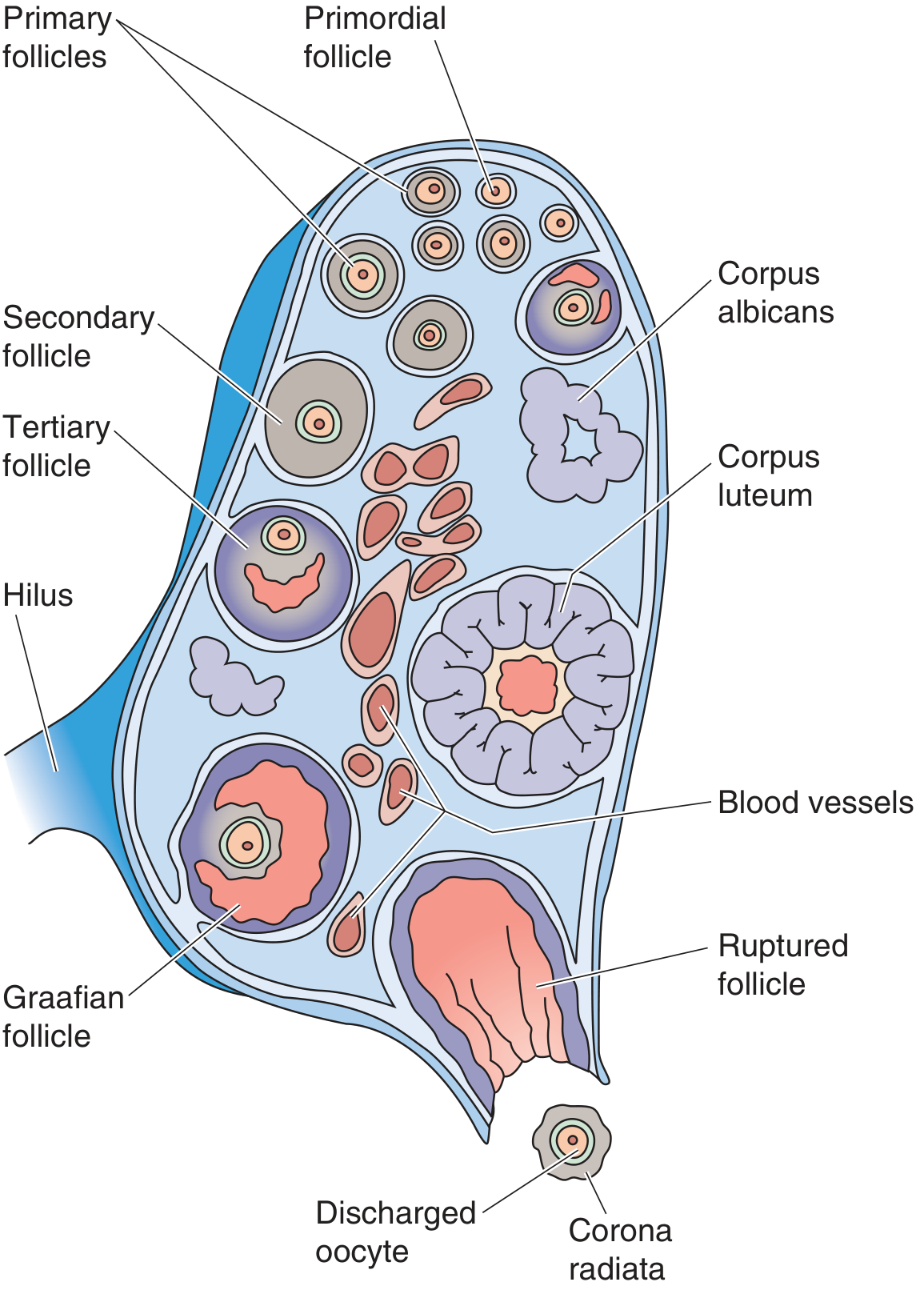
Shows: primordial follicle → primary → secondary → tertiary (Graafian) follicle → ruptured follicle with discharged oocyte → corpus luteum → corpus albicans.
Diagram 3 - Hormonal Changes During the Menstrual Cycle
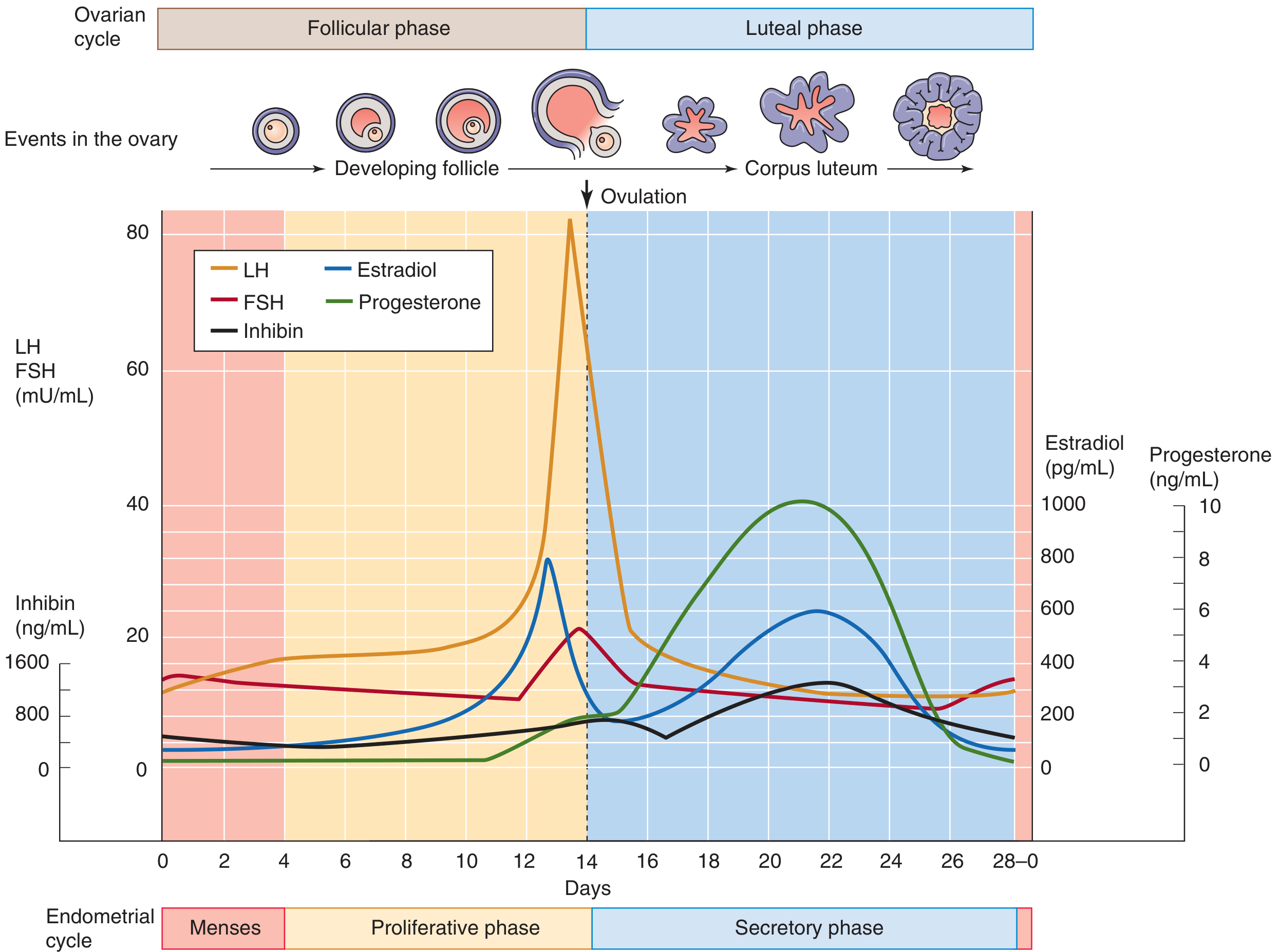
Note the dramatic LH surge at day 14 triggering ovulation, the estradiol peak just before the surge, and the progesterone rise throughout the luteal phase.
Diagram 4 - HPO Axis Feedback During Each Phase
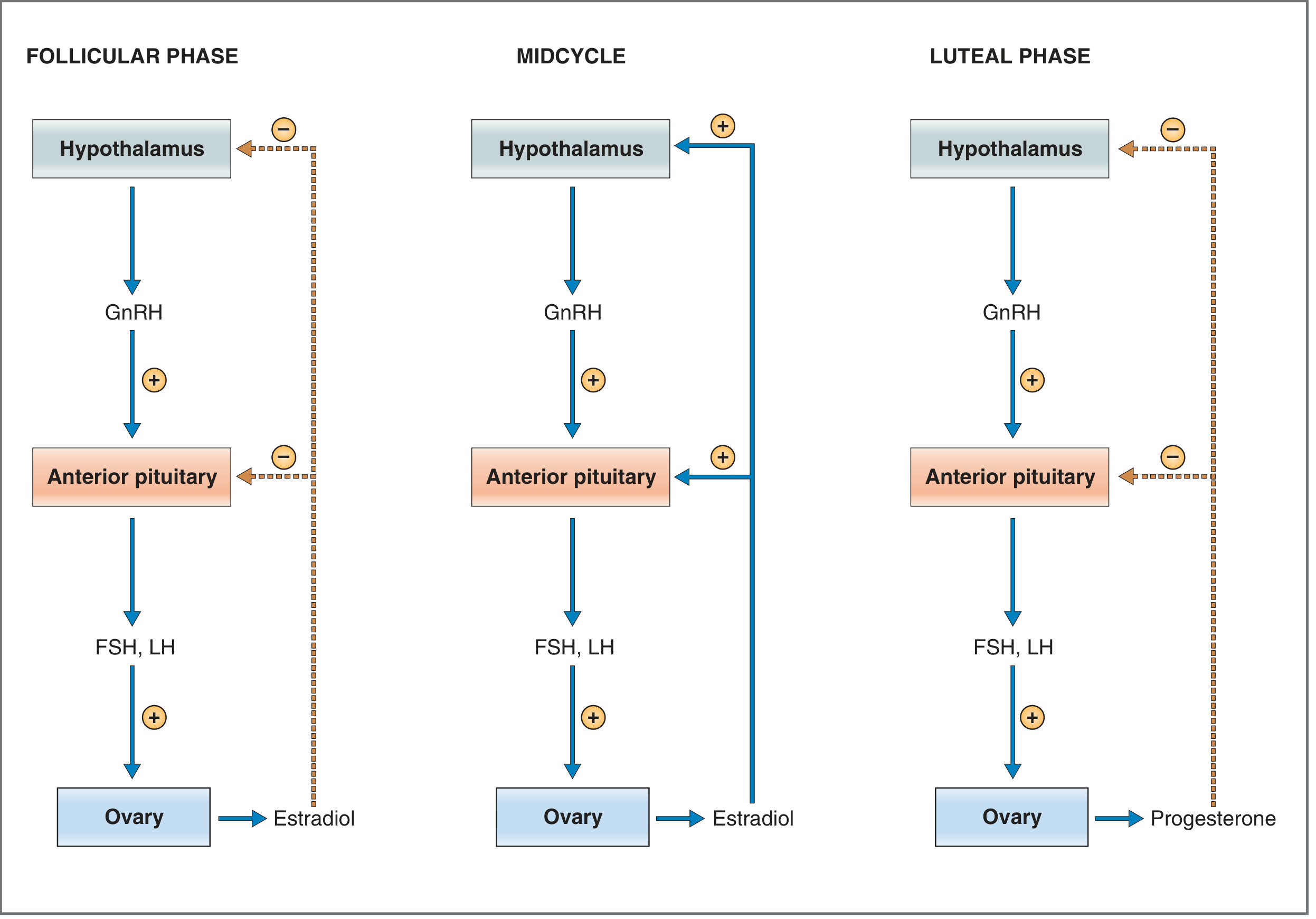
Follicular phase: estradiol exerts negative feedback. Midcycle: positive feedback triggers FSH/LH surge. Luteal phase: progesterone exerts negative feedback.
Phase 1: Follicular Phase (Days 0-14)
1A. Folliculogenesis
Each month, a cohort of 10-30 primordial follicles is recruited to undergo folliculogenesis. The stages are:
| Stage | Size | Key Feature |
|---|---|---|
| Primordial follicle | 30-60 µm | Oocyte + single layer of flat pre-granulosa cells |
| Primary follicle | Slightly larger | Pre-granulosa cells become cuboidal; zona pellucida begins forming |
| Secondary follicle | Multi-layer | Multiple layers of granulosa cells; theca interna & externa form |
| Tertiary (Antral) follicle | ~2-10 mm | Antrum (fluid-filled cavity) appears; oocyte eccentric |
| Graafian (Preovulatory) follicle | 20-25 mm | Dominant follicle; mature oocyte; large antrum; cumulus oophorus |
(Medical Physiology, p. 1634)
Key players in folliculogenesis:
- FSH acts on granulosa cells (only ovarian cells with FSH receptors): stimulates growth and estradiol synthesis
- LH acts on theca cells: stimulates androgen (androstenedione) production
- Androstenedione diffuses to granulosa cells where aromatase converts it to estradiol (Two-cell, two-gonadotropin theory)
1B. Dominant Follicle Selection (Days 5-7)
As estradiol rises, FSH levels fall due to negative feedback. The dominant follicle survives because it:
- Has the most FSH receptors (FSH-independent survival)
- Has highest aromatase activity → highest estradiol/androgen ratio
- Receives greater blood supply to its theca
Non-dominant follicles accumulate androgens → undergo atresia (apoptosis and collapse).
Flowchart 1 - Follicular Phase Events
Day 0-4: Menses. FSH rises (due to loss of corpus luteum progesterone)
         ↓
Day 1-5: Cohort of primordial follicles recruited
         ↓ FSH + LH
Day 5-7: One DOMINANT follicle selected
         ↓ FSH stimulates granulosa cells
         ↓ LH stimulates theca cells → androstenedione → aromatase → ESTRADIOL ↑
Day 7-12: Estradiol RISES → negative feedback on hypothalamus/pituitary
          → FSH and LH levels slightly fall
          → Non-dominant follicles undergo ATRESIA
Day 12-13: Estradiol surges above threshold (~200 pg/mL for ≥2 days)
           → Feedback SWITCHES from NEGATIVE → POSITIVE
Phase 2: Ovulation (Day 14)
Triggered by the LH surge (and smaller FSH surge):
Mechanism of LH surge:
- Peak estradiol from the dominant follicle acts on the hypothalamus (positive feedback)
- GnRH pulse frequency and amplitude increase
- Anterior pituitary releases a massive LH surge (~3x baseline), peaking ~12 hours after onset
- LH surge lasts ~48 hours; ovulation occurs ~36 hours after surge onset
Events at ovulation:
- Primary oocyte (arrested in prophase I since fetal life) resumes meiosis I → extrudes first polar body → becomes secondary oocyte (arrested in metaphase II)
- Cumulus oophorus expands (hyaluronidase synthesis stimulated by FSH)
- Oocyte-cumulus complex breaks free and floats in antrum
- Follicle wall thins and ruptures under prostaglandin and protease action
- Oocyte + corona radiata discharged into peritoneal cavity → swept into fallopian tube
Flowchart 2 - Ovulatory Mechanism
Estradiol > 200 pg/mL for ≥ 2 days
        ↓ (Positive feedback)
Hypothalamus: GnRH pulse frequency ↑↑
        ↓
Anterior pituitary: LH SURGE (peak ~80 mU/mL) + FSH surge
        ↓ (~36 hours later)
Dominant Graafian follicle RUPTURES
        ↓
Oocyte released → Ovulation
        ↓
Secondary oocyte + corona radiata → fallopian tube
Phase 3: Luteal Phase (Days 14-28)
3A. Formation of the Corpus Luteum
After ovulation, the remnant granulosa and theca cells of the ruptured follicle undergo luteinization under the influence of LH:
- Granulosa-lutein cells: Large, pale cells; produce progesterone and estradiol
- Theca-lutein cells: Smaller; produce androgens (precursors for estradiol)
- The corpus luteum is highly vascularized (angiogenesis stimulated by VEGF)
- Begins producing progesterone and estradiol within 1-2 days of ovulation
3B. Hormonal Function
| Hormone | Source | Effect |
|---|---|---|
| Progesterone | Corpus luteum | Stimulates secretory endometrium; negative feedback on hypothalamus/pituitary; raises basal body temperature by ~0.5°C |
| Estradiol | Corpus luteum | Supports endometrium; negative feedback |
| Inhibin A | Corpus luteum | Suppresses FSH |
Progesterone rises sharply after day 14 and peaks around day 22. This negative feedback suppresses FSH and LH, preventing new follicles from being recruited and preventing a second ovulation.
3C. Fate of the Corpus Luteum
If no fertilization:
- Corpus luteum begins degenerating at days 20-22 (luteolysis)
- Mechanism not fully understood; local prostaglandins and falling LH play roles
- Progesterone and estradiol fall sharply by day 26-28
- Withdrawal of hormonal support → endometrial shedding (menses)
- Corpus luteum becomes the corpus albicans (white scar tissue)
- FSH rises again → new follicular cohort recruited → new cycle begins
If fertilization occurs:
- Blastocyst implants ~6-7 days after ovulation
- Trophoblast secretes human chorionic gonadotropin (hCG)
- hCG mimics LH → rescues and maintains the corpus luteum
- Corpus luteum continues producing progesterone and estradiol until the placenta takes over (~8-10 weeks)
- No menses occurs (pregnancy maintained)
Flowchart 3 - Luteal Phase and Its Outcome
Ovulation (Day 14)
        ↓
Corpus luteum forms (luteinization by LH)
        ↓
Progesterone ↑↑ + Estradiol ↑ (peaks day 20-22)
        ↓ negative feedback
FSH and LH remain LOW
        ↓
         ┌──────────────────────┬───────────────────────────┐
         │ NO fertilization     │ Fertilization occurs       │
         ↓                      ↓                            │
Corpus luteum degenerates   Blastocyst → hCG secreted       │
(days 20-22)                        ↓                        │
Progesterone/Estradiol ↓↓   Corpus luteum RESCUED           │
        ↓                   Progesterone maintained         │
Endometrial shedding        No menses → Pregnancy           │
(Menses, days 0-4)                                          │
FSH rises → New follicle cohort recruited
Summary Table: Ovarian Changes at a Glance
| Day | Phase | Ovarian Event | Dominant Hormone |
|---|---|---|---|
| 0-4 | Menses | Corpus albicans; FSH rises, new cohort recruited | FSH |
| 1-13 | Follicular | Folliculogenesis; dominant follicle selected; estradiol rising | Estradiol |
| 12-13 | Late follicular | Estradiol peaks; positive feedback; LH/FSH surge | Estradiol (peak) |
| 14 | Ovulation | Graafian follicle ruptures; oocyte released; first polar body | LH surge |
| 14-28 | Luteal | Corpus luteum forms; progesterone + estradiol secreted | Progesterone |
| 20-22 | Mid-luteal | Corpus luteum peaks; maximum progesterone | Progesterone |
| 24-28 | Late luteal | Corpus luteum degenerates (no hCG); hormones fall | Declining |
| 28 → 0 | Luteolysis | Menses begins; new cycle starts | FSH rises |
Key Points for Exam (15-mark Answer)
-
Ovarian cycle = follicular phase (days 0-14) + luteal phase (days 14-28); the luteal phase is constant at 14 days; variability in cycle length is due to the follicular phase.
-
Folliculogenesis proceeds: primordial → primary → secondary → tertiary (antral) → Graafian follicle; most undergo atresia; only one dominant follicle survives each cycle.
-
Two-cell, two-gonadotropin theory: LH acts on theca cells (androgen) → FSH acts on granulosa cells (aromatase → estradiol).
-
Positive feedback - when estradiol exceeds ~200 pg/mL for ≥2 days, it switches from negative to positive feedback, triggering the LH surge and ovulation.
-
LH surge - peaks ~12 hours after onset; ovulation ~36 hours later; initiates completion of meiosis I by the oocyte.
-
Corpus luteum - formed from luteinized granulosa and theca cells; produces progesterone (dominant) and estradiol; maintained by hCG in pregnancy, degenerates in ~14 days if no pregnancy.
-
Corpus albicans - white avascular scar replacing the degenerated corpus luteum.
-
Inhibin A (from corpus luteum) and Inhibin B (from granulosa cells) selectively suppress FSH without affecting LH.
Sources: Medical Physiology (Boron & Boulpaep), pp. 1621-1638; Costanzo Physiology 7th Edition, pp. 476-481
This is a shared conversation. Sign in to Orris to start your own chat.