
Explain anatomy of thyroid gland , cbme curriculum , india mbbs phase 1
Reading File
Now I'll search the medical library for thyroid gland anatomy in parallel with web search for the CBME curriculum context.
Finding Sources
Searching the Web
CBME curriculum India MBBS Phase 1 anatomy thyroid gland competencies
Finding Sources
Reading Web Page
https://www.nmc.org.in/wp-content/uploads/2020/01/UG-Curricu…
Finding Sources
Finding Sources
Excellent! I found the key sources. Now let me read the detailed anatomy sections in parallel.
Reading File
Reading File
Reading File
Excellent content! Let me now get the blood/lymphatic supply from Sabiston and the histology, plus fetch the anatomy images.
Reading File
Reading File
Loading Image
Now let me get the Guyton & Hall anatomy/histology diagram and the blood supply from Sabiston in detail, plus the lymphatics.
Loading Image
Reading File
I now have comprehensive content from multiple authoritative textbooks. Let me compile the complete, CBME-aligned answer.
Anatomy of the Thyroid Gland
CBME Curriculum — India MBBS Phase 1 (Anatomy)
CBME competency alignment (NMC): The student should be able to describe the gross anatomy, relations, blood supply, nerve supply, lymphatic drainage, and applied anatomy of the thyroid gland (Competency AN 47 / Surgery SU22.1).
1. Development (Embryology)
The thyroid originates from two components:
- Median anlage — endodermal thickening at the base of the tongue (foramen cecum), descends in the midline along the thyroglossal duct
- Lateral anlage — from the 4th–5th pharyngeal pouches; contributes C cells (parafollicular cells)
The two anlagen fuse at the final position anterior to the trachea by the 7th week. Remnants of the thyroglossal duct may persist as a pyramidal lobe (present in 50–75% of individuals) or a thyroglossal duct cyst (midline neck swelling that moves up on tongue protrusion; treated by Sistrunk procedure).
2. Gross Anatomy
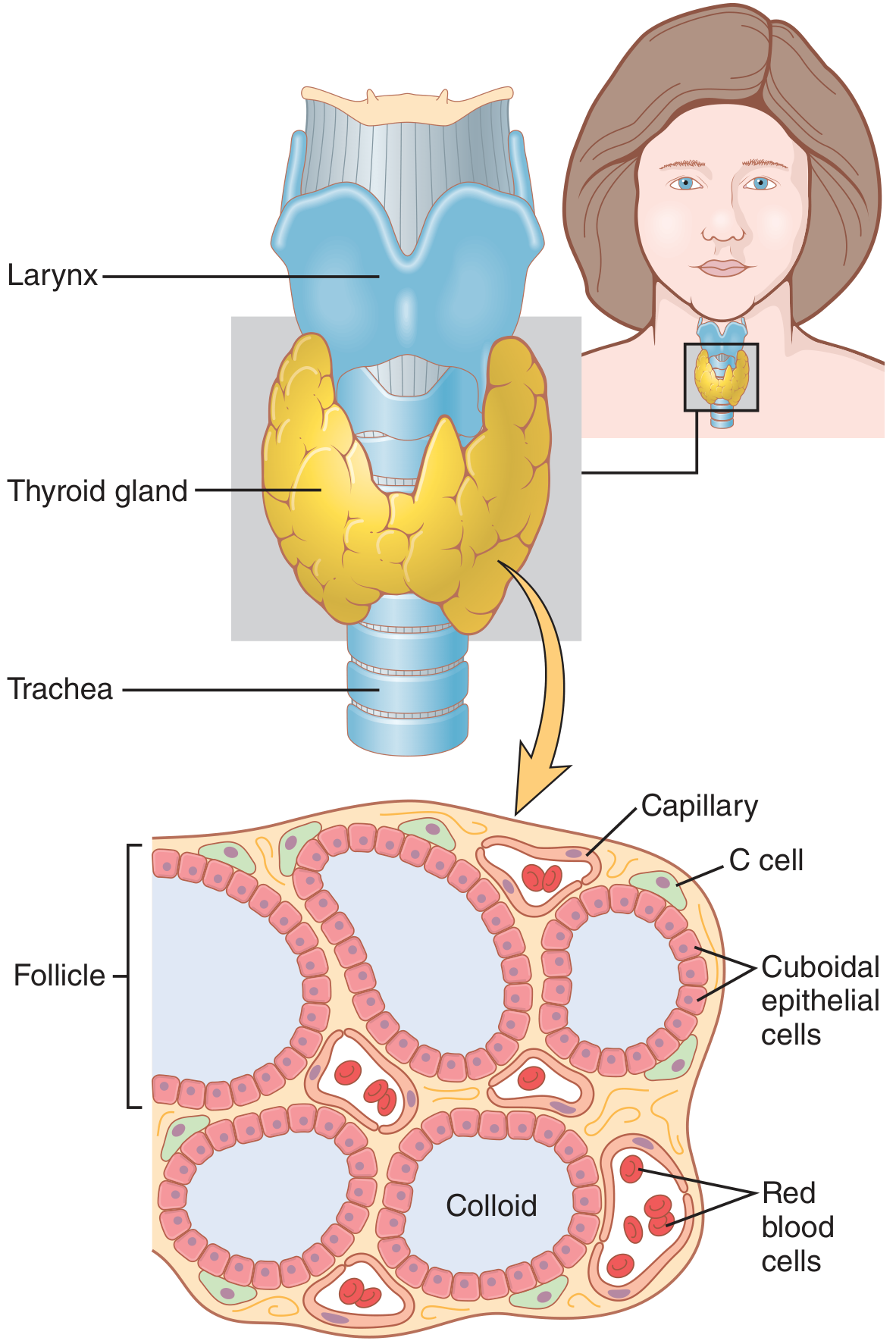
Anatomy and microscopic appearance of the thyroid gland (Guyton & Hall Textbook of Medical Physiology)
Shape, Size, and Weight
| Parameter | Value |
|---|---|
| Shape | Butterfly / H-shaped |
| Weight (adult) | 20–30 g (females slightly heavier) |
| Each lobe height | 4–6 cm |
| Lobe transverse/AP dimensions | 1.3–1.8 cm |
| Isthmus thickness | 2–3 mm |
| Color | Reddish-brown |
| Consistency | Rubbery/firm |
Position
- Lies in the anterior triangle of neck, posterior to the sternohyoid and sternothyroid (strap) muscles
- Isthmus overlies tracheal rings 2–4, just caudal to the cricoid cartilage
- Each lobe extends from the mid-thyroid cartilage level down to the 5th–6th tracheal rings
Parts
- Right lobe and Left lobe — the major components
- Isthmus — connects the lower poles; lies over tracheal rings 2–4
- Pyramidal lobe — a cranial extension from the isthmus (remnant of thyroglossal duct), present in ~50–75% of individuals
- Tubercle of Zückerkandl — a small posterolateral projection of each lobe; important surgical landmark for the RLN
3. Relations
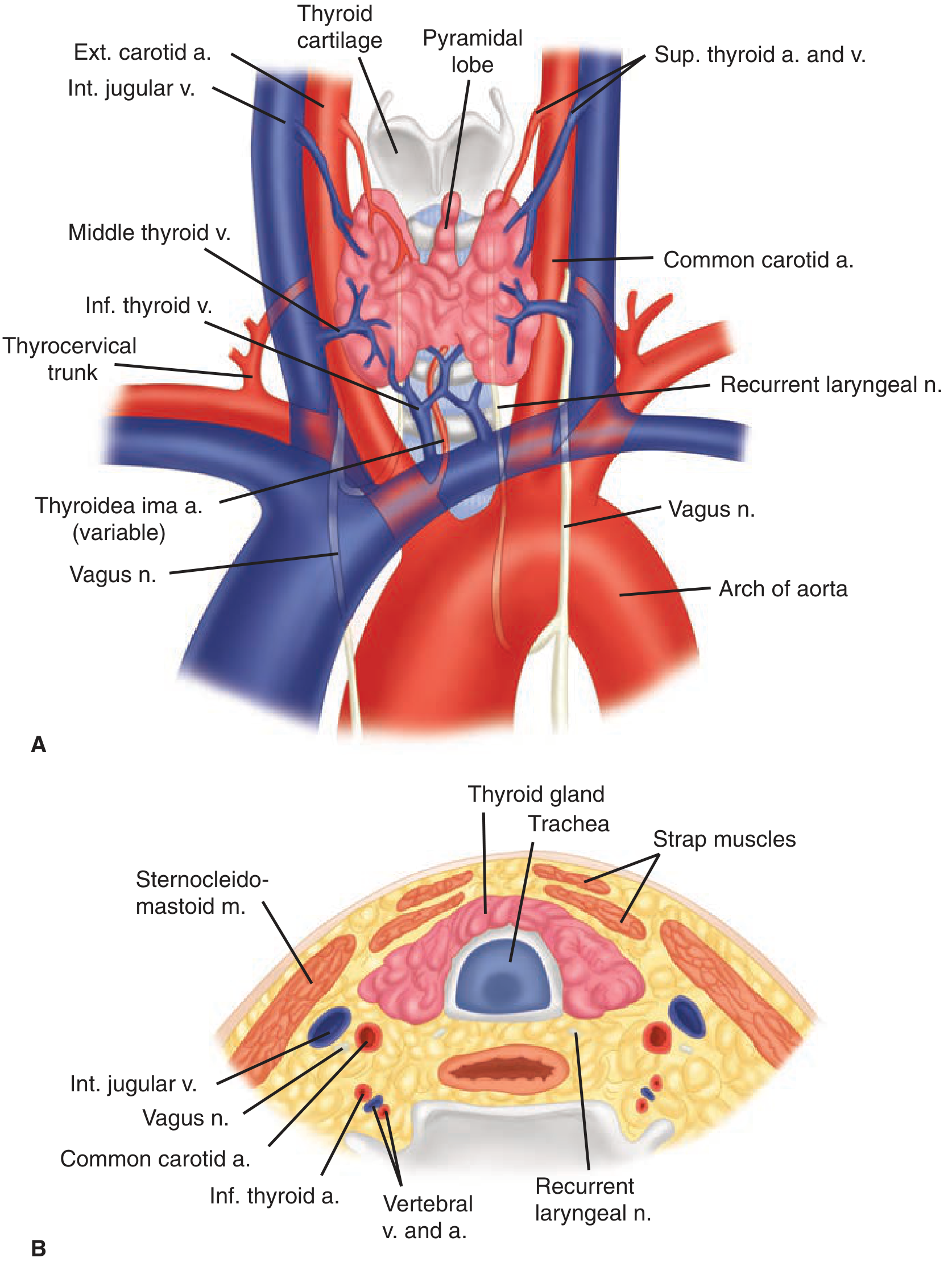
Figure 38-2. Anterior (A) and cross-sectional (B) views of thyroid gland and surrounding structures — Schwartz's Principles of Surgery, 11e
| Surface/Direction | Structures |
|---|---|
| Anterior | Sternohyoid and sternothyroid strap muscles, pretracheal fascia |
| Posterior | Trachea and esophagus (especially left side), parathyroid glands, RLN |
| Lateral | Carotid sheath (common carotid artery, internal jugular vein, vagus nerve), sternocleidomastoid |
| Superior | Cricoid cartilage, inferior pharyngeal constrictor |
| Medial | Trachea, cricoid/thyroid cartilages, cricothyroid muscles |
Capsule & Fascial Coverings
- The gland is invested by pretracheal fascia (forms the true capsule)
- This condenses as the suspensory ligament of Berry (posterior medial), which anchors the gland to the trachea — the RLN passes close to this ligament and may even traverse it in 25% of individuals
- Also forms the anterior suspensory ligament above the isthmus
4. Blood Supply
Arterial Supply
| Artery | Origin | Area Supplied |
|---|---|---|
| Superior thyroid artery (paired) | External carotid artery | Upper poles; divides into anterior and posterior branches at apex of each lobe |
| Inferior thyroid artery (paired) | Thyrocervical trunk (subclavian) | Lower and posterior part of each lobe; passes posterior to carotid sheath, enters midpole |
| Thyroidea ima artery (variable, 1–4%) | Aorta or innominate artery | Enters isthmus or replaces a missing inferior thyroid artery |
The inferior thyroid artery crosses the recurrent laryngeal nerve — this relationship is the most critical surgical landmark during thyroidectomy.
Venous Drainage
Three sets of veins drain the thyroid:
- Superior thyroid veins — run with superior thyroid arteries → drain into internal jugular vein (IJV)
- Middle thyroid veins — most variable; drain laterally → IJV
- Inferior thyroid veins — form a plexus from the inferior poles → drain into brachiocephalic (innominate) veins
5. Lymphatic Drainage
The lymphatic network is rich and extensive. Drainage follows a consistent pattern relevant to thyroid cancer staging and surgery:
- Primary drainage: Perithyroidal nodes in the central neck (Level VI) — bounded superiorly by the hyoid bone, inferiorly by the innominate artery, laterally by the carotid sheaths
- Secondary drainage: Level VI drains into lateral cervical nodes (Levels II, III, IV) along the jugular veins bilaterally
- Upper thyroid/pyramidal lobe → pretracheal and prelaryngeal (Delphian) nodes → Level VI
- Mediastinal nodes may also receive drainage inferiorly
6. Nerve Supply
| Nerve | Origin | Function |
|---|---|---|
| Recurrent laryngeal nerve (RLN) | Vagus (CN X) | Motor to all intrinsic laryngeal muscles except cricothyroid; sensation below vocal cords |
| External branch of superior laryngeal nerve (EBSLN) | Superior laryngeal nerve (branch of vagus) | Motor to cricothyroid muscle (tenses vocal cords; controls pitch) |
| Sympathetic fibers | Middle cervical ganglion | Vasomotor |
RLN course (critical applied anatomy):
- Left RLN: arises from vagus at aortic arch, loops around ligamentum arteriosum, ascends in the tracheoesophageal groove
- Right RLN: arises at right subclavian artery, more oblique course, less predictable
- Non-recurrent RLN: right side in 0.5–1% (associated with aberrant right subclavian artery); left only with situs inversus — a catastrophic surgical surprise
- Both RLNs are most vulnerable near the ligament of Berry and at their crossing with the inferior thyroid artery
7. Histology (Microanatomy)
The thyroid is composed of:
| Structure | Description |
|---|---|
| Follicles | Spherical units, 100–300 µm diameter; the functional unit |
| Follicular cells (principal cells) | Cuboidal/low columnar epithelium; secrete T3 and T4; height varies with activity (tall = active, flat = inactive) |
| Colloid | Proteinaceous material filling follicle lumen; mainly thyroglobulin |
| Parafollicular cells (C cells) | Derived from neural crest; secrete calcitonin; located between follicles or at periphery of follicular epithelium |
| Rich capillary network | Blood flow ~5× gland weight/minute — one of the highest perfusion rates in the body |
8. Applied Anatomy (Clinically Important)
| Condition | Anatomical Basis |
|---|---|
| Thyroglossal duct cyst | Persistence of thyroglossal duct; midline, moves up with tongue protrusion or swallowing |
| Lingual thyroid | Failure of median anlage to descend; mass at base of tongue; often the only thyroid tissue |
| RLN palsy after thyroidectomy | Injury during ligation of inferior thyroid artery or at Berry's ligament → hoarseness |
| EBSLN injury | Damage during superior pole ligation → loss of high pitch (cricothyroid denervation) |
| Tracheotomy precaution | Thyroidea ima artery can bleed catastrophically during emergency tracheotomy |
| Retrosternal goiter | Enlargement of substernal thyroid → compresses trachea and esophagus |
| Superior parathyroid | Dorsal to RLN plane (more constant); inferior parathyroid is ventral (more variable) |
| Berry's ligament | RLN passes posterior to it; branches may traverse the ligament in 25% of individuals |
9. CBME Phase 1 Competency Summary (NMC India)
According to the NMC CBME curriculum (Vol. I), the relevant Phase 1 anatomy competency requires the student to:
- Describe the gross anatomy and position of the thyroid gland
- Describe its relations to surrounding structures
- Describe its blood supply, venous drainage, and lymphatic drainage
- Describe the nerve supply with emphasis on the RLN and external laryngeal nerve
- Explain the applied aspects and clinical implications (thyroiditis, goiter, thyroidectomy complications)
- Integrated teaching with Surgery (SU22.1 — applied anatomy and physiology of thyroid)
The topic spans Anatomy (Phase 1) integrated with Physiology (thyroid hormones) and forms the anatomical basis for surgical competencies in Phase 2/3.
Sources:
- Schwartz's Principles of Surgery, 11e — Ch. 38, Thyroid Anatomy
- Sabiston Textbook of Surgery — Ch. 73, Thyroid Embryology and Anatomy
- Mulholland & Greenfield's Surgery, 7e — Anatomy of the Thyroid
- Guyton & Hall Textbook of Medical Physiology — Ch. 77, Physiological Anatomy of the Thyroid Gland
- NMC CBME Curriculum Vol. I (Anatomy competencies; Surgery SU22.1)
This is a shared conversation. Sign in to Orris to start your own chat.