
Parkinsonism with physiology
I'll read the medical library skill first, then research Parkinsonism comprehensively.
Reading File
Now let me search the library in parallel for Parkinsonism, its physiology, and pathology.
Finding Sources
Finding Sources
Searching PubMed
"Parkinson disease"[MeSH Terms] AND "pathophysiology"[MeSH Terms]
Excellent results. Now let me read the key textbook sections in parallel - especially Costanzo Physiology, Ganong's, Bradley's, and Kandel's Neuroscience.
Reading File
Reading File
Reading File
Reading File
Excellent content. Now let me read Bradley's detailed clinical section and Ganong's continuation, plus fetch the key basal ganglia diagram images.
Reading File
Reading File
Loading Image
Now let me read more of Ganong's Parkinson section and Bradley's main Parkinson chapter for clinical details and pathophysiology.
Reading File
Finding Sources
Now let me read Robbins pathology section on Parkinson and Goldman-Cecil for pathobiology.
Reading File
Reading File
I now have comprehensive material across physiology, pathology, and clinical neurology textbooks. Let me fetch the basal ganglia pathway diagram from Neuroscience Exploring the Brain and Ganong's Parkinson figure.
Loading Image
Finding Sources
Excellent - I have the basal ganglia diagram. Now let me get the Stahl's section on the D1/D2 pathways and Ganong's figure on Parkinson pathogenesis.
Reading File
Finding Sources
I have comprehensive content from multiple authoritative sources. Let me now compile the complete response.
Parkinsonism - Physiology, Pathology, and Clinical Features
1. Definition and Terminology
Parkinsonism is a clinical syndrome defined by six cardinal features (Bradley's Neurology):
- Tremor at rest
- Bradykinesia (slowness of movement)
- Rigidity
- Loss of postural reflexes
- Flexed posture
- Freezing (motor blocks)
The acronym TRAP captures the four major characteristics: Tremor, Rigidity, Akinesia, Postural disturbances.
Parkinson disease (PD) is the most common cause of idiopathic parkinsonism, but many other conditions can produce the syndrome (see causes below).
2. Normal Basal Ganglia Physiology (the foundation)
The basal ganglia serve as a motor selection system - they decide which movements get "the green light" and suppress competing motor programs. Understanding normal circuitry is essential to understanding PD.
Key Structures
| Structure | Role |
|---|---|
| Striatum (caudate + putamen) | Input nucleus; receives cortical input |
| Globus pallidus interna (GPi) / SNpr | Output nucleus; tonically inhibits thalamus via GABA |
| Globus pallidus externa (GPe) | Relays in indirect pathway |
| Subthalamic nucleus (STN) | Excitatory relay in indirect pathway |
| Substantia nigra pars compacta (SNpc) | Dopamine source; modulates striatum |
| VL Thalamus | Receives BG output; projects to motor cortex |
The Direct Pathway ("GO" - facilitates movement)
Cortex → Striatum (D1 receptors) → GPi/SNpr → VL Thalamus → Motor Cortex
- Striatum sends inhibitory (GABA) signals to GPi
- GPi normally sends inhibitory (GABA) signals to thalamus
- When GPi is inhibited by striatum, thalamus is released (disinhibited) → motor cortex is excited
- Net result: excitatory overall - promotes movement
- Dopamine acts on D1 receptors in the direct pathway: excitatory effect, enhancing movement
The Indirect Pathway ("STOP" - inhibits movement)
Cortex → Striatum (D2 receptors) → GPe → STN → GPi/SNpr → VL Thalamus → Motor Cortex
- Striatum inhibits GPe (via GABA)
- GPe normally inhibits STN (via GABA) - so when GPe is inhibited, STN becomes more active
- STN sends excitatory (glutamate) signals to GPi
- GPi becomes more active → greater inhibition of thalamus → less motor cortex excitation
- Net result: inhibitory overall - suppresses movement
- Dopamine acts on D2 receptors in the indirect pathway: inhibitory effect on striatum = reduces the indirect pathway's "STOP" signal = net "go more"
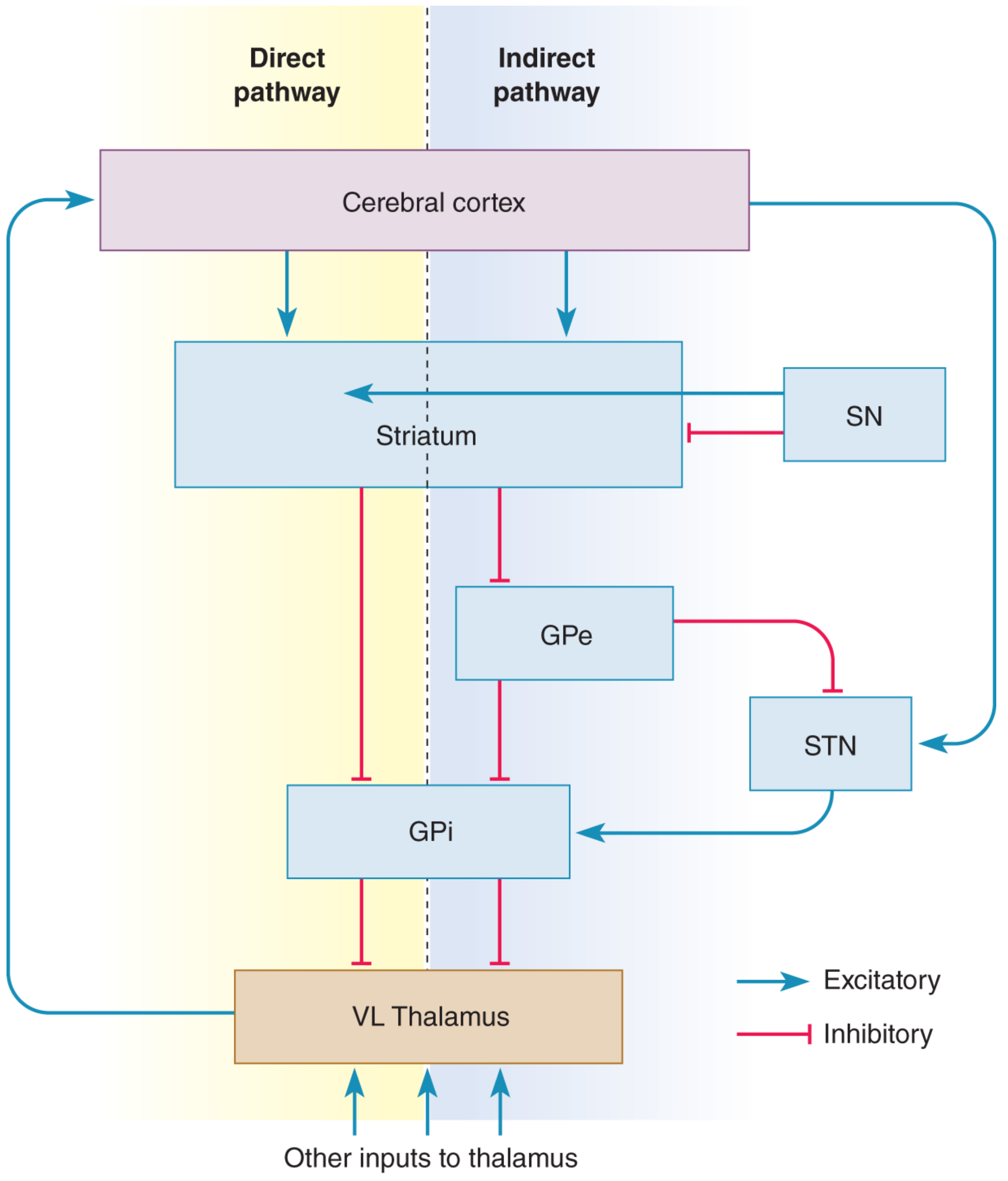
Summary: Dopamine facilitates the direct (GO) pathway via D1 and inhibits the indirect (STOP) pathway via D2 - in both cases, dopamine promotes movement. The direct and indirect pathways are in careful balance; the basal ganglia act as a "funnel" to select desired actions while suppressing competing ones.
3. Pathophysiology of Parkinsonism
Core Lesion
In Parkinson disease, there is selective degeneration of dopaminergic neurons in the substantia nigra pars compacta (SNpc). The projection from SNpc to the putamen (the nigrostriatal pathway) is most severely affected, with >80% of dopaminergic neurons lost before symptoms become clinically evident.
What Happens Without Dopamine?
When SNpc neurons degenerate and dopamine drops:
Direct pathway effect:
- D1 receptors in striatum are no longer activated
- Striatum fails to adequately inhibit GPi
- GPi becomes overactive → thalamus is strongly inhibited → less excitation of motor cortex
Indirect pathway effect:
- D2 receptor inhibition is lost
- Striatum inhibits GPe more strongly (D2 no longer holds it back)
- GPe is inhibited → STN is released (disinhibited)
- STN fires more vigorously → drives GPi to be even more active
- GPi further inhibits the thalamus
Net effect: Both pathways conspire to create excessive inhibitory output from GPi to the thalamus, strongly suppressing the motor cortex. Movements are difficult to initiate and slow to execute.
Kandel's Principles of Neural Science describes this as "a failure to select sensorimotor options" - the basal ganglia cannot adequately disinhibit the target structures needed to initiate movement, resulting in akinesia and bradykinesia. The increased tonic and oscillatory activity in basal ganglia output nuclei also generates the resting tremor characteristic of the disease.
4. Molecular Pathology
From Robbins Pathology and Goldman-Cecil Medicine:
- Lewy bodies: Intraneuronal, eosinophilic, round cytoplasmic inclusions containing α-synuclein (also neurofilaments and ubiquitin) - the pathological hallmark of PD
- α-Synuclein is normally involved in synaptic transmission; in PD it becomes misfolded and aggregates, disrupting cellular function
- Gross finding: Pallor of the substantia nigra and locus coeruleus (loss of melanin-containing neurons) + gliosis
- Mechanisms of neuronal death: Abnormal protein clearance (autophagy/lysosomal dysfunction), mitochondrial dysfunction, oxidative stress
Genetics
| Gene/Mutation | Inheritance | Key Note |
|---|---|---|
| SNCA (α-synuclein) | AD (rare) | First PD gene discovered |
| LRRK2 | AD | Most common autosomal dominant PD; common in North Africans, Ashkenazi Jews |
| Parkin (PARK2) | AR | Up to 50% of early-onset parkinsonism |
| PINK1 | AR | Mitophagy role |
| GBA1 (glucocerebrosidase) | Risk factor | Lysosomal pathway |
5. Clinical Features of Parkinson Disease
Motor Features (Ganong's, Robbins, Bradley's)
| Feature | Description |
|---|---|
| Bradykinesia | Slowness of movement; reduced amplitude; decreased blink rate, arm swing, facial expression ("hypomimia"/"masked facies") |
| Rigidity | "Lead-pipe" rigidity - equal resistance to passive movement in both agonist and antagonist muscles; "Cogwheel" rigidity = lead-pipe + tremor superimposed |
| Resting tremor | Pill-rolling tremor, 4-8 Hz, present at rest, disappears with voluntary movement; from alternating contractions of antagonist muscles |
| Postural instability | Festinant (shuffling) gait, propulsion, retropulsion, frequent falls |
| Akinesia | Difficulty initiating movement; loss of unconscious/automatic movements |
| Freezing | Sudden inability to move ("feet glued to floor"), especially at doorways |
Key Differentiating Points
- Rigidity vs. Spasticity: Rigidity increases tone equally in all directions (lead-pipe), no clasp-knife phenomenon; spasticity is velocity-dependent and shows clasp-knife release
- Tremor: Resting tremor (4-6 Hz) is characteristic of PD; essential tremor is action/postural tremor (6-12 Hz)
Non-Motor Features (often precede motor symptoms)
- Autonomic: constipation, orthostatic hypotension, urinary dysfunction, sweating abnormalities
- REM sleep behavior disorder (RBD) - may predate motor symptoms by years
- Depression, anxiety
- Anosmia (loss of smell)
- Cognitive impairment/dementia (later stages; Parkinson disease dementia)
6. Causes of Parkinsonism
Primary (Neurodegenerative)
- Parkinson disease (PD) - most common
- Multiple System Atrophy (MSA)
- Progressive Supranuclear Palsy (PSP)
- Corticobasal Degeneration (CBD)
- Dementia with Lewy Bodies (DLB)
Secondary (Acquired)
- Drug-induced: Dopamine antagonists (haloperidol, metoclopramide), VMAT2 inhibitors (tetrabenazine, reserpine)
- Toxin-induced: MPTP (1-methyl-4-phenyl-1,2,3,6-tetrahydropyridine), manganese, carbon monoxide, pesticides
- Vascular parkinsonism: Subcortical ischemic lesions
- Postencephalitic parkinsonism
- Metabolic: Wilson disease (copper accumulation → putamen degeneration), hypoparathyroidism
7. Neurochemical Balance in Basal Ganglia
Three pathways must stay in balance (Ganong's):
| System | Normal Role | Disruption |
|---|---|---|
| Nigrostriatal dopaminergic | Modulates D1/D2 in striatum | ↓ in PD → hypokinesia |
| Intrastriatal cholinergic | Modulates striatal neurons | Relatively unopposed in PD |
| GABAergic (striatum → GP/SN) | Inhibitory output of basal ganglia | Dysregulated in PD |
In PD, the dopamine/acetylcholine imbalance is critical: dopamine falls, leaving acetylcholine activity relatively unopposed. This is why:
- Anticholinergic drugs were historically used (and still used for tremor)
- Levodopa/dopamine agonists are the primary treatment - to restore dopamine
8. Treatment Rationale (Physiological Basis)
| Approach | Mechanism | Examples |
|---|---|---|
| Levodopa (L-DOPA) | Dopamine precursor crosses BBB → restores dopamine in striatum | L-DOPA + carbidopa (prevents peripheral conversion) |
| Dopamine agonists | Directly stimulate D1/D2 receptors | Bromocriptine, pramipexole, ropinirole |
| MAO-B inhibitors | Reduce dopamine breakdown | Selegiline, rasagiline |
| COMT inhibitors | Prolong L-DOPA effect | Entacapone |
| Anticholinergics | Reduce unopposed ACh activity | Trihexyphenidyl, benztropine (mainly for tremor) |
| Deep Brain Stimulation (DBS) | High-frequency stimulation of GPi or STN disrupts pathological firing patterns, effectively reducing GPi overactivity | Electrodes in GPi or STN |
The physiological rationale for DBS targeting the STN or GPi: by silencing the overactive output nucleus (GPi), thalamic inhibition is relieved, restoring thalamocortical excitation and improving motor function.
Summary Diagram of Parkinsonism Physiology
NORMAL:
SNpc --[DA]→ Striatum:
   ↳ D1 (direct) → "GO" → inhibit GPi → disinhibit thalamus → cortex activated
   ↳ D2 (indirect) → inhibit "STOP" pathway → less GPi activity

PARKINSONISM (↓ Dopamine):
   ↳ Direct: Striatum fails to inhibit GPi → GPi overactive ↑
   ↳ Indirect: GPe underactive → STN overactive → drives GPi ↑↑
   ↳ Result: GPi floods thalamus with GABA → thalamus suppressed
   ↳ Motor cortex receives less drive → AKINESIA, BRADYKINESIA, RIGIDITY
   ↳ Oscillatory discharges in GPi → RESTING TREMOR
Sources:
- Costanzo Physiology, 7th ed. - Basal Ganglia, Direct/Indirect Pathways
- Ganong's Review of Medical Physiology, 26th ed. - Parkinson Disease, Basal Ganglia Diseases
- Kandel's Principles of Neural Science, 6th ed. - Parkinson Disease as Failure of Sensorimotor Selection
- Neuroscience: Exploring the Brain, 5th ed. - Basal Ganglia Disorders
- Robbins & Kumar Basic Pathology - Parkinson Disease Morphology and Pathogenesis
- Bradley and Daroff's Neurology in Clinical Practice - TRAP, Parkinsonism
- Stahl's Essential Psychopharmacology - D1/D2 Direct and Indirect Pathways
- Goldman-Cecil Medicine - Lewy Body Pathobiology
This is a shared conversation. Sign in to Orris to start your own chat.