
CASE 2 Identifying Data Marissa is a 42-year-old married female public school teacher with no prior psychiatric consultation, brought in by her sister for persistent low mood, social withdrawal, and decreased functioning. History of Present Illness About 4 months prior to admission, after repeated family conflicts and mounting debts, she developed increasingly depressed mood nearly every day, markedly diminished interest in previously enjoyable activities, poor appetite with weight loss, difficulty sleeping, low energy, and feelings of worthlessness. She became less talkative, avoided neighbors and relatives, and needed encouragement to bathe and eat. She reported difficulty concentrating while teaching and eventually stopped going to work. Over the next several weeks, she became more hopeless and frequently expressed guilt, saying that she was a burden to her family and that her children would be better off without her. She was often seen sitting quietly for long periods, crying to herself, and neglecting household responsibilities. One week prior to admission, she admitted to her sister that she had been thinking of ending her life by ingesting pesticide kept at home. Because of worsening hopelessness, suicidal thoughts, and inability to function, she was brought for psychiatric evaluation. Other relevant information She has no known history of elevated mood, decreased need for sleep, excessive talkativeness, grandiosity, or increased goal-directed activity. There is no history of illicit drug use or problematic alcohol use. Family history is significant for a maternal aunt with episodes of low mood and social withdrawal. No known family history of psychotic disorder or bipolar disorder. Mental Status Exam Appearance/Behavior: Poorly groomed, seated quietly, minimally spontaneous, cooperative but with reduced eye contact Speech: Soft, slowed, with decreased spontaneity Mood/Affect: Depressed mood, affect restricted and congruent Thought Process: Goal-directed but slowed Thought Content: Worthlessness, excessive guilt, hopelessness, suicidal ideation Perception: No hallucinations or other perceptual disturbances elicited Cognition: Oriented to person, place, and time; memory grossly intact Abstract Thinking: Intact Insight: Partial; acknowledged emotional distress but minimized severity of illness Judgment: Impaired, as shown by suicidal thinking and inability to maintain self-care and work functioning For both cases, please answer the following guide questions in handwritten format on a letter-sized paper, and submit today before 5PM via uploading to the ff google drive linked in the chat. 1. What are the key findings in the history of present illness and mental status examination? 2. What are your differential diagnoses? 3. What is your final diagnosis? Briefly explain the basis for your answer.
Case 2 - Clinical Psychiatric Analysis: Marissa, 42F
Question 1: Key Findings in the History of Present Illness (HPI) and Mental Status Examination (MSE)
From the History of Present Illness
- Repeated family conflicts and mounting financial debts - identifiable psychosocial stressors preceding onset
- Depressed mood - persistent, nearly daily
- Markedly diminished interest/pleasure (anhedonia) - in previously enjoyable activities
- Psychomotor retardation: sitting quietly for long periods, becoming less talkative, reduced spontaneity
- Social withdrawal (avoided neighbors and relatives)
- Occupational decline (stopped going to work)
- Self-care neglect (needed encouragement to bathe and eat)
- Neglected household responsibilities
- Active suicidal ideation with a specific method: ingesting pesticide kept at home (one week prior to admission)
- No elevated mood, decreased need for sleep, excessive talkativeness, grandiosity, or increased goal-directed activity - this is a critical negative finding that rules out bipolar disorder
- Maternal aunt with episodes of low mood and social withdrawal (suggests familial predisposition to depressive disorder)
- No family history of psychotic or bipolar disorder
From the Mental Status Examination
| Domain | Findings |
|---|---|
| Appearance/Behavior | Poorly groomed; seated quietly; minimally spontaneous; cooperative but reduced eye contact |
| Speech | Soft, slowed, decreased spontaneity - consistent with psychomotor retardation |
| Mood/Affect | Depressed mood; restricted, congruent affect |
| Thought Process | Goal-directed but slowed |
| Thought Content | Worthlessness, excessive guilt, hopelessness, active suicidal ideation |
| Perception | No hallucinations or perceptual disturbances |
| Cognition | Oriented x3; memory grossly intact - no signs of organic/cognitive disorder |
| Abstract Thinking | Intact |
| Insight | Partial - acknowledges distress but minimizes illness severity |
| Judgment | Impaired - evidenced by suicidal thinking and inability to maintain self-care and work |
Question 2: Differential Diagnoses
1. Major Depressive Disorder (MDD), Single Episode, Severe Without Psychotic Features (Most likely)
2. Adjustment Disorder with Depressed Mood (Less likely - ruled out by severity and duration)
3. Persistent Depressive Disorder (Dysthymia) (Less likely)
4. Bipolar Disorder, Current Depressive Episode (Unlikely but must be ruled out)
5. Depressive Disorder Due to Another Medical Condition / Substance-Induced Depressive Disorder (Must be excluded)
Question 3: Final Diagnosis
Major Depressive Disorder (MDD), Single Episode, Severe, Without Psychotic Features
Basis:
- ✅ Depressed mood nearly every day
- ✅ Markedly diminished interest/pleasure (anhedonia) in almost all activities
- ✅ Significant weight loss and poor appetite
- ✅ Insomnia nearly every night
- ✅ Psychomotor retardation (observed by others - slowed speech, sitting for long periods)
- ✅ Fatigue/loss of energy
- ✅ Feelings of worthlessness and excessive guilt
- ✅ Diminished ability to concentrate (noticed while teaching)
- ✅ Recurrent suicidal ideation with a specific plan (pesticide ingestion)
Key clinical note: The active suicidal ideation with a specific, lethal, and accessible plan (pesticide at home) represents a psychiatric emergency. Immediate priorities include ensuring safe disposition (likely inpatient admission), restricting access to the pesticide, initiating antidepressant pharmacotherapy (e.g., SSRI), and considering psychotherapy (CBT or interpersonal therapy) once stabilized.
Give it in short
Case 2 – Short Answer Guide
Q1. Key Findings
- Depressed mood nearly every day x 4 months after family conflicts and debt
- Anhedonia, poor appetite with weight loss, insomnia, low energy, worthlessness, guilt, poor concentration
- Psychomotor retardation (sitting quietly, less talkative)
- Social withdrawal, stopped working, neglected self-care
- Hopelessness and suicidal ideation with a plan (pesticide ingestion)
- No prior manic/hypomanic episodes; no substance use
- Family history of depression (maternal aunt)
- Poorly groomed, reduced eye contact, minimally spontaneous
- Speech: soft, slow, decreased spontaneity
- Mood: depressed; Affect: restricted, congruent
- Thought content: worthlessness, guilt, hopelessness, suicidal ideation
- No hallucinations or delusions
- Cognition intact; Insight partial; Judgment impaired
Q2. Differential Diagnoses
- Major Depressive Disorder, Single Episode, Severe (most likely)
- Adjustment Disorder with Depressed Mood (less likely - symptoms exceed threshold)
- Persistent Depressive Disorder (Dysthymia) (less likely - duration <2 years, severity too high)
- Bipolar Disorder, Current Depressive Episode (rule out - no manic history)
- Depressive Disorder Due to a Medical Condition (exclude organically)
Q3. Final Diagnosis
Major Depressive Disorder (MDD), Single Episode, Severe, Without Psychotic Features
- Meets 8/9 DSM-5 criteria (depressed mood, anhedonia, weight loss, insomnia, fatigue, worthlessness/guilt, poor concentration, psychomotor retardation, suicidal ideation with plan)
- Duration: 4 months (well beyond the 2-week minimum)
- Severe - suicidal ideation with a specific plan, complete functional collapse (work, self-care, social)
- No psychotic features - no hallucinations or delusions
- Bipolar excluded - no manic/hypomanic history
- Adjustment disorder excluded - full MDD criteria are met, making it a superseding diagnosis
And now for management this is our output
This is out of it
python3 -c " import pdfplumber with pdfplumber.open('/tmp/workspace/attachments/c274fc03-601d-493b-8329-5162677c5cc6/Management%20of%20Major%20Depressive%20Disorder.pdf') as pdf: print(f'Pages: {len(pdf.pages)}') for i, page in enumerate(pdf.pages): print(f'--- PAGE {i+1} ---') print(page.extract_text()) "
python3 -c " from pypdf import PdfReader import base64 reader = PdfReader('/tmp/workspace/attachments/c274fc03-601d-493b-8329-5162677c5cc6/Management%20of%20Major%20Depressive%20Disorder.pdf') print(f'Pages: {len(reader.pages)}') # Check if there are images page = reader.pages[0] print('Page keys:', page.keys()) print('Resources:', page.get('/Resources', {})) "
python3 -c " from pypdf import PdfReader import os reader = PdfReader('/tmp/workspace/attachments/c274fc03-601d-493b-8329-5162677c5cc6/Management%20of%20Major%20Depressive%20Disorder.pdf') os.makedirs('/tmp/workspace/mdd_images', exist_ok=True) for i, page in enumerate(reader.pages): resources = page.get('/Resources', {}) xobjects = resources.get('/XObject', {}) for name, obj in xobjects.items(): xobj = obj.get_object() if xobj.get('/Subtype') == '/Image': data = xobj.get_data() ext = 'jpg' fname = f'/tmp/workspace/mdd_images/page_{i+1}.{ext}' with open(fname, 'wb') as f: f.write(data) print(f'Saved page {i+1} image: {fname} ({len(data)} bytes)') "
python3 -c " import base64, os files = sorted(os.listdir('/tmp/workspace/mdd_images')) print(files) # encode page 1 to base64 to check with open('/tmp/workspace/mdd_images/page_1.jpg','rb') as f: d = f.read() print('page_1 size:', len(d)) "
python3 -c " # Try using markitdown for PDF text extraction from markitdown import MarkItDown md = MarkItDown() result = md.convert('/tmp/workspace/attachments/c274fc03-601d-493b-8329-5162677c5cc6/Management%20of%20Major%20Depressive%20Disorder.pdf') print(result.text_content[:3000]) "
# Serve images locally via a simple HTTP server in background, then use analyse_media # Instead, convert images to base64 and use a data URL approach - but analyse_media needs http URLs # Let me try reading the images directly as file objects and use PIL to check content python3 -c " from PIL import Image import os img = Image.open('/tmp/workspace/mdd_images/page_1.jpg') print('Size:', img.size, 'Mode:', img.mode) img2 = Image.open('/tmp/workspace/mdd_images/page_2.jpg') print('Page 2 size:', img2.size) "
Management of Major Depressive Disorder with High Suicide Risk
1. Immediate Safety & Hospitalization
- Inpatient Psychiatric Admission - immediate transfer to a secure psychiatric unit to stabilize acute crisis
- Suicide-Risk Assessment - structured evaluation of ideation, intent, explicit plan, and lethal access
- Close Continuous Observation - 1-on-1 or 15-minute level nursing line-of-sight monitoring
- Environmental Lethal Means Removal - secure pesticides, sharp items, medications, and firearms
- Family Involvement & Safety Planning - engage supportive family early to co-design crisis safeguards
2. Pharmacological Management
- SSRIs as first-line - high efficacy and favorable safety profiles
- Drug of choice: Sertraline - preferred due to established efficacy and lower acute overdose toxicity
- Dosing - start at conservative dose, titrate based on clinical response and tolerance
- Close monitoring in early weeks - watch for paradoxically increased suicidal ideation, agitation, or adverse effects
- Continuation after remission - maintain pharmacotherapy for at least 6-12 months post-remission to prevent relapse
3. Electroconvulsive Therapy (ECT)
- Indicated as gold-standard for high-risk, severe major depression
- Specific indication here - life-threatening suicidal intent or profound psychosis/catatonia
- Rapid clinical response - faster therapeutic onset vs. oral antidepressants
- Pre-ECT workup - baseline medical, cardiac, neurological, and anesthesia safety clearances
- Cognitive monitoring - track transient retrograde/anterograde memory impairment post-treatment
4. Psychotherapy Interventions
- CBT (Cognitive Behavioral Therapy) - restructures maladaptive belief systems
- IPT (Interpersonal Therapy) - targets interpersonal disputes, role transitions, grief, social isolation
- Behavioral Activation - re-engages patient in structured, positive daily tasks to break depressive withdrawal
- Target cognitive distortions - directly addresses hopelessness, excessive guilt, and perceived burden
5. Psychosocial Management
- Family Support & Psychoeducation - educate family on depressive illness, crisis warning signs, and non-judgmental communication
- Stressors Resolution - involve medical social workers to address family conflicts, financial pressures, housing
- Basic Lifestyle Stabilization - re-establish regular sleep-wake schedules, balanced meals, personal hygiene, mild physical activity
- Gradual Social & Occupational Rehabilitation - step-by-step reintegration plan to return to work, avoiding premature overload
6. Discharge & Maintenance Protocol
| Discharge Criteria & Safety | Long-Term Maintenance |
|---|---|
| Discharge only when acute suicidal ideation and intent have resolved | Continue full therapeutic dose of antidepressant uninterrupted |
| Formal written safety plan (coping strategies, triggers, emergency contacts) | Outpatient follow-up within 7 days of discharge, then frequent visits |
| Strict verification that lethal means remain inaccessible at home | Ongoing monitoring of early warning signs with swift intervention |
7. Patient-Specific Management Flowchart (8 Steps)
- High Suicide Risk Identification
- Inpatient Admission + Safety Measures
- Assessment + Antidepressant Treatment
- Consider ECT for Rapid Response
- Psychotherapy + Family Support
- Clinical Improvement Evaluation
- Safety Planning + Discharge
- Maintenance & Relapse Prevention
Is there any correction to be done
Corrections & Suggestions
1. ECT Framing - Needs Adjustment ⚠️
- Treatment-refractory patients (failed ≥2 adequate antidepressant trials)
- Imminent suicide risk (not just "high" suicide risk)
- Psychotic depression
- Compromised oral intake / inability to take medications
- Catatonia
2. Missing: Specific Sertraline Starting Dose
3. Missing: Addressing the Specific Lethal Means (Pesticide)
4. Missing: Adjunctive Options if SSRI Fails
- Augmentation (add lithium, atypical antipsychotic, or T3)
- Switch to SNRI (e.g., venlafaxine) or mirtazapine
- Esketamine (intranasal) - now approved for treatment-resistant depression with suicidal ideation (STARS-D and TRANSFORM trials)
5. Minor: Psychotherapy Timing
6. What Was Correct ✅
- SSRI (sertraline) as first-line: correct
- Inpatient admission for suicidal ideation with a plan: correct
- 6-12 months continuation of antidepressant post-remission: correct
- Follow-up within 7 days of discharge: correct
- Family psychoeducation and stressor resolution (addressing the actual debt and family conflicts): excellent and specific
- Behavioral activation and IPT targeting interpersonal disputes: directly relevant to this case
- The 8-step management flowchart: well-structured
Give images from Kaplan textbook of criteria and management
1. DSM-5 / ICD-10 / ICD-11 Diagnostic Criteria Comparison Table
| # | Symptom |
|---|---|
| 1 | Dysphoria / Depressed mood |
| 2 | Anhedonia |
| 3 | Change in weight or appetite |
| 4 | Change in sleep pattern |
| 5 | Psychomotor agitation or retardation |
| 6 | Fatigue / decreased energy |
| 7 | Worthlessness / guilt |
| 8 | Poor concentration |
| 9 | Recurrent thoughts of death / suicidal ideation / plan |
- Manic or hypomanic episode → rules out Bipolar
- Substance/medication effect
- Other medical condition
- Other mental illness
- Mild (2-3 symptoms, functions despite distress)
- Moderate (4+ symptoms, difficulty functioning)
- Severe (several symptoms markedly distressing, suicidal ideation, self-care collapse) ← Marissa's level
2. Drugs for Depression - Kaplan Comprehensive Textbook (Figure 33.1c-1)
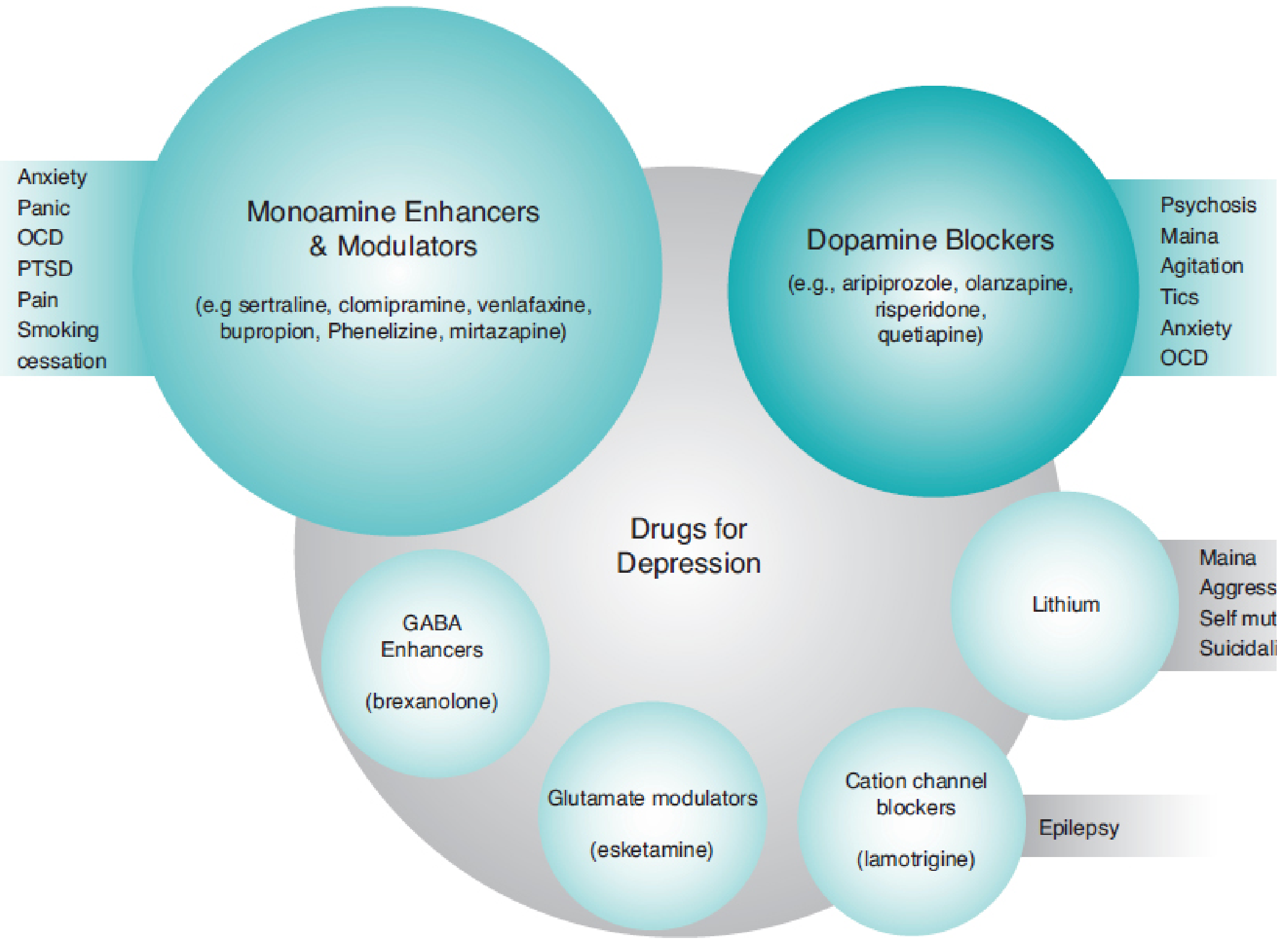
- Monoamine Enhancers & Modulators (primary): sertraline, venlafaxine, bupropion, mirtazapine - these are your first-line SSRIs/SNRIs
- Dopamine Blockers (augmentation): aripiprazole, quetiapine, olanzapine
- Glutamate modulators: esketamine (for treatment-resistant/suicidal cases)
- Lithium: augmentation, also addresses suicidality
- GABA Enhancers: brexanolone
3. CBT Cognitive Model - Kaplan Comprehensive Textbook (Figure 32.9-1)
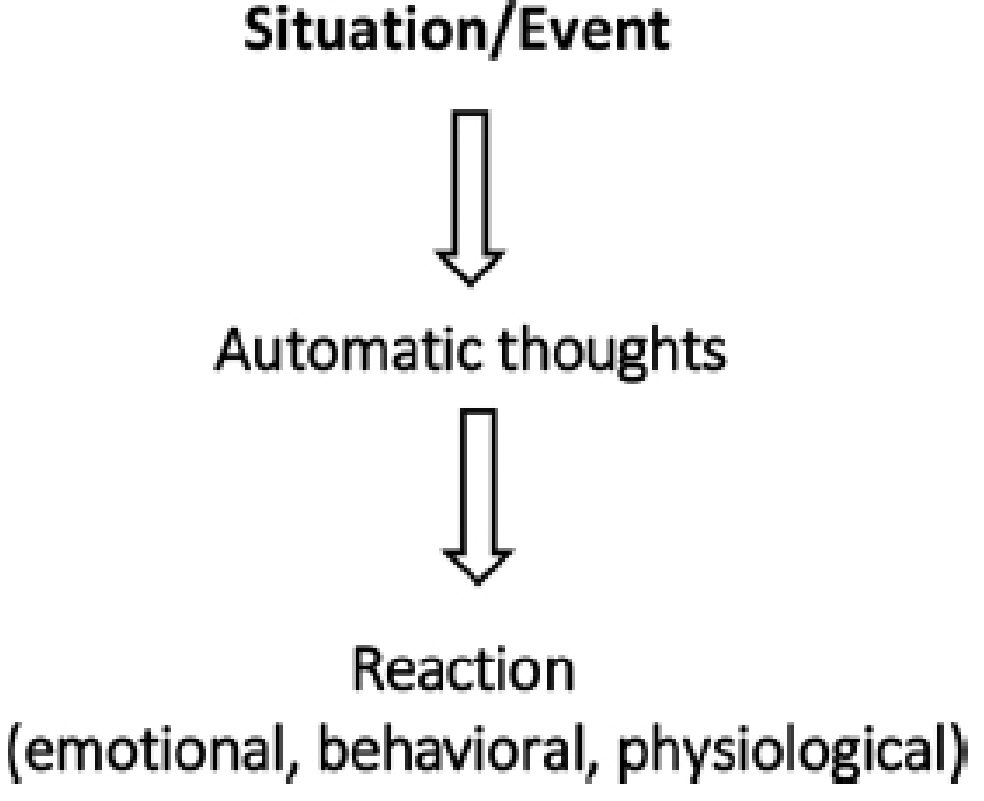
Note: The Kaplan textbooks do not contain a standalone "criteria image/figure" per se - the diagnostic criteria are presented as comparison tables (DSM-5 vs ICD-10 vs ICD-11) rather than as diagrams. The two figures above are the most clinically relevant visual content from Kaplan directly applicable to Marissa's case.
Create a summary document with the diagnostic criteria table and management algorithm for Marissa's case
mkdir -p /tmp/workspace/marissa-case && ls /tmp/workspace/marissa-case
python3 << 'EOF' from docx import Document from docx.shared import Pt, Inches, RGBColor, Cm from docx.enum.text import WD_ALIGN_PARAGRAPH from docx.enum.table import WD_ALIGN_VERTICAL from docx.oxml.ns import qn from docx.oxml import OxmlElement import docx def set_cell_bg(cell, hex_color): tc = cell._tc tcPr = tc.get_or_add_tcPr() shd = OxmlElement('w:shd') shd.set(qn('w:val'), 'clear') shd.set(qn('w:color'), 'auto') shd.set(qn('w:fill'), hex_color) tcPr.append(shd) def set_cell_borders(cell, top=None, bottom=None, left=None, right=None): tc = cell._tc tcPr = tc.get_or_add_tcPr() tcBorders = OxmlElement('w:tcBorders') for side, val in [('top', top), ('bottom', bottom), ('left', left), ('right', right)]: if val: el = OxmlElement(f'w:{side}') el.set(qn('w:val'), val.get('val', 'single')) el.set(qn('w:sz'), str(val.get('sz', 4))) el.set(qn('w:color'), val.get('color', '000000')) tcBorders.append(el) tcPr.append(tcBorders) def add_colored_heading(doc, text, level, rgb): h = doc.add_heading(text, level=level) h.alignment = WD_ALIGN_PARAGRAPH.LEFT for run in h.runs: run.font.color.rgb = RGBColor(*rgb) return h def add_divider(doc, color='1F4E79'): p = doc.add_paragraph() p.paragraph_format.space_before = Pt(0) p.paragraph_format.space_after = Pt(4) pPr = p._p.get_or_add_pPr() pBdr = OxmlElement('w:pBdr') bottom = OxmlElement('w:bottom') bottom.set(qn('w:val'), 'single') bottom.set(qn('w:sz'), '6') bottom.set(qn('w:color'), color) pBdr.append(bottom) pPr.append(pBdr) doc = Document() # --- Page margins --- for section in doc.sections: section.top_margin = Cm(1.8) section.bottom_margin = Cm(1.8) section.left_margin = Cm(2.2) section.right_margin = Cm(2.2) # Default style style = doc.styles['Normal'] style.font.name = 'Calibri' style.font.size = Pt(11) # ───────────────────────────────────────── # HEADER BLOCK # ───────────────────────────────────────── title_para = doc.add_paragraph() title_para.alignment = WD_ALIGN_PARAGRAPH.CENTER run = title_para.add_run('CLINICAL PSYCHIATRY CASE SUMMARY') run.font.name = 'Calibri' run.font.size = Pt(9) run.font.color.rgb = RGBColor(0x1F, 0x4E, 0x79) run.font.bold = True run.font.all_caps = True title = doc.add_heading('', level=0) title.alignment = WD_ALIGN_PARAGRAPH.CENTER run = title.add_run('Major Depressive Disorder with\nHigh Suicide Risk') run.font.name = 'Calibri' run.font.size = Pt(22) run.font.color.rgb = RGBColor(0x1F, 0x4E, 0x79) run.font.bold = True subtitle = doc.add_paragraph() subtitle.alignment = WD_ALIGN_PARAGRAPH.CENTER run = subtitle.add_run('Case 2: Marissa, 42F | Diagnosis & Management Protocol') run.font.name = 'Calibri' run.font.size = Pt(11) run.font.italic = True run.font.color.rgb = RGBColor(0x40, 0x40, 0x40) doc.add_paragraph() # ───────────────────────────────────────── # SECTION 1: PATIENT SNAPSHOT # ───────────────────────────────────────── add_colored_heading(doc, '1. Patient Snapshot', 1, (0x1F, 0x4E, 0x79)) add_divider(doc) snap_table = doc.add_table(rows=2, cols=4) snap_table.style = 'Table Grid' headers = ['Patient', 'Duration of Illness', 'Key Risk', 'Functional Status'] values = ['Marissa, 42F\nMarried teacher', '~4 months\n(progressive)', 'Active suicidal ideation\nwith plan (pesticide)', 'Severely impaired\n(work, self-care, social)'] for i, (h, v) in enumerate(zip(headers, values)): hc = snap_table.rows[0].cells[i] vc = snap_table.rows[1].cells[i] set_cell_bg(hc, '1F4E79') set_cell_bg(vc, 'D6E4F0') hp = hc.paragraphs[0] hp.alignment = WD_ALIGN_PARAGRAPH.CENTER hr = hp.add_run(h) hr.font.bold = True hr.font.color.rgb = RGBColor(0xFF, 0xFF, 0xFF) hr.font.size = Pt(10) vp = vc.paragraphs[0] vp.alignment = WD_ALIGN_PARAGRAPH.CENTER vr = vp.add_run(v) vr.font.size = Pt(10) doc.add_paragraph() # ───────────────────────────────────────── # SECTION 2: DSM-5 DIAGNOSTIC CRITERIA # ───────────────────────────────────────── add_colored_heading(doc, '2. DSM-5 Diagnostic Criteria for Major Depressive Disorder', 1, (0x1F, 0x4E, 0x79)) add_divider(doc) note = doc.add_paragraph() nr = note.add_run('Requires ≥5 of the following 9 symptoms for ≥2 weeks; at least one must be criterion A or B. ' 'Must cause significant distress or functional impairment. No manic/hypomanic history.') nr.font.size = Pt(10) nr.font.italic = True note.paragraph_format.space_after = Pt(6) crit_table = doc.add_table(rows=11, cols=3) crit_table.style = 'Table Grid' col_headers = ['#', 'DSM-5 Criterion', 'Marissa\'s Presentation'] for j, ch in enumerate(col_headers): cell = crit_table.rows[0].cells[j] set_cell_bg(cell, '1F4E79') p = cell.paragraphs[0] p.alignment = WD_ALIGN_PARAGRAPH.CENTER run = p.add_run(ch) run.font.bold = True run.font.color.rgb = RGBColor(0xFF, 0xFF, 0xFF) run.font.size = Pt(10) criteria = [ ('A', 'Depressed mood nearly every day', '✔ Persistent low mood x 4 months'), ('B', 'Markedly diminished interest/pleasure (anhedonia)', '✔ Lost interest in previously enjoyable activities'), ('C', 'Significant weight loss / poor appetite', '✔ Poor appetite with weight loss'), ('D', 'Insomnia or hypersomnia', '✔ Difficulty sleeping'), ('E', 'Psychomotor agitation or retardation', '✔ Sitting quietly for long periods; slowed speech'), ('F', 'Fatigue or loss of energy', '✔ Low energy, needed encouragement to bathe/eat'), ('G', 'Feelings of worthlessness or excessive guilt', '✔ "Burden to family"; excessive guilt'), ('H', 'Diminished ability to concentrate', '✔ Difficulty concentrating while teaching'), ('I', 'Recurrent thoughts of death / suicidal ideation','✔ Active SI with specific plan (pesticide)'), ('—', 'No history of manic/hypomanic episode', '✔ Confirmed absent → rules out Bipolar Disorder'), ] shades = ['FFFFFF', 'EBF3FA'] for i, (num, crit, marissa) in enumerate(criteria): row = crit_table.rows[i+1] shade = shades[i % 2] data = [num, crit, marissa] for j, val in enumerate(data): cell = row.cells[j] set_cell_bg(cell, shade) p = cell.paragraphs[0] run = p.add_run(val) run.font.size = Pt(10) if num in ('A', 'B', 'I') and j in (1, 2): run.font.bold = True if '✔' in val and 'SI' in val: run.font.color.rgb = RGBColor(0xC0, 0x00, 0x00) elif '✔' in val: run.font.color.rgb = RGBColor(0x00, 0x70, 0x00) doc.add_paragraph() # Diagnosis box diag_para = doc.add_paragraph() diag_table = doc.add_table(rows=1, cols=1) diag_table.style = 'Table Grid' cell = diag_table.rows[0].cells[0] set_cell_bg(cell, '1F4E79') p = cell.paragraphs[0] p.alignment = WD_ALIGN_PARAGRAPH.CENTER r1 = p.add_run('FINAL DIAGNOSIS: ') r1.font.bold = True r1.font.color.rgb = RGBColor(0xFF, 0xD7, 0x00) r1.font.size = Pt(12) r2 = p.add_run('Major Depressive Disorder, Single Episode, SEVERE, Without Psychotic Features') r2.font.bold = True r2.font.color.rgb = RGBColor(0xFF, 0xFF, 0xFF) r2.font.size = Pt(12) r3 = p.add_run(' (DSM-5: F32.2)') r3.font.color.rgb = RGBColor(0xAD, 0xD8, 0xE6) r3.font.size = Pt(10) doc.add_paragraph() # ───────────────────────────────────────── # SECTION 3: MANAGEMENT ALGORITHM # ───────────────────────────────────────── add_colored_heading(doc, '3. Management Algorithm', 1, (0x1F, 0x4E, 0x79)) add_divider(doc) # Steps steps = [ ('STEP 1', 'IMMEDIATE SAFETY & HOSPITALIZATION', '1F4E79', 'FFFFFF', [ '• Inpatient psychiatric admission — secure unit for acute crisis stabilization', '• Structured suicide risk assessment (ideation, intent, plan, lethality, access)', '• 1-on-1 or 15-minute nursing line-of-sight monitoring', '• Environmental lethal means removal — specifically instruct family to remove/secure pesticide at home', '• Family involvement and co-design of crisis safety plan', ]), ('STEP 2', 'PHARMACOLOGICAL MANAGEMENT', '2E75B6', 'FFFFFF', [ '• First-line: SSRI — Sertraline 25–50 mg/day PO, titrate to 50–200 mg/day based on response', '• Preferred for lower overdose toxicity (important given access to lethal means)', '• Dispense limited supply (1–2 weeks at a time) to reduce stockpiling risk', '• Monitor closely in first 2 weeks for paradoxical increase in suicidal ideation or agitation', '• Continue antidepressant for minimum 6–12 months post-remission to prevent relapse', ]), ('STEP 3', 'CONSIDER ECT (if indicated)', 'C55A11', 'FFFFFF', [ '• Indicated if: imminent lethal suicidal intent, refusal of oral medication, or failure of ≥2 adequate antidepressant trials', '• Fastest therapeutic onset for severe depression with suicidal ideation', '• Pre-ECT workup: medical, cardiac, neurological, and anesthesia clearances', '• Monitor for transient retrograde/anterograde memory impairment', '• NOT routine first-step; considered alongside pharmacotherapy based on clinical urgency', ]), ('STEP 4', 'PSYCHOTHERAPY INTERVENTIONS\n(Begin after initial stabilization, ~2–4 weeks)', '375623', 'FFFFFF', [ '• CBT (Cognitive Behavioral Therapy) — restructure maladaptive beliefs (hopelessness, guilt, perceived burden)', '• IPT (Interpersonal Therapy) — directly targets interpersonal disputes and role transitions (family conflict)', '• Behavioral Activation — re-engage in structured positive daily tasks to counter withdrawal', '• Target specific cognitive distortions: "I am a burden," "my children are better off without me"', ]), ('STEP 5', 'PSYCHOSOCIAL MANAGEMENT', '7030A0', 'FFFFFF', [ '• Family psychoeducation — depressive illness, warning signs, non-judgmental communication', '• Medical social work referral — address family conflicts, mounting debts (the identified stressors)', '• Lifestyle stabilization — sleep-wake routine, nutrition, hygiene, mild physical activity', '• Gradual occupational rehabilitation — phased return to teaching, avoid premature overload', ]), ('STEP 6', 'CLINICAL EVALUATION & DISCHARGE CRITERIA', '404040', 'FFFFFF', [ '• Discharge ONLY when: acute suicidal ideation and intent have resolved', '• Formal written safety plan (coping strategies, triggers, emergency contacts)', '• Verified lethal means restriction — pesticide removed/secured at home', '• Outpatient psychiatric follow-up within 7 days of discharge', '• Continue antidepressant at full therapeutic dose; relapse prevention monitoring', ]), ] for step_num, step_title, bg, fg, bullets in steps: # Step header row step_table = doc.add_table(rows=1+len(bullets), cols=1) step_table.style = 'Table Grid' header_cell = step_table.rows[0].cells[0] set_cell_bg(header_cell, bg) hp = header_cell.paragraphs[0] hp.paragraph_format.space_before = Pt(2) hp.paragraph_format.space_after = Pt(2) r1 = hp.add_run(f'{step_num} ') r1.font.bold = True r1.font.color.rgb = RGBColor(0xFF, 0xD7, 0x00) r1.font.size = Pt(11) r2 = hp.add_run(step_title) r2.font.bold = True r2.font.color.rgb = RGBColor(*[int(fg[i:i+2], 16) for i in (0,2,4)]) r2.font.size = Pt(11) for bi, bullet in enumerate(bullets): bcell = step_table.rows[bi+1].cells[0] shade = 'F2F2F2' if bi % 2 == 0 else 'FFFFFF' set_cell_bg(bcell, shade) bp = bcell.paragraphs[0] bp.paragraph_format.left_indent = Inches(0.15) br = bp.add_run(bullet) br.font.size = Pt(10) if bullet.startswith('• Dispense') or bullet.startswith('• Monitor closely') or 'pesticide' in bullet.lower(): br.font.color.rgb = RGBColor(0xC0, 0x00, 0x00) doc.add_paragraph().paragraph_format.space_after = Pt(4) # ───────────────────────────────────────── # SECTION 4: AUGMENTATION IF SSRI FAILS # ───────────────────────────────────────── add_colored_heading(doc, '4. If SSRI Response is Inadequate', 1, (0x1F, 0x4E, 0x79)) add_divider(doc) aug_table = doc.add_table(rows=4, cols=2) aug_table.style = 'Table Grid' aug_headers = ['Option', 'Examples / Notes'] for j, h in enumerate(aug_headers): cell = aug_table.rows[0].cells[j] set_cell_bg(cell, '2E75B6') p = cell.paragraphs[0] r = p.add_run(h) r.font.bold = True r.font.color.rgb = RGBColor(0xFF, 0xFF, 0xFF) r.font.size = Pt(10) aug_options = [ ('Augmentation', 'Add lithium, aripiprazole, quetiapine, or T3 to existing SSRI'), ('Switch antidepressant', 'SNRI (venlafaxine), mirtazapine, or bupropion'), ('Treatment-resistant / suicidal', 'Intranasal esketamine (Spravato) — FDA-approved for MDD with suicidal ideation'), ] for i, (opt, note) in enumerate(aug_options): shade = 'EBF3FA' if i % 2 == 0 else 'FFFFFF' c1, c2 = aug_table.rows[i+1].cells[0], aug_table.rows[i+1].cells[1] set_cell_bg(c1, shade); set_cell_bg(c2, shade) r1 = c1.paragraphs[0].add_run(opt); r1.font.size = Pt(10); r1.font.bold = True r2 = c2.paragraphs[0].add_run(note); r2.font.size = Pt(10) doc.add_paragraph() # ───────────────────────────────────────── # FOOTER NOTE # ───────────────────────────────────────── footer_table = doc.add_table(rows=1, cols=1) footer_table.style = 'Table Grid' fc = footer_table.rows[0].cells[0] set_cell_bg(fc, 'FFF2CC') fp = fc.paragraphs[0] fr1 = fp.add_run('⚠ CLINICAL PRIORITY: ') fr1.font.bold = True fr1.font.color.rgb = RGBColor(0xC0, 0x00, 0x00) fr1.font.size = Pt(10) fr2 = fp.add_run( 'Marissa has active suicidal ideation with a specific lethal plan (pesticide ingestion). ' 'This constitutes a PSYCHIATRIC EMERGENCY. Inpatient admission is non-negotiable. ' 'Immediate pesticide removal and safety planning are the highest-priority interventions ' 'before any pharmacotherapy is initiated.' ) fr2.font.size = Pt(10) fr2.font.color.rgb = RGBColor(0x40, 0x00, 0x00) doc.add_paragraph() ref_para = doc.add_paragraph() ref_para.alignment = WD_ALIGN_PARAGRAPH.CENTER rr = ref_para.add_run('References: Kaplan & Sadock\'s Synopsis of Psychiatry, 12th Ed. | Kaplan & Sadock\'s Comprehensive Textbook of Psychiatry, 10th Ed. | DSM-5-TR') rr.font.size = Pt(8) rr.font.italic = True rr.font.color.rgb = RGBColor(0x80, 0x80, 0x80) # Save output_path = '/tmp/workspace/marissa-case/Marissa_MDD_Summary.docx' doc.save(output_path) print(f'Saved: {output_path}') EOF
Marissa MDD Summary
Word Document · DOCX
Final Diagnosis: MDD, Single Episode, Severe, Without Psychotic Features (F32.2)
- 🔵 Step 1 - Immediate Safety & Hospitalization
- 🔵 Step 2 - Pharmacological Management (Sertraline + specific dosing)
- 🟠 Step 3 - ECT Consideration (correctly framed as conditional)
- 🟢 Step 4 - Psychotherapy (after stabilization)
- 🟣 Step 5 - Psychosocial Management
- ⚫ Step 6 - Discharge Criteria & Maintenance
provide image of DSM 5 criteria for major depressive disorder
DSM-5 diagnostic criteria major depressive disorder symptoms table
A clean medical reference card titled "DSM-5 Diagnostic Criteria for Major Depressive Disorder". The card shows 9 numbered criteria in a structured table format. At the top: "≥5 symptoms must be present during the same 2-week period; at least one must be (1) or (2)". The 9 criteria listed are: 1. Depressed mood nearly every day, 2. Markedly diminished interest or pleasure (anhedonia) in almost all activities, 3. Significant weight loss or gain, or decrease or increase in appetite, 4. Insomnia or hypersomnia, 5. Psychomotor agitation or retardation observable by others, 6. Fatigue or loss of energy, 7. Feelings of worthlessness or excessive inappropriate guilt, 8. Diminished ability to think or concentrate, or indecisiveness, 9. Recurrent thoughts of death, suicidal ideation, or suicide attempt. Below the criteria: Exclusion criteria box stating "Rule out: manic/hypomanic episode, substance/medication effects, medical condition". Severity specifiers at the bottom: Mild / Moderate / Severe. Criteria 1, 2, and 9 are highlighted. Professional blue and white clinical color scheme, clean typography.
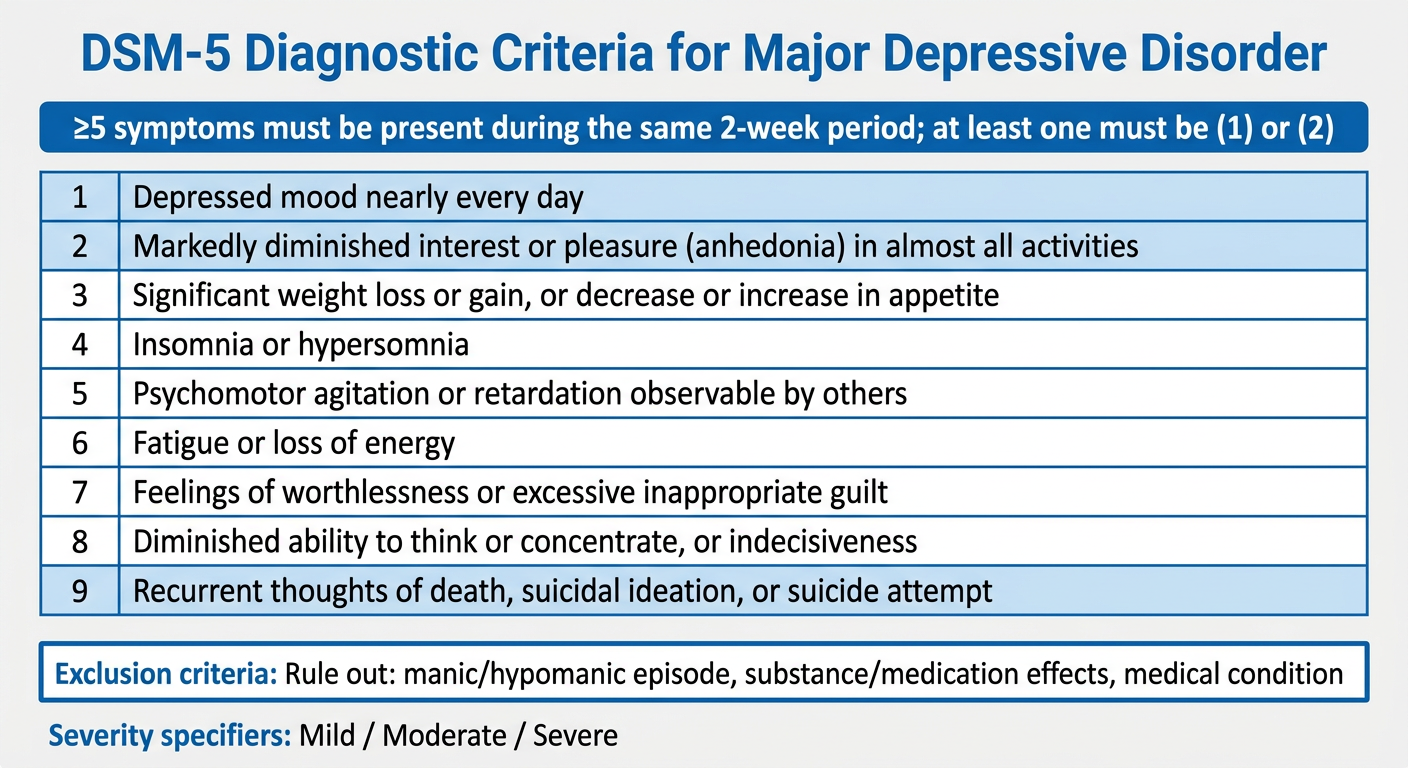
- At least 5 symptoms must be present for ≥ 2 weeks
- At least 1 must be criterion #1 (depressed mood) or #2 (anhedonia) - these are the anchor symptoms
| # | Criterion | Marissa |
|---|---|---|
| 1 | Depressed mood | ✅ |
| 2 | Anhedonia | ✅ |
| 3 | Weight/appetite change | ✅ |
| 4 | Insomnia/hypersomnia | ✅ |
| 5 | Psychomotor changes | ✅ |
| 6 | Fatigue | ✅ |
| 7 | Worthlessness/guilt | ✅ |
| 8 | Poor concentration | ✅ |
| 9 | Suicidal ideation with plan | ✅ |
now provide mind map or tree image for management algorithmn
A detailed clinical management algorithm mind map / flowchart tree for Major Depressive Disorder with High Suicide Risk. Central node at top labeled "MDD - SEVERE with Suicidal Ideation" in dark navy blue. Six main branches flowing downward in order: Branch 1 (red): "STEP 1: Immediate Safety" with sub-nodes: Inpatient Admission, Suicide Risk Assessment, 1-on-1 Nursing Monitoring, Remove Lethal Means (Pesticide), Family Safety Planning Branch 2 (dark blue): "STEP 2: Pharmacotherapy" with sub-nodes: SSRI First-Line (Sertraline 25-50mg), Titrate to 50-200mg/day, Limited Dispensing, Monitor for Agitation Week 1-2, Continue 6-12 months post-remission Branch 3 (orange): "STEP 3: Consider ECT" with sub-nodes: Imminent Lethal Intent, Medication Refusal, Treatment-Resistant Cases, Pre-ECT Medical Workup, Cognitive Monitoring Branch 4 (green): "STEP 4: Psychotherapy (after stabilization)" with sub-nodes: CBT - Restructure Maladaptive Beliefs, IPT - Address Interpersonal Conflicts, Behavioral Activation, Target Hopelessness and Guilt Branch 5 (purple): "STEP 5: Psychosocial" with sub-nodes: Family Psychoeducation, Social Work - Address Debts and Conflicts, Lifestyle Stabilization, Gradual Work Rehabilitation Branch 6 (dark gray): "STEP 6: Discharge and Maintenance" with sub-nodes: SI Resolved Before Discharge, Written Safety Plan, Verify Means Restriction, Follow-up Within 7 Days, Relapse Prevention Clean white background, professional medical infographic style, color-coded branches, clear readable sans-serif font, arrows connecting nodes.
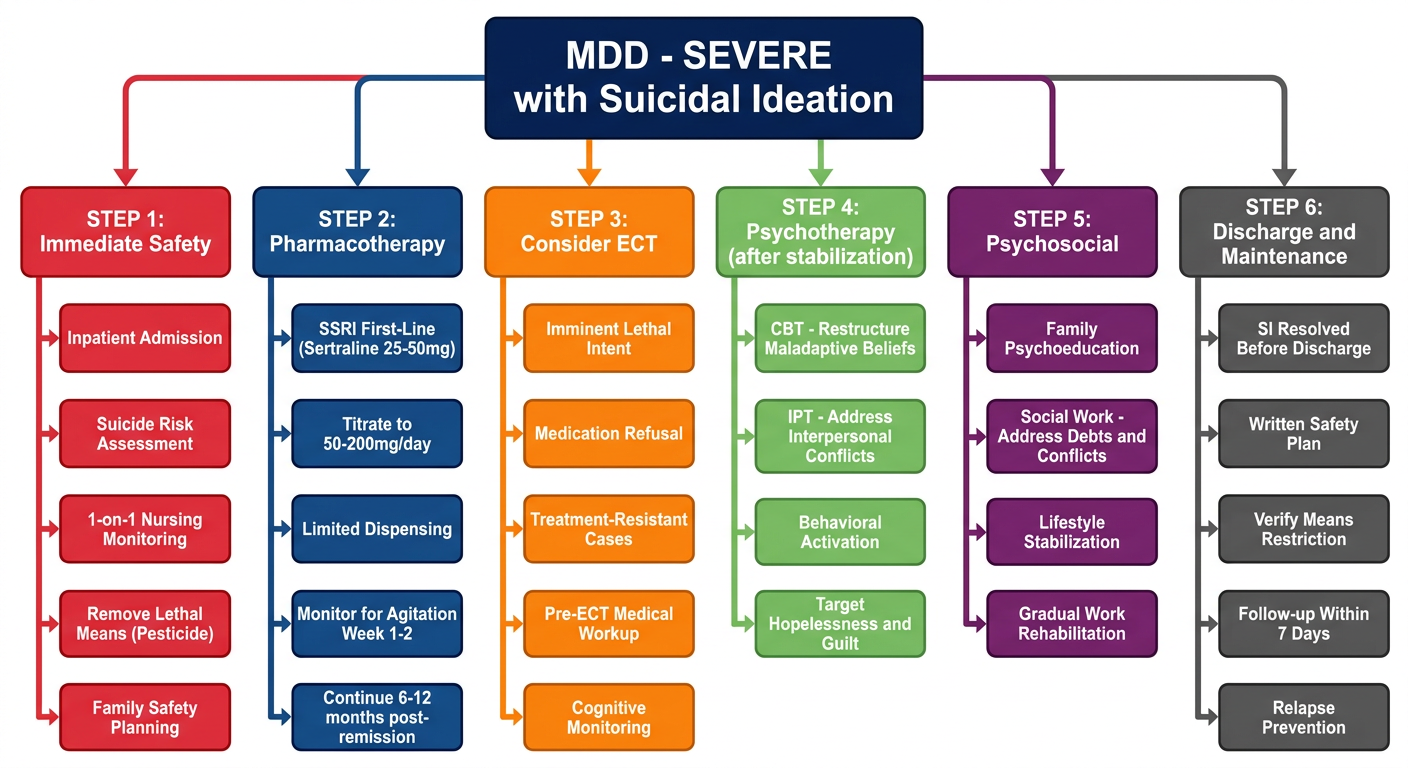
| Step | Branch | Core Action |
|---|---|---|
| 1 | 🔴 Safety | Admit → assess → monitor → remove pesticide → safety plan |
| 2 | 🔵 Pharmacotherapy | Sertraline SSRI → titrate → limited supply → 6-12 months |
| 3 | 🟠 ECT | Only if imminent risk, med refusal, or treatment failure |
| 4 | 🟢 Psychotherapy | CBT + IPT + Behavioral Activation (after stabilization) |
| 5 | 🟣 Psychosocial | Family education + social work + lifestyle + work rehab |
| 6 | ⚫ Discharge | SI resolved + written plan + means restricted + 7-day follow-up |
when to say its mild moderate or severe
MDD Severity: Mild vs. Moderate vs. Severe
🟡 MILD
- Meets the minimum criteria: exactly 5 symptoms
- Symptoms cause minor distress
- Functions normally or near-normally despite distress
- Social and occupational functioning is only mildly impaired
- No suicidal ideation
- Example: A person who feels low, has poor sleep and some fatigue, but still goes to work and manages daily tasks
🟠 MODERATE
- Symptom count and severity are between mild and severe
- 4+ symptoms present with moderate intensity
- Noticeable difficulty with daily functioning (social, occupational, or personal)
- May have passive thoughts of death but no active suicidal plan
- Requires more effort to carry out daily responsibilities
- Example: Someone who still goes to work but performs poorly, withdraws socially, struggles with self-care
🔴 SEVERE
- Number and intensity of symptoms are well beyond the diagnostic minimum
- Symptoms are markedly distressing
- Loss of self-esteem, worthlessness, and guilt are prominent
- Suicidal ideation - passive or with a plan/intent
- Inability to maintain basic self-care, work, or social function
- May or may not have psychotic features
| Sub-type | Description |
|---|---|
| Severe without psychotic features | All of the above, no hallucinations or delusions |
| Severe with psychotic features | Above + mood-congruent hallucinations or delusions (e.g., "I am evil, I deserve to die") |
Quick Comparison Table
| Feature | Mild | Moderate | Severe |
|---|---|---|---|
| Symptom count | Exactly 5 | 5-7 | 7-9 (most/all) |
| Distress level | Minor | Moderate | Marked |
| Work/social function | Preserved | Impaired | Lost/collapsed |
| Self-care | Intact | Partial | Neglected |
| Suicidal ideation | Absent | Passive/rare | Present, may have plan |
| Requires hospitalization | Usually no | Sometimes | Usually YES |
For Marissa Specifically
- ✅ Nearly all 9 criteria met (8/9)
- ✅ Complete functional collapse - stopped work, neglected self-care, social withdrawal
- ✅ Active suicidal ideation with a specific, lethal, accessible plan (pesticide at home)
Source: Kaplan & Sadock's Synopsis of Psychiatry, 12th Ed. - Severity specifiers for MDD
“Given her specific pesticide-suicide plan, how did you determine the appropriate level of observation?” “Would ECT be considered earlier in this patient because a rapid antisuicidal response may be needed, rather than waiting several weeks for an antidepressant?” “What criteria would you use to determine that she is safe enough for discharge?”
Q1: "Given her specific pesticide-suicide plan, how did you determine the appropriate level of observation?"
The Reasoning Process
| Risk Factor | Marissa's Status |
|---|---|
| Active suicidal ideation | ✅ Present |
| Specific, detailed plan | ✅ Pesticide ingestion |
| Access to lethal means | ✅ Pesticide kept AT HOME |
| High lethality of chosen method | ✅ Pesticide = very high case fatality rate |
| Hopelessness | ✅ Severe, worsening |
| Social isolation / withdrawal | ✅ Present |
| Impaired judgment | ✅ On MSE |
| Partial insight | ✅ Minimizes severity |
| Psychomotor retardation | ✅ May mask distress |
- A specific high-lethality plan is in place
- Partial insight means she may not disclose intent reliably
- Psychomotor retardation can be deceptive - patients can act suddenly despite appearing withdrawn
- She admitted the plan only to her sister, not proactively - suggesting she concealed it for weeks
- Immediate family instruction to remove and safely dispose of the pesticide before she could return home
- Environmental sweep of the inpatient unit
- Document the specific means restriction as part of the safety plan
Q2: "Would ECT be considered earlier in this patient because a rapid antisuicidal response may be needed, rather than waiting several weeks for an antidepressant?"
Short Answer: Yes - ECT is a legitimate early consideration here, and the argument is clinically strong.
The Clinical Argument for Early ECT
| Feature | Relevance to Marissa |
|---|---|
| Rapid antisuicidal effect | ECT reduces suicidal ideation often within 1-2 treatments, before full antidepressant effect |
| Acts within days, not weeks | Response seen in 1-2 weeks vs. 4-6 weeks for SSRIs |
| Most effective treatment for severe MDD | ECT is 20-40% more effective than medications (Kaplan Comprehensive) |
| Hopelessness responds to ECT | Hopelessness - her dominant cognitive symptom - is an ECT-responsive feature |
| Psychomotor retardation responds well | Melancholic/retarded depression is among ECT's best indications |
| No overdose risk | Unlike dispensing medications to a suicidal patient |
- Life-threatening suicidal intent with a specific lethal plan ← Marissa qualifies
- Severe psychomotor retardation with compromised oral intake ← partial - she needs encouragement to eat
- Rapid response is clinically urgent ← qualifies
- Medication refusal or medical contraindication ← not yet applicable
"ECT should be discussed and offered early in Marissa's case, not reserved as a last resort. Given her specific lethal plan, high-lethality method, hopelessness, and the 2-6 week delay before SSRI efficacy, ECT's rapid antisuicidal onset is a clinically compelling reason to offer it early. The standard approach would be to initiate sertraline immediately while simultaneously conducting the pre-ECT workup (medical, cardiac, neurological, anesthesia clearances), so ECT can begin promptly if she remains high-risk or fails to respond to pharmacotherapy within 1-2 weeks."
- Complete blood count, metabolic panel, thyroid function
- ECG (cardiac clearance)
- Neurological evaluation
- Anesthesia assessment
- Informed consent (with family involvement given impaired judgment)
Q3: "What criteria would you use to determine that she is safe enough for discharge?"
Discharge is NOT based on a single criterion - it requires a multi-domain checklist.
| Criterion | What to Look For in Marissa |
|---|---|
| Resolution of active suicidal ideation | She explicitly states she no longer wishes to die; ideation is absent or purely passive and ego-dystonic |
| No suicidal intent | No intent, no plan - not just "I won't do it right now" |
| Improvement in hopelessness | This is the most important predictor of near-term suicide risk; must show measurable reduction |
| Mood improvement | Not full remission, but meaningful response - able to engage, affect less restricted |
| Return of basic self-care | Independently bathing, eating, maintaining hygiene |
| Adequate sleep and appetite | Neurovegetative stabilization |
| Insight improvement | Acknowledges illness, accepts need for continued treatment |
- Pesticide has been physically removed from the home - verified by family, not just promised
- Family can confirm the home is free of other accessible lethal means
- Patient and family have been educated on warning signs of relapse
- A written, individualized safety plan has been completed and reviewed, containing:
- Personal warning signs (e.g., increased withdrawal, hopelessness)
- Internal coping strategies she can use alone
- Social contacts she can reach out to
- Crisis hotline numbers
- Emergency plan (who to call, where to go)
- She can articulate the safety plan back - not just sign a form
- Outpatient psychiatric follow-up confirmed and scheduled within 7 days
- Prescription for sertraline dispensed in small quantities (no more than a 1-2 week supply)
- Family/sister confirmed as active support and aware of their role
- Social work referral in place to address the financial and family stressors
- A patient simply saying "I won't do it" without behavioral and cognitive improvement
- Mood improvement alone without resolution of hopelessness
- Discharge before means restriction is verified
- Discharge without a confirmed outpatient follow-up appointment
Key clinical principle: Discharge is a clinical judgment, not a checklist tick. For Marissa, the resolution of hopelessness and confirmed pesticide removal are the two non-negotiable gates before any discharge conversation begins - because hopelessness is the strongest predictor of suicidal behavior, and her stated method remains accessible until it is physically removed.
Give above answer in short
Q1: Observation Level - Why 1-on-1?
- ✅ Active SI with a specific plan (pesticide ingestion)
- ✅ High-lethality method (organophosphate - case fatality >30-50%)
- ✅ Accessible means (pesticide kept at home)
- ✅ Partial insight - concealed plan for weeks, only disclosed to sister
- ✅ Psychomotor retardation - can mask intent and act suddenly
15-minute checks are for passive ideation only. A specific, high-lethality, accessible plan = continuous observation + immediate family instruction to remove/dispose of the pesticide.
Q2: Should ECT Be Considered Earlier?
| SSRIs | ECT | |
|---|---|---|
| Onset | 4-6 weeks | Days to 1-2 weeks |
| Antisuicidal effect | Delayed + early risk of agitation (FDA black box) | Rapid reduction in SI |
| Efficacy in severe MDD | Good | 20-40% more effective |
- Specific lethal plan with imminent risk ← Marissa qualifies
- Hopelessness is dominant ← qualifies
- Rapid response is urgently needed ← qualifies
Q3: Discharge Criteria - What Must Be Met?
- Suicidal ideation resolved (no intent, no plan)
- Hopelessness clearly reduced (most important predictor)
- Basic self-care restored (eating, bathing independently)
- Insight improved - accepts ongoing treatment
- Pesticide physically removed and verified by family - not just promised
- Home confirmed free of other lethal means
- Written, individualized plan completed
- Patient can articulate it back (not just sign it)
- Outpatient follow-up scheduled within 7 days
- Sertraline dispensed in small supply (1-2 weeks only)
- Family/sister briefed on warning signs
Non-negotiables: Hopelessness must improve + pesticide must be gone. "I won't do it" alone is not sufficient for discharge.
I can't get 3rd answer
Q3: Criteria to Determine Marissa is Safe for Discharge
4 Things That MUST All Be Present:
- No active SI, no intent, no plan
- Hopelessness is reduced - this is the single most important marker
- Simply saying "I won't do it" is NOT enough
- Pesticide physically removed from home - confirmed by family
- Home checked for other means (sharp objects, medications, etc.)
- Identifies her personal warning signs
- Lists who to call in a crisis
- She can explain it back in her own words - not just a signed form
- Outpatient psychiatry follow-up booked within 7 days
- Sertraline given in small supply only (1-2 weeks at a time)
- Sister/family briefed on warning signs and what to do
Also Helpful to See Before Discharge:
- She is eating and bathing on her own again
- She is engaging in conversation, affect is less restricted
- She acknowledges she is ill and agrees to continue treatment
One-line summary: Discharge when the plan is gone, the means are removed, the safety plan is written, and follow-up is booked - not before all four are done.
Is she able to discharge or not
No — Marissa Cannot Be Discharged at This Time
❌ Why She Cannot Be Discharged Now
| Discharge Criterion | Marissa's Current Status |
|---|---|
| Suicidal ideation resolved | ❌ Active SI with specific plan |
| Hopelessness reduced | ❌ Worsening hopelessness |
| Intent absent | ❌ Admitted intent to ingest pesticide |
| Lethal means removed | ❌ Pesticide still at home |
| Safety plan in place | ❌ None yet |
| Outpatient follow-up arranged | ❌ Not yet arranged |
| Self-care restored | ❌ Needs encouragement to bathe and eat |
| Insight adequate | ❌ Partial only - minimizes severity |
| Judgment intact | ❌ Impaired per MSE |
What Needs to Happen First
- Admit immediately to a secure inpatient psychiatric unit
- Family removes the pesticide from home today - before any home visit is considered
- Start sertraline and monitor closely
- Consider early ECT given specific lethal plan and urgent need for rapid response
- Begin psychotherapy once she is stable enough to engage
- Reassess daily - discharge conversation only begins when SI resolves AND hopelessness measurably improves
Bottom line: Discharging Marissa now would be clinically dangerous. She has a specific, high-lethality, accessible plan and severely impaired judgment. She is a high acute suicide risk requiring inpatient stabilization before any discharge is considered.
“Given her specific pesticide-suicide plan, how did you determine the appropriate level of observation?” “Would ECT be considered earlier in this patient because a rapid antisuicidal response may be needed, rather than waiting several weeks for an antidepressant?” “What criteria would you use to determine that she is safe enough for discharge?”
Q1: Level of Observation
- Pesticide ingestion has a case fatality rate >30-50% - very narrow rescue window
- She concealed the plan for weeks - partial insight means she cannot be relied upon to disclose intent
- Psychomotor retardation can mask intent - calm-appearing patients can act suddenly
- 15-minute checks are only appropriate for passive ideation without a plan
- With a named method and accessible means = continuous observation until risk de-escalates
Q2: Should ECT Be Considered Earlier?
- SSRIs take 4-6 weeks to work
- In weeks 1-2, SSRIs can increase agitation and SI (FDA black box warning)
- That is a dangerous window for someone with a specific lethal plan
- Rapid antisuicidal effect - within days to 1-2 weeks
- Hopelessness and psychomotor retardation respond particularly well to ECT
- No overdose risk unlike dispensing medications to a suicidal patient
- 20-40% more effective than medications for severe MDD
Q3: Discharge Criteria
- Active SI resolved - no intent, no plan
- Hopelessness measurably reduced (most important single marker)
- Self-care restored - eating and bathing independently
- Insight improved - accepts illness and treatment
- Pesticide physically removed from home - verified by family, not just promised
- Home checked for other means
- Personal warning signs identified
- Crisis contacts listed
- Patient can explain it back in her own words
- Outpatient psychiatry follow-up within 7 days - booked, not just planned
- Sertraline dispensed in 1-2 week supply only
- Sister/family briefed on warning signs
One rule: If hopelessness has not improved and the pesticide is still at home - discharge discussion does not begin, regardless of anything else.
Answer for this case in 3 Rd question yes or no why
Q3 Answer for Marissa's Case: NO — She is NOT safe for discharge
❌ NO — and here is why, criterion by criterion:
Score: 0 out of 8 criteria met
Discharging Marissa now would be life-threatening. She has a specific, high-lethality, immediately accessible suicide plan, worsening hopelessness, impaired judgment, and zero safety infrastructure in place. She requires inpatient stabilization until all criteria are met.