
Patient coming with the puritis. What the cause for him? With the patient, the provider is what the meaning for that. Mm-hmm. Symptom. And what are the diseases caused the, the two writers? Can you tell with the different diagnosis in between the diseases?
Reading File
Finding Sources
Finding Sources
Searching PubMed
pruritus etiology diagnosis
Reading File
Reading File
Pruritus (Itching): Cause, Meaning as a Symptom, and Differential Diagnosis
1. What pruritus actually means
Pruritus (itching) is a symptom, not a disease. It's defined as an unpleasant cutaneous sensation that provokes the urge to scratch. When a provider says a patient has "pruritus," they are documenting a complaint, not a diagnosis - the real work is finding the underlying cause. Per the WHO Global Burden of Disease study, pruritus is one of the 50 most common symptoms encountered across specialties, and if it persists beyond 6 weeks it's classified as chronic pruritus, which behaves very differently from acute itch (acute itch usually has an obvious trigger like an allergen or urticaria flare and resolves once that's treated; chronic itch involves persistent peripheral and central nervous system sensitization that can outlast the original cause) - Fitzpatrick's Dermatology, p. 387.
2. How diseases causing itch are classified (the "two" categories)
The International Forum for the Study of Itch (IFSI) groups chronic pruritus by the condition of the skin, which is the key first branch point in differential diagnosis:
- Group I - Pruritus on diseased/inflamed skin: a visible primary skin disorder explains the itch (eczema, psoriasis, scabies, urticaria, contact dermatitis, fungal infection).
- Group II - Pruritus on normal-appearing skin: no primary rash is visible, which points toward a systemic, renal, hepatic, endocrine, hematologic, or neurologic cause.
- Group III - Pruritus with chronic secondary scratch lesions: prurigo nodules, lichenification, excoriations from long-standing scratching, seen in either dermatologic or systemic disease.
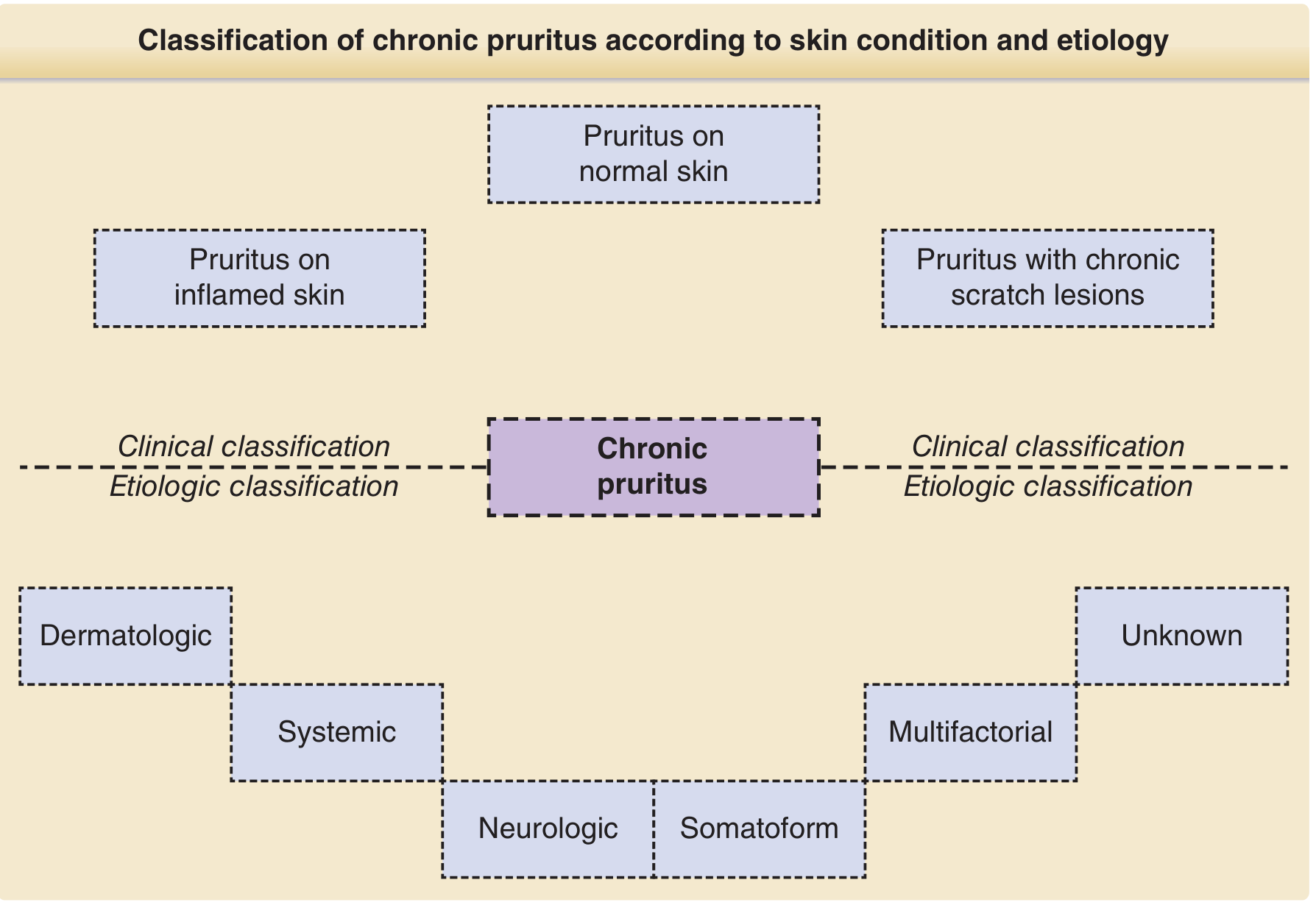
This distinction (skin disease present vs. skin looks normal) is the single most useful differential-diagnosis tool at the bedside, because it tells you whether to biopsy the skin or work up systemic disease.
3. Main causes, organized by category
A. Skin (dermatologic) diseases - itch with visible rash
- Eczema/atopic dermatitis, contact dermatitis, urticaria (hives), psoriasis
- Infections/infestations: scabies, tinea (fungal), lice, insect bites (fleas, mosquitoes)
- Xerosis (dry skin) - very common in the elderly and usually of no systemic significance
B. Systemic (generalized) diseases - itch with normal-appearing skin
- Renal failure / uremia (uremic pruritus, common in dialysis patients)
- Hepatic/cholestatic disease (obstructive jaundice, primary biliary cholangitis)
- Endocrine: thyrotoxicosis (hyperthyroidism), diabetes mellitus (also causes localized pruritus vulvae/ani)
- Hematologic/oncologic: iron-deficiency anemia, polycythemia vera, lymphoma (especially Hodgkin lymphoma) and other malignancies
- (S. Das, A Manual on Clinical Surgery, p. 20; Fitzpatrick's Dermatology)
C. Local irritation (localized itch, e.g. anal/vulvar/scrotal pruritus)
- Perianal conditions: hemorrhoids, fissures, fistulas, threadworm infestation, fungal infection (Candida, Epidermophyton), excess moisture/poor hygiene
- Pruritus vulvae has its own set of local causes distinct from systemic disease
D. Drug-induced pruritus
- Opioids, antimalarials (especially in African American patients), SSRIs, and drugs that cause cholestatic liver injury - usually via allergic hypersensitivity, and it varies between individuals
E. Neurologic and psychogenic causes
- Neuropathic itch (e.g., notalgia paresthetica, brachioradial pruritus, post-stroke itch)
- Psychiatric/psychogenic pruritus, including delusions of parasitosis, anxiety, and somatic symptom disorders - Kaplan & Sadock's Comprehensive Textbook of Psychiatry
F. Pregnancy-specific
- Intrahepatic cholestasis of pregnancy (ICP) - itch without primary skin lesions, important to distinguish from other pregnancy dermatoses that DO have primary lesions (e.g., PUPPP) - Fitzpatrick's Dermatology
4. How to differentiate between these diseases clinically
| Clue | Points toward |
|---|---|
| Visible primary rash/lesions | Dermatologic cause (eczema, scabies, psoriasis, urticaria) |
| Normal skin, generalized itch | Systemic cause - check renal function, LFTs, TSH, CBC/iron studies, HIV, and consider chest imaging if lymphoma suspected |
| Anal/genital localization only | Local irritation (hemorrhoids, threadworm, Candida, hygiene, diabetes) |
| Itch started after new medication | Drug-induced pruritus |
| Itch in a specific dermatome/band, burning quality | Neuropathic pruritus |
| No organic findings, secondary gain/psychiatric history | Psychogenic pruritus |
| Pregnant patient, worse at night, abnormal LFTs, no rash | Intrahepatic cholestasis of pregnancy |
The practical workup sequence a provider follows: (1) full skin exam to place the patient in IFSI Group I, II, or III, (2) history for new drugs, pregnancy, systemic symptoms (weight loss, night sweats -> lymphoma; polyuria/polydipsia -> diabetes; jaundice -> cholestasis), (3) targeted labs (renal panel, LFTs, TSH, CBC with iron studies, sometimes HIV and chest X-ray) if skin is normal, (4) skin biopsy if a dermatosis is suspected but not obvious.
Recent evidence note
A 2024 Cochrane systematic review (PMID: 38837237) evaluated interventions for postburn pruritus, and a 2025 systematic review/meta-analysis (PMID: 39173895) assessed gabapentin/pregabalin for pruritus generally - both relevant if the itch is neuropathic or burn-related and doesn't respond to standard antihistamines. These don't contradict the etiology framework above, they refine treatment options once a cause is identified.
This is a shared conversation. Sign in to Orris to start your own chat.