
Explain apoptosis
Reading File
Finding Sources
Searching the Web
apoptosis mechanism pathways overview
The best textbook sources are Robbins & Kumar Basic Pathology and Sleisenger & Fordtran's GI (which has the most paragraphs). Let me read both in parallel.
Reading File
Reading File
Searching Images
apoptosis intrinsic extrinsic pathway diagram caspase
I have rich textbook content and a diagram. Let me read more of the Robbins section on mechanisms of apoptosis.
Reading File
I now have comprehensive textbook content. Let me compose a thorough answer.
Apoptosis
Apoptosis is a form of programmed cell death in which cells activate intracellular enzymes that methodically dismantle their own nuclear DNA, nuclear envelope, and cytoplasmic proteins. The dying cell fragments into membrane-bound apoptotic bodies that are rapidly phagocytosed by macrophages — the plasma membrane remains intact throughout, so cellular contents never spill out and no inflammatory reaction is triggered. This distinguishes apoptosis sharply from necrosis.
Morphological Features
| Feature | Description |
|---|---|
| Cell shrinkage | Cytoplasm condenses; organelles pack more tightly |
| Chromatin condensation | Nuclear chromatin aggregates at the nuclear envelope (pyknosis) |
| Nuclear fragmentation | Nucleus breaks into discrete pieces (karyorrhexis) |
| Membrane blebbing | Plasma membrane blebs outward |
| Apoptotic bodies | Cell fragments into membrane-enclosed particles |
| Phagocytosis | Bodies cleared by macrophages/neighboring cells without inflammation |
When Apoptosis Occurs
Physiologic situations (essential, beneficial):
- Embryonic development — sculpting organs, eliminating interdigital webbing
- Turnover of proliferating tissues (intestinal epithelium, lymphocytes)
- Involution of hormone-dependent tissues (endometrium after menstruation)
- Eliminating self-reactive lymphocytes to prevent autoimmunity
- Culling surplus leukocytes after an immune response resolves
Pathologic situations (damage-triggered):
- Severe DNA damage (radiation, cytotoxic drugs) — p53-mediated
- Accumulation of misfolded proteins (ER stress)
- Certain viral infections
- Cytotoxic T lymphocyte (CTL)-mediated killing of infected/tumor cells
The Two Pathways of Apoptosis
Both converge on caspase activation — cysteine proteases that cleave proteins after aspartic acid residues. Initiator caspases (caspase-8, -9) activate executioner caspases (caspase-3, -6, -7), which carry out the actual demolition.
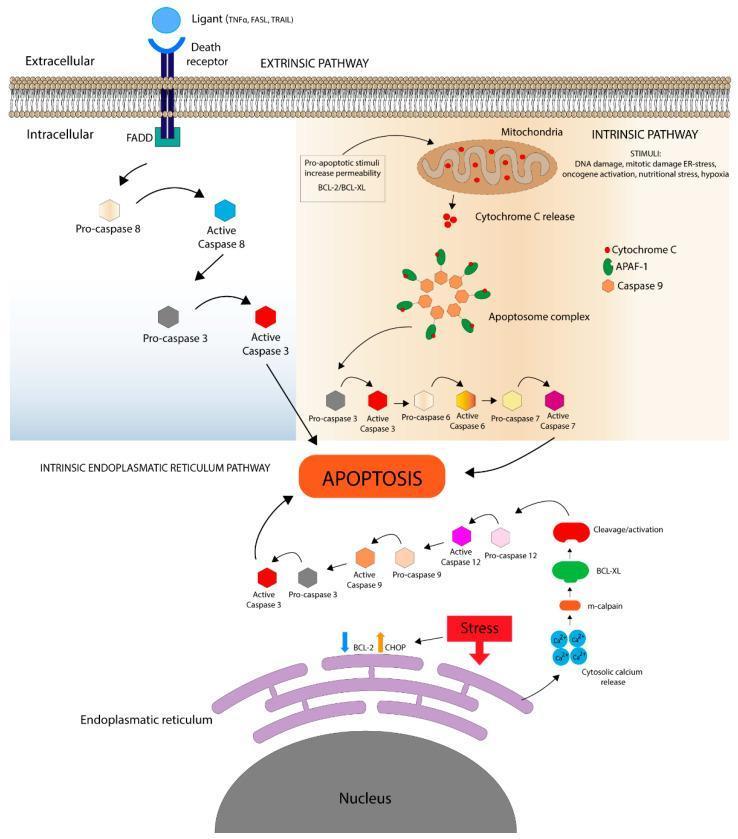
1. Intrinsic (Mitochondrial) Pathway
The dominant pathway in most physiologic and pathologic apoptosis.
Trigger: Loss of survival signals, DNA damage, misfolded protein accumulation, hypoxia, toxins.
Key steps:
- Sensor proteins called BH3-only proteins (e.g., BIM, BID, PUMA, NOXA) are activated by cellular stress.
- They shift the balance toward pro-apoptotic BAX and BAK, which dimerize and insert into the outer mitochondrial membrane, forming channels.
- Simultaneously, survival signals drop → levels of anti-apoptotic BCL-2 and BCL-XL fall.
- Cytochrome c (and other proteins like SMAC/DIABLO) leaks from the mitochondrial intermembrane space into the cytosol.
- Cytochrome c + APAF-1 + pro-caspase-9 assemble into the apoptosome.
- The apoptosome activates caspase-9, which cleaves and activates executioner caspases-3 and -7.
BCL-2 family — the master switch:
| Pro-apoptotic | Anti-apoptotic |
|---|---|
| BAX, BAK (pore-formers) | BCL-2, BCL-XL, MCL-1 |
| BH3-only sensors (BIM, BID, PUMA…) |
The ratio of pro- to anti-apoptotic BCL-2 family members determines cell fate. In cancer, BCL-2 overexpression (e.g., follicular lymphoma t(14;18)) tips the balance toward survival.
2. Extrinsic (Death Receptor) Pathway
Trigger: Binding of extracellular "death ligands" to surface death receptors.
Key players:
- Receptors: FAS (CD95), TNFR1, TRAIL-R (DR4/5) — all members of the TNF receptor superfamily containing a cytoplasmic "death domain."
- Ligands: FasL (on activated T cells), TNF-α, TRAIL.
Key steps:
- Ligand binds → receptor trimerizes → death domains recruit adaptor protein FADD.
- FADD recruits pro-caspase-8 → the Death-Inducing Signaling Complex (DISC) forms.
- Proximity-induced auto-cleavage activates caspase-8.
- Caspase-8 directly activates executioner caspases-3 and -7.
- In some cells (type II), caspase-8 also cleaves BID → truncated tBID → amplifies via the mitochondrial pathway.
c-FLIP (a catalytically inactive caspase-8 homologue) is a key inhibitor that blocks DISC assembly, serving as an anti-apoptotic brake.
The Execution Phase
Once executioner caspases (3, 6, 7) are active, they cleave:
- CAD (caspase-activated DNase) — released from its inhibitor ICAD → cleaves DNA into ~180 bp fragments (ladder pattern on gel electrophoresis)
- Nuclear lamins → nuclear envelope breakdown
- Cytoskeletal proteins → cell shrinkage and blebbing
- Various signaling proteins → cell disassembly
Clearance: "Eat-Me" Signals
Apoptotic cells display phosphatidylserine (PS) on the outer leaflet of the plasma membrane (normally inner leaflet only). This "eat-me" signal is recognized by phagocyte receptors (e.g., TIM-4, MerTK) → efferocytosis (phagocytic clearance) without triggering inflammation.
Apoptosis vs. Necrosis
| Feature | Apoptosis | Necrosis |
|---|---|---|
| Trigger | Programmed / regulated | Uncontrolled injury |
| Cell size | Shrinks | Swells |
| Membrane integrity | Maintained | Disrupted |
| DNA cleavage | Organized (ladder) | Random |
| Inflammation | None | Yes (DAMPs released) |
| Fate of debris | Phagocytosed as bodies | Lysed, contents spill |
Clinical Significance
| Condition | Apoptosis role |
|---|---|
| Cancer | BCL-2 overexpression or caspase loss → cells evade apoptosis → uncontrolled proliferation |
| Neurodegenerative disease | Excess apoptosis of neurons (Alzheimer's, Parkinson's, ALS) |
| Autoimmunity | Failure to eliminate self-reactive lymphocytes via Fas pathway (e.g., ALPS — autoimmune lymphoproliferative syndrome) |
| Ischemic injury | Apoptosis at the ischemic penumbra following stroke/MI |
| HIV | CD4+ T cell depletion partly via apoptosis |
| Therapeutics | Venetoclax (BCL-2 inhibitor) reactivates apoptosis in CLL; many chemotherapeutics work by triggering the intrinsic pathway |
Sources: Robbins & Kumar Basic Pathology, p. 24–26; Sleisenger & Fordtran's Gastrointestinal and Liver Disease, p. 23.
This is a shared conversation. Sign in to Orris to start your own chat.