


Given is the case of retinoblastoma, make a detailed case presentation from top to bottom including provisional diagnosis, differential diagnosis and final diagnosis
Reading File
Finding Sources
Searching the Web
retinoblastoma case presentation clinical features leukocoria diagnosis management
Reading File
Reading File
Searching PubMed
retinoblastoma diagnosis classification treatment
Reading File
Reading File
Reading File
Loading Image
Reading File
Loading Image
Reading File
I now have comprehensive data from the clinical documents and textbooks. Let me compile the full structured case presentation.
CASE PRESENTATION: RETINOBLASTOMA
Institution: Bharatpur Eye Hospital, Bharatpur, Chitwan
Department: Pediatrics / Ophthalmology
Date: 17 June 2026
I. PATIENT PROFILE
| Parameter | Details |
|---|---|
| Patient Name | B/O Laxmi Gurung (infant) |
| Age/Sex | 30 days / Male |
| Registration No. | 83031985 |
| Address | Bandipur Rural Municipality-6, Tanahun |
| Referred from | Community level |
| Birth Weight | 3300 grams |
| Gestational Age | ~37 weeks (near-term) |
II. CHIEF COMPLAINTS
- Redness of eyes x 10 days
- Watery discharge from eyes x 10 days
- White pupillary reflex (leukocoria) noted by parents
- Poor visual response (child fails to blink/respond to light, RE)
III. HISTORY OF PRESENT ILLNESS
A 30-day-old male infant, B/O Laxmi Gurung, born at Bandipur Rural Municipality, presented with a 10-day history of bilateral eye redness and watery discharge. The mother noticed that the right eye did not appear to follow movement or respond to light. There was no watering or photophobia noted initially, though discomfort was inferred from the infant's irritability. The infant was started empirically on Tobramycin eye drops twice daily for 2 days at the community level with no improvement.
No history of:
- Trauma to the eye
- Fever or systemic illness
- Antenatal infections (TORCH complex not documented)
- Family history of retinoblastoma, glaucoma, night blindness, or retinal detachment
No H/O of illness in the maternal history noted on the record.
IV. BIRTH AND DEVELOPMENTAL HISTORY
- Birth weight: 3300 grams
- Gestational age: near-term (~37 weeks, estimated from notes)
- No NICU admission documented
- No history of oxygen supplementation (makes retinopathy of prematurity less likely)
V. PAST MEDICAL / SURGICAL HISTORY
- No prior systemic illness
- No prior ocular surgery
- Current medications: Tobramycin eye drops
VI. FAMILY HISTORY
- No documented family history of retinoblastoma
- Negative for glaucoma, retinal detachment, night blindness in parents
VII. EXAMINATION FINDINGS
A. General Examination
- Infant, alert, age-appropriate weight
- No dysmorphic facies
- No proptosis noted on initial inspection
B. Visual Acuity (Unaided)
| Eye | Visual Acuity |
|---|---|
| RE (OD) | BLC - blinks to light, responds to light (poor) |
| LE (OS) | Blinks to light - glow (+) noted on retinoscopy |
- No H/O of illness with prognosis documented by the examining physician
- Visual field (confrontation): Intact (+) bilaterally (gross screen)
C. Ocular Motility
- Hirschberg test: not documented
- Ocular motility: Full in all directions
D. Slit Lamp Examination (RE)
| Structure | Findings |
|---|---|
| Lids/Adnexa | Not remarkable |
| Conjunctiva | - |
| Cornea | Corneal edema (+) |
| Anterior Chamber | Shallow |
| Pupil | Dilated, non-reactive (pupil dilated/NVI - neovascularization of iris noted) |
| Lens | Hazy |
E. Slit Lamp Examination (LE)
- AC: Deep
- Pupil: Reactive, glow (+)
- Cornea: Clear
- Normal anterior segment
F. Funduscopy (Indirect Ophthalmoscopy)
| Eye | Findings |
|---|---|
| RE (OD) | NVI (neovascularization of iris); Corneal scar/edema; AC shallow; Pest glow (-) - absent red reflex / leukocoria; Media hazy |
| LE (OS) | AC deep; Glow (+) - normal red reflex; Normal fundal glow preserved |
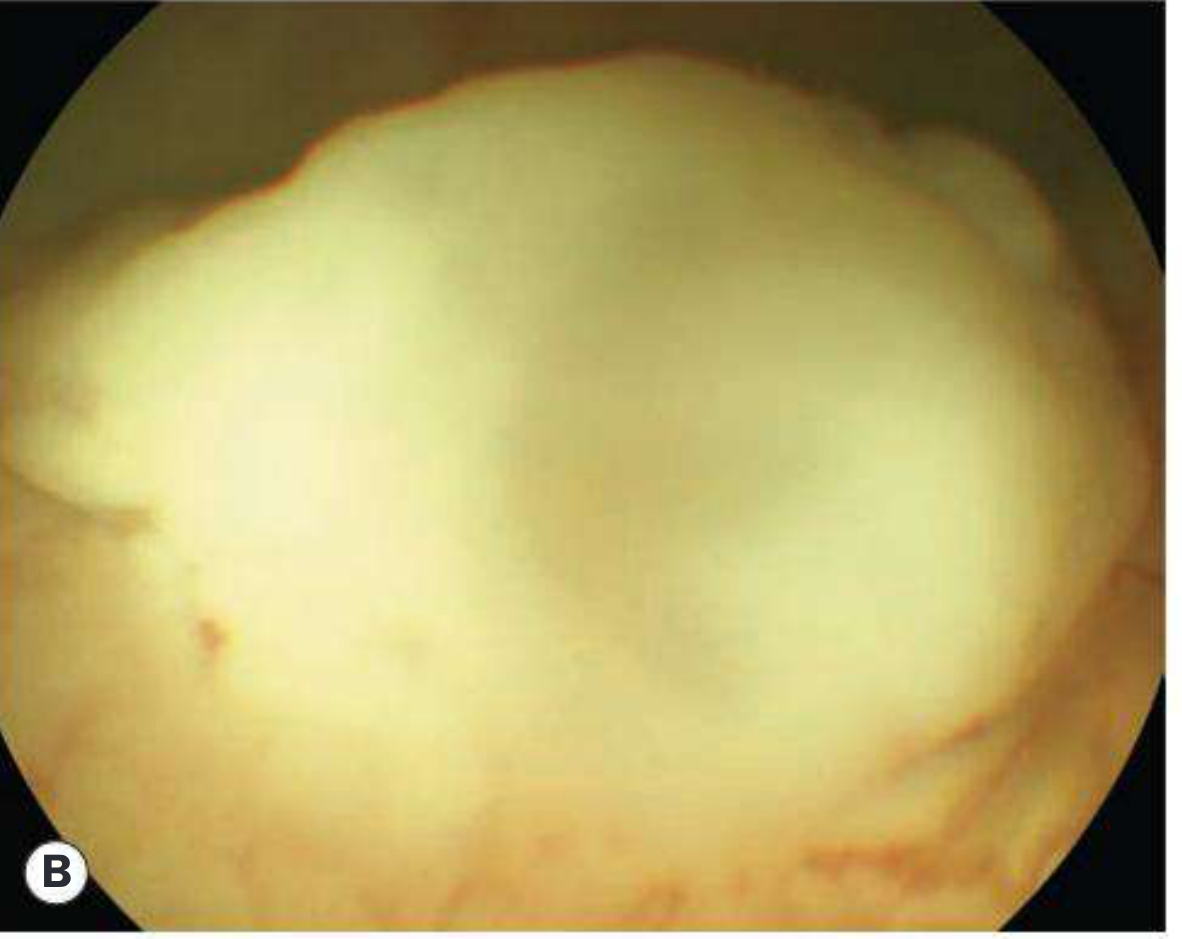
Fundal diagram (RE): Loss of red reflex, hazy media suggesting intraocular mass occupying the globe. Corneal edema and NVI indicate secondary glaucoma.
G. IOP
- Not formally documented (NCT/Schiotz deferred due to corneal edema)
- Clinical evidence of raised IOP: corneal edema, dilated fixed pupil, NVI - consistent with secondary glaucomatous stage
VIII. INVESTIGATIONS
A. B-Scan Ultrasonography (Oculus Dexter - RE)
Right Eye (OD/R):
B-scan shows a large, echogenic, hyperreflective intraocular mass with:
- Irregular, lobulated borders
- Calcified foci producing characteristic high-amplitude acoustic echoes
- Retinal detachment component
- No normal posterior vitreous clear space (mass fills most of the globe)
- High internal reflectivity on A-scan - consistent with calcification within tumor
- Written interpretation: "Globe shows irregular echogenic mass with calcification - retinoblastoma vs. atypical lesion"
Left Eye (OS):
- B-scan: Normal posterior segment
- Normal globe dimensions
- No intraocular mass
- Written note: "Normal P/S" (posterior segment)
This is illustrated by the B-scan images provided:
The B-scan images of the OD (images 2 & 3 in your documents) show:
- Top-left panel: Quiet/early scan - subtle mass visible
- Top-right panel: Full globe scan - large hyperechoic mass filling the vitreous cavity
- Bottom two panels: Lobulated mass with internal calcification foci and acoustic shadowing - classic for retinoblastoma
The OS B-scan (images 1 of document 1) shows a normal-appearing posterior segment with clear vitreous.
IX. PROVISIONAL DIAGNOSIS
RE: Retinoblastoma (Right Eye) - Advanced Intraocular Stage (Group D-E per IIRC)
Supporting features:
- Neonatal/infant age (30 days) - within the classic age range
- Absent red reflex (leukocoria) in the RE
- NVI (rubeosis iridis) - neovascularization of iris
- Secondary glaucoma features: corneal edema, dilated non-reactive pupil, shallow AC
- B-scan showing large echogenic intraocular mass with calcification
- Hazy media - consistent with vitreous seeding (endophytic component)
- Left eye normal - possible unilateral sporadic or early-presentation bilateral disease
As written by Dr. Anisha Thapa (MD Resident, Ophthalmology, NMC 32135):
"RE: Retinoblastoma" - with advice for USG B-scan bilateral and referral to higher centre.
X. DIFFERENTIAL DIAGNOSIS
All conditions presenting with leukocoria in an infant must be considered. The following table outlines the key differentials and distinguishing features:
1. Coats Disease
- Telangiectatic retinal vessels with massive subretinal exudation
- Almost always unilateral
- More common in boys, typically presents later (mean age 5 years; older than retinoblastoma)
- B-scan: no calcification; subretinal lipid-rich fluid with low reflectivity
- Distinguishing: No calcification on B-scan/CT; no solid tumor mass; Coats is older at presentation
- Against this diagnosis: Age only 30 days; B-scan shows solid mass with high-reflectivity echoes
2. Persistent Fetal Vasculature (PFV) / Persistent Hyperplastic Primary Vitreous (PHPV)
- Unilateral leukocoria from failure of regression of the primary vitreous
- Typically microphthalmic eye
- Retrolental fibrovascular membrane visible
- No calcification
- B-scan: retrolental membrane, small globe
- Distinguishing: No solid mass, microphthalmia, no calcification
- Against: Globe appears normal/large in this infant; solid mass on B-scan with calcification
3. Retinopathy of Prematurity (ROP) - Advanced
- Occurs in premature, low birth-weight infants requiring oxygen supplementation
- Bilateral fibrovascular proliferation, tractional retinal detachment
- Distinguishing: History of prematurity and NICU/O2 supplementation required
- Against: Birth weight 3300g, no history of prematurity or oxygen, no NICU stay; age of presentation too early for advanced ROP changes
4. Congenital Cataract
- White pupillary reflex from lens opacity
- Slit-lamp shows lens opacification
- No intraocular mass
- No calcification on B-scan
- Distinguishing: Lens opacity on slit lamp; no posterior segment mass
- Against: B-scan shows a posterior mass, not an anterior lens abnormality; Hazy media is attributed to NVI/corneal edema, not isolated lens opacity
5. Endophthalmitis (Bacterial/Fungal)
- Can present with hypopyon, hazy media, painful red eye
- Inflammatory cells in vitreous can appear as a mass on B-scan
- Distinguishing: History of trauma/sepsis; blood cultures; vitreous tap positive; no calcification
- Against: No history of penetrating trauma; B-scan shows calcified solid mass not consistent with inflammatory debris alone
6. Toxocara (Ocular Toxocariasis)
- Posterior pole granuloma can mimic endophytic retinoblastoma
- Usually presents in older children (2-10 years); history of contact with dogs/cats, pica
- Serology (ELISA) for Toxocara positive
- Distinguishing: Age of child; epidemiological history; serology; typically no calcification
- Against: Age 30 days - far too young; no epidemiological exposure possible
7. Norrie Disease / Vitreoretinal Dysplasia
- X-linked recessive; bilateral blindness at birth, cochlear deafness, mental retardation
- Bilateral dysplastic retina with retrolental mass
- Distinguishing: Bilateral; genetic testing; associated systemic features
- Against: Only one eye affected; no systemic features documented; solid calcified mass on B-scan
XI. SUMMARY OF DISTINGUISHING FEATURES FAVORING RETINOBLASTOMA
| Feature | Present in this Case |
|---|---|
| Age < 3 years (neonatal) | Yes - 30 days |
| Leukocoria (absent red reflex RE) | Yes - "pest glow (-)" |
| Solid intraocular mass on B-scan | Yes |
| Calcification on B-scan | Yes (high-amplitude echoes) |
| Secondary glaucoma (NVI, corneal edema) | Yes |
| Hazy media (vitreous seeding) | Yes |
| Unilateral (RE involved, LE normal) | Yes |
| No history of prematurity | Yes (birth weight 3300g, near-term) |
XII. FINAL DIAGNOSIS
RE: RETINOBLASTOMA (RIGHT EYE)
- Classification: International Intraocular Retinoblastoma Classification (IIRC) - Group D or E
- Group D: Extensive disease with vitreous or subretinal seeding
- Group E: Very advanced disease with one or more of: irreversible neovascular glaucoma, massive intraocular hemorrhage, corneal staining, aseptic orbital cellulitis, tumor anterior to vitreous face
Basis of Final Diagnosis:
- Clinical: Leukocoria RE, NVI, secondary glaucoma, hazy media, shallow AC, dilated non-reactive pupil
- Imaging: B-scan USG showing large echogenic calcified intraocular mass occupying the globe with retinal detachment
- Left eye: Normal (unilateral disease, possibly sporadic non-heritable form - 90% of unilateral cases are non-heritable)
- Physician diagnosis confirmed: "RE: Retinoblastoma" - documented by examining ophthalmologist
LE: No evidence of retinoblastoma (normal B-scan, normal red reflex, normal fundal glow)
XIII. MANAGEMENT PLAN
Immediate
- USG B-scan bilateral (already performed - confirms RE mass, normal LE)
- Refer to higher centre (Pediatric Oncology + Ocular Oncology) - as documented on the prescription
Investigations to Be Arranged at Referral Centre
- MRI orbit + brain (without CT if possible to avoid radiation) - to assess optic nerve involvement, extraocular extension, pinealoblastoma
- CT orbit (if MRI not immediately available) - detects calcification in 95% of cases; confirms diagnosis
- Examination Under Anesthesia (EUA) - full fundoscopic documentation, tumor mapping, measurement
- Systemic staging: Physical examination, bone scan, lumbar puncture, bone marrow aspiration if high-risk features present
- Genetic testing (RB1 gene) - blood sample from patient and parents; siblings should be screened if germline mutation found
Treatment Options (Decision at Referral Centre Based on Staging)
| Stage | Treatment |
|---|---|
| Small intraocular (Group A/B) | Focal consolidation: laser photocoagulation, thermotherapy, cryotherapy |
| Moderate (Group C/D) | IV chemotherapy (Carboplatin + Etoposide + Vincristine - CEV regimen, 3-6 cycles) ± focal treatment |
| Advanced (Group D/E) | Selective intra-arterial chemotherapy (ophthalmic artery infusion - melphalan/topotecan) or Enucleation |
| This case (Group E likely) | Enucleation of RE is most likely required given advanced glaucomatous changes; histopathology to assess high-risk features; followed by systemic chemotherapy if needed |
| LE monitoring | Bilateral EUA screening at regular intervals; RB1 genetic testing |
- Per Kanski's Clinical Ophthalmology 10th ed.: Chemotherapy (CEV) is the mainstay; selective ophthalmic artery infusion gives "significantly better results than intravenous treatment in eyes classified as group D." However, eyes with neovascular glaucoma and corneal decompensation typically require enucleation.
Follow-Up After Treatment
- Regular EUA screening LE until age 5-7 years
- Genetic counseling for parents and siblings
- Long-term surveillance for second malignancies (osteosarcoma, pinealoblastoma) if heritable form confirmed
- Low vision rehabilitation as needed
- Psychological support for parents (documented high rates of depression/anxiety in parents of retinoblastoma children)
XIV. PROGNOSIS
- Survival: >95% in specialized centers with timely treatment
- Globe salvage: Advanced disease (Group D/E) with NVI and secondary glaucoma has poor globe salvage prognosis; enucleation is likely required for RE
- Vision: LE vision should be preserved with close monitoring
- Genetic risk: If germline RB1 mutation identified, 50% transmission risk to offspring; siblings require urgent screening
XV. KEY TEACHING POINTS
- Retinoblastoma is the most common primary intraocular malignancy of childhood (1:18,000 live births) and the second most common intraocular tumor after uveal melanoma - Kanski's Clinical Ophthalmology, 10th ed.
- Leukocoria (absent red reflex) in any child must be treated as retinoblastoma until proven otherwise.
- The "two-hit hypothesis" (Knudson): both alleles of RB1 tumor suppressor gene on chromosome 13q14 must be inactivated for tumor development.
- B-scan USG is the primary imaging tool for diagnosis and follow-up; calcification in 90-95% is pathognomonic.
- MRI (not CT) is preferred for optic nerve evaluation and intracranial spread (MRI does not use ionizing radiation, which is important given these children's predisposition to radiation-induced second malignancies).
- Secondary glaucoma with NVI and corneal edema indicates advanced (glaucomatous) stage - this eye is unlikely to be salvaged but the child's life can be saved with enucleation and chemotherapy.
- Heritable form (40%) = bilateral, multifocal, younger age; predisposed to trilateral retinoblastoma (pinealoblastoma), osteosarcoma, soft tissue sarcomas.
Sources:
- Kanski's Clinical Ophthalmology: A Systematic Approach, 10th edition - Ch. 20 (Retinoblastoma)
- Grainger & Allison's Diagnostic Radiology, 6th ed. - Ch. 60 (Orbital Tumors)
- Robbins & Kumar Basic Pathology - Ch. 4 (Pediatric Tumors)
- Singh L et al. "Epidemiology, Diagnosis and Genetics of Retinoblastoma: ICMR Consensus Guidelines." Indian J Pediatr. 2024 Nov [PMID: 38492167]
- AAO Review of Retinoblastoma; UpToDate Apr 2026
This is a shared conversation. Sign in to Orris to start your own chat.