
Trichomycosis axillaris
Reading File
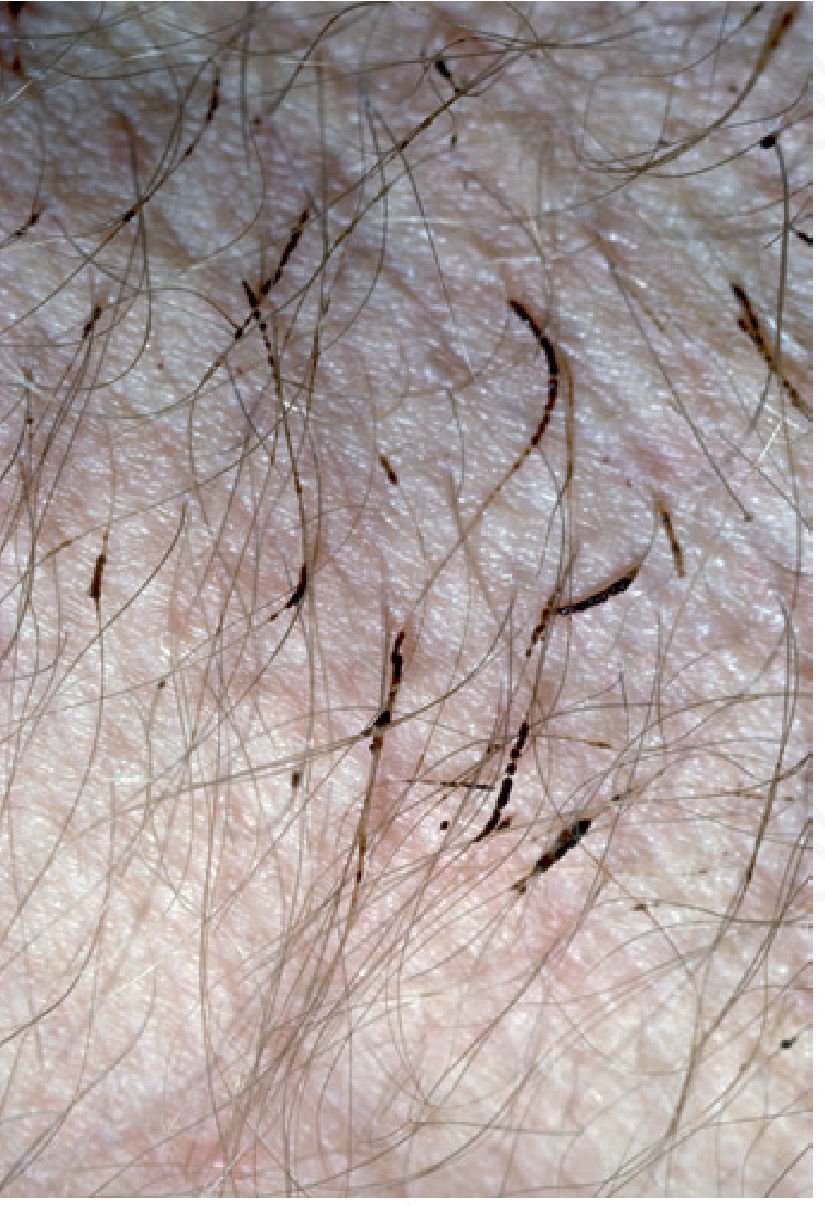
Trichomycosis axillaris is a superficial bacterial infection of axillary (and occasionally pubic) hair shafts, caused by Corynebacterium species (mainly C. tenax). It presents as yellow, red, or black nodular concretions coating the hair shafts, associated with hyperhidrosis and malodor.
Searching sources...
Finding Sources
Searching PubMed
trichomycosis axillaris
Good hits. Let me read all three textbook sections in parallel.
Reading File
Reading File
Reading File
Loading Image
Here is a thorough overview of trichomycosis axillaris drawn from three dermatology/urology textbooks.
Trichomycosis Axillaris
Synonyms: Trichobacteriosis axillaris, trichomycosis pubis (when pubic hair is involved)
Despite its name, this is not a fungal infection - it is a bacterial condition caused by Corynebacterium species.
Etiology and Pathogenesis
Trichomycosis axillaris is a superficial bacterial infection of axillary and, less frequently, pubic hair shafts, caused by Corynebacterium species (principally C. tenax, a Gram-positive rod). Occasionally, scalp hairs in infants can be affected. Large numbers of corynebacteria form compact concretions that adhere firmly to the hair shaft. Hyperhidrosis is a major predisposing factor, as the warm, moist apocrine-gland-rich environment of the axilla favors bacterial colonization.
Clinical Features
- Hair shaft nodules or cylindrical sheaths - discrete, 1-2 mm concretions firmly attached to the hair shaft, visible to the naked eye
- Color variants: yellow (most common), red, or black - the color corresponds to pigment produced by different Corynebacterium strains
- Characteristic odor - often the presenting complaint; the apocrine sweat is altered by bacterial metabolism
- Chromhidrosis-like staining - sweat may take on a red/yellow color and stain clothing
- Hyperhidrosis of the affected region is almost always present
- Yellowish discoloration of the axillary skin may be noted
- The condition frequently goes unnoticed by the patient
Diagnosis
| Method | Finding |
|---|---|
| Clinical examination | Colored nodules/sheaths on hair shafts |
| Magnification | Distinguishes from pediculosis and piedra |
| Wood's lamp | Pale yellow fluorescence |
| Gram stain of concretions | Gram-positive rods (corynebacteria) |
| KOH | Negative (rules out fungal piedra) |
Differential diagnosis: White piedra (Trichosporon spp.), black piedra (Piedraia hortae), pediculosis pubis (nits/lice), hair casts.
Associated Conditions
Trichomycosis axillaris may coexist with other corynebacterial infections - a "corynebacterial triad":
- Erythrasma (C. minutissimum - coral-red fluorescence on Wood's lamp)
- Pitted keratolysis (plantar surface pitting and odor)
- Trichomycosis axillaris
All three share hyperhidrosis and poor hygiene as risk factors.
Treatment
| Approach | Details |
|---|---|
| Shaving | Fastest and most immediately effective; instant cure by removing the infected hair |
| Topical antibiotics | Clindamycin 1% gel/solution or erythromycin - first-line |
| Benzoyl peroxide | Antibacterial and astringent properties |
| Naftifine | Has both antifungal and antibacterial properties |
| Antibacterial cleansers | Prevent recurrences |
| Hyperhidrosis control | Topical aluminum chloride; addresses underlying predisposing factor |
| Oral erythromycin | 500-1000 mg/day for refractory cases |
The combination of a topical antibiotic plus a modality that decreases hyperhidrosis gives the best sustained results. Shaving alone provides immediate improvement but recurrence is common unless sweating is also addressed.
Key Points Summary
- Despite the name "-mycosis," it is bacterial (corynebacterial), not fungal
- Predisposed by hyperhidrosis and apocrine-rich skin sites
- Yellow > red > black nodular concretions on hair shafts
- Wood's lamp: pale yellow fluorescence (vs. coral-red of erythrasma)
- Treatment: shave + topical clindamycin/erythromycin ± benzoyl peroxide
- Part of the corynebacterial triad with erythrasma and pitted keratolysis
Sources: Andrews' Diseases of the Skin (Clinical Dermatology); Dermatology 2-Volume Set 5e; Campbell-Walsh-Wein Urology
Recent literature (2023-2025) continues to confirm Corynebacterium as the sole causative genus and supports topical antibiotics plus hygiene measures as the standard of care (PMID 37900398 - comprehensive 2023 review; PMID 40125056 - 2025 clinicoetiological study).
This is a shared conversation. Sign in to Orris to start your own chat.