
interstitial lung disease etiology and treatment
Reading File
Reading File
Finding Sources
Searching PubMed
"Lung Diseases, Interstitial"[MeSH Terms] AND "therapy"
Searching the Web
interstitial lung disease classification treatment guideline progressive pulmonary fibrosis nintedanib nerandomilast
Reading File
Finding Sources
Reading File
Reading File
Reading File
Finding Sources
Interstitial lung disease (ILD): etiology and treatment
ILD is a group of more than 200 disorders. They share inflammation and/or fibrosis of the alveolar walls and perialveolar tissue. This leads to restrictive physiology, impaired gas exchange and, in many cases, progressive fibrosis.
Etiology
1. Known cause
- Connective tissue disease (CTD-ILD): rheumatoid arthritis, systemic sclerosis, myositis/antisynthetase syndrome, SLE, Sjögren, MCTD.
- Rheumatoid ILD is more common in men (about 3:1), in smokers, and with high rheumatoid factor titers or nodules.
- The MUC5B promoter variant is linked to RA-ILD, specifically the UIP pattern. - Murray & Nadel's Textbook of Respiratory Medicine
- Systemic sclerosis ILD typically shows lower-lobe peripheral reticulation and ground-glass opacities on HRCT. - Goldman-Cecil Medicine
- Drugs and treatments: amiodarone, nitrofurantoin, methotrexate, bleomycin and other chemotherapy, checkpoint inhibitors, and thoracic radiation.
- Environmental and occupational exposures:
- Inorganic dusts cause pneumoconioses: asbestos, silica, coal, beryllium.
- Organic antigens cause hypersensitivity pneumonitis (HP): birds, mold, humidifiers, hot tubs.
- Smoking-related: respiratory bronchiolitis-ILD, desquamative interstitial pneumonia, Langerhans cell histiocytosis, and combined pulmonary fibrosis and emphysema.
2. Granulomatous: sarcoidosis (cause unknown), HP, and vasculitides such as GPA.
3. Idiopathic interstitial pneumonias
- IPF is the most common and has the worst prognosis.
- Others are idiopathic NSIP, cryptogenic organizing pneumonia (COP), AIP, and LIP.
- IPF typically affects people over 60, with slowly progressive dyspnea, dry cough, inspiratory crackles, and clubbing in roughly 45-75%. - The Washington Manual of Medical Therapeutics
- Risk factors include smoking, MUC5B, and telomere-related gene mutations (TERT, TERC). Short telomere syndrome accounts for about 15% of familial pulmonary fibrosis.
4. Other: pulmonary alveolar proteinosis, eosinophilic pneumonias, lymphangioleiomyomatosis, and others.
Diagnosis rests on four steps:
- Exclude exposures, CTD and drugs.
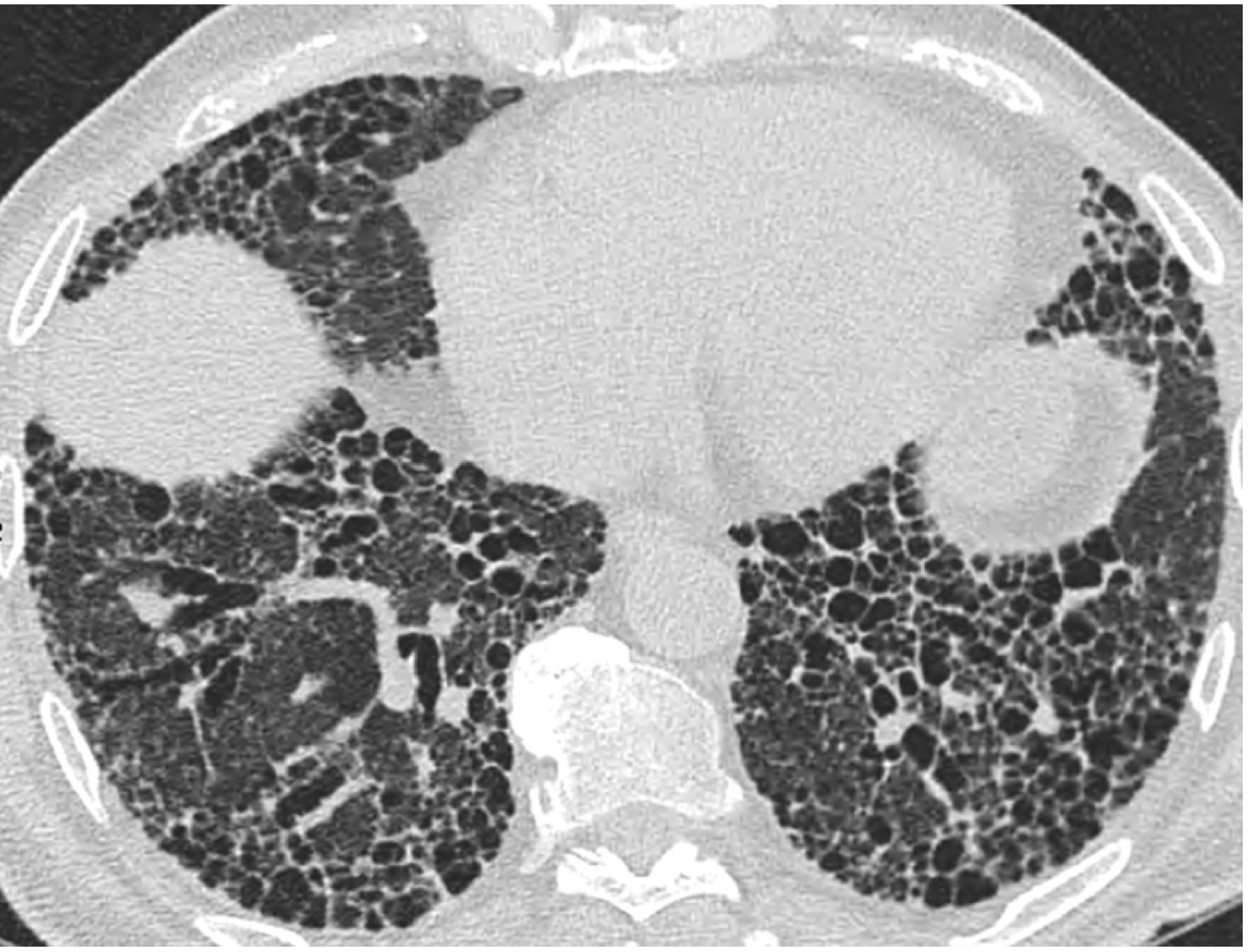
- HRCT, which is mandatory. A definite UIP pattern shows honeycombing with subpleural, basal-predominant reticulation.
- BAL or biopsy when needed. Surgical (VATS) biopsy is preferred over transbronchial biopsy, which is diagnostic in under one-third of cases.
- Multidisciplinary discussion, which improves diagnostic accuracy. - The Washington Manual of Medical Therapeutics
Treatment
Treatment depends on the specific diagnosis. A summary from The Washington Manual of Medical Therapeutics:
| Subtype | Main approach |
|---|---|
| Drug-induced | Stop the culprit drug, steroids if needed |
| CTD-ILD (UIP, NSIP, COP) | Corticosteroids plus immunosuppression (mycophenolate, azathioprine, cyclophosphamide, rituximab) |
| IPF | Antifibrotics: pirfenidone or nintedanib |
| DIP, RB-ILD | Smoking cessation (steroids probably of limited benefit) |
| Sarcoidosis | Corticosteroids; methotrexate, azathioprine or infliximab as steroid-sparing agents |
| HP | Antigen avoidance; steroids or immunosuppression; antifibrotic if fibrotic and progressive |
IPF specifics
- There is no cure.
- Pirfenidone and nintedanib slow the decline in forced vital capacity (FVC) and may reduce mortality.
- Nintedanib commonly causes diarrhea (about 62%), nausea and vomiting.
- Pirfenidone commonly causes rash (about 30%), photosensitivity and nausea.
- Monitor liver tests with both drugs.
- Avoid immunosuppression in IPF. The combination of prednisone, azathioprine and N-acetylcysteine increased death and hospitalization.
- Supportive care: pulmonary rehabilitation (improves 6-minute walk distance and quality of life), oxygen, vaccination, GERD and comorbidity management, palliative care, and early lung transplant referral.
Systemic sclerosis ILD: add nintedanib (150 mg twice daily) or tocilizumab (162 mg subcutaneously weekly) alongside immunosuppression. - Goldman-Cecil Medicine
Progressive pulmonary fibrosis (PPF)
- Up to one-third of non-IPF ILD patients develop a progressive fibrosing phenotype. It is defined by worsening symptoms, FVC decline and radiographic progression, regardless of cause. - Goldman-Cecil Medicine
- Nintedanib slows FVC decline in PPF (INBUILD trial).
- Immunosuppression remains first-line for CTD-ILD and HP.
Recent developments (web and PubMed)
- Nerandomilast (Jascayd) is a PDE4B inhibitor. According to Medscape, it is now approved for IPF and PPF in adults. The FIBRONEER-IPF and FIBRONEER-ILD trials supported this. I did not review the trial data directly.
- Recent systematic reviews are on steroids in acute exacerbation of ILD (PMID 39721758), antifibrotics started during acute exacerbation (PMID 40561888), and oxygen therapy in fibrotic ILD (PMID 38718907). I haven't read their abstracts in detail, so check them before relying on them for decisions. The textbook content above is consistent with the general guideline approach. Treatment of acute exacerbations is the area most likely to have been updated.
If you'd like more depth on one subtype (IPF, HP, CTD-ILD or sarcoidosis), the diagnostic algorithm, or drug dosing and monitoring, tell me which.
This is a shared conversation. Sign in to Orris to start your own chat.