
Turners syndrome
Reading File
Turner syndrome is a chromosomal condition in females caused by partial or complete absence of one X chromosome (45,X is the classic karyotype). Key features include short stature, gonadal dysgenesis (streak ovaries), primary amenorrhea, webbed neck, shield chest, and cardiovascular defects (especially bicuspid aortic valve and coarctation of the aorta). Treatment includes growth hormone therapy and estrogen replacement.
Searching sources...
Finding Sources
Searching PubMed
"Turner syndrome"[MeSH Terms] AND management
Good. Now let me read the most comprehensive sources - Robbins Pathology (basic and pathologic basis), plus the embryology text.
Reading File
Reading File
Reading File
Now let me get the rest of the Robbins Pathologic Basis section (which had more content) and the clinical features image:
Reading File
Loading Image
I now have comprehensive information from Robbins & Kumar. Let me compile the full answer.
Turner Syndrome
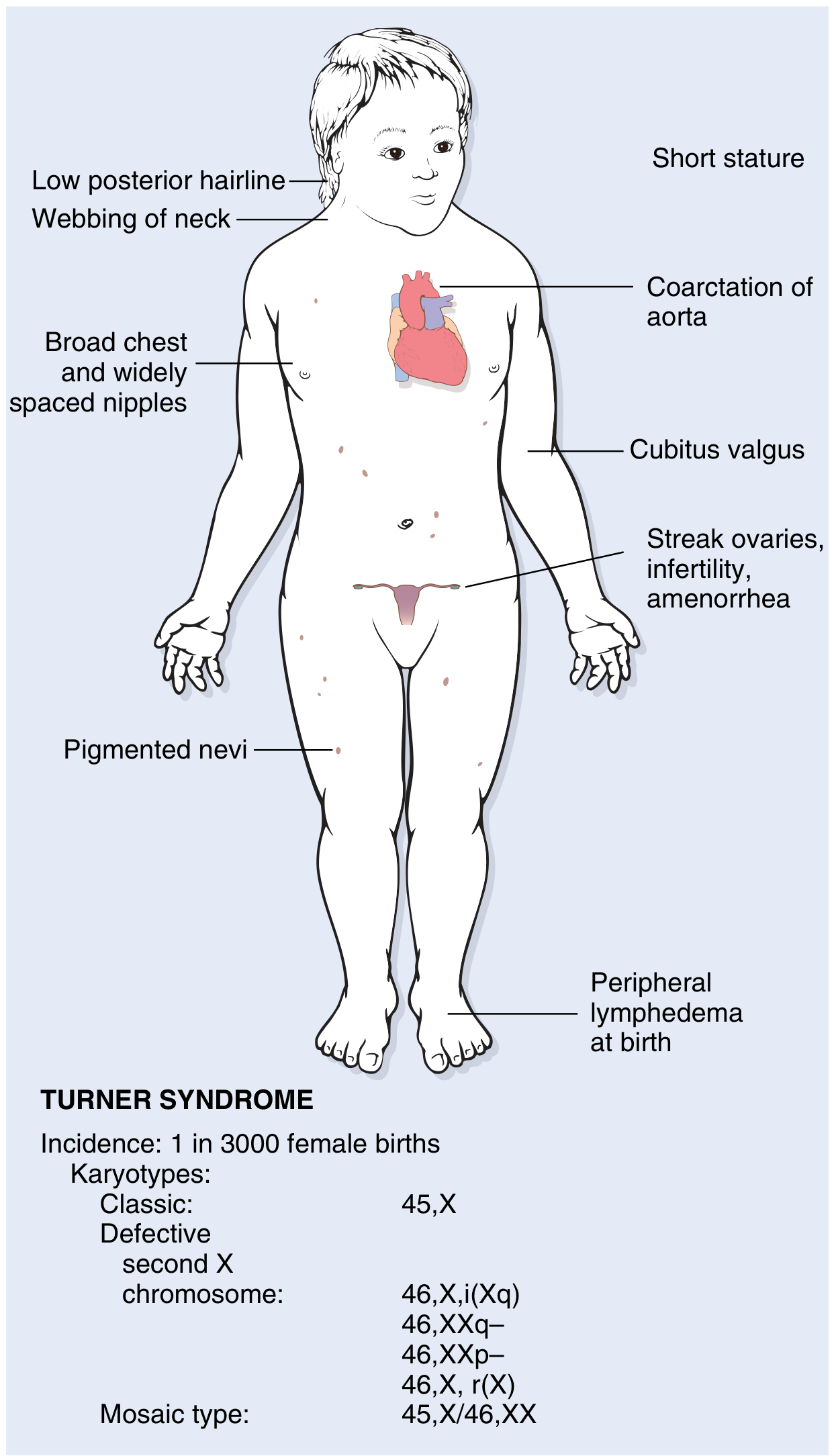
Fig. 4.20 - Clinical features and karyotypes of Turner syndrome (Robbins & Kumar Basic Pathology)
Definition
Turner syndrome is characterized by primary hypogonadism in phenotypic females, resulting from complete or partial monosomy of the X chromosome. It is the most common sex chromosome abnormality in females.
- Incidence: approximately 1 in 2,000-3,000 live-born females
- Only ~1% of monosomy X embryos survive to birth; the 45,X karyotype accounts for ~18% of all chromosomally abnormal spontaneous abortions
Karyotypes
| Type | Karyotype | Frequency |
|---|---|---|
| Classic | 45,X | ~57% |
| Isochromosome of long arm | 46,X,i(Xq10) - loss of short arm | Most common structural variant |
| Ring chromosome | 46,X,r(X) - deletion of both long and short arm portions | Less common |
| Short/long arm deletion | 46,X,del(Xp) or 46,X,del(Xq) | Less common |
| Mosaic | 45,X/46,XX; 45,X/46,XY; 45,X/47,XXX | ~29% |
Key point: 5-10% of patients have Y chromosome sequences (e.g., 45,X/46,XY). These patients carry a significantly elevated risk of gonadoblastoma and require prophylactic gonadectomy.
The true prevalence of mosaicism may be as high as 75% when more sensitive techniques are used. Patients with a higher proportion of 45,X cells have a more severe phenotype; those with detectable 45,X/46,XX mosaicism may appear nearly normal and present only with primary amenorrhea.
Pathogenesis
- In ~80% of cases, the X chromosome retained is maternal in origin, implying an error in paternal gametogenesis (absent or defective sperm contributes most errors).
- The fetal ovaries develop normally up to ~18 weeks of gestation, but the absence of the second X leads to accelerated oocyte attrition, complete by age 2 years - effectively "menopause before menarche."
- SHOX gene (at Xp22.33, pseudoautosomal region, escapes X inactivation): haploinsufficiency of SHOX is responsible for short stature. Normally, both males and females have two copies. SHOX is expressed in the growth plates of long bones (radius, ulna, tibia, fibula).
- Genes on the short arm largely determine somatic features; genes on the long arm influence fertility and menstruation.
Clinical Features
At Birth / Infancy
- Peripheral lymphedema of dorsum of hands and feet (due to lymph stasis)
- Cystic hygroma - markedly distended lymphatic channels at the nape of neck, later manifests as neck webbing
- Congenital heart disease in 25-50% of patients
Somatic Features (Childhood onward)
- Short stature (below 3rd percentile) - most consistent feature
- Webbed neck (pterygium colli) with low posterior hairline
- Shield chest with broad thorax and widely spaced nipples
- Cubitus valgus (increased carrying angle of the arms)
- High-arched palate
- Pigmented nevi
- Horseshoe kidney
Cardiovascular (most common cause of death in childhood)
- Preductal coarctation of the aorta (most common cardiac lesion)
- Bicuspid aortic valve
- Aortic root dilation in ~30% of cases
- 100-fold increased risk of aortic dissection
- ~5% of young females initially diagnosed with coarctation of the aorta have Turner syndrome
Reproductive / Endocrine (Adolescence/Adulthood)
- Primary amenorrhea (most common presenting complaint in adults)
- Failure to develop secondary sexual characteristics at puberty
- Infantile external genitalia, minimal breast development, sparse pubic hair
- Streak ovaries - bilateral fibrous white strands devoid of follicles and ova (result of oocyte attrition)
- Infertility (a very small number of mosaic patients can conceive)
Other Systemic Associations
- Autoimmune hypothyroidism - antithyroid autoantibodies are common; up to 50% of patients (especially those with isochromosome Xp) develop clinical hypothyroidism
- Glucose intolerance, insulin resistance, obesity, non-alcoholic fatty liver disease - a subset develops full metabolic syndrome
- Subtle deficits in visuospatial information processing - overall intellect is generally within normal limits
- Sensorineural hearing loss (noted in ENT literature)
Diagnosis
- Short stature + primary amenorrhea in an adolescent/adult female - strong clinical suspicion
- Karyotype (peripheral blood lymphocytes) - confirmatory
- Prenatal: detected on maternal serum screening (elevated hCG, low estriol) or fetal ultrasound (cystic hygroma, nuchal translucency, hydrops, cardiac defects)
- FISH or array CGH for detecting mosaicism or structural rearrangements with Y material
Management
| Problem | Treatment |
|---|---|
| Short stature | Recombinant growth hormone (GH) therapy (started early in childhood); note: GH worsens insulin resistance |
| Hypogonadism / puberty induction | Estrogen replacement (low-dose estrogen at ~12-13 years, then cyclical estrogen/progesterone) |
| Fertility | Not typically achievable without donor oocytes + IVF |
| Cardiovascular | Echocardiography screening; surgical correction of coarctation; aortic surveillance (MRI) |
| Hypothyroidism | Levothyroxine supplementation |
| Y-chromosome material | Prophylactic gonadectomy to prevent gonadoblastoma |
| Psychological | Support for identity, peer relationships, and body image issues |
Recent Evidence (2025)
Recent systematic reviews add important updates:
- A 2025 meta-analysis (PMID 40557696) confirms the impact of karyotype on congenital heart disease risk in Turner syndrome - structural variants carry different CHD profiles than classic 45,X.
- A 2025 meta-analysis (PMID 41243107) quantifies the global prevalence of autoimmune diseases in Turner syndrome, underscoring the need for systematic autoimmune surveillance.
- A 2025 systematic review (PMID 39743222) on karyotype-phenotype associations in non-mosaic X chromosome structural rearrangements helps predict clinical severity.
Sources: Robbins & Kumar Basic Pathology; Robbins, Cotran & Kumar Pathologic Basis of Disease; The Developing Human - Clinically Oriented Embryology
This is a shared conversation. Sign in to Orris to start your own chat.