
Classification of amino acids chart biochem
Reading File
Now let me search the medical library for amino acid classification content:
Finding Sources
Finding Sources
Excellent - found dedicated sections in two top biochemistry textbooks. Let me read both:
Reading File
Reading File
Let me now read the detailed classification section from Basic Medical Biochemistry and fetch the key classification images from Lippincott:
Reading File
Loading Image
Loading Image
Now let me fetch the acidic and basic side chain images:
Loading Image
Loading Image
Loading Image
I now have all the content and images needed. Let me also read the detailed classification section from Basic Medical Biochemistry for the complete pKa table and essential/non-essential info:
Reading File
Classification of fatty acids chart biochem
Fatty acids are classified by chain length (short/medium/long/very long), degree of saturation (saturated, monounsaturated, polyunsaturated), and whether they are essential (linoleic, alpha-linolenic). The double bond position and configuration (cis vs trans) also determine their biological role.
Searching sources...
Finding Sources
Finding Sources
Finding Sources
Finding Sources
Reading File
Reading File
Reading File
Reading File
Reading File
Loading Image
Loading Image
Loading Image
Reading File
Reading File
I now have everything needed for a comprehensive answer. Let me compile it all.
Classification of Fatty Acids - Biochemistry
A fatty acid is an aliphatic carboxylic acid with a hydrophobic hydrocarbon chain. The carboxyl group (pKa ~4.8) ionizes at physiologic pH to -COO⁻, giving the molecule its amphipathic character. Carbon numbering starts at the carboxyl end (C1 = α), with the terminal methyl carbon called the ω (omega) carbon.
Notation: [carbons]:double bonds - e.g., 18:2(9,12) = 18 carbons, 2 double bonds at C9 and C12.
1. Classification by Chain Length
(Lippincott's Illustrated Biochemistry 8e, Fig. 16.4)
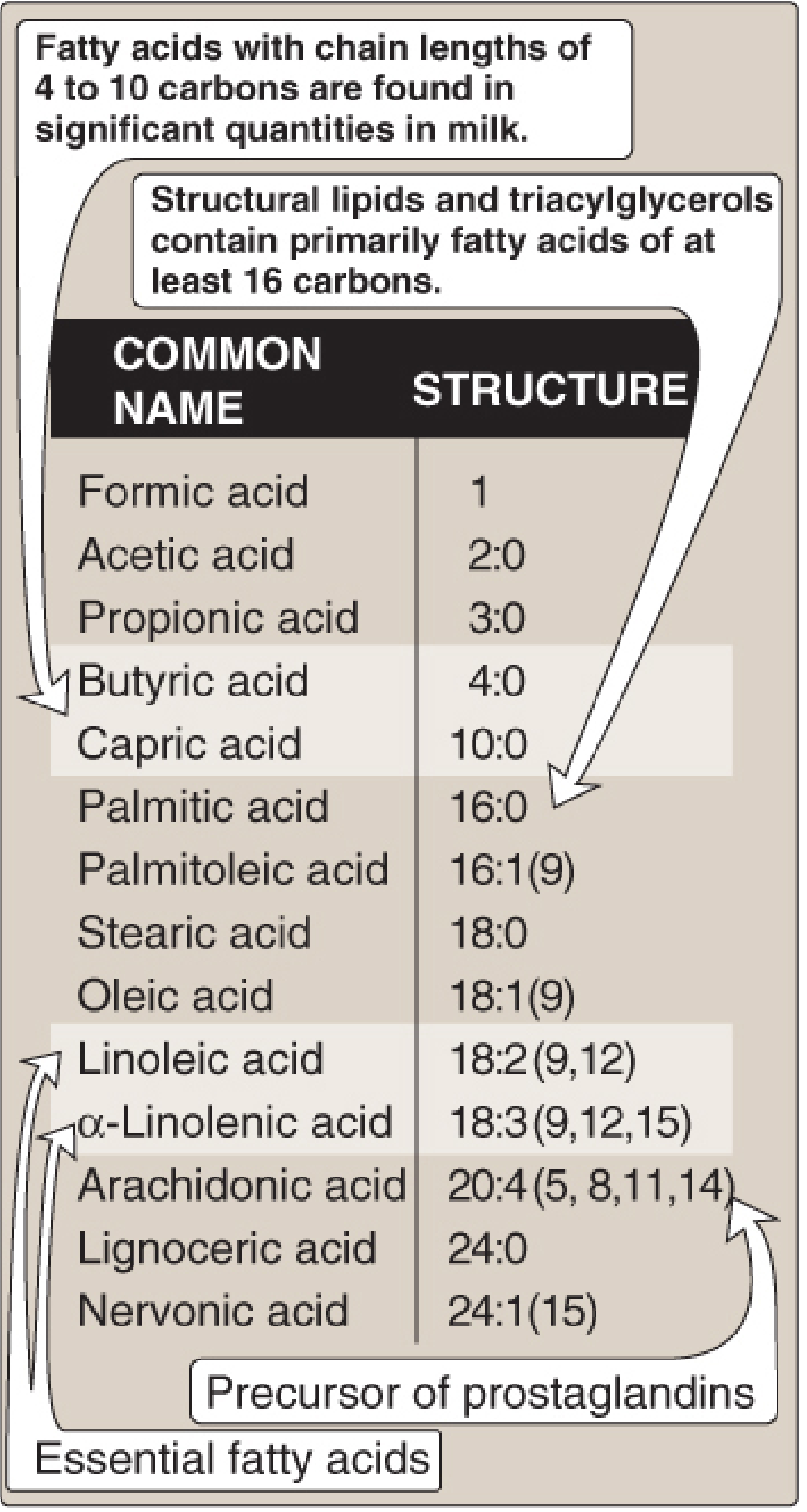
| Class | Carbon Atoms | Examples | Key Features |
|---|---|---|---|
| Short-chain | 2-4 | Acetic (2:0), Butyric (4:0) | Water-soluble; found in butter; fermentation products |
| Medium-chain | 6-12 | Caproic (6:0), Capric (10:0), Lauric (12:0) | Found in milk/coconut oil; don't require carnitine for mitochondrial entry |
| Long-chain | 14-20 | Palmitic (16:0), Stearic (18:0), Oleic (18:1), Arachidonic (20:4) | Most common in structural lipids and triacylglycerols |
| Very long-chain | ≥22 | Lignoceric (24:0), Nervonic (24:1) | Abundant in brain; peroxisomal oxidation required |
2. Classification by Degree of Saturation
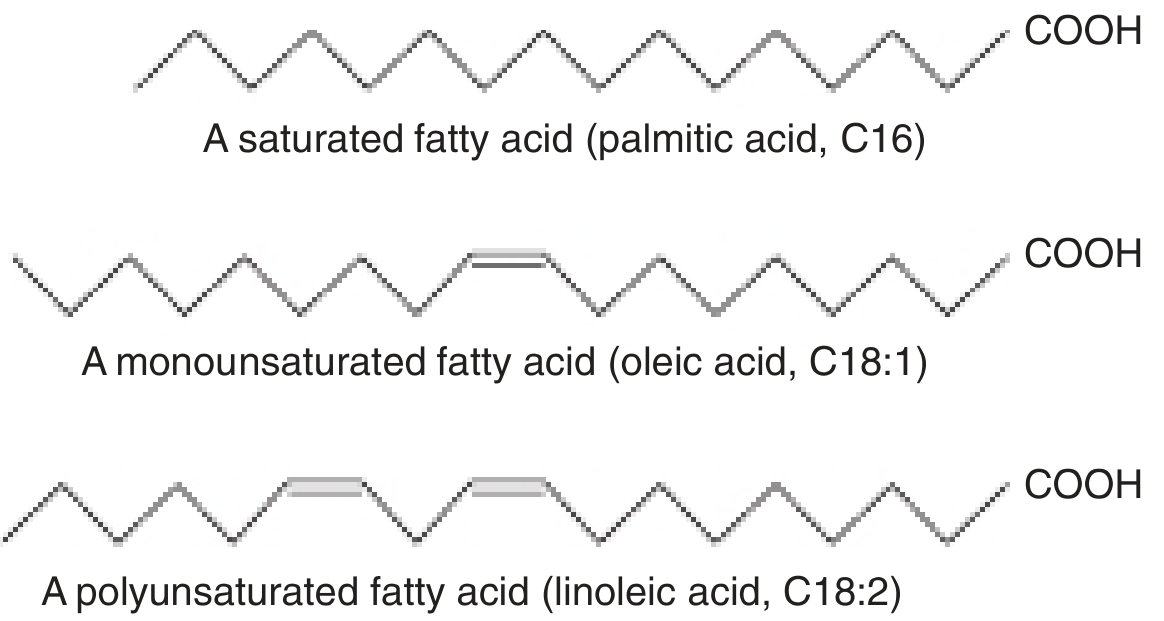
A. Saturated Fatty Acids (SFA) - No double bonds
All C-C bonds are single bonds; straight chain conformation; pack tightly; solid at room temperature.
| Common Name | Notation | Carbons | Occurrence |
|---|---|---|---|
| Butyric acid | 4:0 | 4 | Butter |
| Lauric acid | 12:0 | 12 | Coconut oil, palm kernel |
| Myristic acid | 14:0 | 14 | Nutmeg, coconut oil |
| Palmitic acid | 16:0 | 16 | Most common in all animal/plant fats; primary product of de novo synthesis |
| Stearic acid | 18:0 | 18 | Animal fats; second most common saturated FA |
B. Monounsaturated Fatty Acids (MUFA) - One double bond
| Common Name | Notation | Family | Occurrence |
|---|---|---|---|
| Palmitoleic acid | 16:1(9) | ω-7 | Most fats |
| Oleic acid | 18:1(9) | ω-9 | Most abundant MUFA; olive oil (~70%); synthesized endogenously |
| Elaidic acid | 18:1(9) trans | ω-9 | Hydrogenated fats (trans FA) |
C. Polyunsaturated Fatty Acids (PUFA) - Two or more double bonds
Double bonds are always cis in natural FAs and always spaced 3 carbons apart.
| Common Name | Notation | Family | Essential? | Key Role |
|---|---|---|---|---|
| Linoleic acid | 18:2(9,12) | ω-6 | Yes | Precursor of arachidonic acid; skin water barrier |
| γ-Linolenic acid | 18:3(6,9,12) | ω-6 | No | Evening primrose oil |
| α-Linolenic acid | 18:3(9,12,15) | ω-3 | Yes | Precursor of EPA and DHA; growth/development |
| Arachidonic acid | 20:4(5,8,11,14) | ω-6 | Conditionally | Substrate for prostaglandin, thromboxane, leukotriene synthesis |
| EPA | 20:5(5,8,11,14,17) | ω-3 | No | Anti-inflammatory eicosanoids |
| DHA | 22:6(4,7,10,13,16,19) | ω-3 | No | Brain/retinal development |
3. cis vs. trans Configuration
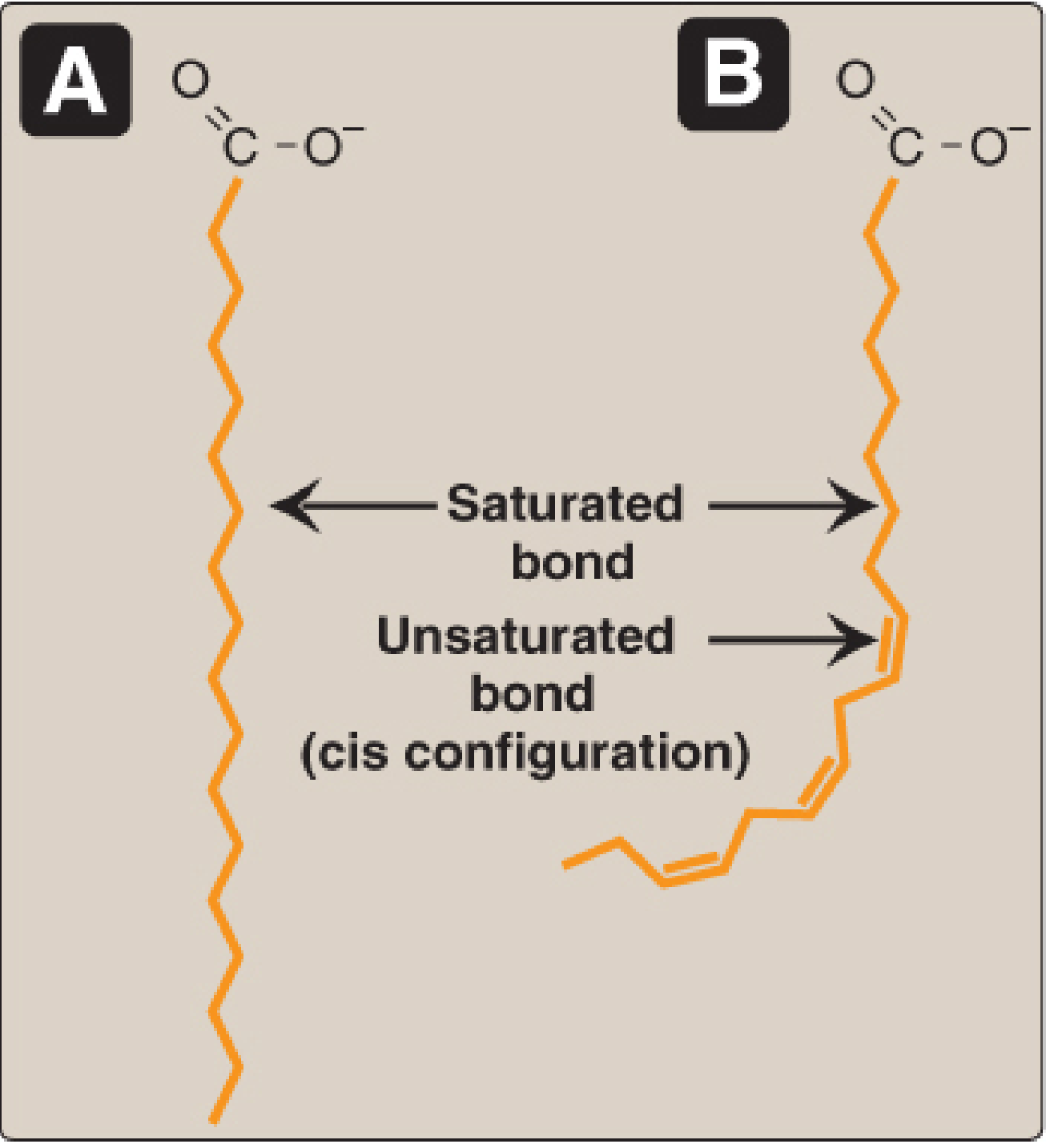
| Feature | cis | trans |
|---|---|---|
| Hydrogen positions | Same side of double bond | Opposite sides |
| Chain shape | Kinked/bent | Straight (like saturated) |
| Melting point | Lower (more fluid) | Higher (more solid-like) |
| Membrane fluidity | Maintained | Disrupted |
| Natural occurrence | All natural unsaturated FAs | Hydrogenated/ruminant fats |
| Clinical significance | Cardioprotective (PUFA) | Atherogenic |
4. Essential Fatty Acids (EFA)
Humans lack the desaturase enzymes needed to introduce double bonds beyond C9 from the ω-end. Therefore:
- Linoleic acid (18:2, ω-6) - must be obtained from diet (vegetable oils)
- α-Linolenic acid (18:3, ω-3) - must be obtained from diet (flaxseed, fish)
Arachidonic acid (20:4, ω-6) becomes conditionally essential when linoleic acid is deficient. Essential FA deficiency presents as dry, scaly dermatitis due to failure to synthesize the skin water barrier.
5. Effect of Chain Length and Unsaturation on Melting Point
| Factor | Effect on Melting Point | Example |
|---|---|---|
| Increasing chain length | Raises Tm | C18 SFA solid vs. C4 SFA liquid at room temp |
| Increasing double bonds | Lowers Tm | Vegetable oils (many PUFA) are liquid; butter (SFA) is solid |
| cis configuration | Lowers Tm (kink prevents packing) | Oleic acid (18:1 cis) melts at 13°C; stearic (18:0) at 70°C |
| trans configuration | Raises Tm | Elaidic acid (18:1 trans) melts at 44°C |
Summary Table of ω Families
| Family | Parent EFA | Derived FAs | Physiologic Roles |
|---|---|---|---|
| ω-3 | α-Linolenic acid | EPA, DHA | Anti-inflammatory, cardiovascular protection, neural development |
| ω-6 | Linoleic acid | γ-Linolenic, Arachidonic | Pro-inflammatory eicosanoids, cell membrane structure |
| ω-9 | Oleic acid (non-essential) | Mead acid (if EFA deficient) | Synthesized endogenously; membrane fluidity |
Sources: Biochemistry 8e, Lippincott Illustrated Reviews, pp. 513-517; Harper's Illustrated Biochemistry 32e, pp. 217-219; Basic Medical Biochemistry 6e, p. 129
This is a shared conversation. Sign in to Orris to start your own chat.