
Division of skeleton axial and appendicular complete notes 206 bones
Reading File
Finding Sources
Finding Sources
Finding Sources
Finding Sources
Finding Sources
Finding Sources
Reading File
Reading File
Reading File
Finding Sources
Reading File
Finding Sources
Reading File
Finding Sources
I now have sufficient information from multiple authoritative textbooks to compile a thorough set of notes. Let me write them out:
Division of the Human Skeleton: Axial & Appendicular
Total: 206 Bones
- Axial Skeleton: 80 bones
- Appendicular Skeleton: 126 bones
(Miller's Review of Orthopaedics, 9th Ed.)
PART 1 - AXIAL SKELETON (80 Bones)
The axial skeleton forms the central axis of the body - the skull, vertebral column, and thoracic cage. It protects the brain, spinal cord, and thoracic organs.
A. SKULL (22 Bones)
The skull is divided into the cranium (neurocranium) and the facial skeleton (viscerocranium).
(Gray's Anatomy for Students)
1. Cranial Bones - Neurocranium (8 bones)
| Bone | Number | Notes |
|---|---|---|
| Frontal | 1 | Forms forehead; supra-orbital foramina |
| Parietal | 2 | Form sides and roof of cranium |
| Temporal | 2 | Contain the middle/inner ear structures |
| Occipital | 1 | Forms base/back of skull; foramen magnum |
| Sphenoid | 1 | "Keystone" of cranial base; houses pituitary fossa (sella turcica) |
| Ethmoid | 1 | Forms part of orbit floor and nasal septum |
Calvaria (skullcap): Mainly paired temporal and parietal bones + parts of frontal, sphenoid, and occipital bones.
Cranial base: Mainly parts of sphenoid, temporal, and occipital bones.
2. Facial Bones - Viscerocranium (14 bones)
| Bone | Number | Notes |
|---|---|---|
| Mandible | 1 | Lower jaw - only movable bone of the skull (NOT part of the cranium proper) |
| Maxillae | 2 | Upper jaw; form most of hard palate |
| Zygomatic | 2 | Cheekbones |
| Nasal | 2 | Bridge of nose |
| Lacrimal | 2 | Medial orbit wall; contain lacrimal fossa |
| Palatine | 2 | Posterior hard palate |
| Inferior nasal conchae | 2 | Inside nasal cavity |
| Vomer | 1 | Posterior nasal septum |
Note: The mandible is NOT part of the cranium or formal facial skeleton in some classifications but is counted among the 22 skull bones.
B. EAR OSSICLES (6 Bones)
3 tiny bones in each middle ear = 6 total (sometimes listed separately)
| Bone | Location | Function |
|---|---|---|
| Malleus (hammer) | Attached to tympanic membrane | Transmits vibration |
| Incus (anvil) | Between malleus and stapes | Transmits vibration |
| Stapes (stirrup) | Against oval window | Transmits sound to cochlea |
C. HYOID BONE (1 Bone)
- U-shaped bone at the base of the tongue
- The only bone in the body that does not articulate with any other bone
- Supports the tongue and serves as attachment for muscles of the floor of the mouth
D. VERTEBRAL COLUMN (26 Bones)
| Region | Number of Vertebrae | Notes |
|---|---|---|
| Cervical (C1-C7) | 7 | C1 = Atlas; C2 = Axis |
| Thoracic (T1-T12) | 12 | Articulate with ribs |
| Lumbar (L1-L5) | 5 | Largest vertebrae; weight-bearing |
| Sacrum | 1 | 5 fused sacral vertebrae (S1-S5) |
| Coccyx | 1 | 3-4 fused coccygeal vertebrae |
Total: 26 bones (33 vertebral segments, but sacrum and coccyx fuse in adulthood)
(Gray's Anatomy for Students)
Structure of a Typical Vertebra:
- Vertebral body - anterior; major weight-bearing component; increases in size from C2 to L5
- Vertebral arch - formed by two pedicles (lateral pillars) and two laminae
- Spinous process - projects posteriorly from arch (posterior midline)
- Transverse processes - extend laterally
- Articular processes - superior and inferior; articulate with adjacent vertebrae
- Vertebral foramen - forms the vertebral canal when stacked
Special Cervical Vertebrae:
- C1 (Atlas) - ring-shaped, no body, supports skull
- C2 (Axis) - has dens (odontoid process) that projects into C1
- C7 (Vertebra prominens) - longest spinous process, easily palpable
E. THORACIC CAGE (25 Bones)
The thoracic skeleton = vertebral column + 12 pairs of ribs + sternum.
(General Anatomy and Musculoskeletal System, Thieme Atlas)
Ribs (24 = 12 pairs)
| Type | Ribs | Attachment |
|---|---|---|
| True (vertebrosternal) ribs | 1-7 | Articulate directly with sternum via costal cartilage |
| False (vertebrochondral) ribs | 8-10 | Attach to costal cartilage of rib 7 |
| Floating (vertebral) ribs | 11-12 | Attach only to thoracic vertebrae; no anterior attachment |
Each rib has:
- Head - articulates with vertebral body
- Neck - narrow part adjacent to head
- Tubercle - articulates with transverse process of vertebra
- Shaft (body) - main curved portion; has costal groove on inferior inner border (neurovascular bundle runs here)
Sternum (1 bone)
| Part | Notes |
|---|---|
| Manubrium | Upper portion; articulates with clavicles and ribs 1-2 |
| Body (mesosternum) | Middle; articulates with ribs 2-7 |
| Xiphoid process | Lowest; cartilaginous in youth, ossifies in adults |
- Sternal angle (Angle of Louis) - junction of manubrium and body; at level of T4/T5 disc; rib 2 attaches here
PART 2 - APPENDICULAR SKELETON (126 Bones)
The appendicular skeleton includes the bones of the upper and lower limbs plus the girdles that attach them to the axial skeleton.
A. PECTORAL (SHOULDER) GIRDLE (4 Bones)
2 bones per side = 4 total
| Bone | Number | Notes |
|---|---|---|
| Clavicle | 2 | "Collar bone"; only bony connection between upper limb and axial skeleton |
| Scapula | 2 | "Shoulder blade"; flat triangular bone; has glenoid cavity for shoulder joint |
B. UPPER LIMB (60 Bones = 30 per side)
Arm (1 bone/side)
| Bone | Notes |
|---|---|
| Humerus | Long bone; head articulates with glenoid cavity; distal end forms elbow |
Forearm (2 bones/side)
| Bone | Notes |
|---|---|
| Radius | Lateral; rotates around ulna; articulates with wrist on thumb side |
| Ulna | Medial; olecranon forms point of elbow |
Wrist - Carpal Bones (8/side = 16 total)
Mnemonic: "Some Lovers Try Positions That They Cannot Handle"
| Proximal Row | Distal Row |
|---|---|
| Scaphoid | Trapezium |
| Lunate | Trapezoid |
| Triquetrum | Capitate |
| Pisiform | Hamate |
Note: Scaphoid is the most commonly fractured carpal bone (fall on outstretched hand)
Hand
| Bone | Number/Side | Total |
|---|---|---|
| Metacarpals | 5 | 10 |
| Phalanges | 14 (2 in thumb + 3 in each finger) | 28 |
- Thumb: proximal + distal (2 phalanges)
- Fingers 2-5: proximal + middle + distal (3 phalanges each)
Total per upper limb: 30 bones × 2 = 60 bones
C. PELVIC (HIP) GIRDLE (2 Bones)
| Bone | Notes |
|---|---|
| Hip bone (os coxa) x2 | Each formed by fusion of 3 bones: ilium + ischium + pubis |
The two hip bones + sacrum + coccyx form the bony pelvis.
Each hip bone has:
- Ilium - large flared upper part; iliac crest is palpable
- Ischium - inferior-posterior; forms ischial tuberosity ("sitting bone")
- Pubis - anterior; two pubic bones meet at pubic symphysis
- Acetabulum - cup-shaped socket at junction of all 3 bones; receives femoral head
D. LOWER LIMB (60 Bones = 30 per side)
Thigh (1 bone/side)
| Bone | Notes |
|---|---|
| Femur | Longest and strongest bone in the body; head articulates with acetabulum |
Kneecap (1 bone/side)
| Bone | Notes |
|---|---|
| Patella | Sesamoid bone embedded in quadriceps tendon; largest sesamoid bone |
Leg (2 bones/side)
| Bone | Notes |
|---|---|
| Tibia | Medial; weight-bearing; tibial tuberosity for patellar ligament |
| Fibula | Lateral; non-weight-bearing; forms lateral malleolus |
Ankle - Tarsal Bones (7/side = 14 total)
Mnemonic: "The Cunning Ninja Catches Many Lizards Fast" (or similar)
| Bone | Notes |
|---|---|
| Talus | Articulates with tibia and fibula above (ankle joint) |
| Calcaneus | Largest tarsal; forms heel; attachment for Achilles tendon |
| Navicular | Medial side |
| Cuboid | Lateral side |
| Medial cuneiform | |
| Intermediate cuneiform | |
| Lateral cuneiform |
Foot
| Bone | Number/Side | Total |
|---|---|---|
| Metatarsals | 5 | 10 |
| Phalanges | 14 (2 in hallux + 3 in toes 2-5) | 28 |
- Big toe (hallux): proximal + distal (2 phalanges)
- Toes 2-5: proximal + middle + distal (3 each)
Total per lower limb: 30 bones × 2 = 60 bones
SUMMARY TABLE: 206 Bones at a Glance
Axial Skeleton (80 Bones)
| Region | Bones | Count |
|---|---|---|
| Skull - Cranial | Frontal, Parietal(2), Temporal(2), Occipital, Sphenoid, Ethmoid | 8 |
| Skull - Facial | Mandible, Maxillae(2), Zygomatic(2), Nasal(2), Lacrimal(2), Palatine(2), Inf. nasal conchae(2), Vomer | 14 |
| Ear ossicles | Malleus, Incus, Stapes (x2) | 6 |
| Hyoid | Hyoid | 1 |
| Vertebral column | Cervical(7), Thoracic(12), Lumbar(5), Sacrum(1), Coccyx(1) | 26 |
| Thoracic cage | Sternum(1), Ribs(24) | 25 |
| TOTAL | 80 |
Appendicular Skeleton (126 Bones)
| Region | Bones | Count |
|---|---|---|
| Pectoral girdle | Clavicle(2), Scapula(2) | 4 |
| Upper limb | Humerus(2), Radius(2), Ulna(2) | 6 |
| Carpals | 8 per wrist | 16 |
| Metacarpals | 5 per hand | 10 |
| Hand phalanges | 14 per hand | 28 |
| Pelvic girdle | Hip bones (os coxa) | 2 |
| Lower limb | Femur(2), Patella(2), Tibia(2), Fibula(2) | 8 |
| Tarsals | 7 per ankle | 14 |
| Metatarsals | 5 per foot | 10 |
| Foot phalanges | 14 per foot | 28 |
| TOTAL | 126 |
Key Clinical Points
Ossification types:
- Intramembranous - direct bone deposition without cartilage model (e.g., skull flat bones, clavicle)
- Endochondral - bone replaces a cartilage precursor (most bones); begins at primary ossification centers in diaphyses, mostly present at birth; secondary ossification centers develop at epiphyses and are sites of physeal (growth plate) fractures in children
Bone marrow distribution:
- Red marrow (active hematopoiesis) - first develops in appendicular skeleton, later in axial skeleton in adults
- Yellow marrow (inactive; ~80% fat) - replaces red marrow peripherally with age
Morphological bone types:
- Long bones - femur, humerus, metacarpals, phalanges
- Short bones - carpals, tarsals
- Flat bones - skull, scapula, sternum, ribs
- Irregular bones - vertebrae, hyoid, facial bones
- Sesamoid bones - patella (largest), pisiform
Notable facts:
- The femur is the longest and strongest bone
- The hyoid is the only bone that articulates with no other bone
- The stapes is the smallest bone in the body
- The patella is the largest sesamoid bone
- The scaphoid is the most commonly fractured carpal bone
Sources: Miller's Review of Orthopaedics 9th Edition; Gray's Anatomy for Students; Imaging Anatomy Text and Atlas Vol. 3, Bones, Joints, Vessels and Nerves; General Anatomy and Musculoskeletal System (Thieme Atlas)
Make a detailed pdf showing 206 bones in body only name and position in body
Reading File
Running Command
Running Command
Writing File
Running Command
Running Command
Your PDF is ready! Here's what's included:
206 Bones of Human Body
PDF Document · PDF
What's inside the PDF:
- Cover summary badges showing total count at a glance: 206 total, 80 axial, 126 appendicular
- Part 1 - Axial Skeleton (80 bones) organized into 6 sections:
- Cranial bones (8) - Facial bones (14) - Ear ossicles (6) - Hyoid (1) - Vertebral column (26) - Thoracic cage (25)
- Part 2 - Appendicular Skeleton (126 bones) organized into 8 sections:
- Pectoral girdle (4) - Upper limb arm/forearm (6) - Carpals/wrist (16) - Metacarpals + hand phalanges (54) - Pelvic girdle (6) - Lower limb thigh/knee/leg (8) - Tarsals/ankle (14) - Metatarsals + foot phalanges (56)
- Every bone listed with its exact position in the body and quantity
- Final tally table summarizing all counts that add up to 206
- Color-coded tables, alternating row shading, and running page headers throughout
Skull bones 8 bone images in diagram with leveling
Finding Sources
Reading File
Reading File
Loading Image
Loading Image
Finding Sources
Reading File
Finding Sources
Reading File
Loading Image
Loading Image
Loading Image
Reading File
Loading Image
Running Command
Writing File
Running Command
Editing File
Editing File
Editing File
Editing File
Editing File
Editing File
Editing File
Running Command
Running Command
Your PDF is ready — 9.3 MB with all real textbook diagrams embedded:
Skull 8 Cranial Bones Diagrams
PDF Document · PDF
What's inside (multi-page, fully labeled):
6 Real Anatomical Diagrams from Medical Textbooks:
| # | Diagram | Source |
|---|---|---|
| 1 | Lateral view — adult skull, color-coded bones + sutures | Gray's Anatomy for Students |
| 2 | Anterior view — frontal, orbits, nasal, mandible | Gray's Anatomy for Students |
| 3 | Superior view — calvaria internal surface (frontal/parietal/occipital) | Gray's Anatomy for Students |
| 4 | Internal cranial base — 3 fossae, all 8 bones color-coded | Netter's Atlas of Human Anatomy |
| 5 | Newborn skull lateral — ideal for learning bone territories | Netter's Atlas of Human Anatomy |
| 6 | Newborn skull superior — fontanelles + sutures labeled | Netter's Atlas of Human Anatomy |
8 Individual Bone Cards (numbered, colour-coded) each with:
- Bone name + Latin term
- Position in the skull
- Full key features and landmarks
Sutures Reference Table — all 8 major skull sutures with bones joined, location, and landmark junctions
Clinical Note on the Pterion and extradural haematoma
Skull bones 8 bone images in diagram with leveling
Generating Image
Loading Image
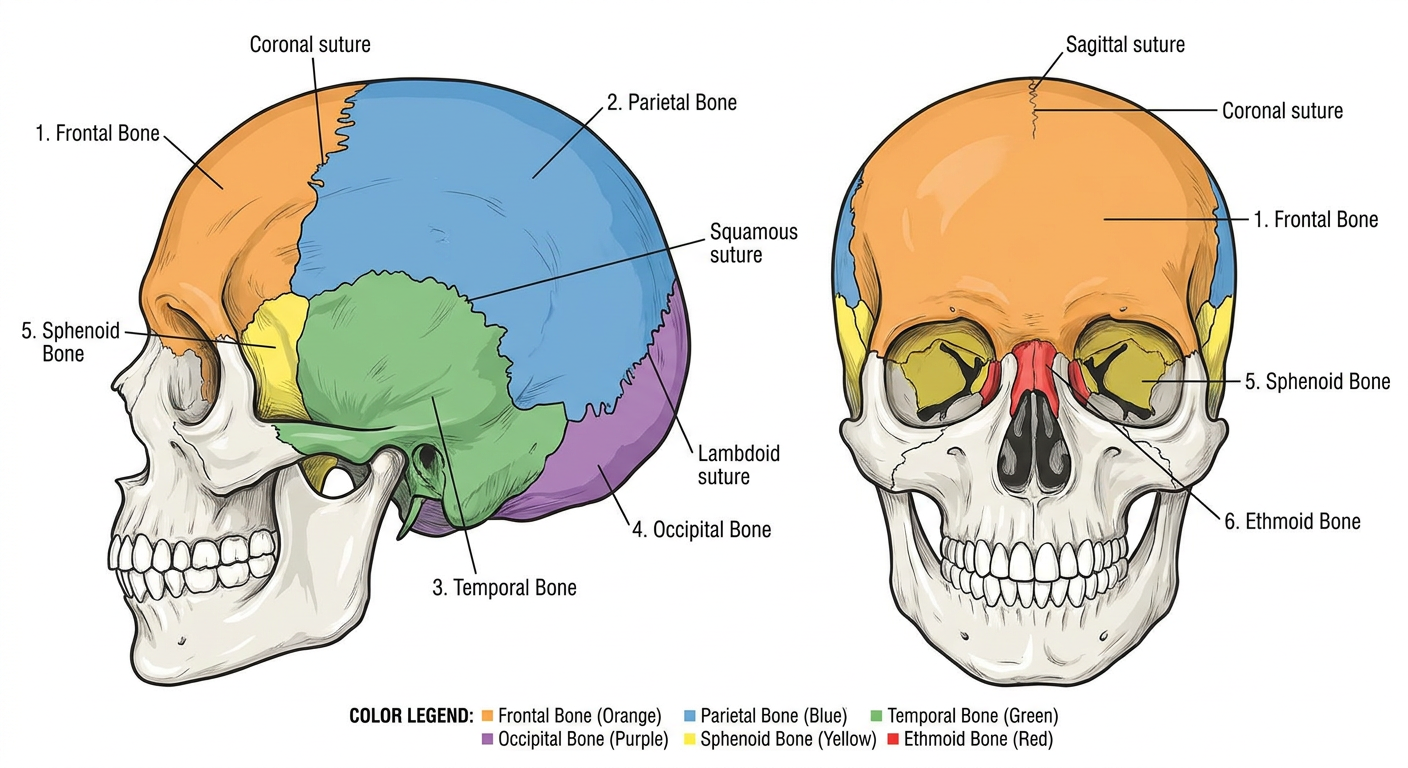
Here is your labeled diagram of the 8 cranial bones shown in two views:
Lateral View (Left) — 6 bones visible:
| # | Bone | Color | Sutures Visible |
|---|---|---|---|
| 1 | Frontal Bone | Orange | Coronal suture (with Parietal) |
| 2 | Parietal Bone ×2 | Blue | Squamous (with Temporal), Lambdoid (with Occipital) |
| 3 | Temporal Bone ×2 | Green | Squamous suture |
| 4 | Occipital Bone | Purple | Lambdoid suture |
| 5 | Sphenoid Bone | Yellow | Sphenoparietal junction |
Anterior View (Right) — deeper bones revealed:
| # | Bone | Color | Notes |
|---|---|---|---|
| 1 | Frontal Bone | Orange | Forms forehead + orbital roofs |
| 5 | Sphenoid Bone | Yellow | Greater wings visible in orbits laterally |
| 6 | Ethmoid Bone | Red | Between orbits — nasal septum + cribriform plate |
Sutures Labeled:
- Coronal — Frontal/Parietal junction
- Sagittal — Between the two Parietal bones (midline)
- Squamous — Parietal/Temporal junction
- Lambdoid — Parietal/Occipital junction
Note: The Ethmoid bone is deep and only seen in the anterior/internal views. The Parietal and Temporal bones each appear as a pair (×2), making the total count = 8 bones.
This is a shared conversation. Sign in to Orris to start your own chat.