
How to do continuous bladder irrigation
I'll read the medical library skill first, then search for continuous bladder irrigation content in parallel.
Reading File
Now I'll search the medical library and web in parallel.
Finding Sources
Finding Sources
Searching the Web
continuous bladder irrigation procedure nursing technique 2024
Good - I found the key textbook section in Roberts and Hedges' Clinical Procedures in Emergency. Let me read it now, along with the figure image.
Reading File
The content was truncated. Let me read the specific bladder irrigation section and fetch the diagram image.
Reading File
Loading Image
I now have everything needed for a thorough, well-illustrated answer.
Continuous Bladder Irrigation (CBI)
Continuous bladder irrigation is a procedure that flushes the bladder with sterile saline via a three-way Foley catheter to prevent or dissolve blood clots - most commonly after transurethral resection of the prostate (TURP) or other bladder/prostatic surgery.
Indications
- Post-TURP or post-prostatectomy hematuria with clot risk
- Gross hematuria with clot retention
- Hemorrhagic cystitis (radiation-induced, cyclophosphamide-related)
- Post-bladder tumor resection
Equipment Needed
- Three-way (triple-lumen) Foley catheter - 22F to 26F (larger bore accommodates clot passage)
- Port 1: irrigation inflow
- Port 2: drainage outflow
- Port 3: balloon inflation
- Sterile normal saline in 2-L or 4-L bags
- IV administration/irrigation tubing set
- Large-volume drainage collection bag
- IV pole
Step-by-Step Procedure
The 10-step photo guide below comes from Roberts and Hedges' Clinical Procedures in Emergency Medicine:
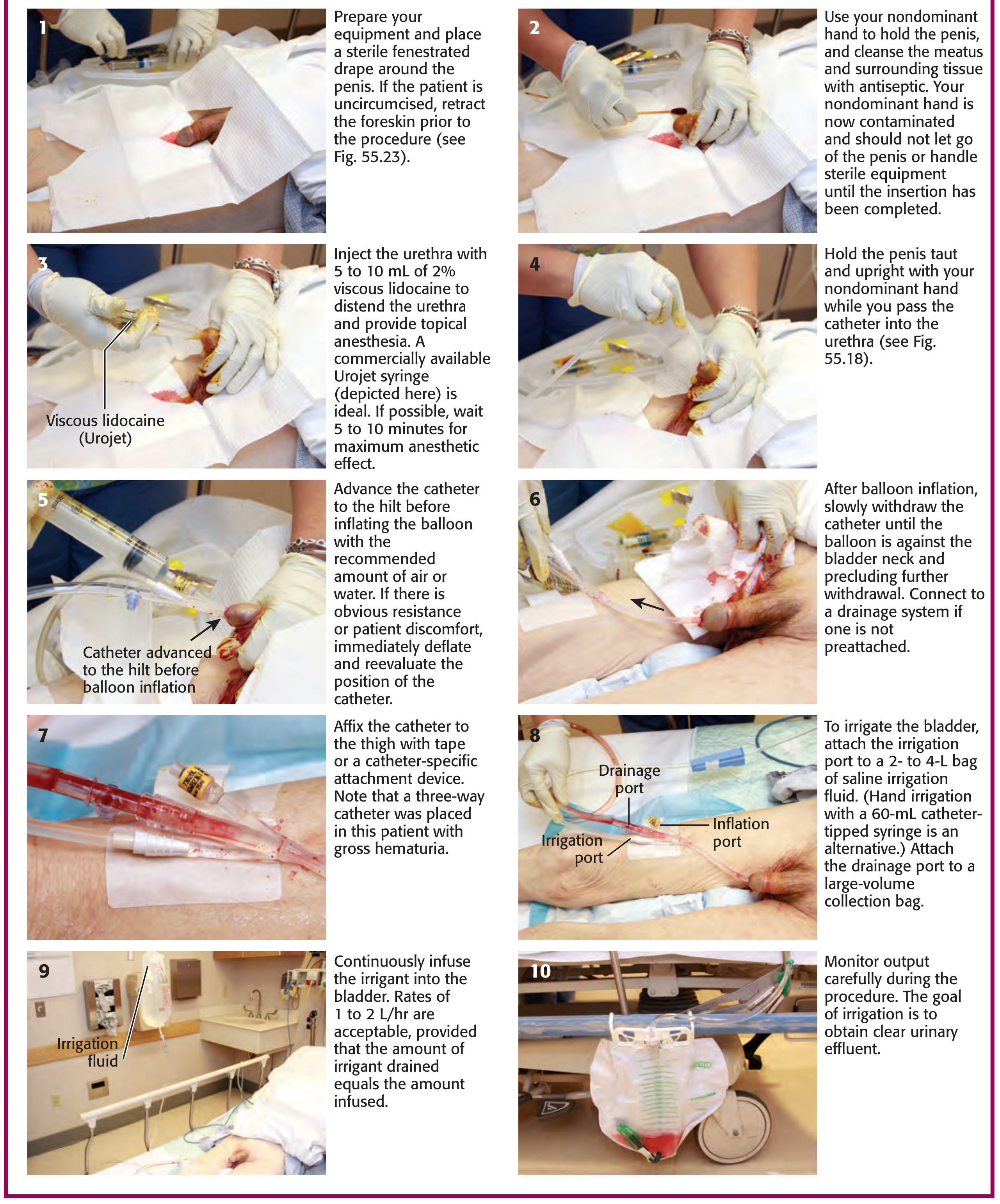
Steps 1-7: Catheter insertion (if not already in place)
- Prepare equipment; place a sterile fenestrated drape. Retract foreskin if uncircumcised.
- Hold the penis with the non-dominant hand; cleanse the meatus and surrounding tissue with antiseptic (hand is now contaminated - do not release grip).
- Inject 5-10 mL of 2% viscous lidocaine into the urethra for topical anesthesia and urethral distention. Wait 5-10 minutes for maximum effect.
- Hold the penis taut and upright; pass the catheter gently into the urethra.
- Advance the catheter fully to the hilt before inflating the balloon. If resistance or patient discomfort occurs, deflate immediately and reposition.
- After balloon inflation, slowly withdraw the catheter until the balloon seats against the bladder neck. Connect to the drainage system.
- Affix the catheter to the thigh with tape or a catheter-specific attachment device.
Steps 8-10: Setting up irrigation
- Attach the irrigation port to a 2-4 L bag of sterile saline irrigation fluid hung on an IV pole. Attach the drainage port to a large-volume collection bag at the bedside.
- Begin continuous infusion by gravity. Rates of 1 to 2 L/hr are acceptable, provided the volume drained equals the volume infused.
- Monitor output closely - adjust the flow rate based on urine color. The goal is clear urinary effluent.
Flow Rate Titration
| Urine color | Action |
|---|---|
| Bright red / frank blood | Increase flow rate; consider manual syringe flush to break up clots |
| Dark pink/rose | Maintain current rate |
| Light pink/straw | Can cautiously decrease rate |
| Clear | Consider stopping CBI if sustained |
The rate can be brisk - 1 to 2 L/hr or more - as long as output volume equals input volume. Use 60-mL aliquots with a catheter-tipped syringe for manual irrigation if gravity is insufficient to clear a clot.
Calculating Urine Output During CBI
Because saline is continuously entering the drainage bag, you cannot read urine output directly. Use this formula:
True urine output = Total drainage bag volume - Total irrigation saline infused
Track saline infused carefully on a running worksheet. Document at regular intervals (every 1-4 hours depending on clinical need).
Monitoring and Nursing Care
- Check urine color every 15-30 minutes initially; adjust flow accordingly
- Ensure the catheter and tubing are free of kinks at all times
- If drainage stops suddenly, suspect clot obstruction - perform a manual bladder irrigation with a 60-mL catheter-tipped syringe
- Ensure output volume equals input volume; if less is draining than going in, the catheter may be blocked
- Monitor for bladder distension - patient reports suprapubic pressure, urge to void around the catheter, or leakage around the catheter
Complications to Watch For
| Complication | Signs | Action |
|---|---|---|
| Catheter obstruction by clot | Reduced/absent drainage, suprapubic pain | Manual flush with 60-mL syringe |
| Bladder distension | Suprapubic fullness, leakage around catheter | Check tubing for kinks; manual flush |
| Fluid overload (over-irrigation) | Edema, electrolyte imbalance | Ensure in = out; slow rate |
| Infection (CAUTI) | Fever, foul-smelling urine | Routine antibiotic prophylaxis is NOT recommended; treat if symptomatic |
| Bladder spasm | Cramping, urge around catheter | Antispasmodics (e.g., oxybutynin) may help |
Routine antimicrobial prophylaxis should not be used during catheterization to avoid promoting antimicrobial resistance. - Roberts and Hedges' Clinical Procedures in Emergency Medicine
When to Stop CBI
- Urine remains consistently clear for several hours
- Physician orders discontinuation based on clinical assessment
- Typically 12-24 hours post-operatively after TURP, though this varies by case
Key Points Summary
-
Always use a three-way (22-26F) Foley - a standard two-way catheter cannot handle simultaneous inflow and outflow
-
Gravity drive at 1-2 L/hr is sufficient; titrate to urine color
-
Always verify drainage = infusion to avoid bladder over-distension
-
Calculate true urine output by subtracting total irrigant infused from total drainage
-
A manual syringe flush with 60 mL saline is the first response to catheter obstruction
-
Roberts and Hedges' Clinical Procedures in Emergency Medicine, Fig. 55.21 and Bladder Irrigation section
-
Bailey and Love's Short Practice of Surgery 28th Ed., Urology chapter (post-TURP CBI context)
This is a shared conversation. Sign in to Orris to start your own chat.