
How is HIV screening done
HIV screening uses a combination of tests depending on the stage of infection and clinical context. The standard approach is a 4th-generation combination antigen/antibody test, which detects both HIV-1/2 antibodies and the p24 antigen, allowing detection as early as 18-45 days after exposure.
Searching sources...
Reading File
Searching the Web
HIV screening guidelines 2025 WHO CDC
Finding Sources
Searching Images
HIV screening algorithm antigen antibody test flowchart
Finding Sources
Searching PubMed
"HIV screening" AND "laboratory diagnosis"
Reading File
Reading File
Reading File
Finding Sources
Reading File
Reading File
Loading Image
Here is a thorough overview of how HIV screening is performed, drawn from authoritative medical textbooks and current CDC guidelines.
HIV Screening: Overview
Who Should Be Screened
The CDC recommends routine, universal HIV screening for all patients aged 13-64 in any healthcare setting, unless the local prevalence of undiagnosed HIV has been documented below 0.1%. As of CDC's 2024/2025 draft update, the recommendation extends to at least one lifetime test for all persons 15 years and older, with no upper age limit. Selective "high-risk only" screening is considered inefficient because:
- Clinicians do not consistently ask about risk factors
- Patients may under-report risk behaviors
- Not all HIV-infected patients have identifiable risk factors
Pregnant women should receive HIV screening as part of routine prenatal care. - Symptom to Diagnosis, Evidence-Based Guide
The Standard Diagnostic Algorithm (CDC Recommended)
HIV screening follows a 3-step algorithm:
Step 1 - Initial Screen: 4th Generation Antigen/Antibody Combination Immunoassay (ELISA)
- Detects: HIV-1/HIV-2 antibodies (IgM + IgG) AND the p24 capsid antigen simultaneously
- Window period: ~16-18 days from infection (rapid point-of-care version: ~19-20 days)
- This is the current standard of care recommended by the CDC
- Some manufacturers require repeating the test if initially reactive
Step 2 - Confirmatory: HIV-1/HIV-2 Antibody Differentiation Immunoassay
- Performed on any specimen reactive on the initial screen
- Differentiates between HIV-1 and HIV-2 antibodies
- Window period: ~32-36 days
Step 3 - Reflex: Nucleic Acid Test (NAT/NAAT) for HIV-1 RNA
-
Used when the initial 4th gen screen is positive but the differentiation assay is negative or indeterminate
-
This resolves early acute infections where antibodies haven't yet formed
-
Shortest window period: RNA detectable at ~10-12 days (qualitative) or ~6-10 days (quantitative viral load assay)
-
Dermatology 5th Ed (Elsevier); Red Book 2021; Quick Compendium of Clinical Pathology 5th ed
Test Types and Window Periods
| Test | What it Detects | Window Period |
|---|---|---|
| Quantitative HIV-1 RNA (viral load) | RNA (≥20-40 copies/mL) | 6-10 days |
| Qualitative HIV-1 NAT | RNA (≥100 copies/mL) | 10-12 days |
| 4th gen Ag/Ab EIA (recommended) | IgM, IgG, p24 antigen | 16-18 days |
| 3rd gen Ab EIA | IgM, IgG | 22-24 days |
| HIV-1/HIV-2 differentiation EIA | IgG | 32-36 days |
| HIV-1 Western blot | IgG | 35-40 days |
- Dermatology 5th Ed, Table 78.4
5th Generation Tests (Emerging)
- Simultaneously detect and differentiate p24 antigen vs. HIV-1 antibodies vs. HIV-2 antibodies as three separate results
- Theoretical advantage: a p24-positive/antibody-negative result indicates very early infection
- FDA-cleared for initial screening but not yet widely used for confirmation
- Quick Compendium of Clinical Pathology; Jawetz Medical Microbiology 28th Ed
Western Blot (Historical Confirmatory Test)
Western blot was the traditional confirmatory test. A positive result requires any 2 of the following bands: p24, gp41, gp120/160.
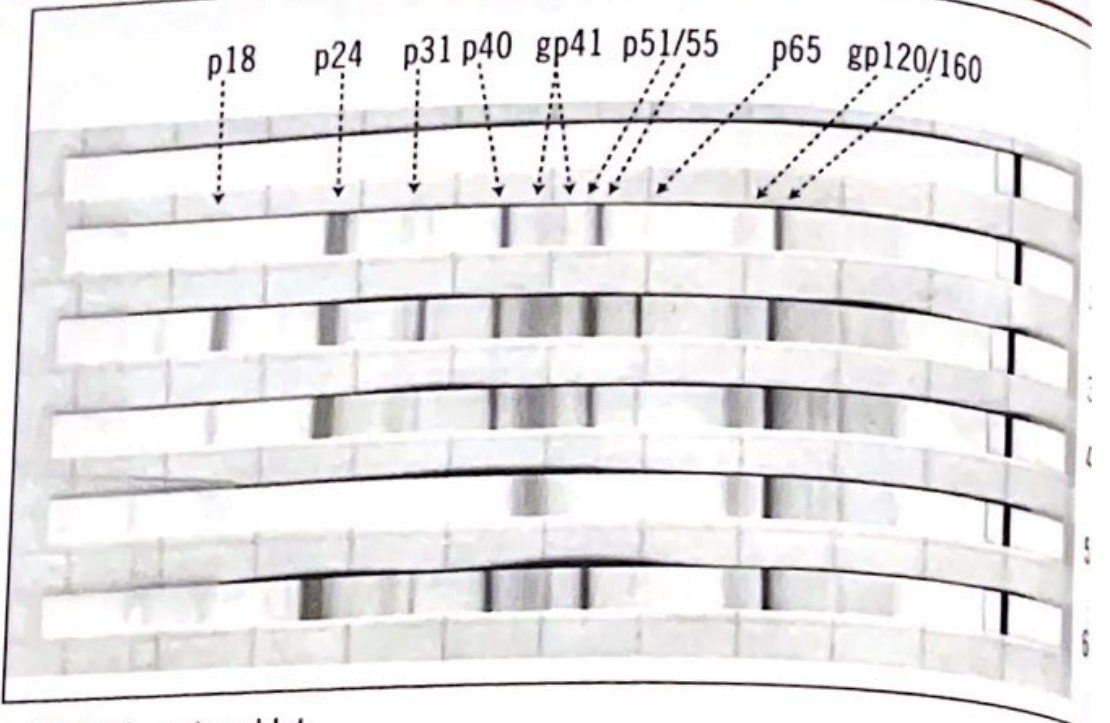
Western blot has largely been replaced by the HIV-1/HIV-2 differentiation immunoassay in current CDC guidelines. - Quick Compendium of Clinical Pathology 5th ed
Special Populations
Neonates / Infants born to HIV-positive mothers:
- Maternal antibodies can persist for months, making antibody-based tests unreliable
- Use HIV DNA PCR (proviral DNA PCR) for early diagnosis in neonates
- Test at birth, at 2 weeks, at 4-6 weeks, and at 4-6 months
Suspected acute HIV (seronegative window):
- Order HIV RNA (viral load/NAT) directly - antibody tests will be falsely negative
- Acute retroviral syndrome occurs 7-14 days after acquisition and lasts 5-7 days; many patients are not ill enough to seek care
End-stage AIDS:
- Antibody assays may also be falsely negative due to immune exhaustion - use virologic (NAT) testing
Other Diagnostic Tests (Monitoring, Not Primary Screening)
| Test | Purpose |
|---|---|
| CD4+ T-cell count (flow cytometry) | Assess immune status and disease progression |
| HIV viral load (RT-PCR) | Monitor treatment response; confirm diagnosis |
| Genotypic resistance testing | Guide ART selection at diagnosis and treatment failure |
| HIV DNA PCR | Neonatal diagnosis; proviral DNA in PBMCs |
Point-of-Care and Home Tests
- Rapid tests (e.g., OraQuick): results in <30 minutes from oral fluid or fingerstick blood; slightly longer window period (~19-20 days for 4th gen rapid)
- At-home mail-in tests: fingerprick sample sent to lab, results next day
- Point-of-care tests have a longer window period than lab-based assays and should be confirmed if reactive
Consent
Written informed consent is no longer required in most jurisdictions. Many US states have adopted an opt-out approach, where patients are informed that HIV testing will be done as part of routine care and may decline. - Quick Compendium of Clinical Pathology 5th ed
Summary of the CDC Algorithm:
4th gen Ag/Ab screen → Reactive → HIV-1/HIV-2 differentiation assay → Reactive = confirmed HIV-1 or HIV-2 → if nonreactive/indeterminate → HIV-1 RNA NAT → positive = acute HIV infectionTriple Testing screening of HIV
"Triple testing" in HIV screening typically refers to simultaneous screening of HIV, syphilis, and hepatitis B/C - or alternatively, the three-test sequential algorithm (4th gen EIA → differentiation assay → NAT). Let me look this up properly.
Searching sources...
Finding Sources
Searching the Web
HIV triple testing screening algorithm explained
Finding Sources
Searching the Web
HIV triple testing antenatal pregnancy syphilis hepatitis B screening
Reading Web Page
https://www.who.int/news/item/15-07-2025-who-prequalifies-th…
Reading File
Searching PubMed
"triple" AND "HIV" AND "syphilis" AND "hepatitis B" AND "screening"
The term "Triple Testing" in HIV has two distinct meanings depending on context. Here is a full breakdown of both:
Triple Testing in HIV - Two Meanings
Meaning 1: The 3-Step (Triple) HIV Laboratory Diagnostic Algorithm
This is the CDC/APHL recommended sequential testing algorithm - three steps performed in cascade on the same sample.
Step 1 - 4th Generation Antigen/Antibody Immunoassay (Initial Screen)
- Detects HIV-1/HIV-2 antibodies (IgM + IgG) AND HIV-1 p24 antigen simultaneously
- Highly sensitive - designed to catch all true positives including acute infection
- Window period: ~16-18 days
- If non-reactive → report as HIV negative (no further testing needed)
- If reactive → proceed to Step 2
Step 2 - HIV-1/HIV-2 Antibody Differentiation Immunoassay (Confirmatory)
- Differentiates between HIV-1 antibodies vs. HIV-2 antibodies separately
- If reactive for HIV-1 or HIV-2 → confirmed HIV diagnosis; initiate ART referral
- If reactive but undifferentiated (both HIV-1 + HIV-2) → repeat differentiation test
- If non-reactive or indeterminate → proceed to Step 3
- Window period: ~32-36 days
Step 3 - Nucleic Acid Test (NAT/NAAT) for HIV-1 RNA (Reflex)
-
Used specifically when Step 1 is reactive but Step 2 is negative/indeterminate
-
This scenario = acute HIV infection (virus present, antibodies not yet formed)
-
If NAT positive → confirmed acute HIV-1 infection
-
If NAT negative → false positive on Step 1; report as HIV negative
-
Window period: RNA detectable at ~10-12 days
-
Turnaround time for the combined Step 1+2 assay is ~60 minutes; NAT can take a few days
-
Tintinalli's Emergency Medicine; Goldman-Cecil Medicine; Red Book 2021
Visual summary of the algorithm:
Step 1: 4th gen Ag/Ab EIA
     |
     ├─ Non-reactive → HIV NEGATIVE
     |
     └─ Reactive ↓
         Step 2: HIV-1/HIV-2 Differentiation Assay
              |
              ├─ Reactive (HIV-1 or HIV-2) → CONFIRMED HIV
              |
              └─ Negative/Indeterminate ↓
                  Step 3: HIV-1 RNA NAT
                       |
                       ├─ Positive → ACUTE HIV INFECTION
                       └─ Negative → FALSE POSITIVE (HIV negative)
Meaning 2: Triple Elimination Screening (Antenatal / Pregnancy)
This is the more commonly referenced "Triple Testing" in global public health - simultaneous screening of 3 vertically transmissible infections in pregnant women:
| Infection | Test Used | Purpose |
|---|---|---|
| HIV | HIV-1/2 Ag/Ab combo assay (4th gen) | Detect HIV-1/2 and p24 antigen |
| Hepatitis B | HBsAg (Hepatitis B surface antigen) | Detect active HBV infection |
| Syphilis | Treponema pallidum antibody (rapid treponemal test) | Detect syphilis exposure |
Why Triple?
All three infections share the common risk of mother-to-child (vertical) transmission during pregnancy, delivery, or breastfeeding. Without screening and treatment:
- HIV: ~15-45% transmission to infant
- Hepatitis B: ~70-90% transmission if mother is HBeAg positive
- Syphilis: can cause congenital syphilis, miscarriage, or stillbirth
The global initiative to eliminate all three is known as the "Triple Elimination" program (WHO).
WHO Prequalification (July 2025 - Very Recent)
The WHO prequalified the first combined triple diagnostic test in July 2025 - the Determine™ Antenatal Care Panel - which tests all three simultaneously from a single fingerprick of capillary blood:
- Determine™ HIV Early Detect (HIV-1/2 Ag/Ab)
- Determine™ HBsAg 2
- Determine™ Syphilis TP
This is a point-of-care test, visually read, designed for pregnant women aged 12+ in low-resource settings.
Antenatal Protocol (NHS/WHO Standard)
-
Offered at the booking appointment (ideally before 10 weeks gestation)
-
A single blood draw from the arm
-
Testing should be as early as possible so treatment can begin promptly
-
If positive: specialist midwife referral, further confirmatory workup, and care planning
-
Opt-out approach encouraged (patient informed but must actively decline)
-
Repeat testing in 3rd trimester for high-risk women
-
NHS Antenatal Screening; WHO 2025 prequalification notice
Cost-Effectiveness
A 2025 Lancet meta-analysis (Sabin et al.) found triple-integrated antenatal screening for HIV, syphilis, and hepatitis B to be highly cost-effective compared with dual-integrated strategies.
Key Takeaway
| Context | "Triple Testing" Means |
|---|---|
| Laboratory / CDC algorithm | 3-step cascade: Ag/Ab screen → differentiation assay → NAT |
| Antenatal / Global health | Simultaneous screening for HIV + Hepatitis B + Syphilis in pregnancy |
Both are important. The 3-step laboratory algorithm ensures accurate HIV diagnosis and identifies acute infections; the antenatal triple screen is the backbone of mother-to-child transmission prevention programs worldwide.
This is a shared conversation. Sign in to Orris to start your own chat.