
Mangement of diabetic foot ulcer
I'll start with a quick overview while I pull from the medical library.
Diabetic foot ulcer (DFU) management involves wound care, offloading pressure, infection control, vascular assessment, and glycemic optimization. The key pillars are: debridement, dressings, antibiotic therapy for infected ulcers, revascularization when ischemia is present, and amputation prevention.
Searching sources...
Reading File
Now I'll run parallel searches across the medical library and PubMed simultaneously.
Finding Sources
Searching PubMed
"diabetic foot ulcer"[MeSH Terms] AND management
Finding Sources
Searching PubMed
"diabetic foot"[MeSH Terms] AND "wound healing"
Excellent results. Now I'll read the most comprehensive sources in parallel - Bailey & Love's surgical textbook and Current Surgical Therapy, which are the most clinically detailed.
Reading File
Reading File
Excellent - very rich content. Let me now read more of Current Surgical Therapy (the most detailed surgical source) and also read Bailey & Love's continuation, in parallel.
Reading File
Reading File
I have excellent content from Current Surgical Therapy. Let me read the rest of the management section - specifically wound care, offloading, infection treatment, and surgical management.
Reading File
Reading File
I now have enough comprehensive information from authoritative sources to write a thorough answer. Let me also fetch the key clinical images.
Loading Image
I now have all the information needed for a comprehensive, well-structured answer. Here it is:
Management of Diabetic Foot Ulcer (DFU)
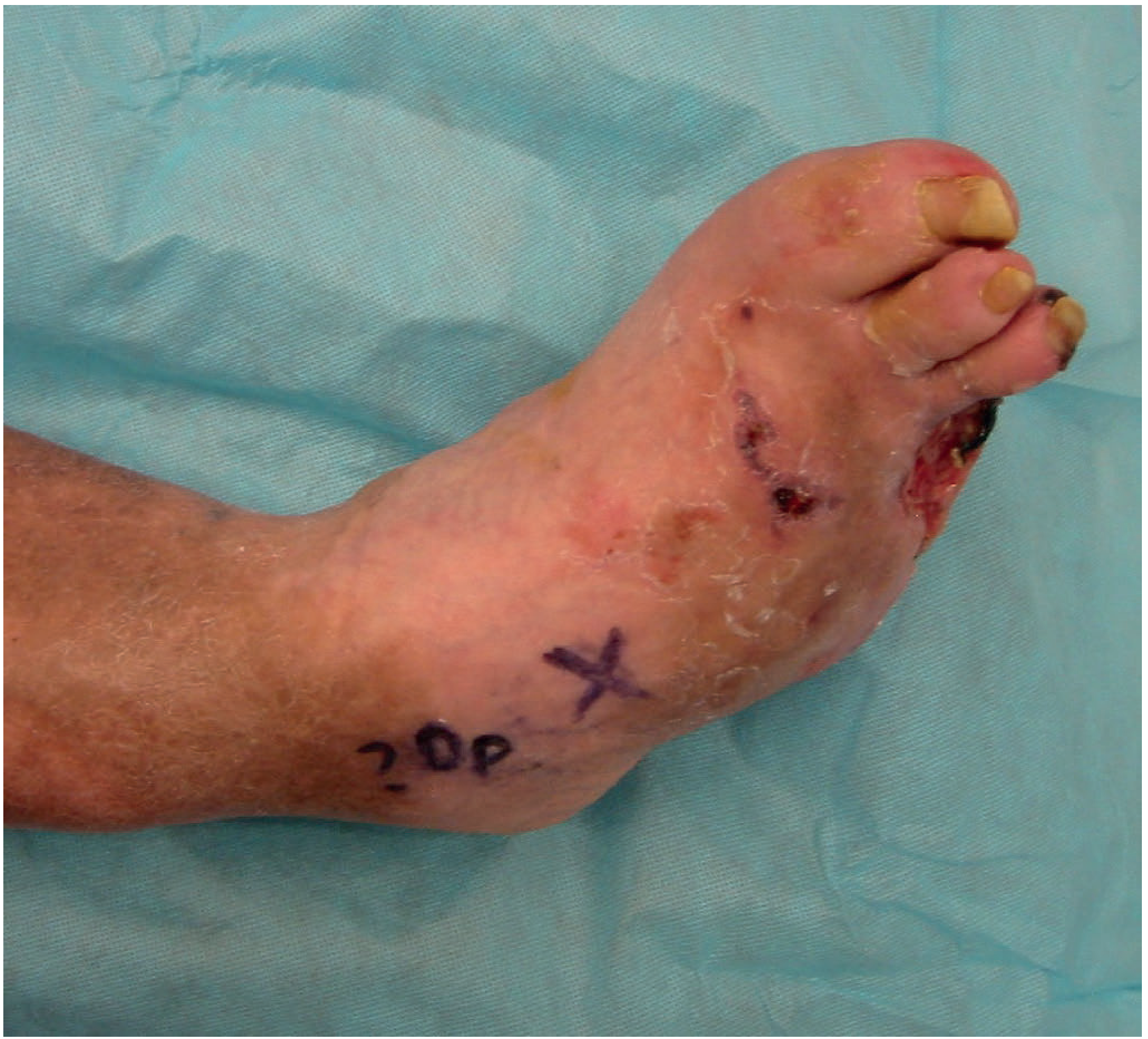
Pathophysiology: The Triad
DFUs are multifactorial, driven by a triad of neuropathy, ischemia, and infection:
- Peripheral neuropathy - loss of protective sensation (LOPS), muscle atrophy, claw/hammer toe deformities, autonomic neuropathy causing dry skin and fissures
- Peripheral arterial disease (PAD) - macrovascular and microvascular insufficiency; ~15-20% of DFUs lead to lower extremity amputation (LEA); ~85% of all amputations are preceded by DFU
- Immune dysfunction - impaired neutrophil function, poor tissue healing, susceptibility to polymicrobial infection
Step 1: Classification
The WIfI classification (Wound, Ischemia, foot Infection) is the modern standard, grading each domain 0-3 and predicting:
- 1-year risk of major amputation
- Theoretical benefit/requirement of revascularization
| WIfI Domain | Grade 0 | Grade 1 | Grade 2 | Grade 3 |
|---|---|---|---|---|
| Wound | No ulcer/preulcer | Shallow, no exposed bone | Exposed bone, digit gangrene, shallow heel ulcer | Extensive ulcer/gangrene, full-thickness heel ulcer |
| Ischemia | Toe BP ≥60 mmHg, ABI ≥0.80 | Toe BP 40-59, ABI 0.6-0.79 | Toe BP 30-39, ABI 0.4-0.59 | Toe BP <30, ABI <0.4 |
| Infection | None | Mild (skin/subcut only) | Moderate (deep/extensive) | Severe (systemic signs) |
Older systems: Wagner grading (0-5), University of Texas classification, and SINBAD are still widely referenced.
Step 2: Comprehensive Evaluation
Wound Assessment
- Debride overlying callus to expose true wound extent
- Probe with cotton swab back for depth and bone penetration (probe-to-bone test)
- 3-view plain X-ray of the foot - evaluates for osteomyelitis, Charcot deformity, structural abnormalities
Neuropathy Assessment
- 10-g monofilament (primary tool) + at least one of: pinprick, temperature, vibration, or proprioception
- Assess for structural deformity (claw/hammer toe, bunion, callus)
Vascular Assessment
- Palpation of pulses (unreliable in diabetics due to medial calcinosis/calcification)
- Ankle-brachial index (ABI) - can be falsely elevated due to vessel calcification
- Toe-brachial index (TBI) and toe pressure - more reliable in diabetics
- Transcutaneous oxygen (TcPO2) - useful for wound healing potential
- Duplex ultrasound, CTA, or MRA for detailed vascular mapping before revascularization
Infection Workup
- Blood: CBC, CRP, ESR, blood cultures if systemically unwell (markers may be normal/mildly elevated)
- Superficial ulcer swabs are unreliable for deep infection - deep tissue culture or bone biopsy preferred
- MRI is the most sensitive modality for osteomyelitis (detects before plain X-ray changes appear)
- Probe-to-bone test + elevated inflammatory markers + abnormal X-ray = osteomyelitis confirmed
Step 3: Management Pillars
A. Glycemic Optimization
- Tight glycemic control is essential throughout management
- Target HbA1c <7-8% in most patients; reduces infection risk and improves healing
- Insulin often required acutely even in type 2 DM when infected/hospitalized
B. Pressure Offloading
- Single most important local treatment for neuropathic plantar ulcers
- Total contact cast (TCC) - gold standard offloading device; redistributes plantar pressure
- Removable cast walker (RCW)/aircast boot - useful but compliance-dependent
- Felted foam padding, therapeutic footwear, crutches/wheelchair as alternatives
- Structural deformities causing recurrent ulceration may require surgical correction (exostectomy, rebalancing procedures)
C. Local Wound Care
Debridement
- Sharp surgical debridement at every visit removes non-viable tissue, callus, fibrinous slough
- Exposes wound base for accurate grading and improved healing
- Enzymatic or autolytic debridement for wounds not amenable to sharp debridement
Dressings
- Maintain moist wound environment without maceration
- Saline-moistened gauze - simple, widely available
- Hydrocolloid/hydrogel - for clean granulating wounds
- Alginate/foam - for highly exudative wounds
- Silver-impregnated dressings - for mildly infected/colonized wounds
- Iodine-based dressings - antimicrobial for biofilm-heavy wounds
- Avoid wet-to-dry dressings (damages granulation tissue)
Advanced Wound Therapies (for non-healing wounds)
- Negative pressure wound therapy (NPWT / VAC) - promotes granulation, reduces edema; meta-analysis (PMID 39241769, 2024) confirms efficacy in RCTs
- Bioengineered skin substitutes (e.g., Apligraf, Dermagraft) - for chronic non-healing ulcers
- Platelet-rich plasma (PRP)
- Hyperbaric oxygen therapy (HBO) - last resort for wounds with inadequate perfusion (osteomyelitis, gangrene, non-revascularizable ischemia)
- Growth factors (PDGF - becaplermin)
D. Infection Management
Microbiology
| Infection Type | Organisms |
|---|---|
| Mild/superficial | S. aureus, beta-hemolytic Streptococci |
| Moderate/severe | + Gram-negative bacilli (E. coli, Klebsiella, Proteus) |
| Severe/chronic | + Pseudomonas aeruginosa, Anaerobes |
| Empirical severe | Must include Pseudomonas cover + metronidazole if necrotic/abscess |
Antibiotic Principles
- Mild infection (skin/subcutaneous only): oral antibiotics targeting S. aureus and Streptococci (e.g., amoxicillin-clavulanate, cefalexin)
- Moderate infection: broader spectrum oral or IV (e.g., co-amoxiclav IV, or fluoroquinolone + metronidazole)
- Severe infection: IV broad-spectrum (e.g., piperacillin-tazobactam, or carbapenem + vancomycin for MRSA risk)
- Always de-escalate based on culture results
- Duration: 1-2 weeks for soft tissue only; 4-6+ weeks for osteomyelitis
Surgical Management of Infection
- Required for: collections/abscesses, necrotic tissue, extensive osteomyelitis
- Debridement must remove all infected material; excess bone resected to allow tension-free skin closure
- Distinguish superficial osteitis (loss of soft tissue cover, responds to local measures) from deep osteomyelitis (requires bone debridement)
- In severe peripheral neuropathy, a below-knee amputation in an area with intact sensation may be preferable to repeated forefoot surgeries
E. Vascular Management (Revascularization)
- Mandatory full vascular assessment in all patients with poor pulses or grade 1+ ischemia
- Endovascular intervention (PTA, stenting) - first-line for suitable lesions; lower perioperative risk
- Open surgical bypass - preferred for long-segment occlusions, heavily calcified vessels not crossable endovascularly; use single-segment saphenous vein; translocated (not reversed) for size match to tibial vessels; arm vein is an acceptable alternative
- Both approaches show equivalent amputation-free survival in experienced centers
- Perform debridement for source control first in acutely infected wounds before angiography; in subacute infection, revascularize before debridement to prevent ischemia-mediated necrosis
Step 4: Osteomyelitis - Specific Management
| Feature | Detail |
|---|---|
| Best imaging | MRI (most sensitive; can be normal early on plain X-ray) |
| Diagnosis | Probe-to-bone + elevated CRP/ESR + plain X-ray changes |
| Cultures | Deep tissue biopsy (not surface swabs) |
| Antibiotic duration | Typically 6 weeks IV, then oral if sensitive organism |
| Surgery | Debridement/sequestrectomy; may need partial ray/transmetatarsal amputation |
Step 5: Amputation
- Not a failure of management but sometimes the correct option
- Indications: uncontrollable infection, extensive tissue loss, non-reconstructable ischemia, failed revascularization
- Wound healing is unreliable post-amputation in diabetics - ensure adequate perfusion at planned level
- Toe/ray amputation - for isolated digit disease
- Transmetatarsal amputation - for forefoot involvement
- Below-knee amputation - preferable to above-knee when vascular supply allows; better rehabilitation potential
- Bone resection must be adequate to remove all infected material; tension-free skin closure is essential
Step 6: Multidisciplinary Team and Prevention
MDT Approach
- Diabetologist / endocrinologist (glycemic control)
- Vascular surgeon (revascularization)
- Orthopedic/podiatric surgeon (debridement, reconstruction)
- Infectious disease specialist (antibiotic stewardship)
- Orthotist/podiatrist (offloading, footwear)
- Wound care nurse
- Rehabilitation team
MDT programs have been shown to reduce the rate of LEA through early recognition and management of risk factors.
Prevention of Recurrence
- Custom therapeutic footwear and regular podiatry
- Daily foot inspection by patient
- Strict glycemic control
- Smoking cessation
- Correction of structural deformities
- Periodic monofilament screening and vascular monitoring
- Patient education
Summary Algorithm
DFU Diagnosed
    ↓
Classify (WIfI grade)
    ↓
Assess Triad: Neuropathy | Ischemia | Infection
    ↓
All Patients:
  • Glycemic control
  • Offloading (TCC preferred)
  • Debridement + appropriate dressing
    ↓
Infected? → Antibiotics (targeted); Surgery if collection/necrosis/osteomyelitis
    ↓
Ischemic? → Vascular imaging → Endovascular or open bypass
    ↓
Non-healing at 4-6 weeks? → Advanced therapies (NPWT, skin substitute, HBO)
    ↓
Unsalvageable limb → Amputation at appropriate level
    ↓
MDT follow-up + Prevention
Sources:
- Current Surgical Therapy 14e (Kavousi, Hicks, Abularrage), pp. 1185-1192
- Bailey and Love's Short Practice of Surgery 28th Ed, pp. 627-628
- Dalmedico MM et al. Effectiveness of NPWT in DFU: systematic review and meta-analysis. Wounds. 2024 Aug. PMID: 39241769
This is a shared conversation. Sign in to Orris to start your own chat.