
How to differentiate leptospirosis vs viral fever from only symptoms
Reading File
Now let me search the medical library and web simultaneously for the best clinical differentiation.
Finding Sources
Searching the Web
leptospirosis vs viral fever clinical differentiation symptoms signs
Searching PubMed
leptospirosis clinical features differentiation viral fever
Good. Now let me read the most clinically relevant textbook sections.
Reading File
Reading File
Excellent - I have very rich clinical content. Let me read the Goldman-Cecil section further for the clinical features and differential diagnosis details.
Reading File
Reading File
Reading File
I now have comprehensive data. Let me also fetch the key clinical image showing conjunctival suffusion.
Loading Image
I now have everything needed for a comprehensive, well-structured answer. Here it is:
Leptospirosis vs. Viral Fever: Clinical Differentiation
Leptospirosis is frequently misdiagnosed as dengue, influenza, or other viral fevers because the early phase overlaps heavily. However, several clinical clues - when taken together - tilt the balance strongly toward leptospirosis.
1. Exposure History (Most Useful Single Clue)
Before anything else, ask about exposure:
| Feature | Leptospirosis | Viral Fever |
|---|---|---|
| Flood/waterlogged area contact | Very suggestive | Not specific |
| Rodent exposure / rat urine contact | Strongly suggestive | Absent |
| Occupation: farmer, sewer worker, veterinarian | Raises suspicion | Not linked |
| Adventure sports, swimming in rivers | Reported in outbreaks | Not typical |
| Monsoon season in tropics | Endemic peak | Dengue also peaks |
- Goldman-Cecil Medicine: "Leptospirosis predominantly affects medically underserved populations...infections spike during heavy rainfall when rodents are forced from their burrows."
2. The Biphasic Course (Unique to Leptospirosis)
Leptospirosis classically has two phases:
- Leptospiremic phase (days 1-7): Abrupt fever, chills, severe headache, myalgia - looks just like viral fever
- Immune phase (days 7-14): Brief defervescence followed by return of fever + organ complications
Viral fevers are typically monophasic (fever gradually settles or stays without this second spike). If a patient appears to improve then gets worse again, think leptospirosis.
3. Pathognomonic / Highly Distinctive Symptoms
| Feature | Leptospirosis | Viral Fever (dengue/influenza) |
|---|---|---|
| Conjunctival suffusion (red eyes WITHOUT discharge/exudate) | Characteristic (~86% of cases) | Rare/absent |
| Calf muscle pain + tenderness | Pathognomonic (~85%) | Diffuse myalgia, not localized to calves |
| Bitemporal/frontal throbbing headache with retro-orbital pain + photophobia | Very common | Retro-orbital pain seen in dengue too |
| Lumbar/lower back pain | ~40% | Uncommon |
| Jaundice (early, deep) | Present in Weil disease (~75%) | Mild or absent (except hepatitis) |
| Oliguria/reduced urine output | ~56% (tubular injury) | Absent |
Conjunctival suffusion is the key bedside differentiator - it is redness with injection but NO discharge, and no corneal involvement. This image shows conjunctival suffusion + scleral icterus in Weil disease:
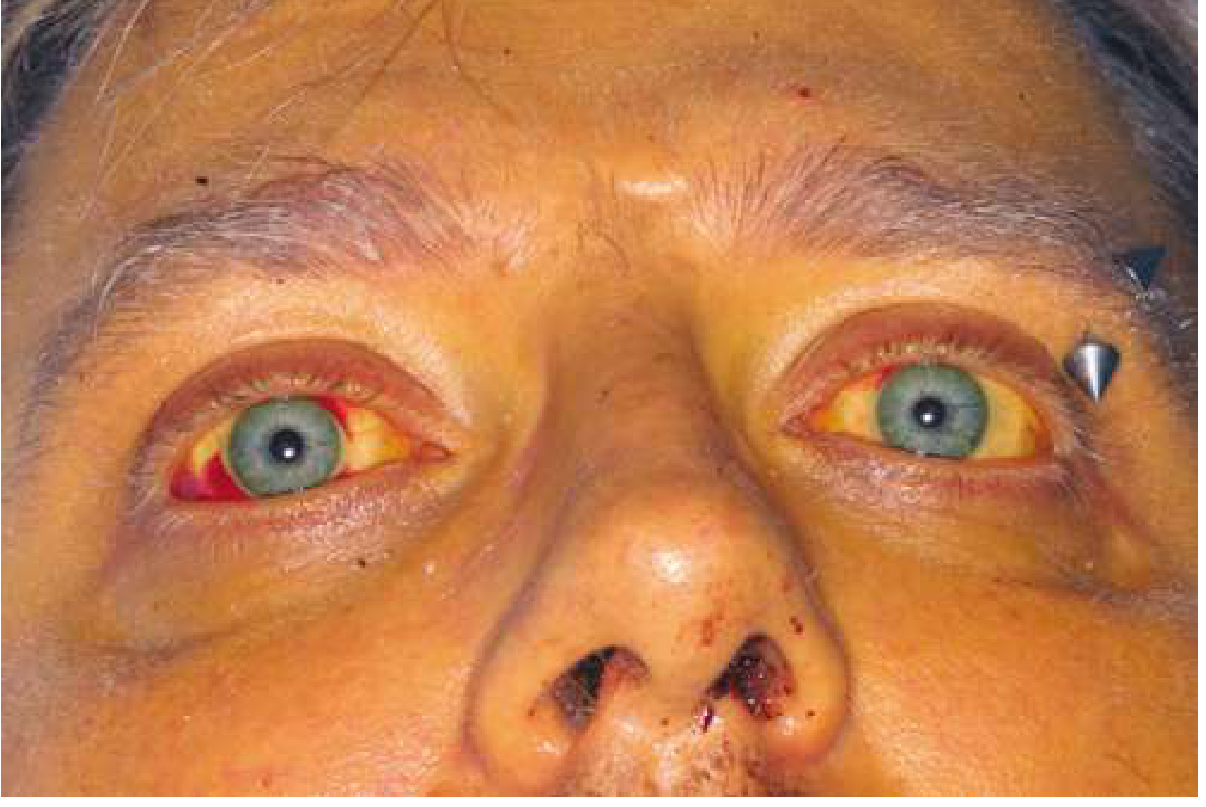
Goldman-Cecil Medicine: "Conjunctival suffusion (a pathognomonic injection without exudate)"
4. Symptom-by-Symptom Comparison Table
| Symptom | Leptospirosis | Dengue | Influenza |
|---|---|---|---|
| Abrupt onset fever | ✅ 100% | ✅ Yes | ✅ Yes |
| Chills/rigors | ✅ ~79% | Less prominent | ✅ Yes |
| Severe headache | ✅ ~68% | ✅ Yes | ✅ Yes |
| Calf muscle tenderness | ✅ ~85% | ❌ Absent | ❌ Absent |
| Generalized myalgia | ✅ ~52% | ✅ Yes | ✅ Yes |
| Conjunctival suffusion | ✅ ~86% | ❌ Absent | ❌ Absent |
| Rash | Pretibial, maculopapular (later) | Maculopapular early, widespread | Rare |
| Nausea/vomiting | ✅ ~88% | ✅ Yes | ✅ Yes |
| Anorexia | ~65% | ✅ Yes | ✅ Yes |
| Jaundice | ✅ In Weil disease | ❌ Rare | ❌ Absent |
| Oliguria | ✅ ~56% | ❌ Absent | ❌ Absent |
| Lumbar/back pain | ✅ ~40% | ❌ Absent | ✅ Sometimes |
| Photophobia | ✅ ~8% | Sometimes | Sometimes |
| Hemorrhage | Petechiae, GI bleed, hemoptysis | Petechiae, mucosal bleed | Rare |
| Biphasic course | ✅ Yes | ❌ No | ❌ No |
| Clay-colored stool | ❌ Rare (~6%) | ❌ Absent | ❌ Absent |
(Comparison data from Gancheva et al., J IMAB 2007 and Goldman-Cecil Medicine)
5. WHO Clinical Case Definition for Leptospirosis
The WHO suspect case criteria (from Goldman-Cecil Medicine, Table 298-1):
Acute febrile illness (≥38.5°C) + severe headache + myalgia + prostration **and/or conjunctival suffusion + history of exposure
Probable case = suspect case + any 2 of:
- Calf tenderness
- Cough ± hemoptysis
- Shortness of breath
- Skin rash
- Jaundice
- Hemorrhagic manifestations
- Meningeal irritation
- Anuria/oliguria and/or proteinuria
- Cardiac arrhythmias
6. Red Flags That Strongly Point Away From Simple Viral Fever
These features, if present, should make you strongly suspect leptospirosis over a plain viral fever:
- Calf tenderness on palpation - press the calf and patient winces
- Conjunctival suffusion without discharge
- Jaundice appearing early (within first week)
- Reduced urine output (non-oliguric AKI with hypokalemia is classic)
- Hemoptysis or respiratory distress (pulmonary hemorrhage - Weil disease)
- Flood/rodent/water exposure in the prior 2-30 days
- Biphasic fever - improves briefly, then deteriorates
7. Summary: The Practical Bedside Approach
Ask these 3 questions:
- Did they walk through flood water or have rodent exposure in the last 2-4 weeks?
- Do their eyes look red without any discharge? (conjunctival suffusion)
- Is the calf tender when you squeeze it?
If 2 of these 3 are yes - treat empirically for leptospirosis (doxycycline for mild, IV penicillin/ceftriaxone for severe) while awaiting confirmation, since early treatment is what changes outcomes.
Sources: Goldman-Cecil Medicine 27e (Ch. 298 - Leptospirosis) | Comprehensive Clinical Nephrology 7e (Ch. 71) | PAHO/WHO Leptospirosis Clinical Guidance | CDC Clinical Overview of Leptospirosis
Treatment for leptospirosis
Leptospirosis treatment depends on disease severity. For mild disease, oral doxycycline 100 mg twice daily for 7 days is first-line. For severe disease (Weil disease), IV penicillin G or ceftriaxone is used. Supportive care for renal failure, pulmonary hemorrhage, and electrolyte disturbances is critical.
Searching sources...
Finding Sources
Searching PubMed
leptospirosis treatment antibiotics
Excellent - there's a 2024 Cochrane review and a 2024 network meta-analysis. Let me pull those abstracts and the textbook treatment section simultaneously.
Reading Article
PMID: 38483092
Reading Article
PMID: 38627798
Finding Sources
Harrison's 22E (2025) has a full treatment table. Let me read that section.
Reading File
Reading File
Reading File
Reading File
I now have comprehensive treatment information from Harrison's 22E (2025), Goldman-Cecil Medicine, and two 2024 systematic reviews. Let me compile the full answer.
Treatment of Leptospirosis
The core principle is treat early and empirically - waiting for lab confirmation delays antibiotics and worsens outcomes. The approach is divided by disease severity.
Antibiotic Susceptibility Profile
Leptospires are susceptible to:
- Beta-lactams (penicillin, ampicillin, amoxicillin, cephalosporins)
- Tetracyclines (doxycycline)
- Macrolides (azithromycin)
- Aminoglycosides
Leptospires are NOT susceptible to: vancomycin, rifampicin, metronidazole, chloramphenicol.
Antibiotic resistance has not been reported to date in clinical or environmental isolates.
Antibiotic Regimens by Severity
From Harrison's Principles of Internal Medicine 22E (2025) - Table 189-1
| Setting | Drug | Dose & Duration |
|---|---|---|
| Mild (outpatient) | Doxycycline* | 100 mg orally twice daily x 7 days |
| Mild (outpatient) | Azithromycin | 500 mg orally once daily x 3 days |
| Mild (outpatient) | Amoxicillin | 500 mg orally three times daily x 7 days |
| Mild (outpatient) | Ampicillin | 500-750 mg orally four times daily x 7 days |
| Severe (inpatient) | Penicillin G (first-line) | 1.5 mU IV every 6 hours x 7 days |
| Severe (inpatient) | Ampicillin | 0.5-1 g IV every 6 hours x 7 days |
| Severe (inpatient) | Ceftriaxone | 1 g IV every 24 hours x 7 days |
| Severe (inpatient) | Cefotaxime | 1 g IV every 6 hours x 7 days |
| Pregnancy | Azithromycin (preferred) | 500 mg orally once daily x 3 days |
| Pregnancy | Amoxicillin | 500 mg orally three times daily x 7 days |
| Children | Amoxicillin | 15 mg/kg orally three times daily x 7 days |
| Chemoprophylaxis | Doxycycline | 200 mg orally once weekly |
*Doxycycline is contraindicated in pregnant women and children <8 years.
In regions where rickettsial diseases are co-endemic (e.g., South/Southeast Asia), doxycycline or azithromycin is the drug of choice since they cover both organisms simultaneously.
Is One Antibiotic Better Than Another?
Two major 2024 reviews address this directly:
The 2024 Cochrane systematic review (Win et al.) (PMID 38483092) found that penicillin versus ceftriaxone and doxycycline versus penicillin showed no significant differences in mortality or serious outcomes in RCTs. The evidence quality was very low to moderate, reflecting difficulty in conducting trials in endemic settings.
The 2024 network meta-analysis (Ji et al.) (PMID 38627798) across 9 RCTs and 920 patients found:
- All 6 antibiotics tested significantly shortened defervescence time vs control
- Ranked by defervescence time: cefotaxime > azithromycin > doxycycline > ceftriaxone ≈ penicillin
- None significantly reduced mortality or hospital stay
- Azithromycin was highlighted as a suitable alternative for drug-resistant cases
Practical take-home: Cephalosporins, doxycycline, and penicillin are all acceptable. The choice should be based on severity, patient factors (pregnancy, age), and local co-endemic pathogens.
Supportive Care (Critical - Can Be Life-Saving)
1. Fluid and Electrolyte Management
- Leptospirosis causes non-oliguric renal dysfunction with tubular sodium/potassium wasting
- Aggressive IV fluid resuscitation prevents dehydration from progressing to oliguric renal failure
- Potassium supplementation is needed for hypokalemia (a hallmark of tubular injury)
2. Acute Kidney Injury (AKI)
- Monitor urine output, creatinine, and electrolytes closely
- If oliguric renal failure develops: prompt initiation of peritoneal dialysis or hemodialysis
- Dialysis is usually needed only short-term; renal function typically recovers
- Serum creatinine improvement after ~2.7 days of IV penicillin has been documented
3. Pulmonary Hemorrhage (Most Dangerous Complication)
- Mortality up to 50% in severe pulmonary hemorrhage syndrome
- Mechanical ventilation using lung-protective strategy: low tidal volumes (<6 mL/kg) + high PEEP
- ECMO has been used successfully for refractory respiratory failure
- Evidence for glucocorticoids and desmopressin as adjuncts is contradictory - not routinely recommended
4. Weil Disease (Jaundice + AKI + Hemorrhage)
- ICU-level care for multiorgan failure
- Coagulopathy management (monitor INR, aPTT, D-dimer)
- Hepatic dysfunction: supportive; bilirubin/transaminases typically normalize with recovery
Jarisch-Herxheimer Reaction
A Jarisch-Herxheimer reaction - fever, chills, rigors, headache, tachycardia, and sometimes hypotension - may occur within hours of starting antibiotics. This is due to rapid killing of spirochetes releasing endotoxins. It is self-limiting and should not prompt stopping antibiotics.
Chemoprophylaxis
For high-risk exposures (flood response workers, adventure athletes, military in endemic areas):
- Doxycycline 200 mg orally once weekly, starting 1-2 days before exposure
- Azithromycin 500 mg orally once weekly as an alternative
- Note: efficacy data for prophylaxis is limited and the benefit in endemic settings remains unclear
Prognosis
| Scenario | Mortality |
|---|---|
| Mild, self-limited disease | Very low |
| Weil disease (hepatorenal failure) | ~10% |
| Hospitalized patients (overall) | ~24% |
| Severe pulmonary hemorrhage syndrome | Up to 50% |
Poor prognostic factors: Age >40 years, pulmonary involvement, oliguria, creatinine >3 mg/dL, platelets <70,000/µL, altered mental status.
Sources: Harrison's Principles of Internal Medicine 22E (2025), Ch. 189 | Goldman-Cecil Medicine 27e, Ch. 298 | Cochrane Review 2024 - Win et al. (PMID 38483092) | Network Meta-analysis 2024 - Ji et al. (PMID 38627798)
This is a shared conversation. Sign in to Orris to start your own chat.