
Before I start antimicrobials in microbiology, I want to have a small note of concept that what I say make a conceptual note, okay? And you can correct me as well. So, before we jump into antimicrobials, first thing we have to know is more about the bacterial cell wall, because all these antimicrobials gonna target the bacterial cell wall to destroy it, so that we can get free from an infection. So, to learn about antimicrobials, foundation is to know what actually we're gonna block. So, that's the reason I gonna explain a bit about the bacterial cell wall, and you can correct me as well, as I said. So, bacterial cell wall, any cell wall is actually made of peptidoglycans. So, we have like NAM and NAGs, which are interconnected in series together by transglycosidase, and in parallelly they are connected together with transpeptidase. The transpeptidase is also called as the penicillin-binding protein. And so, the...So, if you give a penicillin antibiotic, let's say in a Marxus person or something like that, it will go and bind to the transpeptidase so that the connection between the two parallel NAG and NAMs cannot happen. And that's the reason we are breaking the cell wall, and it's working as an antibiotic. But bacteria are also smart enough that they are changing the transpeptidase or penicillin binding protein shapes. That is called as an altered penicillin binding proteins. And alternatively, they're also producing another substance called penicillinase or beta-lactamase, which looks similar to that of penicillin binding protein, so that if you give a penicillin, penicillin will come and bind to that alternative protein made, so that the penicillin cannot bind to the transpeptidase, and hence it's preventing its step. So this is the main mechanism before you learn for antimicrobials. So explain me about the 30S and 50S ribosome, and also transglycolase, something like that, which parallelly, which seriously connects NAM and NAG, like that. Explain me the concept. make usmle topper level compact and only HY concepts that must to known to solve questions
30S 50S ribosome antibiotic targets protein synthesis inhibitors diagram
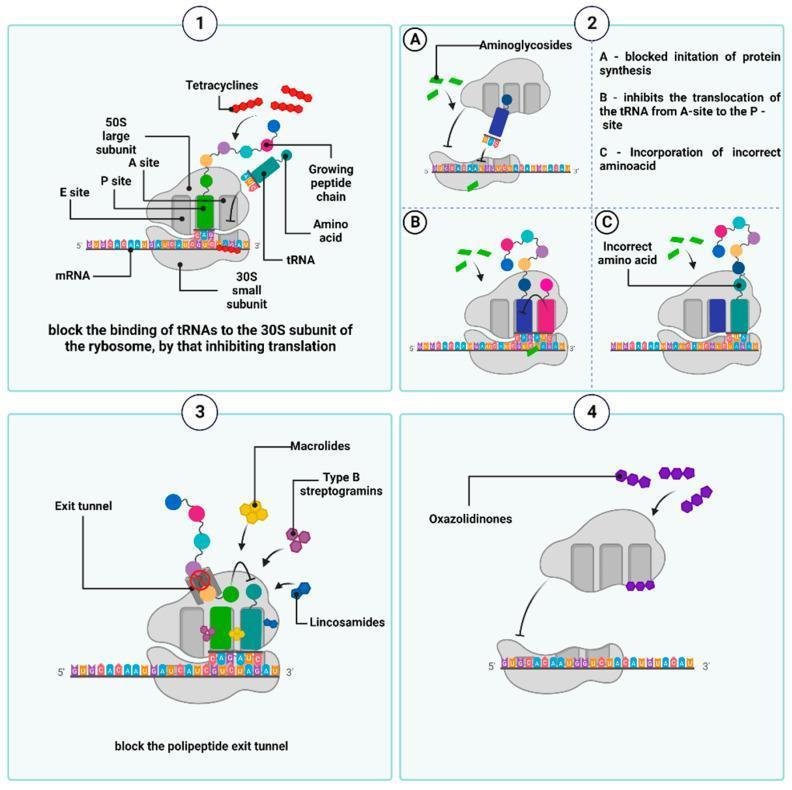
Educational pathophysiology diagram illustrating the mechanisms of action for four classes of protein synthesis inhibitors acting on the bacterial ribosome. The diagram is divided into four numbered quadrants: (1) Tetracyclines, represented by red linked circles, are shown binding to the 30S small subunit, which physically blocks aminoacyl-tRNA from binding to the A-site, thereby inhibiting translation. (2) Aminoglycosides, depicted as green bars, demonstrate three distinct mechanisms: (A) blocking the initiation of protein synthesis, (B) inhibiting tRNA translocation from the A-site to the P-site, and (C) causing mRNA misreading, leading to the incorporation of incorrect amino acids. (3) Macrolides, Lincosamides, and Type B Streptogramins are shown blocking the polypeptide exit tunnel of the 50S large subunit, preventing the extension of the growing peptide chain. (4) Oxazolidinones, shown as purple circles, bind to the 50S subunit at the peptidyl transferase center, inhibiting the formation of the 70S initiation complex and blocking early translation steps. Each panel illustrates key components including the 50S and 30S subunits, mRNA, tRNA, and the growing peptide chain.
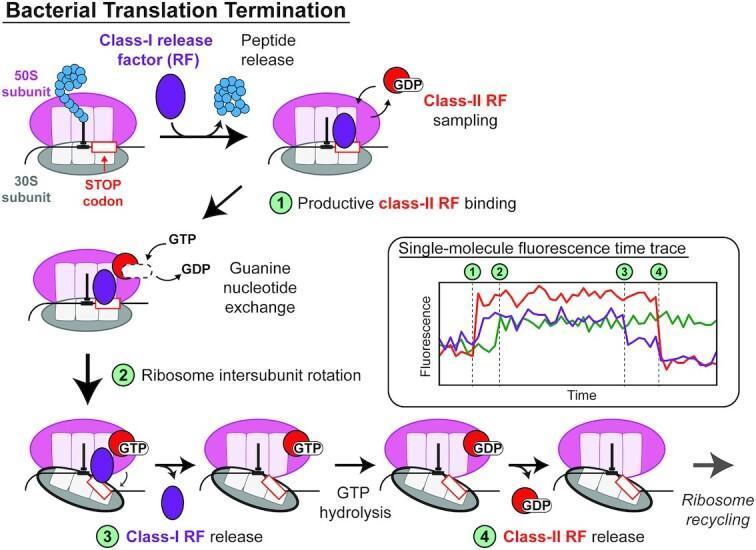
This pathophysiology diagram illustrates the sequential molecular mechanisms of bacterial translation termination and ribosome recycling. The visual is divided into a schematic pathway and a corresponding single-molecule fluorescence time trace. Key stages depicted include: 1. Initial binding of a Class-I Release Factor (RF) to the stop codon in the A site, triggering peptide release from the 50S and 30S subunits. 2. Non-productive 'sampling' by a Class-II RF (RF3) in its GDP-bound state. 3. Productive Class-II RF binding characterized by guanine nucleotide exchange (GDP to GTP). 4. Ribosome intersubunit rotation induced by RF3-GTP, which promotes the dissociation of the Class-I RF. 5. GTP hydrolysis on the Class-II RF, leading to its release in the GDP form. 6. Final ribosome recycling. An inset 'Single-molecule fluorescence time trace' shows multi-colored kinetic data (red, green, blue lines) corresponding to these numbered steps (1-4), highlighting changes in fluorescence intensity that correlate with factor occupancy and conformational changes. This diagram serves as an educational tool for molecular biology and microbiology, detailing the enzymatic regulation of protein synthesis termination.
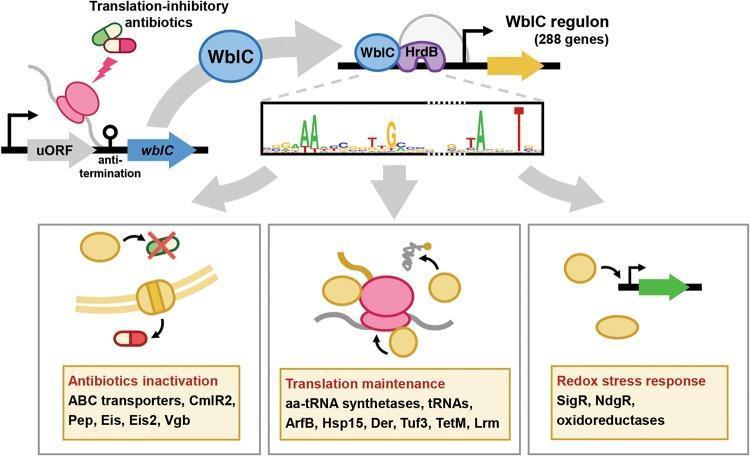
A pathophysiology diagram illustrating the molecular mechanism of WblC-mediated antibiotic resistance in bacteria. The process begins with translation-inhibitory antibiotics (e.g., tetracycline, chloramphenicol) targeting the ribosome, which triggers the induction of the wblC gene via a uORF-mediated anti-termination mechanism. The resulting WblC protein acts as a transcriptional activator by forming a complex with the HrdB sigma factor at target promoter regions containing a conserved GAAAWY motif. This activation controls the 'WblC regulon,' consisting of 288 genes. The diagram categorizes the regulon's downstream effects into three functional groups to counteract antibiotic stress: 1) Antibiotic Inactivation, involving ABC transporters (CmlR2, Pep) and enzymes (Eis, Eis2, Vgb) for efflux or chemical modification; 2) Translation Maintenance, utilizing aminoacyl-tRNA synthetases, tRNAs, and specialized factors (ArfB, Hsp15, Der, Tuf3, TetM, Lrm) to sustain protein synthesis; and 3) Redox Stress Response, mediated by regulators (SigR, NdgR) and oxidoreductases to manage antibiotic-induced cellular damage. This signaling pathway demonstrates how bacterial cells adapt to sub-inhibitory antibiotic concentrations to maintain growth and intrinsic resistance.
🦠 Bacterial Cell Wall + Antibiotic Targets - USMLE HY Master Note
✅ YOUR EXPLANATION - CORRECTIONS FIRST
| What you said | Correct term |
|---|---|
| "Transglycosidase" connects NAG-NAM in series | Correct enzyme name is Transglycosylase (also called glycosyltransferase) |
| Penicillinase "looks similar to PBP so penicillin binds it instead" | Partially correct - more precisely, penicillinase hydrolyzes (breaks) the beta-lactam ring of penicillin, destroying it. It doesn't "trap" penicillin - it inactivates it. |
PART 1 - THE BACTERIAL CELL WALL
The Basic Building Blocks
- NAG = N-Acetylglucosamine
- NAM = N-Acetylmuramic acid
The Two Types of Cross-Linking (THIS IS THE HY PART)
NAG—NAM—NAG—NAM—NAG—NAM   ← horizontal backbone (strand 1)
         |              |
        PEP            PEP         ← vertical cross-links (peptide bridges)
         |              |
NAG—NAM—NAG—NAM—NAG—NAM   ← horizontal backbone (strand 2)
| Direction | Enzyme | What it does |
|---|---|---|
| Horizontal (along the strand) | Transglycosylase | Links NAG to NAM in series - builds the glycan backbone |
| Vertical (between strands) | Transpeptidase = PBP | Cross-links the pentapeptide side chains between adjacent strands |
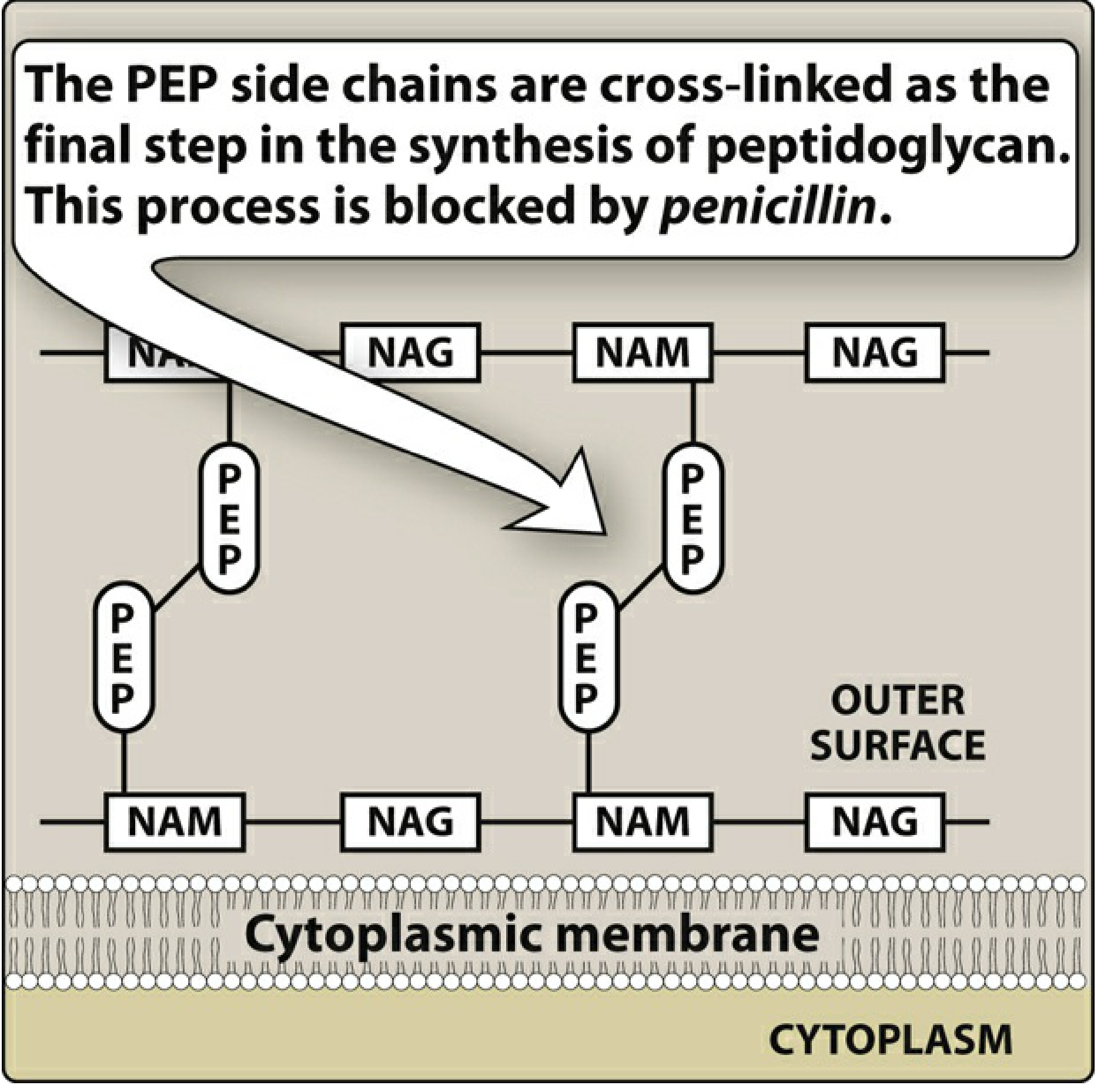
HY TEST POINT: Penicillin blocks the last step of cell wall synthesis = transpeptidation (the cross-linking). The backbone can still form, but without cross-linking, the wall is weak and the cell lyses.
PART 2 - PENICILLIN MECHANISM (CONFIRMED + EXPANDED)
- Penicillin structurally mimics the terminal D-Ala-D-Ala of the pentapeptide
- It competitively binds PBP (transpeptidase) in the periplasmic space
- Cross-linking is blocked → weakened cell wall → osmotic lysis → bactericidal
- Time-dependent killing (efficacy depends on time above MIC, not peak concentration)
HY: Penicillins work ONLY on growing/dividing bacteria (because cell wall synthesis only happens during growth). They are ineffective on dormant bacteria (e.g., persisters in biofilms).
PART 3 - RESISTANCE MECHANISMS (YOUR EXPLANATION WAS GOOD - HERE'S THE COMPLETE PICTURE)
Mechanism 1 - Beta-Lactamase Production ✅ (you got this)
- Bacteria produce beta-lactamase (penicillinase = type of beta-lactamase)
- It hydrolyzes the beta-lactam ring of penicillin → drug is destroyed/inactivated
- Beta-lactamases are in the same serine protease family as PBPs (this is why they can recognize the drug)
- Counter: add a beta-lactamase inhibitor (clavulanate, sulbactam, tazobactam) - these are "suicide inhibitors" that bind and inactivate beta-lactamase
Mechanism 2 - Altered PBP ✅ (you got this)
- Bacteria mutate/acquire a new PBP with low affinity for penicillin
- Classic example: MRSA carries the mecA gene → encodes PBP2a
- PBP2a still cross-links peptidoglycan, but penicillin (and all beta-lactams) cannot bind it
- This is why MRSA is resistant to ALL beta-lactams except ceftaroline (5th-gen cephalosporin that can bind PBP2a)
- Counter: Vancomycin (doesn't need to bind PBP - has a different mechanism)
Mechanism 3 - Decreased Permeability (BONUS HY)
- Gram-negative bacteria can downregulate porin channels → penicillin can't enter
- Most relevant for Pseudomonas resistance
Mechanism 4 - Efflux Pumps (BONUS HY)
- Active pumps eject the antibiotic out before it can work
PART 4 - VANCOMYCIN (BONUS - FITS HERE PERFECTLY)
- Binds the D-Ala-D-Ala terminus of the pentapeptide (the same terminal portion penicillin mimics)
- This blocks transglycosylase from polymerizing the NAG-NAM backbone AND blocks transpeptidation
- Since it binds the substrate (not the enzyme), beta-lactamase and PBP2a are useless against it
- Vancomycin resistance (VRE): vanA gene modifies D-Ala-D-Ala → D-Ala-D-Lac → vancomycin cannot bind (1000x reduced affinity)
PART 5 - RIBOSOME TARGETS (30S vs 50S)
30S Inhibitors - "AT 30"
| Drug class | Mechanism | Bacteriostatic or cidal? |
|---|---|---|
| Aminoglycosides | Binds 30S → irreversible binding → misreads mRNA → wrong amino acids inserted → also blocks initiation | Bactericidal |
| Tetracyclines | Binds 30S → blocks aminoacyl-tRNA from binding A-site → no new amino acid added | Bacteriostatic |
| Glycylcyclines (e.g., tigecycline) | Same as tetracyclines but overcomes tetracycline resistance | Bacteriostatic |
HY mnemonics: "Aminoglycosides are Awful to the kidney" (nephrotoxic + ototoxic). Tetracyclines are "tethered to calcium" (chelate Ca²⁺ → don't give in pregnancy, children <8 yr, dairy products reduce absorption).
50S Inhibitors - "CEL at 50" (Chloramphenicol, Erythromycin/Macrolides, Lincosamides)
| Drug class | Mechanism | Key point |
|---|---|---|
| Macrolides (azithromycin, erythromycin) | Binds 23S rRNA of 50S → blocks polypeptide exit tunnel → stops elongation | Bacteriostatic |
| Lincosamides (clindamycin) | Same binding site as macrolides on 50S | Bacteriostatic |
| Chloramphenicol | Binds 50S → blocks peptidyltransferase | Bacteriostatic (cidal for some) |
| Oxazolidinones (linezolid) | Binds 50S → blocks 70S initiation complex formation (stops translation before it starts) | Bacteriostatic |
| Streptogramins (quinupristin/dalfopristin) | Binds 50S exit tunnel (same as macrolides) | Bactericidal when combined |
HY: Linezolid inhibits the 50S but unlike all others, it blocks initiation (formation of the 70S complex), not elongation. This means it has a unique mechanism and works even when macrolide resistance is present.
MASTER SUMMARY TABLE
| Target | Drug Class | Bacteriostatic/cidal |
|---|---|---|
| Cell wall - transpeptidation | Penicillins, Cephalosporins, Carbapenems, Aztreonam | Cidal |
| Cell wall - D-Ala-D-Ala | Vancomycin | Cidal |
| 30S - A-site block | Tetracyclines | Static |
| 30S - misreading | Aminoglycosides | Cidal |
| 50S - exit tunnel | Macrolides, Clindamycin | Static |
| 50S - peptidyltransferase | Chloramphenicol | Static |
| 50S - initiation block | Linezolid | Static |
| DNA gyrase/topoisomerase | Fluoroquinolones | Cidal |
| RNA polymerase | Rifampin | Cidal |
| Cell membrane | Polymyxins, Daptomycin | Cidal |
ONE-LINE HY POINTS TO MEMORIZE
- MRSA → altered PBP2a (mecA gene) → treat with vancomycin or daptomycin
- VRE → modified D-Ala-D-Lac → treat with linezolid or daptomycin
- ESBL producers (E. coli, Klebsiella) → hyperproducing beta-lactamase → treat with carbapenems
- Beta-lactamase inhibitors (clavulanate, sulbactam, tazobactam) work as suicide substrates - they are NOT antibiotics alone
- Bactericidal + Bacteriostatic combination = often antagonistic (e.g., penicillin + tetracycline) - HY!
- Aminoglycosides need oxygen for uptake → do NOT work against strict anaerobes
make a pdf
ls -la /tmp/workspace/ 2>/dev/null || mkdir -p /tmp/workspace && echo "created"
mkdir -p /tmp/workspace/antimicrobials-note && python3 << 'EOF' from reportlab.lib.pagesizes import A4 from reportlab.lib.styles import getSampleStyleSheet, ParagraphStyle from reportlab.lib.units import mm, cm from reportlab.lib import colors from reportlab.platypus import (SimpleDocTemplate, Paragraph, Spacer, Table, TableStyle, HRFlowable, KeepTogether) from reportlab.lib.enums import TA_LEFT, TA_CENTER, TA_JUSTIFY from reportlab.platypus import PageBreak OUTPUT = "/tmp/workspace/antimicrobials-note/Antimicrobials_Foundation_Note.pdf" doc = SimpleDocTemplate( OUTPUT, pagesize=A4, leftMargin=18*mm, rightMargin=18*mm, topMargin=18*mm, bottomMargin=18*mm ) W = A4[0] - 36*mm # ── Colour palette ────────────────────────────────────────────── NAVY = colors.HexColor("#1a2e4a") BLUE = colors.HexColor("#2563eb") TEAL = colors.HexColor("#0d9488") GREEN = colors.HexColor("#16a34a") AMBER = colors.HexColor("#d97706") RED = colors.HexColor("#dc2626") PURPLE = colors.HexColor("#7c3aed") LGRAY = colors.HexColor("#f1f5f9") MGRAY = colors.HexColor("#e2e8f0") DGRAY = colors.HexColor("#475569") WHITE = colors.white styles = getSampleStyleSheet() # Custom styles def S(name, **kw): return ParagraphStyle(name, **kw) title_style = S("Title", fontSize=20, textColor=WHITE, fontName="Helvetica-Bold", alignment=TA_CENTER, spaceAfter=4) subtitle_style = S("Subtitle", fontSize=11, textColor=colors.HexColor("#bfdbfe"), fontName="Helvetica", alignment=TA_CENTER, spaceAfter=2) h1 = S("H1", fontSize=13, textColor=WHITE, fontName="Helvetica-Bold", spaceBefore=6, spaceAfter=4, leading=16) h2 = S("H2", fontSize=11, textColor=NAVY, fontName="Helvetica-Bold", spaceBefore=8, spaceAfter=3, leading=14) h3 = S("H3", fontSize=10, textColor=TEAL, fontName="Helvetica-Bold", spaceBefore=5, spaceAfter=2, leading=13) body = S("Body", fontSize=9, textColor=NAVY, fontName="Helvetica", spaceBefore=2, spaceAfter=2, leading=13) bullet = S("Bullet", fontSize=9, textColor=NAVY, fontName="Helvetica", spaceBefore=1, spaceAfter=1, leading=12, leftIndent=12, bulletIndent=0) hy_style = S("HY", fontSize=9, textColor=colors.HexColor("#7c2d12"), fontName="Helvetica-Bold", spaceBefore=3, spaceAfter=3, leading=12, leftIndent=8, rightIndent=8) corr_style = S("Corr", fontSize=9, textColor=colors.HexColor("#14532d"), fontName="Helvetica-Bold", spaceBefore=2, spaceAfter=2, leading=12, leftIndent=8) small_gray = S("SmGray", fontSize=8, textColor=DGRAY, fontName="Helvetica", spaceBefore=1, spaceAfter=1, leading=11, alignment=TA_CENTER) story = [] # ── HEADER BANNER ─────────────────────────────────────────────── banner_data = [[ Paragraph("🦠 Bacterial Cell Wall & Antibiotic Targets", title_style), ]] banner_sub = [[ Paragraph("USMLE High-Yield Conceptual Note • Microbiology / Pharmacology", subtitle_style), ]] banner_tbl = Table([[ Table(banner_data, colWidths=[W], rowHeights=[28]), Table(banner_sub, colWidths=[W], rowHeights=[18]), ]], colWidths=[W]) # Simpler approach: stacked rows header_rows = [ [Paragraph("🦠 Bacterial Cell Wall & Antibiotic Targets", title_style)], [Paragraph("USMLE High-Yield Conceptual Note • Microbiology / Pharmacology", subtitle_style)], ] header_tbl = Table(header_rows, colWidths=[W]) header_tbl.setStyle(TableStyle([ ("BACKGROUND", (0,0), (-1,-1), NAVY), ("TOPPADDING", (0,0), (-1,-1), 10), ("BOTTOMPADDING", (0,0), (-1,-1), 8), ("LEFTPADDING", (0,0), (-1,-1), 12), ("RIGHTPADDING", (0,0), (-1,-1), 12), ("ROUNDEDCORNERS", [6]), ])) story.append(header_tbl) story.append(Spacer(1, 8)) # ── CORRECTION BOX ────────────────────────────────────────────── def section_box(title, content_rows, bg=LGRAY, title_bg=TEAL, title_color=WHITE): """Renders a titled coloured section box.""" title_cell = [[Paragraph(title, S("BH", fontSize=10, textColor=title_color, fontName="Helvetica-Bold", leading=13))]] title_tbl = Table(title_cell, colWidths=[W]) title_tbl.setStyle(TableStyle([ ("BACKGROUND", (0,0), (-1,-1), title_bg), ("TOPPADDING", (0,0), (-1,-1), 5), ("BOTTOMPADDING", (0,0), (-1,-1), 5), ("LEFTPADDING", (0,0), (-1,-1), 10), ])) body_cells = [[row] for row in content_rows] body_tbl = Table([[r] for r in content_rows], colWidths=[W]) body_tbl.setStyle(TableStyle([ ("BACKGROUND", (0,0), (-1,-1), bg), ("TOPPADDING", (0,0), (-1,-1), 4), ("BOTTOMPADDING", (0,0), (-1,-1), 4), ("LEFTPADDING", (0,0), (-1,-1), 10), ("RIGHTPADDING", (0,0), (-1,-1), 10), ])) wrapper = Table([[title_tbl], [body_tbl]], colWidths=[W]) wrapper.setStyle(TableStyle([ ("BOX", (0,0), (-1,-1), 0.8, title_bg), ("TOPPADDING", (0,0), (-1,-1), 0), ("BOTTOMPADDING", (0,0), (-1,-1), 0), ("LEFTPADDING", (0,0), (-1,-1), 0), ("RIGHTPADDING", (0,0), (-1,-1), 0), ])) return wrapper # ── CORRECTIONS ───────────────────────────────────────────────── story.append(Paragraph("✅ Your Explanation - Corrections", h2)) corr_data = [ ["What You Said", "Correct Term / Clarification"], ["'Transglycosidase' links NAG-NAM in series", "Correct enzyme = Transglycosylase (glycosyltransferase)"], ["Penicillinase 'looks like PBP so penicillin binds it instead'", "More precisely: penicillinase HYDROLYZES the beta-lactam ring, DESTROYING the drug\n(it doesn't trap/sequester it)"], ] ct = Table(corr_data, colWidths=[W*0.42, W*0.58]) ct.setStyle(TableStyle([ ("BACKGROUND", (0,0), (-1,0), TEAL), ("TEXTCOLOR", (0,0), (-1,0), WHITE), ("FONTNAME", (0,0), (-1,0), "Helvetica-Bold"), ("FONTSIZE", (0,0), (-1,-1), 8.5), ("BACKGROUND", (0,1), (-1,-1), colors.HexColor("#f0fdfa")), ("ROWBACKGROUNDS",(0,1), (-1,-1), [colors.HexColor("#f0fdfa"), WHITE]), ("GRID", (0,0), (-1,-1), 0.4, colors.HexColor("#99f6e4")), ("VALIGN", (0,0), (-1,-1), "MIDDLE"), ("TOPPADDING", (0,0), (-1,-1), 5), ("BOTTOMPADDING", (0,0), (-1,-1), 5), ("LEFTPADDING", (0,0), (-1,-1), 7), ])) story.append(ct) story.append(Spacer(1, 8)) # ── PART 1: CELL WALL ─────────────────────────────────────────── def part_header(num, title, color=BLUE): row = [[Paragraph(f"PART {num} — {title}", S("PH", fontSize=11, textColor=WHITE, fontName="Helvetica-Bold", leading=14))]] t = Table(row, colWidths=[W]) t.setStyle(TableStyle([ ("BACKGROUND", (0,0), (-1,-1), color), ("TOPPADDING", (0,0), (-1,-1), 7), ("BOTTOMPADDING", (0,0), (-1,-1), 7), ("LEFTPADDING", (0,0), (-1,-1), 12), ("ROUNDEDCORNERS", [4]), ])) return t story.append(part_header(1, "THE BACTERIAL CELL WALL", BLUE)) story.append(Spacer(1, 5)) story.append(Paragraph("Building Blocks of Peptidoglycan", h3)) story.append(Paragraph( "Peptidoglycan = scaffold of the bacterial cell wall, made of two alternating sugar units:", body)) bb_data = [ ["Unit", "Full Name", "HY Fact"], ["NAG", "N-Acetylglucosamine", "Shared with fungal chitin — NOT unique to bacteria"], ["NAM", "N-Acetylmuramic acid", "UNIQUE to bacteria — found ONLY in prokaryotes"], ] bbt = Table(bb_data, colWidths=[W*0.12, W*0.38, W*0.50]) bbt.setStyle(TableStyle([ ("BACKGROUND", (0,0), (-1,0), BLUE), ("TEXTCOLOR", (0,0), (-1,0), WHITE), ("FONTNAME", (0,0), (-1,0), "Helvetica-Bold"), ("FONTSIZE", (0,0), (-1,-1), 8.5), ("BACKGROUND", (0,1), (-1,-1), LGRAY), ("ROWBACKGROUNDS",(0,1), (-1,-1), [LGRAY, WHITE]), ("GRID", (0,0), (-1,-1), 0.4, MGRAY), ("VALIGN", (0,0), (-1,-1), "MIDDLE"), ("TOPPADDING", (0,0), (-1,-1), 5), ("BOTTOMPADDING", (0,0), (-1,-1), 5), ("LEFTPADDING", (0,0), (-1,-1), 7), ])) story.append(bbt) story.append(Spacer(1, 6)) story.append(Paragraph("The Two Cross-Linking Enzymes — HY Core", h3)) story.append(Paragraph( "Think of the cell wall as a wire-mesh fence — horizontal backbone strands connected by vertical cross-links:", body)) # ASCII art in a box ascii_box = Table([[Paragraph( "<font name='Courier' size='8'>NAG—NAM—NAG—NAM—NAG—NAM ← Glycan backbone (strand 1)\n" " | |\n" " PEP PEP ← Pentapeptide cross-links\n" " | |\n" "NAG—NAM—NAG—NAM—NAG—NAM ← Glycan backbone (strand 2)</font>", S("Code", fontName="Courier", fontSize=8, leading=12, textColor=NAVY)) ]], colWidths=[W]) ascii_box.setStyle(TableStyle([ ("BACKGROUND", (0,0), (-1,-1), colors.HexColor("#f8fafc")), ("BOX", (0,0), (-1,-1), 0.8, BLUE), ("TOPPADDING", (0,0), (-1,-1), 8), ("BOTTOMPADDING", (0,0), (-1,-1), 8), ("LEFTPADDING", (0,0), (-1,-1), 14), ])) story.append(ascii_box) story.append(Spacer(1, 5)) cw_data = [ ["Direction", "Enzyme", "Action", "Drug that blocks it"], ["Horizontal\n(along strand)", "Transglycosylase\n(Glycosyltransferase)", "Links NAG-NAM\ninto backbone", "Vancomycin\n(partially)"], ["Vertical\n(between strands)", "Transpeptidase\n= PBP", "Cross-links peptide\nbridges (PEP)", "Penicillins,\nCephalosporins,\nCarbapenems"], ] cwt = Table(cw_data, colWidths=[W*0.18, W*0.27, W*0.27, W*0.28]) cwt.setStyle(TableStyle([ ("BACKGROUND", (0,0), (-1,0), NAVY), ("TEXTCOLOR", (0,0), (-1,0), WHITE), ("FONTNAME", (0,0), (-1,-1), "Helvetica"), ("FONTNAME", (0,0), (-1,0), "Helvetica-Bold"), ("FONTSIZE", (0,0), (-1,-1), 8.5), ("ROWBACKGROUNDS",(0,1), (-1,-1), [colors.HexColor("#eff6ff"), WHITE]), ("GRID", (0,0), (-1,-1), 0.4, MGRAY), ("VALIGN", (0,0), (-1,-1), "MIDDLE"), ("TOPPADDING", (0,0), (-1,-1), 5), ("BOTTOMPADDING", (0,0), (-1,-1), 5), ("LEFTPADDING", (0,0), (-1,-1), 7), ])) story.append(cwt) story.append(Spacer(1, 5)) hy1 = Table([[Paragraph( "⚡ HY TEST POINT: Penicillin blocks the LAST STEP of cell wall synthesis = transpeptidation. " "The backbone forms but cannot cross-link → weakened wall → osmotic lysis → BACTERICIDAL. " "Works ONLY on actively dividing bacteria (cell wall synthesis only occurs during growth).", S("HYT", fontSize=8.5, textColor=colors.HexColor("#7c2d12"), fontName="Helvetica-Bold", leading=12)) ]], colWidths=[W]) hy1.setStyle(TableStyle([ ("BACKGROUND", (0,0), (-1,-1), colors.HexColor("#fef3c7")), ("BOX", (0,0), (-1,-1), 1.2, AMBER), ("TOPPADDING", (0,0), (-1,-1), 7), ("BOTTOMPADDING", (0,0), (-1,-1), 7), ("LEFTPADDING", (0,0), (-1,-1), 10), ("RIGHTPADDING", (0,0), (-1,-1), 10), ])) story.append(hy1) story.append(Spacer(1, 8)) # ── PART 2: PENICILLIN MOA ─────────────────────────────────────── story.append(part_header(2, "PENICILLIN MECHANISM OF ACTION", TEAL)) story.append(Spacer(1, 5)) moa_items = [ ("1.", "Penicillin structurally mimics the terminal D-Ala-D-Ala of the NAM pentapeptide"), ("2.", "Competitively binds PBP (transpeptidase) located in the periplasmic space"), ("3.", "Cross-linking is BLOCKED → weakened cell wall → osmotic lysis → cell death"), ("4.", "BACTERICIDAL, TIME-DEPENDENT killing (efficacy correlates with time above MIC, not peak)"), ("5.", "Ineffective on dormant/static bacteria — needs active cell wall synthesis"), ] for num, text in moa_items: story.append(Paragraph(f"<b>{num}</b> {text}", bullet)) story.append(Spacer(1, 8)) # ── PART 3: RESISTANCE ─────────────────────────────────────────── story.append(part_header(3, "RESISTANCE MECHANISMS", RED)) story.append(Spacer(1, 5)) res_data = [ ["Mechanism", "Details", "Key Example", "Counter"], ["Beta-Lactamase\nProduction", "Hydrolyzes the beta-lactam ring,\ndestroying the antibiotic\n(serine protease, same family as PBP)", "ESBL in E. coli,\nKlebsiella (TEM-1, SHV-1)", "Beta-lactamase inhibitors:\nclavulanate, sulbactam,\ntazobactam (suicide inhibitors)"], ["Altered PBP\n(mecA gene)", "New PBP2a has LOW affinity\nfor penicillin — still cross-links\nbut drug can't bind", "MRSA (methicillin-resistant\nS. aureus)", "Vancomycin, Daptomycin,\nCeftaroline (only beta-lactam\nthat binds PBP2a)"], ["Decreased\nPermeability", "Downregulation of porin channels\n— penicillin cannot enter\nGram-negative outer membrane", "Pseudomonas aeruginosa\nresistance", "Larger/different drugs,\nCarbapenems"], ["Efflux Pumps", "Active transporters eject\nthe antibiotic before it\ncan reach PBP", "Multiple Gram-negatives", "Efflux pump inhibitors\n(experimental)"], ] rest = Table(res_data, colWidths=[W*0.18, W*0.30, W*0.25, W*0.27]) rest.setStyle(TableStyle([ ("BACKGROUND", (0,0), (-1,0), RED), ("TEXTCOLOR", (0,0), (-1,0), WHITE), ("FONTNAME", (0,0), (-1,-1), "Helvetica"), ("FONTNAME", (0,0), (-1,0), "Helvetica-Bold"), ("FONTSIZE", (0,0), (-1,-1), 8), ("ROWBACKGROUNDS",(0,1), (-1,-1), [colors.HexColor("#fff1f2"), WHITE]), ("GRID", (0,0), (-1,-1), 0.4, MGRAY), ("VALIGN", (0,0), (-1,-1), "TOP"), ("TOPPADDING", (0,0), (-1,-1), 5), ("BOTTOMPADDING", (0,0), (-1,-1), 5), ("LEFTPADDING", (0,0), (-1,-1), 7), ])) story.append(rest) story.append(Spacer(1, 8)) # ── PART 4: VANCOMYCIN ─────────────────────────────────────────── story.append(part_header(4, "VANCOMYCIN — DIFFERENT MECHANISM, HY!", PURPLE)) story.append(Spacer(1, 5)) van_items = [ "Binds D-Ala-D-Ala terminus of the pentapeptide (the SUBSTRATE, not the enzyme)", "Blocks BOTH transglycosylase (NAG-NAM polymerization) AND transpeptidation", "Beta-lactamase CANNOT destroy vancomycin (no beta-lactam ring)", "PBP2a CANNOT bypass vancomycin (it blocks the substrate before PBP ever acts)", "VRE resistance: vanA gene modifies D-Ala-D-Ala → D-Ala-D-Lac → 1000x reduced affinity", "Treat VRE with: Linezolid or Daptomycin", ] for item in van_items: story.append(Paragraph(f"• {item}", bullet)) story.append(Spacer(1, 8)) # ── PART 5: RIBOSOMES ──────────────────────────────────────────── story.append(part_header(5, "RIBOSOME TARGETS — 30S vs 50S", GREEN)) story.append(Spacer(1, 5)) story.append(Paragraph( "Bacteria have 70S ribosomes (30S + 50S). Humans have 80S (40S + 60S). " "This structural difference is the basis for selective antibiotic toxicity.", body)) story.append(Spacer(1, 5)) story.append(Paragraph("30S Inhibitors — Mnemonic: 'AT 30' (Aminoglycosides + Tetracyclines)", h3)) r30_data = [ ["Drug Class", "Mechanism", "Cidal / Static", "HY Toxicity / Pearls"], ["Aminoglycosides\n(gentamicin, tobramycin,\namikacin, streptomycin)", "Irreversibly binds 30S\nMisreads mRNA (wrong AA)\nBlocks initiation complex", "BACTERICIDAL\n(concentration-dependent)", "Nephrotoxic + Ototoxic\nNeeds O2 for uptake\n→ NO anaerobic coverage\nSynergy with beta-lactams"], ["Tetracyclines\n(doxycycline,\nminocycline)", "Reversibly binds 30S\nBlocks aminoacyl-tRNA\nfrom binding A-site", "Bacteriostatic", "Avoid <8 yrs, pregnancy\nDairy/Ca2+ chelation\n→ reduced absorption\nBroad spectrum (atypicals)"], ["Glycylcyclines\n(tigecycline)", "Same as tetracyclines but\noverrides efflux pump\nresistance", "Bacteriostatic", "Active against MRSA,\nVRE, ESBL organisms\nNOT Pseudomonas"], ] r30t = Table(r30_data, colWidths=[W*0.22, W*0.30, W*0.18, W*0.30]) r30t.setStyle(TableStyle([ ("BACKGROUND", (0,0), (-1,0), GREEN), ("TEXTCOLOR", (0,0), (-1,0), WHITE), ("FONTNAME", (0,0), (-1,-1), "Helvetica"), ("FONTNAME", (0,0), (-1,0), "Helvetica-Bold"), ("FONTSIZE", (0,0), (-1,-1), 8), ("ROWBACKGROUNDS",(0,1), (-1,-1), [colors.HexColor("#f0fdf4"), WHITE]), ("GRID", (0,0), (-1,-1), 0.4, MGRAY), ("VALIGN", (0,0), (-1,-1), "TOP"), ("TOPPADDING", (0,0), (-1,-1), 5), ("BOTTOMPADDING", (0,0), (-1,-1), 5), ("LEFTPADDING", (0,0), (-1,-1), 7), ])) story.append(r30t) story.append(Spacer(1, 6)) story.append(Paragraph("50S Inhibitors — Mnemonic: 'CEL at 50' (Chloramphenicol, Erythromycin/Macrolides, Lincosamides) + Linezolid", h3)) r50_data = [ ["Drug Class", "Mechanism", "Cidal / Static", "HY Pearls"], ["Macrolides\n(azithromycin,\nclarithromycin,\nerythromycin)", "Binds 23S rRNA of 50S\nBlocks polypeptide\nexit tunnel → stops\nelongation", "Bacteriostatic", "Atypicals (Legionella,\nMycoplasma, Chlamydia)\nQT prolongation risk\nCYP3A4 inhibitor"], ["Lincosamides\n(clindamycin)", "Same binding site as\nmacrolides on 50S\n(23S rRNA)", "Bacteriostatic", "Best for anaerobes +\nGram-positives; MRSA\nSkin/soft tissue, aspiration\nC. diff risk"], ["Chloramphenicol", "Binds 50S\nBlocks peptidyltransferase\n(blocks peptide bond\nformation)", "Bacteriostatic\n(cidal for some)", "Gray baby syndrome\nAplastic anemia\nReserved for meningitis\nwhen all else fails"], ["Oxazolidinones\n(linezolid)", "Binds 50S\nBlocks 70S INITIATION\nCOMPLEX formation\n(unique mechanism!)", "Bacteriostatic", "Active vs MRSA, VRE\nSerotonin syndrome risk\n(MAO inhibitor effect)\nMyelosuppression"], ["Streptogramins\n(quinupristin/\ndalfopristin)", "Both bind 50S exit\ntunnel (similar to\nmacrolides)", "BACTERICIDAL\n(when combined)", "VRE (E. faecium, NOT\nE. faecalis)\nMyalgias, arthralgias"], ] r50t = Table(r50_data, colWidths=[W*0.22, W*0.28, W*0.16, W*0.34]) r50t.setStyle(TableStyle([ ("BACKGROUND", (0,0), (-1,0), colors.HexColor("#16a34a")), ("TEXTCOLOR", (0,0), (-1,0), WHITE), ("FONTNAME", (0,0), (-1,-1), "Helvetica"), ("FONTNAME", (0,0), (-1,0), "Helvetica-Bold"), ("FONTSIZE", (0,0), (-1,-1), 8), ("ROWBACKGROUNDS",(0,1), (-1,-1), [colors.HexColor("#f0fdf4"), WHITE]), ("GRID", (0,0), (-1,-1), 0.4, MGRAY), ("VALIGN", (0,0), (-1,-1), "TOP"), ("TOPPADDING", (0,0), (-1,-1), 5), ("BOTTOMPADDING", (0,0), (-1,-1), 5), ("LEFTPADDING", (0,0), (-1,-1), 7), ])) story.append(r50t) story.append(Spacer(1, 8)) # ── MASTER SUMMARY TABLE ──────────────────────────────────────── story.append(part_header(6, "MASTER SUMMARY — ALL ANTIBIOTIC TARGETS", NAVY)) story.append(Spacer(1, 5)) master_data = [ ["Target", "Drug Class / Examples", "Static / Cidal", "Resistance"], ["Cell wall\nTranspeptidation\n(PBP)", "Penicillins, Cephalosporins\nCarbapenems, Aztreonam\n(all beta-lactams)", "CIDAL\n(time-dependent)", "Beta-lactamase\nAltered PBP (MRSA)\nPorins / efflux"], ["Cell wall\nD-Ala-D-Ala\n(substrate)", "Vancomycin, Teicoplanin\n(glycopeptides)", "CIDAL", "vanA: D-Ala-D-Lac\n→ VRE"], ["30S ribosome\nA-site block", "Tetracyclines\nDoxycycline, Minocycline", "Static", "Efflux pumps\nRibosomal protection"], ["30S ribosome\nmRNA misread", "Aminoglycosides\nGentamicin, Amikacin", "CIDAL\n(conc-dependent)", "Modifying enzymes\n(acetylation etc.)"], ["50S ribosome\nExit tunnel", "Macrolides (azithromycin)\nClindamycin, Streptogramins", "Static\n(Strep = cidal)", "Methylation of 23S rRNA\n(erm genes) — MLSB resist"], ["50S ribosome\nPeptidyltransferase", "Chloramphenicol", "Static", "Acetyltransferases"], ["50S ribosome\nInitiation complex", "Linezolid", "Static", "Rare cfr gene mutations"], ["DNA gyrase /\nTopoisomerase II/IV", "Fluoroquinolones\nCiprofloxacin, Levofloxacin", "CIDAL\n(conc-dependent)", "Gyrase mutations\nEfflux pumps"], ["RNA polymerase\n(beta subunit)", "Rifampin, Rifabutin", "CIDAL", "rpoB gene mutation\n(NEVER use alone)"], ["Cell membrane\ndisruption", "Polymyxins (colistin)\nDaptomycin", "CIDAL", "LPS modification\n(polymyxin)\nMembrane changes"], ["Folate synthesis\n(PABA inhibition)", "Sulfonamides + TMP\n(Trimethoprim-Sulfa)", "Static\n(TMP-SMX = cidal)", "PABA overproduction\nDHFR mutations"], ] mastt = Table(master_data, colWidths=[W*0.22, W*0.28, W*0.17, W*0.33]) mastt.setStyle(TableStyle([ ("BACKGROUND", (0,0), (-1,0), NAVY), ("TEXTCOLOR", (0,0), (-1,0), WHITE), ("FONTNAME", (0,0), (-1,-1), "Helvetica"), ("FONTNAME", (0,0), (-1,0), "Helvetica-Bold"), ("FONTSIZE", (0,0), (-1,-1), 8), ("ROWBACKGROUNDS",(0,1), (-1,-1), [LGRAY, WHITE]), ("GRID", (0,0), (-1,-1), 0.4, MGRAY), ("VALIGN", (0,0), (-1,-1), "TOP"), ("TOPPADDING", (0,0), (-1,-1), 5), ("BOTTOMPADDING", (0,0), (-1,-1), 5), ("LEFTPADDING", (0,0), (-1,-1), 7), ])) story.append(mastt) story.append(Spacer(1, 8)) # ── RAPID HY BULLETS ──────────────────────────────────────────── story.append(part_header(7, "RAPID-FIRE HY BULLETS — EXAM KILLERS", AMBER)) story.append(Spacer(1, 5)) hy_bullets = [ ("MRSA", "Altered PBP2a (mecA gene). Treat: Vancomycin (systemic), TMP-SMX (skin), Daptomycin (bacteremia), Ceftaroline (only beta-lactam that works)."), ("VRE", "vanA gene: D-Ala-D-Ala → D-Ala-D-Lac. Treat: Linezolid or Daptomycin."), ("ESBL", "Extended-spectrum beta-lactamases (E. coli, Klebsiella on plasmids). Treat: Carbapenems."), ("Beta-lactamase inhibitors", "Clavulanate, sulbactam, tazobactam = SUICIDE INHIBITORS. NOT antibiotics alone — they inhibit the inhibitor."), ("Bactericidal + Static = ANTAGONISM", "Classic exam trap: Penicillin (cidal) + Tetracycline (static) = antagonistic. Cidal drugs need active growth to work; static drugs STOP growth."), ("Aminoglycosides + anaerobes", "Aminoglycosides need O2 for uptake → ZERO coverage of strict anaerobes."), ("Linezolid uniqueness", "Only 50S drug that blocks INITIATION (formation of 70S complex), not elongation. Also a weak MAO inhibitor — serotonin syndrome risk with SSRIs."), ("Daptomycin + lungs", "Daptomycin is inactivated by pulmonary surfactant → NEVER use for pneumonia. Use for bacteremia, endocarditis."), ("Fluoroquinolones + children", "Avoid in children — cartilage damage (Achilles tendon; also adults >60 yrs)."), ("Rifampin", "NEVER give alone (rapid resistance develops). Used in TB, meningococcal prophylaxis, MRSA combo. Turns urine/tears ORANGE. Major CYP inducer."), ("Chloramphenicol toxicities", "Gray baby syndrome (premature — no UDP-glucuronyl transferase). Aplastic anemia (rare, dose-independent, idiosyncratic)."), ("NAM is unique to bacteria", "NAM is found ONLY in prokaryotes. NAG is also in human cartilage/chitin. This is why cell-wall drugs have low human toxicity."), ] for term, explanation in hy_bullets: row_data = [[ Paragraph(f"<b>{term}</b>", S("BT", fontSize=8.5, textColor=NAVY, fontName="Helvetica-Bold", leading=12)), Paragraph(explanation, S("BE", fontSize=8.5, textColor=NAVY, fontName="Helvetica", leading=12)) ]] bt = Table(row_data, colWidths=[W*0.25, W*0.75]) bt.setStyle(TableStyle([ ("BACKGROUND", (0,0), (0,0), colors.HexColor("#fef9c3")), ("BACKGROUND", (1,0), (1,0), colors.HexColor("#fffbeb")), ("BOX", (0,0), (-1,-1), 0.4, colors.HexColor("#fde68a")), ("TOPPADDING", (0,0), (-1,-1), 4), ("BOTTOMPADDING", (0,0), (-1,-1), 4), ("LEFTPADDING", (0,0), (-1,-1), 7), ("VALIGN", (0,0), (-1,-1), "TOP"), ])) story.append(bt) story.append(Spacer(1, 2)) story.append(Spacer(1, 8)) # ── FOOTER ────────────────────────────────────────────────────── story.append(HRFlowable(width=W, color=MGRAY, thickness=0.5)) story.append(Spacer(1, 3)) story.append(Paragraph( "Sources: Lippincott Illustrated Reviews Pharmacology | Medical Microbiology 9e (Murray) | " "Goodman & Gilman's Pharmacological Basis of Therapeutics | Harrison's 22e", S("Foot", fontSize=7.5, textColor=DGRAY, fontName="Helvetica", alignment=TA_CENTER, leading=11))) # ── BUILD ──────────────────────────────────────────────────────── doc.build(story) print(f"PDF created: {OUTPUT}") EOF
Antimicrobials Foundation Note
PDF Document · PDF
| Section | Content |
|---|---|
| Corrections box | Your 2 small errors fixed (transglycosylase + beta-lactamase mechanism) |
| Part 1 | Cell wall structure - NAG/NAM, transglycosylase vs transpeptidase table + ASCII diagram |
| Part 2 | Penicillin MOA - step-by-step |
| Part 3 | All 4 resistance mechanisms (beta-lactamase, altered PBP, porins, efflux) with examples + counters |
| Part 4 | Vancomycin - why it bypasses beta-lactam resistance + VRE mechanism |
| Part 5 | 30S inhibitors table + 50S inhibitors table (full drug classes) |
| Part 6 | Master summary - all antibiotic targets in one table |
| Part 7 | 12 rapid-fire HY bullets (MRSA, VRE, ESBL, antagonism trap, daptomycin lung trap, etc.) |
Explain the concept of direct coombs and indirect coombs, uh, tests, and important clinical pearls, and, uh, points that I must know for this exam.
... Purchased with... 100 rupees and you have gave me only four questions answers, that's it. Okay.