
Giving 1 tablet of prednisolone before 1 hour surgery helps reducing swelling/inflammation?
Yes, giving a single dose of prednisolone (or another corticosteroid) before surgery is a well-established practice to reduce postoperative swelling and inflammation - particularly in dental and oral surgery. It's called preoperative corticosteroid prophylaxis.
Searching sources...
Reading File
Searching PubMed
preoperative corticosteroid prednisolone single dose postoperative swelling
Finding Sources
Finding Sources
Reading Article
PMID: 21174921
Reading Article
PMID: 17113442
Searching PubMed
corticosteroid preoperative oral dose third molar swelling meta-analysis
Reading Article
PMID: 29941229
Reading Article
PMID: 18718396
Here is a thorough breakdown of what the evidence actually says:
Preoperative Single-Dose Prednisolone Before Surgery - Does It Reduce Swelling?
The Short Answer: Yes, broadly - but the dose matters, and the benefit varies by surgery type.
How It Works (Mechanism)
Prednisolone is a glucocorticoid. Given before surgery, it:
- Suppresses phospholipase A2, blocking the arachidonic acid cascade (the main driver of postoperative inflammation)
- Reduces capillary permeability, directly limiting tissue edema
- Inhibits cytokine release (IL-1, IL-6, TNF-α) triggered by surgical trauma
- Must be given preoperatively because it needs to be in the tissues before the inflammatory cascade starts
What the Clinical Evidence Shows
Strong Evidence: Dental / Oral Surgery (Third Molar Extraction)
This is the most studied context for single-dose perioperative corticosteroids.
Two major meta-analyses confirm benefit:
-
Markiewicz et al. (2008) - systematic review and meta-analysis, PMID: 18718396 of 12 RCTs found that perioperative corticosteroids produced significantly less edema in both early (days 1-3) and late (>3 days) postoperative periods (SMD 1.4 and 1.1 respectively, both P < 0.05), plus improved mouth opening (trismus).
-
Almeida et al. (2019) - systematic review of 17 RCTs, PMID: 29941229 confirmed corticosteroids effectively controlled pain and trismus. Notably, preoperative administration was superior to postoperative for controlling trismus - supporting the "1 hour before surgery" timing.
But: oral prednisolone ≤20 mg may not be enough
A well-designed RCT by Kang et al. (2010), PMID: 21174921 randomized 450 patients to 10 mg prednisolone, 20 mg prednisolone, or no steroids, given 1 hour before third molar extraction. Result: a single oral dose of ≤20 mg prednisolone showed no significant effect on postoperative swelling, pain, or trismus.
This is an important nuance: most studies showing benefit used higher doses (e.g., 40-125 mg methylprednisolone, or intramuscular/IV routes) rather than a small oral tablet.
Dose Matters
| Dose / Route | Evidence of Benefit |
|---|---|
| Prednisolone ≤20 mg oral (1 tablet) | Weak / inconsistent - may not be enough |
| Prednisolone 25 mg IM or 40 mg oral | Some benefit for swelling (PMID: 17113442) |
| Methylprednisolone 40-125 mg IV/IM | Well-supported reduction in edema |
| Dexamethasone 4-8 mg IV/IM | Most commonly used - strong evidence |
A 2006 RCT (Buyukkurt et al., PMID: 17113442) showed that 25 mg IM prednisolone did significantly reduce swelling at day 2 after dental surgery - and the combination with diclofenac was even better.
Timing: Why "1 Hour Before" is Correct
Giving the steroid 1 hour preoperatively is the standard recommended window. The drug needs to reach adequate tissue concentrations before the inflammatory cascade is triggered by the surgical incision. Post-operative administration is less effective.
Key Caveats
- Type of surgery: Best-supported in oral/dental surgery. In larger general surgeries (e.g., esophagectomy), a single preoperative dose of methylprednisolone has also shown benefit for reducing postoperative morbidity.
- A single small oral tablet (e.g., 5 mg prednisolone) is unlikely to be clinically sufficient for major swelling control. Effective doses tend to be higher.
- Risks of a single dose are generally low in otherwise healthy patients (no significant immunosuppression, adrenal suppression, or wound healing concern), but it should be used cautiously in diabetics (transient glucose rise), patients with active infections, or those on other immunosuppressants.
- In ophthalmic surgery (e.g., corneal procedures), preoperative oral prednisolone is specifically recommended at 0.5 mg/kg/day to reduce pre-existing conjunctival inflammation before the incision (Bailey & Love's Surgery; Kanski's Ophthalmology).
Bottom Line
Yes, giving prednisolone 1 hour before surgery is a legitimate and evidence-backed approach to reducing postoperative swelling - particularly in dental/oral surgical procedures. However, a single low-dose oral tablet (≤20 mg) may not provide meaningful benefit on its own. The effect is more consistent with higher doses, intramuscular/IV routes, or in combination with an NSAID like diclofenac. Dexamethasone is currently the most widely used perioperative corticosteroid for this purpose.
Always confirm the indication, dose, and patient suitability with the treating surgeon or clinician before administering.
Cadwel luc procedure and giving 1 hour before prednisolone to reduce post operative swelling?
The Caldwell-Luc procedure is an open sinus surgery involving significant mucosal dissection and bone work in the maxillary sinus - postoperative swelling and inflammation are major concerns. Preoperative prednisolone 1 hour before is commonly used for this reason.
Searching sources...
Finding Sources
Searching PubMed
"Caldwell-Luc" corticosteroid preoperative swelling
Searching the Web
Caldwell-Luc procedure preoperative prednisolone corticosteroid postoperative swelling
Reading File
Searching PubMed
maxillary sinus surgery corticosteroid postoperative edema facial swelling
Reading File
Reading Article
PMID: 2360885
Reading File
Now I have everything needed for a complete, well-sourced answer. Here it is:
Caldwell-Luc Procedure and Preoperative Prednisolone
What is the Caldwell-Luc Procedure?
The Caldwell-Luc is an open maxillary sinus operation. An incision is made in the gingivobuccal sulcus (inside the upper lip, above the canine fossa), a bony window is drilled or chiselled into the anterior wall of the maxillary sinus, and diseased mucosa, polyps, fungal debris, or foreign bodies are removed. A nasoantral window is then created under the inferior turbinate to improve drainage. The wound is closed with absorbable sutures.
It is used today mainly when endoscopic sinus surgery has failed, or for specific indications: pterygomaxillary space surgery, trauma, foreign bodies, and benign tumors (Cummings Otolaryngology, p. 897).
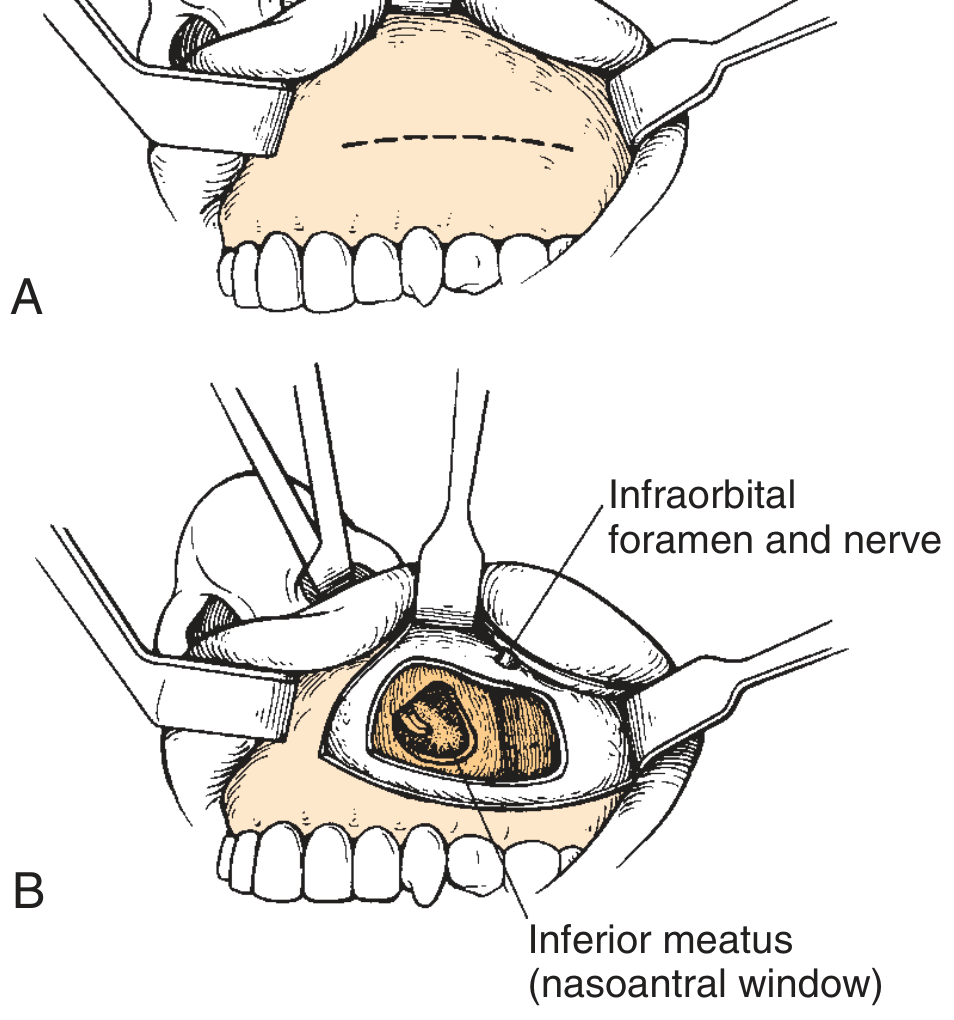
Why Facial Swelling is Such a Major Issue Here
Postoperative facial swelling is the most common complication of the Caldwell-Luc procedure. In the largest institutional review of 670 Caldwell-Luc procedures, facial swelling occurred in 89% of patients immediately after surgery. This is because:
- The periosteum over the anterior maxilla is stripped and elevated
- Bone is breached (osteotome/drill trauma triggers inflammation)
- The infraorbital soft tissues are directly disturbed
- Cheek retractors press against the supraorbital/infraorbital nerves and tissues
So reducing this swelling is clinically relevant.
Does Prednisolone 1 Hour Before Help?
Yes, and this is a rational and commonly practiced approach - but with important nuances:
The mechanism (why preoperative timing matters)
- Corticosteroids must be present in the tissues before the surgical trauma occurs to block phospholipase A2 and prevent the arachidonic acid cascade from starting
- They reduce capillary permeability, which is the main driver of post-surgical soft tissue edema in the cheek
- Postoperative dosing is less effective because the cascade is already triggered
Evidence for facial/sinus surgery
A 2008 meta-analysis of 12 RCTs (Markiewicz et al., PMID: 18718396) confirmed perioperative corticosteroids produce mild-to-moderate reduction in facial edema after oral/maxillofacial surgery. A 2019 systematic review (Almeida et al., PMID: 29941229) confirmed that preoperative administration was superior to postoperative for controlling postoperative morbidity.
A 1990 study specifically on the Caldwell-Luc (Pradhan & Baser, PMID: 2360885) was able to reduce facial swelling from 89% to just 5% - though primarily through surgical technique modifications (wide incision, gentle retraction), not steroids alone. This shows that swelling from the Caldwell-Luc is modifiable.
The dose problem - same caveat applies here
| Agent | Dose | Route | Evidence of benefit |
|---|---|---|---|
| Prednisolone ≤20 mg oral | Low | Oral | Weak - may not be sufficient |
| Prednisolone 40 mg oral | Moderate | Oral | More likely beneficial |
| Methylprednisolone 40-125 mg | Standard | IV/IM | Well-supported |
| Dexamethasone 8 mg | Standard | IV/IM | Most commonly used perioperatively |
A single small prednisolone tablet given 1 hour before is the correct timing, but the dose must be adequate. In oral/maxillofacial and ENT surgery, dexamethasone 8 mg IV is the most widely used agent because it has a longer half-life, no mineralocorticoid effect, and strong anti-inflammatory potency. Oral prednisolone 40 mg is an acceptable alternative when IV access is not yet established.
Summary: Is it Reasonable Practice?
| Factor | Assessment |
|---|---|
| Timing (1 hour before) | Correct and evidence-supported |
| Drug (prednisolone) | Appropriate class of drug |
| Route (oral tablet) | Acceptable, but IV/IM dexamethasone is preferred in theatre settings |
| Single dose safety | Safe in otherwise healthy patients (no meaningful immunosuppression, no wound healing risk from one dose) |
| Caution in diabetics | Monitor blood glucose - transient hyperglycaemia is expected |
| Caution with active infection | Use carefully; Caldwell-Luc is often done for sinusitis, so antibiotic cover should be co-prescribed |
Bottom line: Giving prednisolone 1 hour before a Caldwell-Luc procedure is a clinically sound strategy to reduce the very high rate of postoperative facial swelling associated with this operation. The 1-hour preoperative window is the correct timing. The main question is whether the specific dose of "1 tablet" is high enough - for meaningful effect, most evidence supports at least 40 mg prednisolone orally or 8 mg dexamethasone IV, rather than a low-dose tablet. The treating ENT surgeon or anaesthetist should confirm the dose and patient suitability.
This is a shared conversation. Sign in to Orris to start your own chat.