
Airway pressure release ventilation
Reading File
Searching sources...
Finding Sources
Searching PubMed
"airway pressure release ventilation" APRV
Reading File
Reading File
Reading File
Reading File
Reading File
Loading Image
Here is a comprehensive overview of Airway Pressure Release Ventilation (APRV) drawn from multiple authoritative textbooks.
Airway Pressure Release Ventilation (APRV)
Definition and Classification
APRV (also called bilevel ventilation, biphasic ventilation, or bilevel positive airway pressure) is a time-cycled, pressure-targeted mode of ventilatory support. It is best understood as a modified form of pressure-targeted SIMV (synchronized intermittent mandatory ventilation) that allows spontaneous breathing at any phase of the respiratory cycle - during both the high-pressure phase and the release phase.
- Morgan and Mikhail's Clinical Anesthesiology, 7e - a relatively high PEEP is used while the patient breathes spontaneously; intermittently the PEEP drops to augment CO2 elimination.
- Roberts and Hedges' Clinical Procedures in Emergency Medicine - enabled by a floating valve responsive to patient needs regardless of cycle position.
How It Works: The Two Phases
The clinician sets four parameters:
| Parameter | Description | Typical Values |
|---|---|---|
| P-high (Pressure High) | Upper CPAP level - maintained for the majority of time | Up to 40 cm H2O or higher |
| T-high (Time High) | Duration at P-high - where oxygenation occurs | 4-6 seconds |
| P-low (Pressure Low / Release Pressure) | Lower pressure during release | 0-5 cm H2O |
| T-low (Time Low / Release Phase) | Short release duration - CO2 clearance | 0.2-0.8 s (restrictive); 0.8-1.5 s (obstructive) |
Oxygenation is achieved through the prolonged high-pressure phase, which recruits alveoli with varying time constants. Ventilation (CO2 clearance) occurs during the brief release from P-high to P-low, when elastic recoil drives large-volume gas flow out of well-recruited lungs.
The waveform below shows P-high maintained for ~5 seconds (High CPAP phase), followed by a brief release:
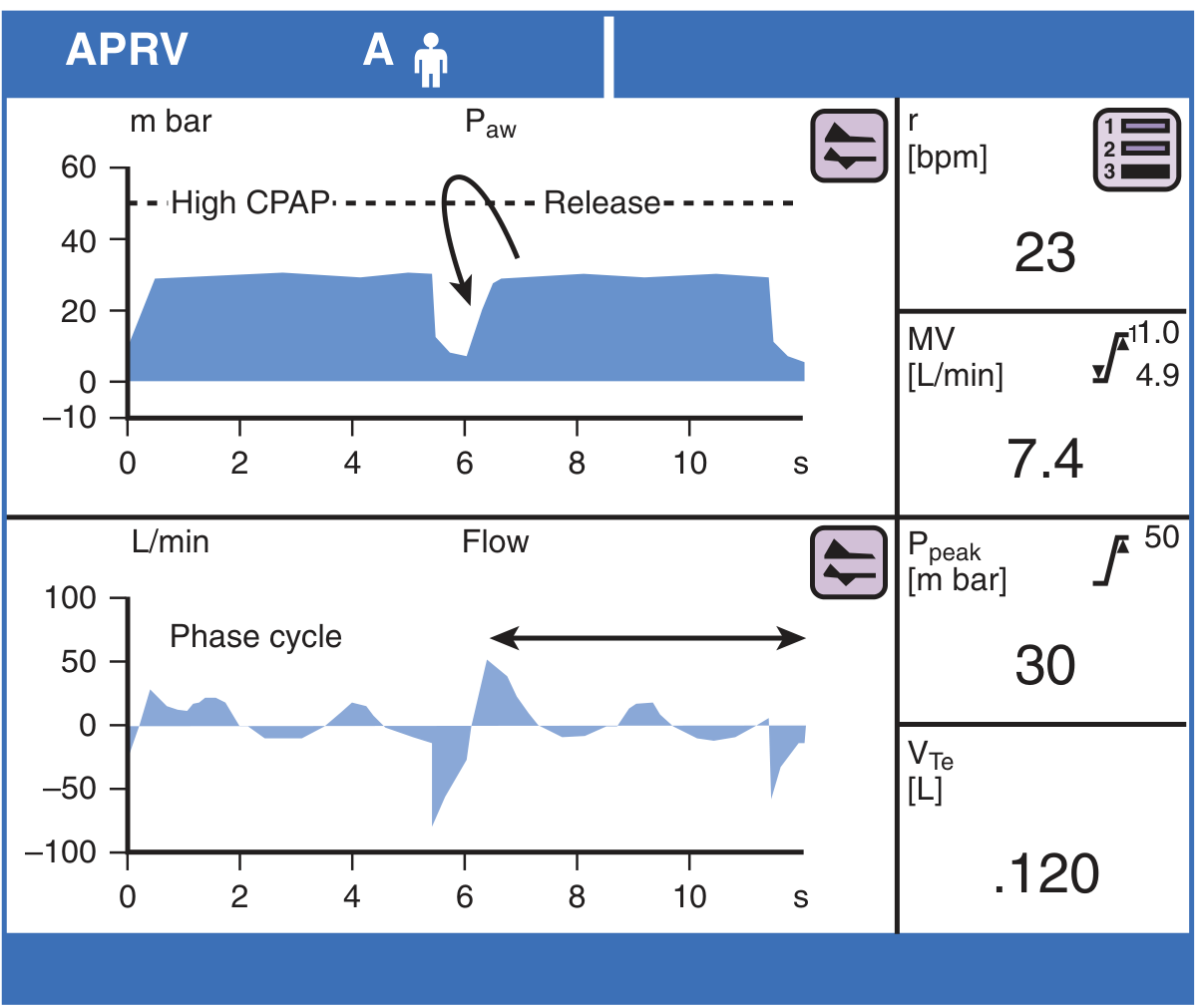
Figure: APRV pressure-time (top) and flow-time (bottom) traces. Note the prolonged P-high for oxygenation, brief T-low release for CO2 clearance, and spontaneous breathing efforts visible in the flow tracing. - Roberts and Hedges' Clinical Procedures in Emergency Medicine, p. 229
Key Differences from Conventional Modes
| Feature | APRV | Conventional CMV/PCV |
|---|---|---|
| Time spent at high pressure | Majority (~80-90%) | Minority (inspiration) |
| Time at low pressure | Brief (0.2-1.5 s) | Majority (expiration) |
| Spontaneous breathing | Allowed throughout | Restricted or suppressed |
| I:E ratio | Inverse (>1:1) | Normal (1:3 or less) |
| Sedation/paralysis | Minimal needed | Often requires heavy sedation |
| Intrinsic PEEP (autoPEEP) | Generated intentionally | Usually avoided |
In a paralyzed patient, APRV is identical to pressure-targeted inverse ratio ventilation (PC-IRV). The key distinction is that APRV does not require paralysis - the floating valve allows free spontaneous breathing in either phase.
Initial Settings (Morgan and Mikhail)
- Minimum PEEP (P-high): 10-12 cm H2O
- Release level (P-low): 5-10 cm H2O
- Number of releases: 10-12 per minute as a starting point
- T-low: Set to allow only 50-70% of expiratory flow to complete (generates "auto-PEEP" and prevents derecruitment)
Physiological Advantages
- Alveolar recruitment: Prolonged inflation recruits more slowly filling alveoli with markedly different regional time constants, at low gas flow rates.
- Raised mean airway pressure without increasing set PEEP (though intrinsic PEEP develops with short T-low).
- Spontaneous breathing during inflation enhances both recruitment and cardiac filling (vs. controlled modes).
- Less circulatory depression and less pulmonary barotrauma compared to PC-IRV.
- Reduced sedation requirement: Patients are more comfortable; neuromuscular blocking agents are rarely needed.
- Improved V/Q matching: Particularly useful in hypoxemic respiratory failure.
- Shorter ICU stay potentially: reduced prolonged neuromuscular blockade syndrome.
Indications
- ARDS (Acute Respiratory Distress Syndrome) - primary use; significantly reduced lung compliance
- Acute hypoxemic respiratory failure
- Patients with large chest walls prone to derecruitment
- As an alternative to PC-IRV when high peak pressures are problematic
Both APRV and bilevel ventilation are most commonly used in patients with significantly reduced lung compliance, such as ARDS. They minimize alveolar pressures while maintaining recruitment. - Sabiston Textbook of Surgery
Evidence and Outcomes
The evidence base is mixed but evolving:
- Most randomized studies comparing APRV to true lung-protective strategies (low tidal volume, conventional PEEP) have not demonstrated differences in important outcomes (Murray & Nadel's Respiratory Medicine).
- One single-center RCT (n=138, ARDS patients) found significantly more ventilator-free days (19 vs. 2, p<0.001) and shorter ICU stay (15 vs. 20 days, p=0.015) with APRV vs. volume-controlled ventilation - but limited by small size, imbalanced comorbidities, and differing sedation protocols.
- A meta-analysis spanning ~19 years of studies in acute hypoxemic respiratory failure suggested a mortality benefit for APRV vs. conventional modes, with no difference in rescue maneuver use (prone positioning, ECMO). - Sabiston Textbook of Surgery, 14e
Limitations and Cautions
- Spontaneous tidal volumes can expand the lung beyond the APRV set pressure, potentially causing overdistension - end-inspiratory lung distention may actually be greater than with other modes.
- T-low set too long is a common error - it essentially mimics pressure-targeted SIMV, defeating the purpose.
- Transport on APRV with P-high >20 cm H2O: patient must stay on the ventilator - hand ventilation cannot replicate the pressure dynamics and frequently causes hypoxemia and hemodynamic instability.
- Not suitable as the sole answer in patients requiring heavy sedation or paralysis for other reasons (neurologic, surgical).
Comparison with Related Modes
| Mode | I:E | Spontaneous breathing | Key use |
|---|---|---|---|
| APRV | Inverse | Yes, throughout | ARDS, hypoxemic failure |
| PC-IRV | Inverse | No (requires paralysis) | Refractory hypoxemia |
| BiPAP/Bilevel | Near equal T-high/T-low | Yes | Similar to APRV, longer T-low |
| SIMV + PS | Normal | Yes, between mandatory breaths | Weaning |
APRV is applicable across neonatal, pediatric, and adult respiratory failure and is considered an alternative open-lung approach to mechanical ventilation.
Sources:
- Murray & Nadel's Textbook of Respiratory Medicine, pp. 411-434
- Roberts and Hedges' Clinical Procedures in Emergency Medicine, pp. 804-823
- Morgan and Mikhail's Clinical Anesthesiology, 7e, pp. 4159-4166
- Sabiston Textbook of Surgery / Current Surgical Therapy 14e, pp. 3015-3021
This is a shared conversation. Sign in to Orris to start your own chat.