
Define cell junctions. Describe its types in brief 5 mark question
Reading File
Finding Sources
Finding Sources
Reading File
Reading File
Loading Image
Reading File
I now have comprehensive information to write a thorough 5-mark answer. Here it is:
Cell Junctions — Definition & Types
Definition
Cell junctions are specialized regions of contact between adjacent cells (or between a cell and the extracellular matrix) that mediate adhesion, communication, or selective sealing of the intercellular space. They are most prominent in epithelial cells but occur in nearly all mammalian tissues.
Types of Cell Junctions
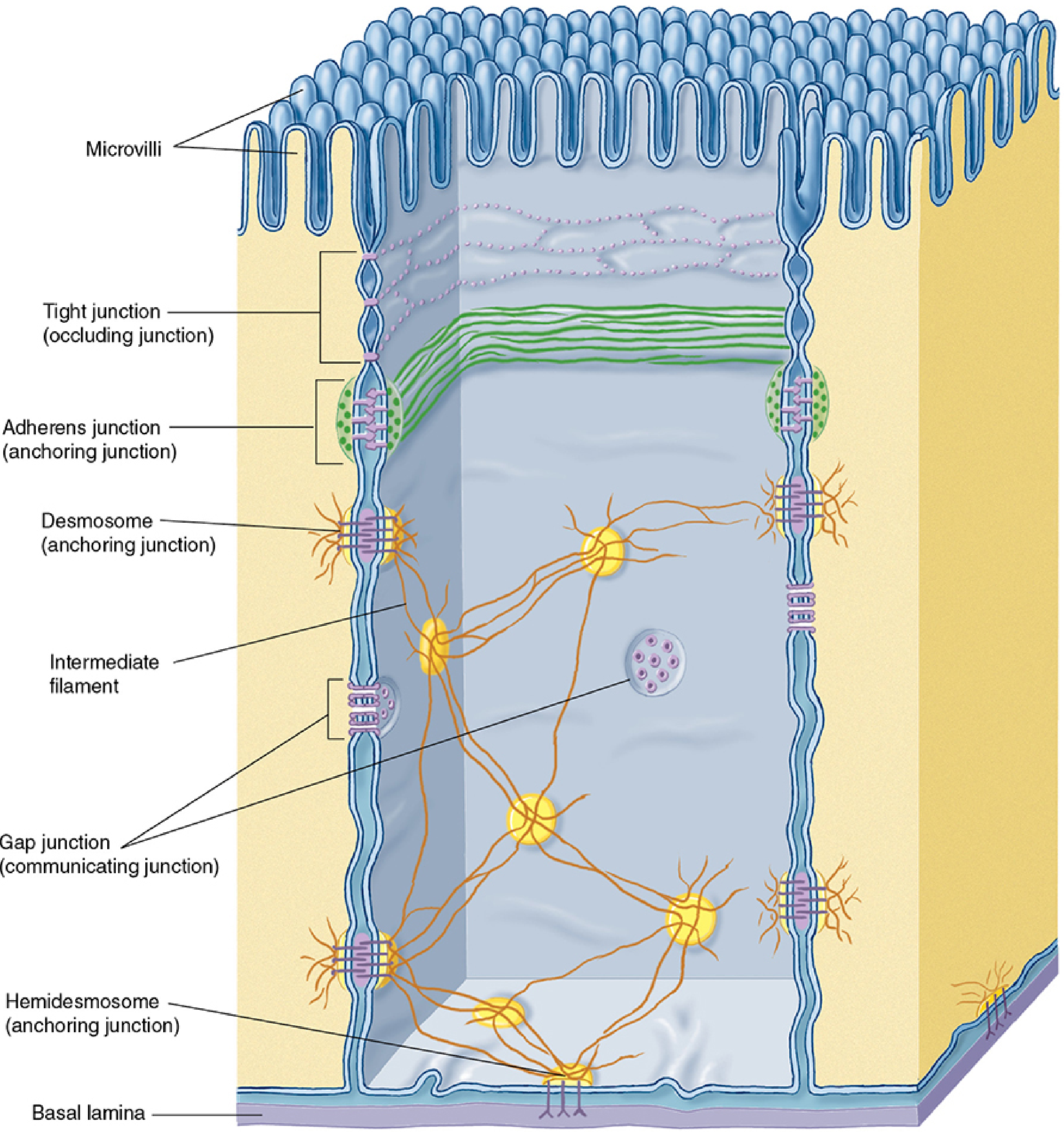
Cell junctions are classified into three functional groups:
1. Occluding Junctions — Tight Junction (Zonula Occludens)
- Located at the most apical end of the lateral cell membrane.
- The term zonula indicates it forms a continuous belt encircling the entire cell.
- Composed of transmembrane proteins — occludins, claudins, and ZO proteins — that fuse adjacent cell membranes into anastomosing strands, virtually obliterating the intercellular space.
- Function: Seals adjacent cells to prevent paracellular passage of molecules; maintains distinct apical and basolateral membrane domains (fence function).
- The number of fused sealing strands determines permeability: fewer strands = leakier epithelium (e.g., proximal renal tubule); more strands = tighter epithelium (e.g., urinary bladder).
- Linked intracellularly to actin filaments.
- Clinical relevance: Clostridium perfringens enterotoxin binds claudins to disrupt tight junctions, causing food-poisoning diarrhoea. Defective occludins may compromise the fetal blood–brain barrier.
2. Anchoring Junctions
These junctions mechanically link cells to each other or to the basal lamina.
a) Adherens Junction (Zonula Adherens)
- Located just below the tight junction, also forming a belt around the cell.
- Transmembrane proteins: E-cadherin (Ca²⁺-dependent); intracellularly linked to catenins → actin filaments (part of the "terminal web").
- Function: Firmly anchors adjacent cells; stabilises and strengthens nearby tight junctions.
- Clinical relevance: Loss of E-cadherin in epithelial tumours (carcinomas) promotes invasion and malignant transformation.
b) Desmosome (Macula Adherens)
- Spot-like "spot-weld" junctions — does not encircle the cell (macula = spot).
- Transmembrane proteins: desmogleins and desmocollins (cadherin family). Intracellularly linked via plakoglobin → desmoplakins to intermediate filaments (cytokeratins / tonofilaments).
- Function: Strong attachment points that resist tensile and shear forces; maintain tissue integrity.
- Clinical relevance: Autoimmune destruction of desmoglein in pemphigus vulgaris leads to loss of epidermal cell cohesion and blistering.
c) Hemidesmosome
- Half-desmosome structure anchoring the basal surface of epithelial cells to the basal lamina (not cell-to-cell).
- Transmembrane proteins: integrins; linked intracellularly to intermediate filaments.
- Clinical relevance: Mutations in integrin-β4 cause certain forms of epidermolysis bullosa (skin blistering).
3. Communicating Junctions — Gap Junction (Nexus)
- Circular patches of aggregated transmembrane protein complexes distributed laterally across the cell membrane.
- Each complex is a connexon — a hexameric ring of six connexin proteins forming a central pore (~1.5 nm diameter).
- Paired connexons from adjacent cells dock to form a continuous hydrophilic channel.
- Function: Allow direct transfer of small molecules, ions, and second messengers (< ~1 kDa) between cells, enabling metabolic cooperation and electrical coupling.
- Provide no mechanical adhesive strength.
- Clinical relevance: Mutations in connexin genes are linked to certain types of hereditary deafness and peripheral neuropathy.
Summary Table
| Junction | Also Called | Key Proteins | Cytoskeleton Link | Function |
|---|---|---|---|---|
| Tight junction | Zonula occludens | Occludins, claudins, ZO proteins | Actin | Sealing; domain separation |
| Adherens junction | Zonula adherens | E-cadherin, catenins | Actin | Cell–cell adhesion |
| Desmosome | Macula adherens | Desmogleins, desmocollins | Intermediate filaments | Strong mechanical coupling |
| Hemidesmosome | — | Integrins | Intermediate filaments | Cell–basal lamina anchoring |
| Gap junction | Nexus | Connexins (connexons) | None | Intercellular communication |
— Junqueira's Basic Histology: Text and Atlas, 17th Ed., pp. 202–207
This is a shared conversation. Sign in to Orris to start your own chat.