
Common causes of foot pain and their treatment
"foot pain" AND "plantar fasciitis"
plantar fasciitis heel pain
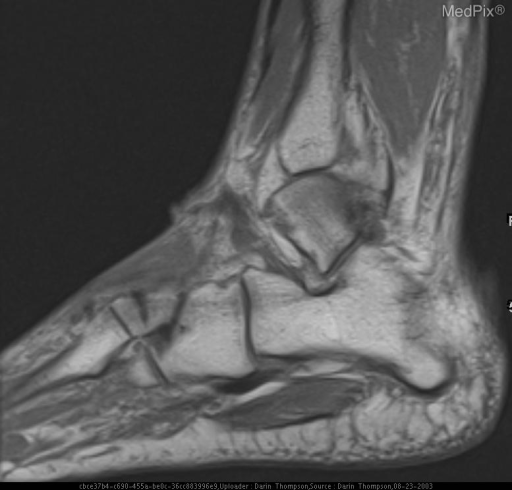
**Imaging Modality:** Magnetic Resonance Imaging (MRI)
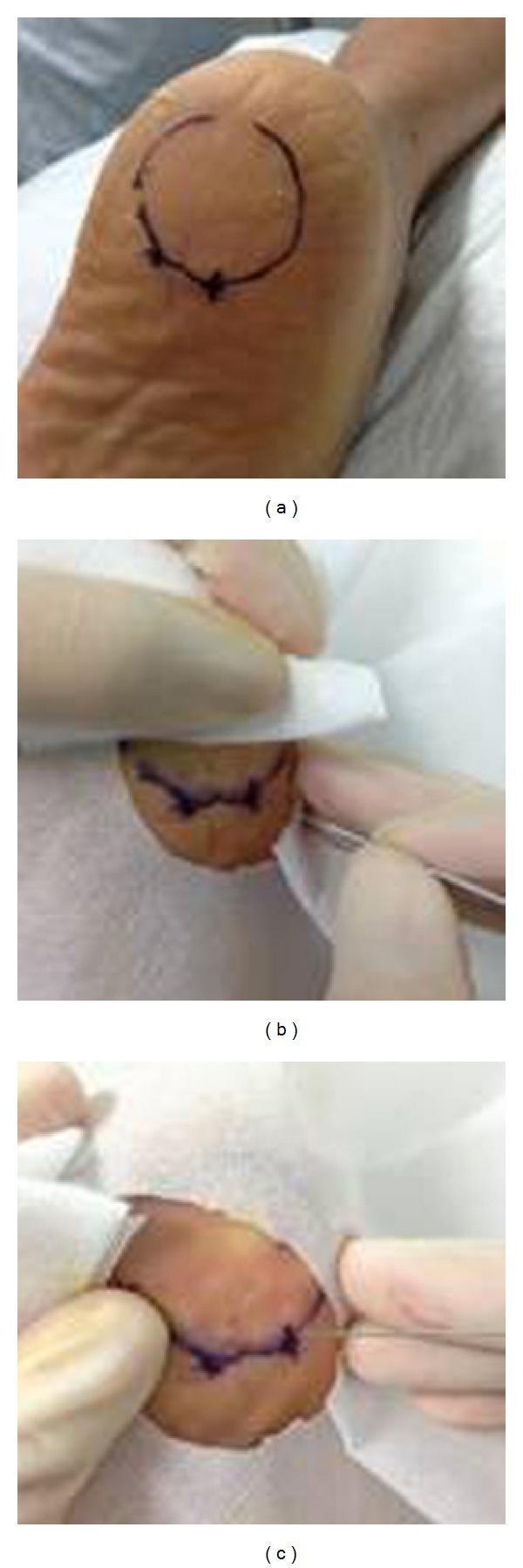
This composite of clinical photographs illustrates the surgical procedure for miniscalpel-needle (MSN) release treatment for plantar fasciitis. Panel (a) shows the plantar aspect of a human heel with a circular surface landmark and 'X' markings used to identify the most painful tender point over the medial tubercle of the calcaneum. Panel (b) depicts the intraoperative phase where a 0.80 mm diameter MSN is inserted vertically into the marked tender point while the patient is in a prone position. The clinician's gloved hands are visible managing the surgical field. Panel (c) shows the immediate post-procedure result, demonstrating a small, linear puncture wound at the insertion site with minimal local skin trauma. The series highlights a minimally invasive approach to musculoskeletal pain management, specifically targeting the release of thickened plantar fascia under local anesthesia. The educational focus is on the localization of anatomical landmarks and the technique for needle-based surgical intervention in chronic heel pain.
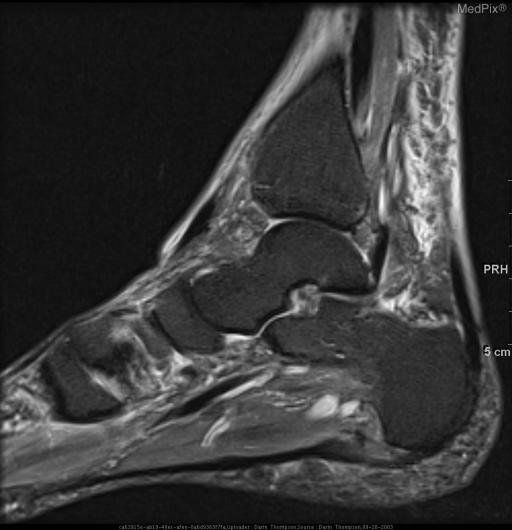
**Imaging Modality:** Magnetic Resonance Imaging (MRI), Sagittal T2-weighted STIR (Short Tau Inversion Recovery) sequence.
Common causes of foot pain and their treatment
Heel pain
- Mechanism: It is probably caused by chronic degeneration and microtears of the fascia, not true inflammation. Risk factors include BMI over 30, prolonged standing, running, and a tight gastrocnemius-soleus complex.
- Symptoms: The pain is sharp or stabbing and is worst with the first steps in the morning or after sitting. There is tenderness over the medial calcaneal tubercle. - Textbook of Family Medicine 9e; Miller's Review of Orthopaedics 9th Ed
- Treatment:
- First line is plantar fascia and Achilles stretching, which Miller's calls the key to effective nonoperative care. Heel cushioning, ice, and activity modification also help.
- Orthotics, night splints, and physical therapy are added as needed.
- NSAIDs mainly work as analgesics, not anti-inflammatories. - Textbook of Family Medicine 9e
- Corticosteroid injection gives short-term relief (about 1 month). It carries a risk of fascia rupture and fat pad atrophy. - Miller's Review of Orthopaedics
- Shock wave therapy is an option for recalcitrant cases.
- Prognosis: 90-95% of cases improve within a year regardless of the treatment used. - Miller's Review of Orthopaedics
- Eccentric loading exercises are the main treatment.
- Avoid corticosteroid injection because of the risk of tendon rupture.
- Platelet-rich plasma showed no benefit over saline.
- Surgery is reserved for chronic cases. - Textbook of Family Medicine 9e
- Treatment is either casting or bracing for about 8 to 10 weeks, or surgery.
- Surgery gives better push-off power and a lower re-rupture rate (up to 2%, versus up to 10% without surgery). It carries a 5-10% risk of wound skin necrosis. - Textbook of Family Medicine 9e
Forefoot pain
- Treatment is footwear change, metatarsal pads or orthoses, and callus care.
- Surgery is rarely needed.
- First line is a wide toe box and a metatarsal pad.
- A corticosteroid plus anesthetic injection was more effective than anesthetic alone. - Campbell's Operative Orthopaedics 15th Ed
- Neurectomy is used if conservative care fails.
- Hallux rigidus is first MTP arthritis with a painful, stiff great toe.
- Treatment starts with stiff-soled or rocker shoes, wide shoes, and NSAIDs.
- Surgery (osteotomy for bunions, arthrodesis or interposition arthroplasty for hallux rigidus) is for persistent pain. - Campbell's Operative Orthopaedics
- It is common with repetitive stress or a cavovarus foot.
- Radiographs may be normal for about 3 weeks, so MRI or bone scan helps.
- Treatment is protected weight bearing, such as a boot. - Miller's Review of Orthopaedics
Other causes
| Cause | Clues | Main treatment |
|---|---|---|
| Gout (classically 1st MTP) | Sudden severe red, hot joint | NSAIDs, colchicine, or steroids for the flare. Urate-lowering therapy afterwards. |
| Tarsal tunnel syndrome | Burning, tingling in the sole, Tinel sign behind the medial malleolus | Orthoses, steroid injection, release if refractory |
| Posterior tibial tendon dysfunction | Medial ankle pain, flatfoot developing | Immobilization, orthoses, surgery if advanced |
| Diabetic neuropathy | Burning, numbness, night pain | Glycemic control, neuropathic agents (gabapentinoids, duloxetine), foot care |
| Peripheral arterial disease | Pain with walking or at rest, cool foot | Vascular assessment and revascularization |
| Charcot foot, infection, osteomyelitis | Warm, swollen foot in a neuropathic diabetic patient | Urgent offloading or antibiotics |
| Inflammatory arthritis (RA, spondyloarthritis) | Multiple joints, morning stiffness, enthesitis | Disease-specific therapy |
Red flags needing urgent assessment
- A hot, red, swollen foot with fever, or an ulcer in a diabetic patient
- Cold, pale foot or rest pain
- Suspected Achilles rupture or fracture
- Progressive numbness or weakness
- Unexplained night or constant pain
General conservative approach
- Relative rest and activity modification.
- Supportive, well-fitting shoes with cushioning, and weight loss if applicable.
- Targeted stretching and strengthening (physical therapy).
- Short-term analgesia (paracetamol or NSAIDs).
- Orthoses or splints.
- Image the foot if pain persists beyond 6 to 8 weeks, or if red flags are present.
- Injection or surgery is the last step, for refractory cases.