
Endometritis 10 marks answer for mbbs
Reading File
Finding Sources
Finding Sources
Reading File
Reading File
Reading File
Reading File
Reading File
I now have comprehensive material. Let me also fetch the histology image showing chronic endometritis with plasma cells, and get the Harrison's content on PID/endometritis.
Loading Image
Reading File
I now have all the information needed to write a comprehensive 10-mark MBBS answer on Endometritis. Here it is:
Endometritis — 10 Marks MBBS Answer
Definition
Endometritis is inflammation of the endometrium (the mucosal lining of the uterine cavity). It is classified as acute, chronic, or granulomatous based on the predominant inflammatory infiltrate.
Classification
| Type | Infiltrate | Context |
|---|---|---|
| Acute | Neutrophilic | Post-delivery / post-abortion |
| Chronic | Lymphoplasmacytic (plasma cells) | PID, IUD, TB, retained products |
| Granulomatous | Epithelioid granulomas | Tuberculosis |
Etiology & Predisposing Factors
Acute Endometritis
Uncommon outside the puerperal/post-abortal setting. Causative organisms:
- Group A hemolytic streptococci (most common historically)
- Staphylococci, coliforms (E. coli, Klebsiella, Proteus)
- Anaerobes (Bacteroides, Peptostreptococcus)
- N. gonorrhoeae, C. trachomatis (ascending STI-related)
Predisposing factors for puerperal endometritis:
- Caesarean section (incidence 5–35% without prophylaxis vs. <10% with it)
- Retained products of conception after delivery or miscarriage
- Prolonged labour and prolonged rupture of membranes
- Multiple vaginal examinations during labour
- Chorioamnionitis, BV, GBS colonisation, young age
Chronic Endometritis
Occurs in association with:
- Chronic pelvic inflammatory disease (N. gonorrhoeae, C. trachomatis)
- Retained gestational tissue (postpartum or postabortion)
- Intrauterine contraceptive devices (IUDs)
- Tuberculosis — miliary spread or drainage from tuberculous salpingitis (common in endemic regions; rare in high-resource settings)
- In ~15% of cases, no identifiable cause is apparent ("nonspecific" chronic endometritis)
Pathology
Gross
- Uterus may be enlarged and boggy (acute); thickened, congested endometrium.
- Malodorous lochia in the puerperal setting.
Microscopy
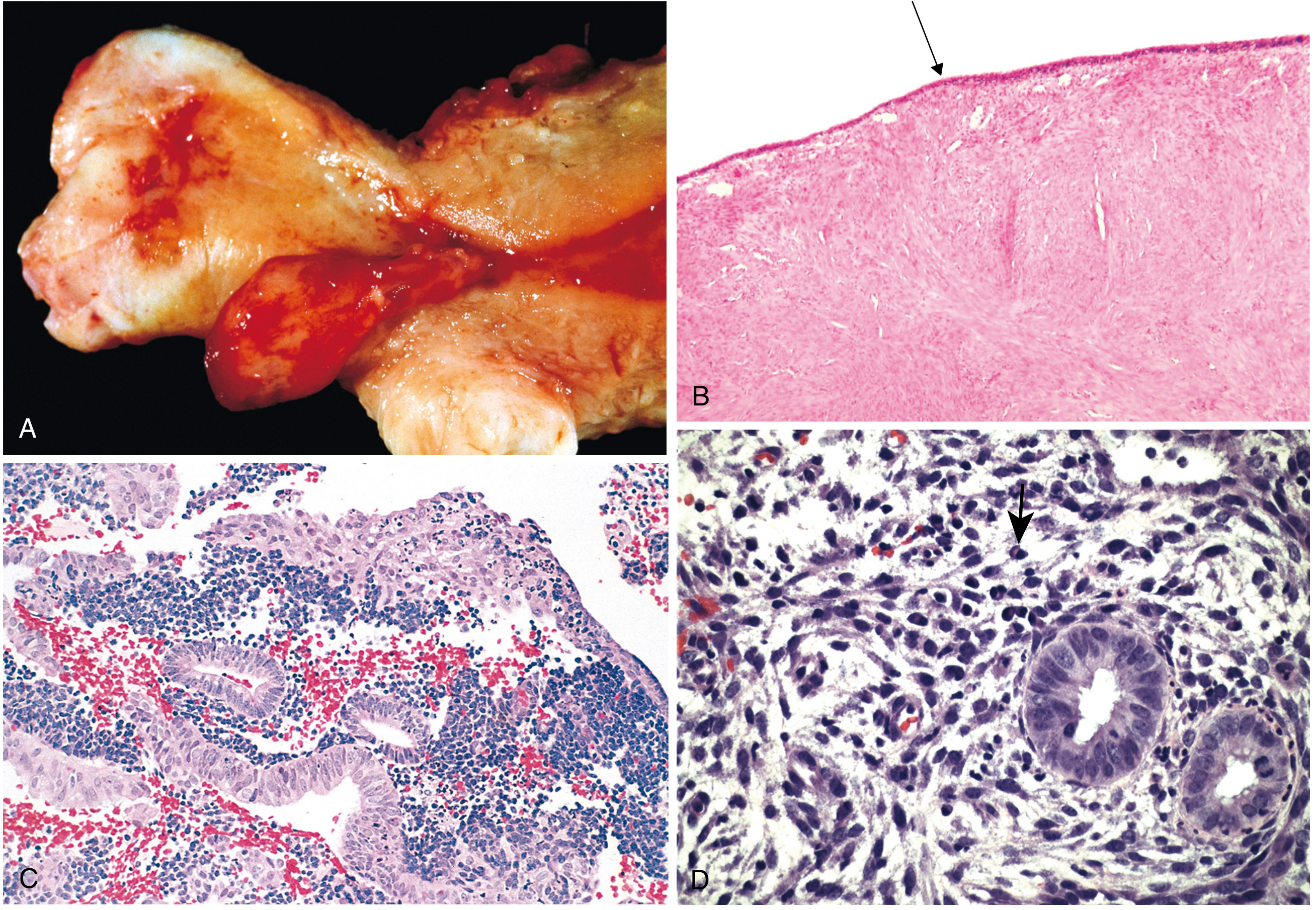
- Acute: Neutrophilic infiltration of the endometrial stroma; not a normal finding outside menstruation.
- Chronic: Plasma cells in the stroma — the hallmark. Lymphocytes alone are insufficient as they are present in normal endometrium. Reactive stromal changes and glandular irregularity are also seen.
- Tuberculous (granulomatous): Epithelioid granulomas within the endometrial stroma, often with Langhans giant cells and central caseation.
Clinical Features
Acute / Puerperal Endometritis:
- Fever ≥38°C within 36 hours of delivery
- Malaise, tachycardia
- Lower abdominal pain and uterine tenderness
- Malodorous lochia (purulent or foul-smelling vaginal discharge)
- Occasionally: tender inflammatory mass in broad ligament or cul-de-sac
Chronic Endometritis:
- Abnormal uterine bleeding (menorrhagia, intermenstrual bleeding)
- Pelvic pain, dyspareunia
- Vaginal discharge
- Infertility and recurrent miscarriage
- Often subclinical / asymptomatic
Tuberculous Endometritis:
- Amenorrhoea, infertility
- Constitutional symptoms (fever, weight loss, night sweats)
- Part of pelvic TB complex
Diagnosis
- Clinical: fever + uterine tenderness + malodorous lochia in postpartum setting is usually sufficient.
- CBC: leukocytosis with neutrophilia.
- Endometrial biopsy: definitive — demonstrating plasma cells (chronic) or granulomas (TB). The hallmark of chronic endometritis is plasma cells, which are absent from normal endometrium.
- Blood cultures: reserved for severe/septic cases or failure to respond to 24–48 hours of treatment.
- Endocervical swabs / NAAT: for N. gonorrhoeae and C. trachomatis in PID-associated cases.
- Hysteroscopy: can identify intrauterine pathology contributing to chronic endometritis.
- AFB staining, culture, PCR on endometrial tissue: for suspected TB.
- Ultrasound: may show retained products; free fluid.
Differential Diagnosis of Postpartum Fever: UTI, perineal infection, wound infection, mastitis, atelectasis, septic pelvic thrombophlebitis, pelvic abscess, DVT.
Treatment
Acute / Puerperal Endometritis (IV antibiotics)
First-line regimen:
- Clindamycin 900 mg IV every 8 hours + Gentamicin 5 mg/kg IV every 24 hours
- Excellent polymicrobial coverage; evidence from >4000 patients in RCTs.
- Add Ampicillin 2 g IV every 6 hours if known GBS colonisation or clindamycin resistance.
Alternative single agents:
- Ampicillin-sulbactam (3 g IV every 6 hours)
- Piperacillin-tazobactam (3.375 g IV every 6 hours)
- Cefotetan, imipenem-cilastatin, meropenem, ertapenem
Duration: Continue IV antibiotics until patient is afebrile and asymptomatic for ~24 hours; then discharge. Oral antibiotics after discharge are generally NOT required.
Treatment failure: Consider Enterococcus (add ampicillin/penicillin) or pelvic abscess.
Chronic Endometritis
- Doxycycline (covers Chlamydia) — commonly used empirically.
- Directed antibiotic therapy based on culture/sensitivity.
- Remove IUD if it is the precipitating cause.
- Curettage to remove retained gestational products.
Tuberculous Endometritis
- Standard anti-tubercular therapy (ATT): HRZE × 2 months → HR × 4 months.
Complications
- Salpingitis → pyosalpinx, tubo-ovarian abscess
- Infertility and recurrent pregnancy loss
- Pelvic peritonitis
- Septicaemia / bacteraemia
- Septic pelvic thrombophlebitis
- Asherman's syndrome (intrauterine adhesions) — especially post-TB
- Spread of TB to fallopian tubes, peritoneum
Key Points for Exam
| Feature | Acute | Chronic |
|---|---|---|
| Infiltrate | Neutrophils | Plasma cells (hallmark) |
| Setting | Post-delivery/post-abortion | PID, IUD, TB, retained products |
| Key symptom | Fever, tender uterus, malodorous lochia | Abnormal bleeding, infertility |
| Diagnosis | Clinical ± CBC | Endometrial biopsy (plasma cells) |
| Treatment | Clindamycin + Gentamicin IV | Doxycycline ± curettage |
Sources: Robbins Pathologic Basis of Disease (10th ed.), Robbins & Kumar Basic Pathology, Creasy & Resnik's Maternal-Fetal Medicine, Harrison's Principles of Internal Medicine (22nd ed.)
This is a shared conversation. Sign in to Orris to start your own chat.