
Treatment for ringworm infection on skin
Reading File
Now let me search the medical library and PubMed in parallel for ringworm (tinea corporis) treatment.
Finding Sources
Finding Sources
Searching PubMed
"tinea corporis" AND treatment
Good results. Now let me read the key sections from Fitzpatrick's dermatology (most detailed management section) and Harrison's, plus the Red Book for pediatric guidance, in parallel.
Reading File
Reading File
Reading File
Let me get the full Harrison's dermatophytosis treatment section and the Andrews' tinea corporis treatment details, plus fetch the clinical image:
Reading File
Reading File
Loading Image
I now have comprehensive information from multiple authoritative textbooks. Let me compile the full answer.
Treatment of Ringworm (Tinea Corporis)
Ringworm is a misnomer - it is not caused by a worm but by dermatophyte fungi (most commonly Trichophyton rubrum, T. interdigitale, Microsporum canis, and Epidermophyton floccosum). It presents as erythematous, scaly, annular (ring-shaped) plaques on the glabrous (relatively hairless) skin.
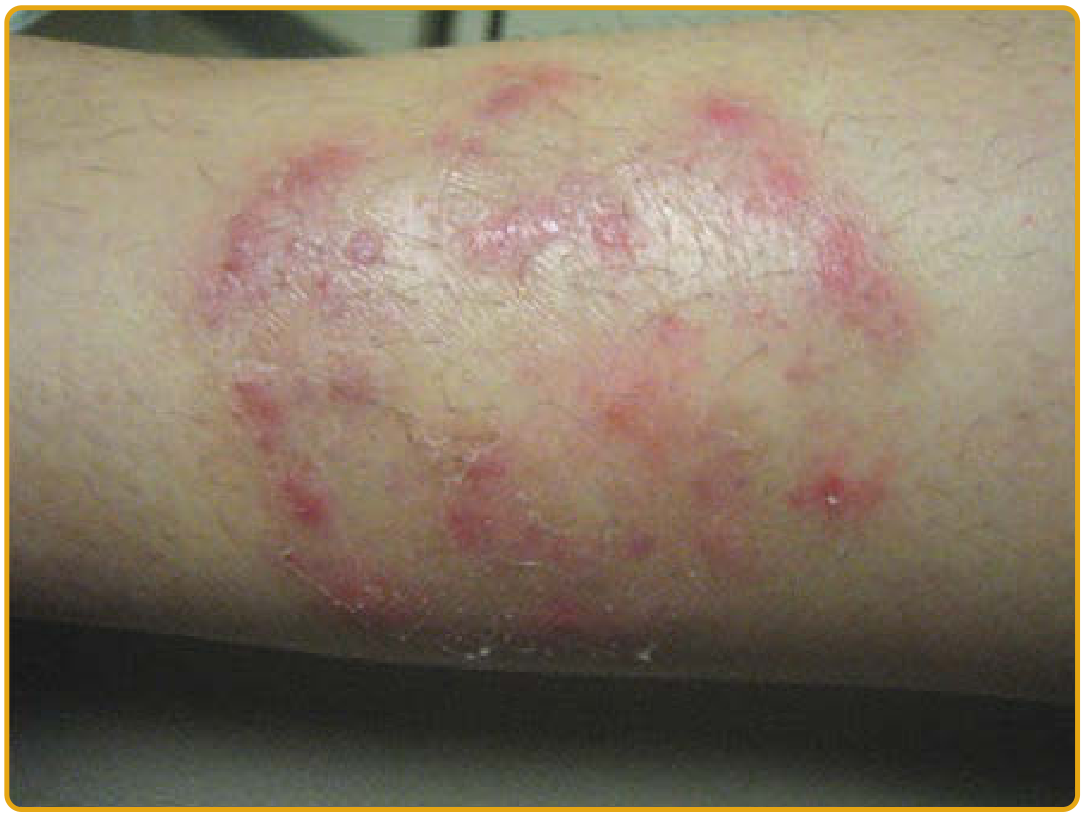
1. Topical Antifungal Therapy (First-Line for Most Cases)
Topical therapy is effective for uncomplicated, limited tinea corporis - isolated plaques on glabrous skin. Treatment should continue for 1 week beyond clinical resolution.
Allylamines (most effective class)
| Drug | Regimen | Notes |
|---|---|---|
| Terbinafine 1% cream/gel | Once or twice daily x 1-2 weeks | Fungicidal; preferred for Trichophyton spp. |
| Naftifine 1-2% cream/gel | Once or twice daily x 2-4 weeks | Fungicidal; good evidence base (see 2025 meta-analysis) |
| Butenafine 1% cream | Once daily x 2-4 weeks | Fungicidal |
Imidazoles (azoles)
| Drug | Regimen |
|---|---|
| Clotrimazole 1% cream | Twice daily x 2-4 weeks |
| Miconazole 2% cream | Twice daily x 2-4 weeks |
| Econazole 1% cream | Twice daily x 2-4 weeks |
| Ketoconazole 2% cream | Once or twice daily x 2-4 weeks |
Other agents
- Tolnaftate 1% - applied twice daily x 4 weeks; effective for tinea corporis and pedis
- Ciclopirox 0.77% cream - twice daily x 2-4 weeks
Key principle: Apply the cream to the lesion AND approximately 2 cm beyond the visible border. Most topicals are applied twice daily for 2-4 weeks.
- Fitzpatrick's Dermatology, p. 2974
- Harrison's Principles of Internal Medicine 22E, p. 432
2. Oral (Systemic) Antifungal Therapy
Reserved for:
- Widespread or highly inflammatory eruptions
- Lesions unresponsive to topical therapy
- Majocchi granuloma (deep folliculitis - topicals cannot penetrate adequately)
- Immunocompromised patients
- Concurrent onychomycosis or tinea capitis
| Drug | Dose | Duration | Notes |
|---|---|---|---|
| Terbinafine | 250 mg/day (adults) | 2-4 weeks | Drug of choice for Trichophyton spp.; fungicidal |
| Itraconazole | 100-200 mg/day | 2-4 weeks | Broad spectrum; off-label for tinea corporis in the US |
| Fluconazole | 150-300 mg/week | 2-4 weeks | Off-label; weekly dosing option |
| Griseofulvin | 500 mg/day (microsize) | 4-6 weeks | Preferred for Microsporum spp.; pediatric dosing available |
Trichophyton species respond better to terbinafine; Microsporum species respond better to griseofulvin.
Important warnings: All oral antifungals can cause hepatotoxicity. Avoid in pregnancy and breastfeeding. Confirm fungal etiology before prescribing orally. - Harrison's 22E
- Harrison's Principles of Internal Medicine 22E
- Andrews' Diseases of the Skin, p. 1961
- Red Book 2021 (AAP), p. 1173
3. Special Situations
Tinea Incognito
- Occurs when ringworm is incorrectly treated with topical corticosteroids - the rash loses its classic appearance, borders become indistinct, and infection can spread or become follicular (Majocchi granuloma)
- Topical steroids are contraindicated in ringworm (even combined antifungal-steroid products should be avoided)
- Treat with oral antifungal; confirm diagnosis with KOH prep or biopsy
Majocchi Granuloma
- Deep follicular/dermal extension of tinea, most common on the legs
- Often due to prior topical steroid use
- Requires oral antifungal therapy (terbinafine or itraconazole x 4-8 weeks)
Immunocompromised Patients
- Lesions may appear as grouped papules or pustules without typical scaling
- Oral therapy is often needed; longer courses may be required
Children
- Topical therapy same as adults for uncomplicated cases
- Oral griseofulvin is well-established pediatrically
- Terbinafine, itraconazole, and fluconazole are options but lack FDA indication for tinea corporis specifically - Red Book 2021
4. Preventive Measures
- Keep affected areas dry - moisture promotes fungal growth
- Wear loose-fitting, breathable clothing
- Use antifungal powders (tolnaftate or miconazole) in intertriginous areas
- Treat concurrent infections (tinea pedis, onychomycosis) simultaneously to prevent reinfection
- Avoid sharing towels, clothing, or footwear
5. Recent Evidence Note
A 2025 systematic review and meta-analysis (PMID: 40053133) confirmed naftifine's efficacy and safety for dermatophyte infections including tinea corporis. A 2026 systematic review (PMID: 42142638) on Trichophyton indotineae - an emerging, treatment-resistant species spreading globally - highlights the importance of considering resistance when treatment fails, particularly with terbinafine.
Bottom line: For a typical, uncomplicated ringworm patch, a 2-4 week course of topical terbinafine or clotrimazole is the standard approach. Use oral terbinafine or itraconazole for widespread, recalcitrant, or deep infections. Never use topical corticosteroids alone - they will worsen the infection.
This is a shared conversation. Sign in to Orris to start your own chat.