
Provide the synthesis, function, and metabolism of epinephrine.
Reading File
Searching sources...
Finding Sources
Finding Sources
Searching PubMed
epinephrine catecholamine synthesis metabolism
Good results. Now let me read the relevant textbook sections in parallel.
Reading File
Finding Sources
Finding Sources
Excellent. Now let me read the detailed textbook sections on synthesis and metabolism in parallel.
Reading File
Reading File
Finding Sources
Good, rich content. Let me fetch the biosynthesis pathway image and search for epinephrine's physiological functions.
Loading Image
Loading Image
Finding Sources
Let me read the full metabolism/degradation and function sections now.
Reading File
Reading File
Let me get the degradation figure and more function content.
Loading Image
Reading File
Excellent content gathered. Let me read a bit more on the physiological functions and the PNMT regulation/degradation.
Reading File
I now have comprehensive content from multiple authoritative textbooks. Let me compile the full answer.
Epinephrine: Synthesis, Function, and Metabolism
1. Synthesis
Epinephrine is a catecholamine synthesized primarily in the chromaffin cells of the adrenal medulla (which accounts for virtually all circulating epinephrine), and in small amounts in select neurons of the CNS and the heart. The pathway starts from the amino acid L-tyrosine and proceeds through four enzymatic steps.
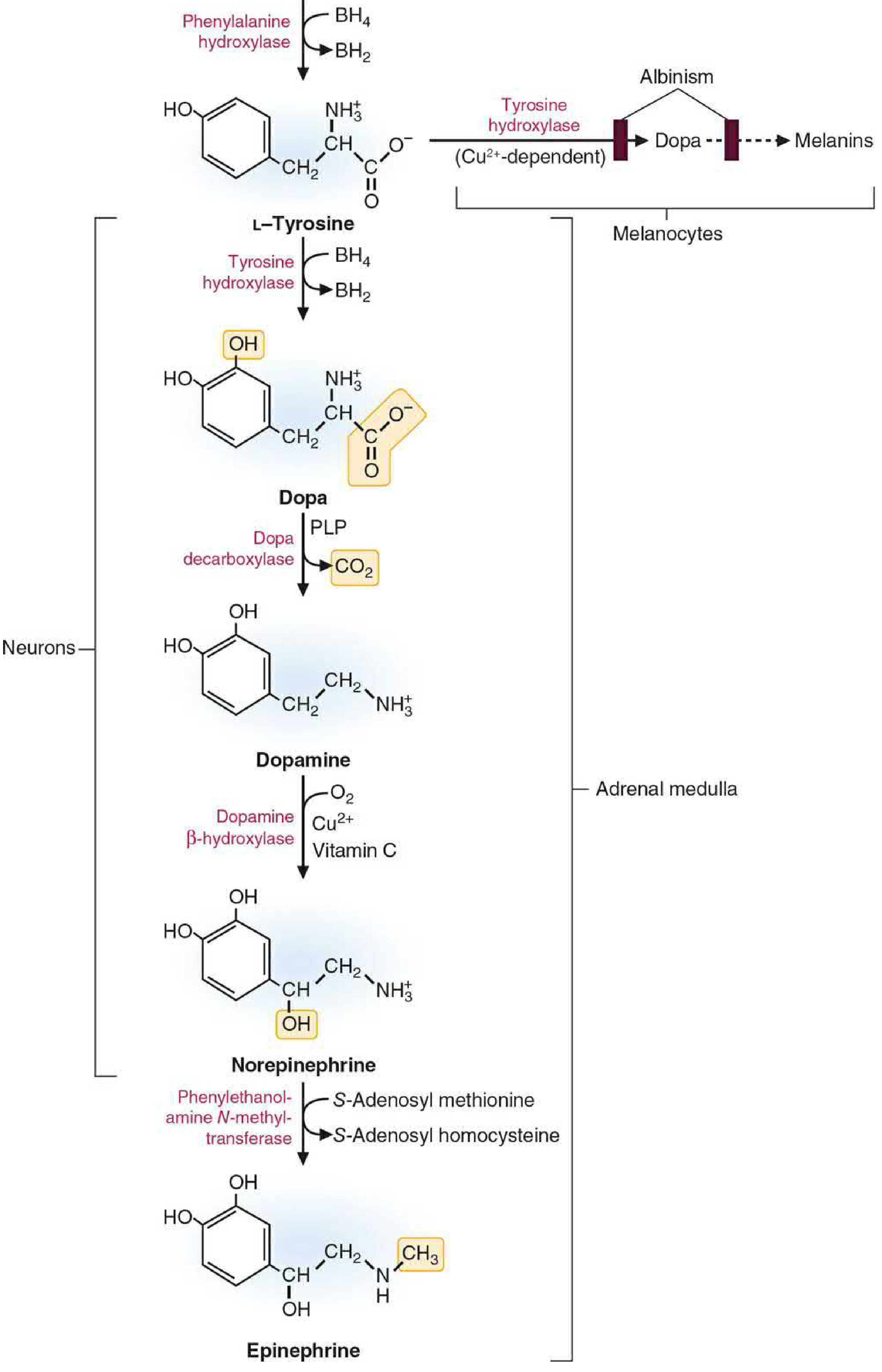
Step-by-Step Pathway
| Step | Substrate | Product | Enzyme | Cofactors | Location |
|---|---|---|---|---|---|
| 1 (rate-limiting) | L-Tyrosine | L-DOPA | Tyrosine hydroxylase (TH) | Tetrahydrobiopterin (BH4) | Cytosol |
| 2 | L-DOPA | Dopamine | Aromatic amino acid decarboxylase (AADC / DOPA decarboxylase) | Pyridoxal phosphate (PLP) | Cytosol |
| 3 | Dopamine | Norepinephrine | Dopamine beta-hydroxylase (DBH) | O2, Cu2+, Vitamin C (ascorbate) | Inside chromaffin granules |
| 4 | Norepinephrine | Epinephrine | Phenylethanolamine-N-methyltransferase (PNMT) | S-adenosylmethionine (SAM) | Cytosol |
Key details:
- Tyrosine itself can be obtained from the diet or synthesized in the liver from phenylalanine via phenylalanine hydroxylase.
- Step 1 (tyrosine hydroxylase) is the rate-limiting step for the entire pathway.
- Dopamine is synthesized in the cytosol, then transported into chromaffin granules (via VMAT1 - vesicular monoamine transporter 1), where DBH converts it to norepinephrine inside the vesicle.
- Norepinephrine then exits the granule back into the cytosol, where PNMT adds a methyl group from SAM, forming epinephrine. The newly synthesized epinephrine is transported back into the granules for storage.
- PNMT is the defining enzyme that distinguishes epinephrine-producing cells. Its expression is upregulated by glucocorticoids (cortisol) delivered through the adrenal portal circulation from the cortex - thus the CRH-ACTH-cortisol axis directly sustains epinephrine synthesis.
- Because the final methylation step requires SAM, epinephrine synthesis is indirectly dependent on vitamin B12 and folate (needed for methionine/SAM regeneration).
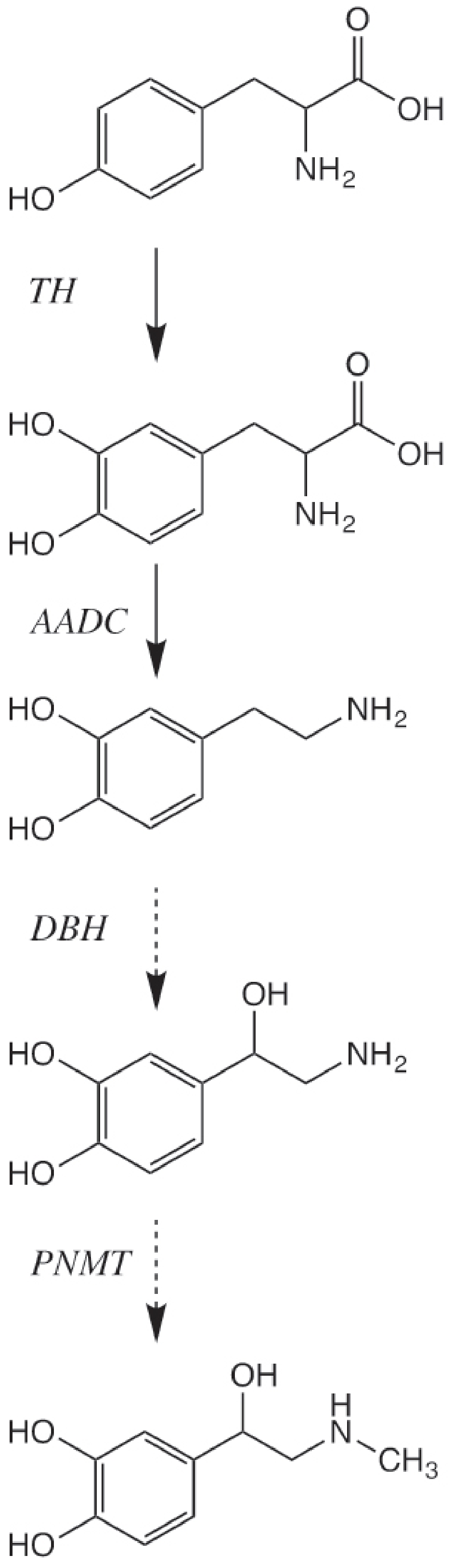
Regulation of synthesis:
- ACTH from the pituitary stimulates synthesis of L-DOPA and norepinephrine.
- Cortisol (from the adrenal cortex portal circulation) upregulates PNMT in chromaffin cells, creating synergy between the HPA axis and the sympatho-adrenal axis.
- Preganglionic sympathetic fibers (splanchnic nerves) release ACh, which acts on nicotinic receptors on chromaffin cells, triggering depolarization, voltage-gated Ca2+ influx, and exocytotic release of granule contents (epinephrine, norepinephrine, ATP, chromogranins).
2. Function
Epinephrine is the primary "fight-or-flight" hormone. Its biological actions are mediated through adrenoceptors (alpha and beta), all of which are G-protein coupled receptors (GPCRs). Epinephrine generally binds both alpha (alpha-1, alpha-2) and beta (beta-1, beta-2, beta-3) receptors, often with higher affinity for beta receptors compared to norepinephrine.
Cardiovascular Effects
- Increases heart rate (positive chronotropy, beta-1)
- Increases myocardial contractility (positive inotropy, beta-1)
- Increases conduction velocity (beta-1)
- Increases blood pressure overall
- Causes vasodilation in skeletal muscle (beta-2) and vasoconstriction in skin/viscera (alpha-1)
Metabolic Effects
- Glycogenolysis: Epinephrine binds GPCRs on hepatocytes and myocytes, activating adenylyl cyclase via Gs, raising cAMP, activating PKA, which phosphorylates and activates glycogen phosphorylase - breaking down glycogen to glucose. Epinephrine's capacity to influence metabolism is 5-10 times greater than norepinephrine.
- Gluconeogenesis: Stimulates hepatic glucose production.
- Lipolysis: Activates hormone-sensitive lipase in adipose tissue (beta-3), mobilizing free fatty acids.
- Insulin suppression / glucagon stimulation: Shifts the body toward a catabolic state.
Other Effects
- Bronchodilation (beta-2 receptors on airway smooth muscle) - basis for its use in anaphylaxis/asthma
- Pupillary dilation (mydriasis)
- Piloerection
- Increases sphincter tone of bowel and bladder
- Mobilization of fuel stores from muscle and fat
- Promotes glycolysis in muscle and glycogen breakdown overall
The combined neuroendocrine response is activated within seconds, and the actions of secreted catecholamines on target tissues are nearly immediate.
3. Metabolism and Inactivation
The biological actions of circulating epinephrine are very brief - approximately 10 seconds. Termination of epinephrine action occurs by two main routes:
(a) Reuptake
In synapses, reuptake into the presynaptic terminal is the primary mode of termination for neuronally released catecholamines.
(b) Enzymatic Degradation
Two enzymes handle the bulk of epinephrine degradation:
Catechol-O-methyltransferase (COMT)
- Found in high concentrations in endothelial cells, heart, liver, and kidneys.
- Transfers a methyl group from SAM to a hydroxyl group on the catecholamine ring.
- Converts epinephrine to metanephrine (the O-methylated product).
- Also converts norepinephrine to normetanephrine.
- Since the reaction requires SAM, it is indirectly dependent on vitamin B12 and folate.
Monoamine oxidase (MAO)
- Located on the outer mitochondrial membrane of many cells (including presynaptic terminals, liver, gut).
- Oxidatively deaminates the amine group to an aldehyde, releasing ammonium (NH4+).
- Two isoforms: MAO-A (preferentially deaminates norepinephrine and serotonin) and MAO-B (acts on a broad spectrum of phenylethylamines).
- Inactivates catecholamines not protected within storage vesicles.
MAO and COMT can act in either order, producing multiple intermediate metabolites.
Final Products
The combined sequential action of COMT and MAO on epinephrine (and norepinephrine) ultimately yields vanillylmandelic acid (VMA, also called 3-methoxy-4-hydroxymandelic acid) as the major urinary end product.
- Intermediate: Epinephrine → Metanephrine (via COMT) → VMA (via MAO)
- OR: Epinephrine → aldehyde intermediate (via MAO) → mandelic acid derivative → VMA (via COMT)
The liver and gut then conjugate these products to sulfate or glucuronide, forming water-soluble derivatives excreted by the kidney.
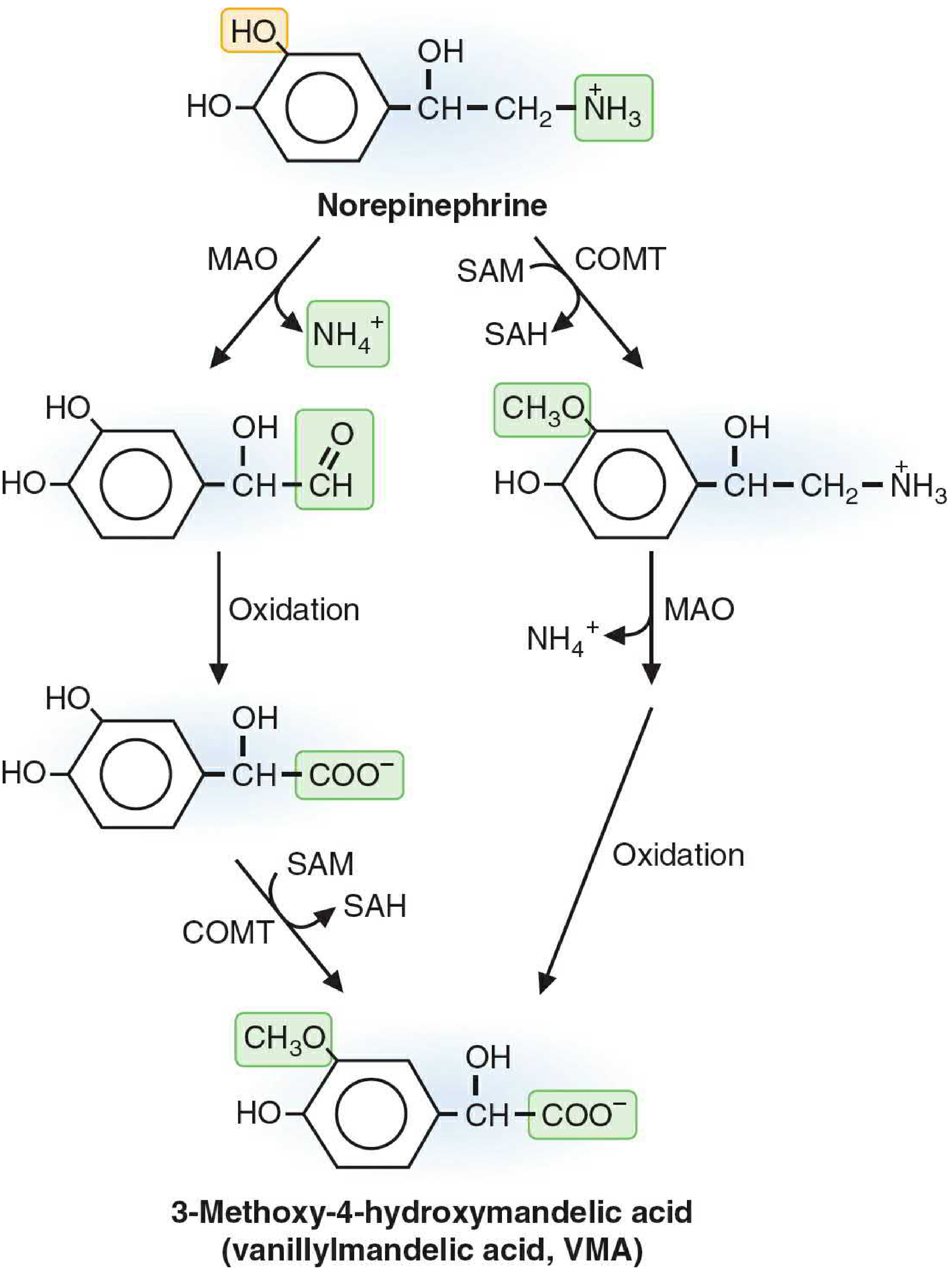
Clinical Relevance of Metabolites
Measurement of urinary catecholamines, metanephrines, and VMA provides a quantitative measure of total catecholamine production by both the adrenal medulla and the sympathetic nervous system. This is used diagnostically for pheochromocytoma (a catecholamine-secreting tumor of the adrenal medulla).
Summary Table
| Aspect | Key Points |
|---|---|
| Precursor | L-Tyrosine (from diet or from phenylalanine) |
| Rate-limiting enzyme | Tyrosine hydroxylase (TH) |
| Unique enzyme | PNMT (only in adrenal medulla chromaffin cells, select CNS neurons) |
| Major site of synthesis | Adrenal medulla (chromaffin cells) |
| Cofactors needed | BH4, PLP (vitamin B6), Vitamin C, Cu2+, SAM (B12/folate dependent) |
| Receptor types | Alpha-1, alpha-2, beta-1, beta-2, beta-3 (all GPCRs) |
| Key functions | Fight-or-flight, increased HR/contractility, glycogenolysis, lipolysis, bronchodilation |
| Primary degrading enzymes | COMT (forms metanephrine), MAO (oxidative deamination) |
| Major urinary metabolite | VMA (vanillylmandelic acid) |
| Duration of action | ~10 seconds in circulation |
Sources: Medical Physiology (Boron & Boulpaep), Basic Medical Biochemistry - A Clinical Approach (6e), Kaplan & Sadock's Comprehensive Textbook of Psychiatry, Schwartz's Principles of Surgery (11e)
This is a shared conversation. Sign in to Orris to start your own chat.