
Treatment of IBS-D in an 40 year old female
Reading File
Now I'll run parallel searches across the library and PubMed simultaneously.
Finding Sources
Searching PubMed
"irritable bowel syndrome" AND "diarrhea" AND treatment
Searching the Web
IBS-D treatment guidelines 2024 2025 female alosetron rifaximin
Now let me read the pharmacology textbook section on IBS drugs and also search for more detailed management content.
Reading File
Finding Sources
Let me read the Katzung IBS drug section further and the Sleisenger section on IBS-D, plus the Lippincott figure.
Reading File
Reading File
Reading File
I now have excellent data from multiple textbooks and guidelines. Let me also quickly fetch the Lippincott IBS drug summary image and read the Harrison's management section.
Loading Image
Finding Sources
I have comprehensive data from multiple textbooks and current guidelines. Let me now compile the full, structured answer.
Treatment of IBS-D in a 40-Year-Old Female
IBS-D (diarrhea-predominant IBS) is characterized by chronic abdominal pain, urgency, and loose/frequent stools. In a 40-year-old woman, the treatment approach is stepwise, combining lifestyle modifications, general pharmacotherapy, and IBS-D–specific agents — with alosetron holding a special FDA indication for women.
1. General Principles & Non-Pharmacologic Measures
- Dietary modifications: Low-FODMAP diet reduces fermentable substrates and is effective for global IBS symptoms. Soluble fiber (psyllium) may help regulate stool consistency.
- Psychosocial/behavioral therapy: CBT, gut-directed hypnotherapy, and mindfulness have evidence for reducing IBS symptom severity.
- Patient education: Reassurance about the benign nature of the condition is important for adherence and symptom management.
- Avoid triggers: Caffeine, alcohol, large fatty meals, and insoluble fiber can worsen diarrhea.
2. First-Line Pharmacotherapy
Loperamide (Imodium)
- Mechanism: μ-opioid receptor agonist → slows intestinal transit, reduces stool frequency
- Dose: 2–16 mg/day; most effective when taken prophylactically before predictable events
- Evidence: Reduces stool frequency and urgency, but does not improve abdominal pain or bloating
- AGA recommendation: Conditional, moderate evidence; generally used as first symptomatic measure
- Cautions: Avoid overuse; no major systemic effects at standard doses
Tricyclic Antidepressants (TCAs)
- Agents: Amitriptyline, desipramine, nortriptyline — 10–50 mg/day (sub-antidepressant dose)
- Mechanism: Alters central processing of visceral afferent pain; anticholinergic properties reduce stool frequency and liquidity; modulates enteric serotonin receptors
- AGA recommendation: Conditional, moderate evidence for pain and global symptoms
- Note: SSRIs are not recommended by AGA for IBS (insufficient evidence, conditional recommendation against)
Antispasmodics (Anticholinergics)
- Agents: Dicyclomine (Bentyl), hyoscyamine (Levsin) for both IBS-C and IBS-D
- Mechanism: Antimuscarinic → reduces GI spasm and motility
- Evidence: Meta-analysis (NNT ~5) for pain and global symptoms; long-term efficacy not firmly established
- Adverse effects: Anticholinergic: dry mouth, blurred vision, urinary retention, constipation
- Also: Peppermint oil (180–200 mg TID, 30 min before meals) — NNT ~3, well tolerated; heartburn/perianal burning can occur
3. IBS-D–Specific Agents
A. Rifaximin (Xifaxan) ⭐ First-line IBS-D specific
- Mechanism: Non-absorbable antibiotic (rifampin analog) → reduces luminal bacterial load, decreases fermentation and gas production
- Dose: 550 mg TID × 14 days
- Efficacy: Improves global symptoms, bloating, stool consistency; ~10.5% absolute benefit over placebo (NNT ~8–16)
- Retreatment: Evidence supports re-treatment with the same regimen if symptoms recur after initial response
- Safety: Excellent — profile similar to placebo; low systemic absorption; minimal C. difficile risk; low resistance concern
- AGA recommendation: Conditional, moderate evidence (2a/2b)
B. Eluxadoline (Viberzi) ⭐ Approved for IBS-D
- Mechanism: Mixed opioid receptor modulator — μ-opioid agonist (slows transit) + δ-opioid antagonist + κ-opioid agonist → reduces pain and diarrhea without typical opioid systemic effects
- Dose: 75 mg or 100 mg BID
- Efficacy: ~27% response vs. 17% placebo (phase III trials); NNT ~7–15
- Contraindications: Prior cholecystectomy (no gallbladder → risk of sphincter of Oddi spasm), alcohol dependence (>3 drinks/day), pancreatitis, hepatic impairment
- AGA recommendation: Conditional, moderate evidence
C. Alosetron (Lotronex) ⭐ Female-specific, second-line
- Mechanism: Selective 5-HT₃ receptor antagonist → reduces visceral afferent pain, slows colonic transit (especially left colon)
- Dose: 0.5 mg BID (start); may titrate to 1 mg BID
- Efficacy: 50–60% adequate relief vs. 30–40% placebo; reduces pain, urgency, stool frequency
- FDA indication: Women only with severe IBS-D who have failed conventional therapies — NNT ~8
- Serious adverse effects:
- Constipation (up to 30%; drug discontinuation in 10%)
- Ischemic colitis (up to 3/1000 patients — some fatal)
- Severe constipation complications requiring hospitalization (1/1000)
- REMS program required: Prescribers must be enrolled; patient must sign informed consent
- ACG position: Second-line for women with severe IBS-D not responding to conventional therapy
- This patient: A 40-year-old woman is an appropriate candidate if conventional therapies fail
4. Drug Summary Table (IBS-D Specific)
| Drug | Brand | Mechanism | Key AE | Notes |
|---|---|---|---|---|
| Loperamide | Imodium | μ-opioid agonist | Constipation | OTC; no pain benefit |
| Rifaximin | Xifaxan | Non-absorbable antibiotic | Rare C. diff | 14-day course; retreatable |
| Eluxadoline | Viberzi | μ/δ/κ opioid modulator | Pancreatitis, constipation | Avoid if no gallbladder |
| Alosetron | Lotronex | 5-HT₃ antagonist | Ischemic colitis, constipation | Women only, REMS |
| Dicyclomine | Bentyl | Antimuscarinic | Anticholinergic | Both IBS-C & IBS-D |
| TCA (amitriptyline) | Elavil | Central/enteric modulation | Sedation, dry mouth | Low dose for pain |
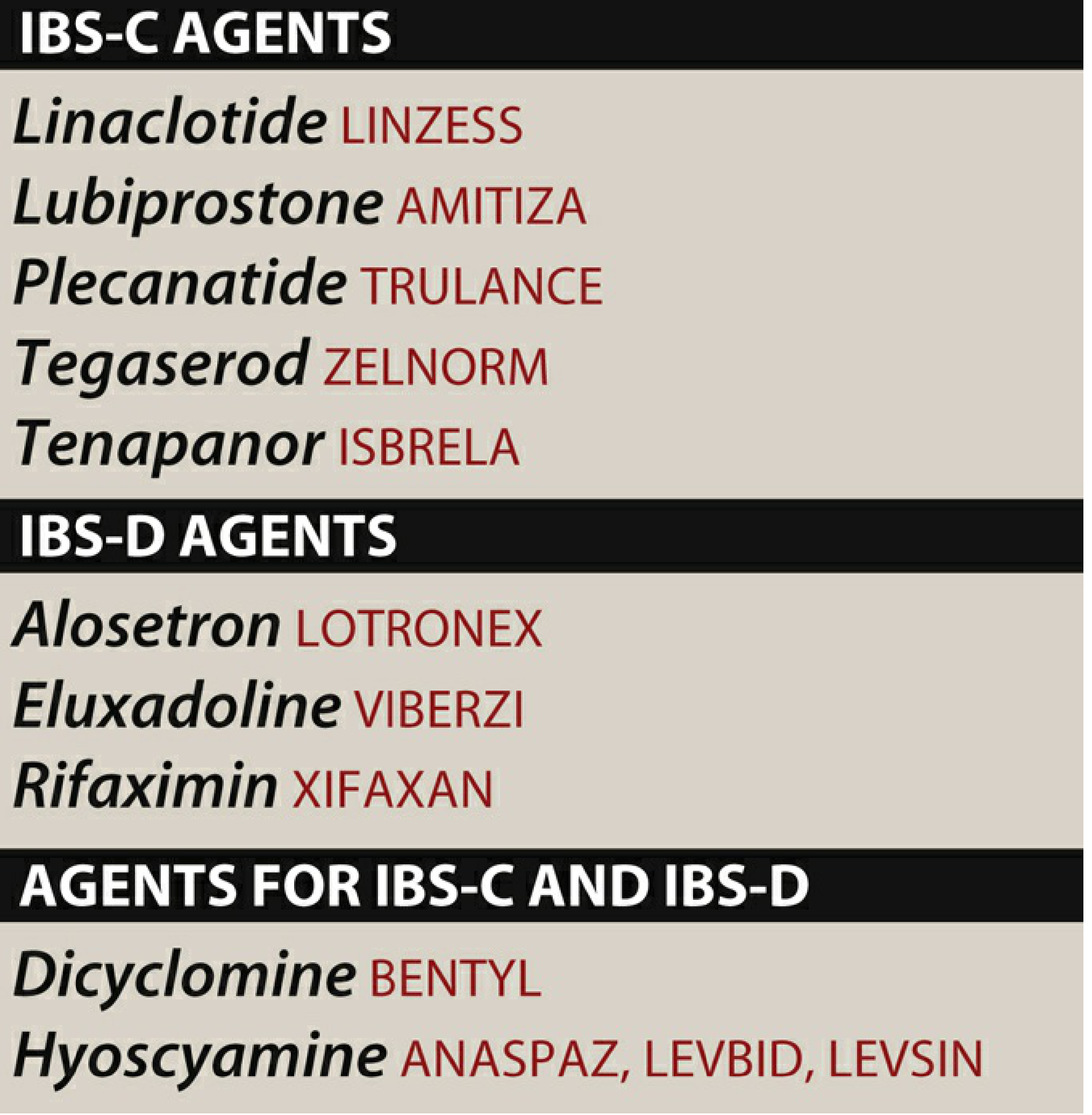
5. Stepwise Management Algorithm
Step 1 (All patients):
  → Dietary modification (low-FODMAP), trigger avoidance, education

Step 2 (Symptomatic relief):
  → Loperamide (urgency/stool frequency) ± antispasmodic/peppermint oil (pain)
  → TCA at low dose if pain is prominent

Step 3 (IBS-D specific — first line):
  → Rifaximin 550 mg TID × 14 days
     (retreatment if recurrence)

Step 4 (If inadequate response):
  → Eluxadoline 75–100 mg BID
     (avoid if cholecystectomy/alcohol dependence)

Step 5 (Severe, refractory — women only):
  → Alosetron 0.5–1 mg BID (via REMS)
     (after failure of conventional therapy)

Comorbid anxiety/depression:
  → TCA preferentially; consider psychological interventions (CBT, hypnotherapy)
6. Special Considerations in a 40-Year-Old Woman
| Consideration | Clinical Implication |
|---|---|
| Alosetron eligibility | Approved only for women — this patient qualifies if severe and refractory |
| Eluxadoline caution | Ask about prior cholecystectomy and alcohol use before prescribing |
| TCAs | Effective; also treat comorbid anxiety/insomnia common in IBS; avoid in suicidal ideation |
| Pregnancy potential | Lubiprostone (Category C) should be avoided if there is pregnancy potential |
| Bile acid diarrhea | Up to 30% of IBS-D patients may have idiopathic bile acid diarrhea — bile acid sequestrants (e.g., cholestyramine) can be a diagnostic-therapeutic trial |
Recent Evidence (2023–2026)
- Probiotics (PMID 37686889): Network meta-analysis (2023) shows strain-specific benefits; no universal recommendation yet.
- Mesalamine (PMID 36858143): Meta-analysis (CGH 2024) shows no significant benefit in IBS — not recommended.
- Acupuncture (PMID 39560589): Meta-analysis (2024) supports acupuncture for IBS-D with comorbid anxiety/depression as adjunct therapy.
- 2025 Seoul Consensus: Reaffirms rifaximin (moderate evidence, weak recommendation) and 5-HT₃ antagonists (high evidence) as effective in IBS-D; alosetron proposed as second-line in women with severe symptoms.
Sources: Katzung's Basic & Clinical Pharmacology 16e | Sleisenger & Fordtran's GI & Liver Disease | Lippincott Illustrated Reviews: Pharmacology | Harrison's Principles of Internal Medicine 22e | AGA Clinical Practice Guidelines on IBS-D (2022) | ACG Guidelines | 2025 Seoul Consensus
This is a shared conversation. Sign in to Orris to start your own chat.