
ecg for 10 marks
Reading File
Finding Sources
Searching the Web
ECG electrocardiogram 10 marks exam answer complete
Finding Sources
Finding Sources
Reading File
Finding Sources
I have multiple excellent sources. Let me now read the key ECG sections from Costanzo Physiology and Harrison's for a comprehensive exam answer.
Reading File
Finding Sources
Reading File
Finding Sources
Reading File
Reading File
Now let me fetch the ECG diagram image and read the leads section from Goldman-Cecil:
Loading Image
Reading File
I now have comprehensive information to write a detailed 10-mark exam answer on ECG. Let me compile it:
Electrocardiogram (ECG) — 10 Marks
Definition
The electrocardiogram (ECG or EKG) is a graphic recording of the potential differences (voltages) generated by the electrical activity of the heart, detected by electrodes placed on the body surface. It reflects the sequence of depolarization and repolarization of the atria and ventricles over time.
(Costanzo Physiology 7th Ed.)
Basis of ECG
The ECG is possible because the entire myocardium does not depolarize simultaneously:
- Atria depolarize before ventricles
- Ventricles depolarize in a specific sequence (apex → base)
- Repolarization follows in a specific sequence
These temporal differences create potential differences detectable at the body surface.
ECG Waveforms, Intervals & Segments
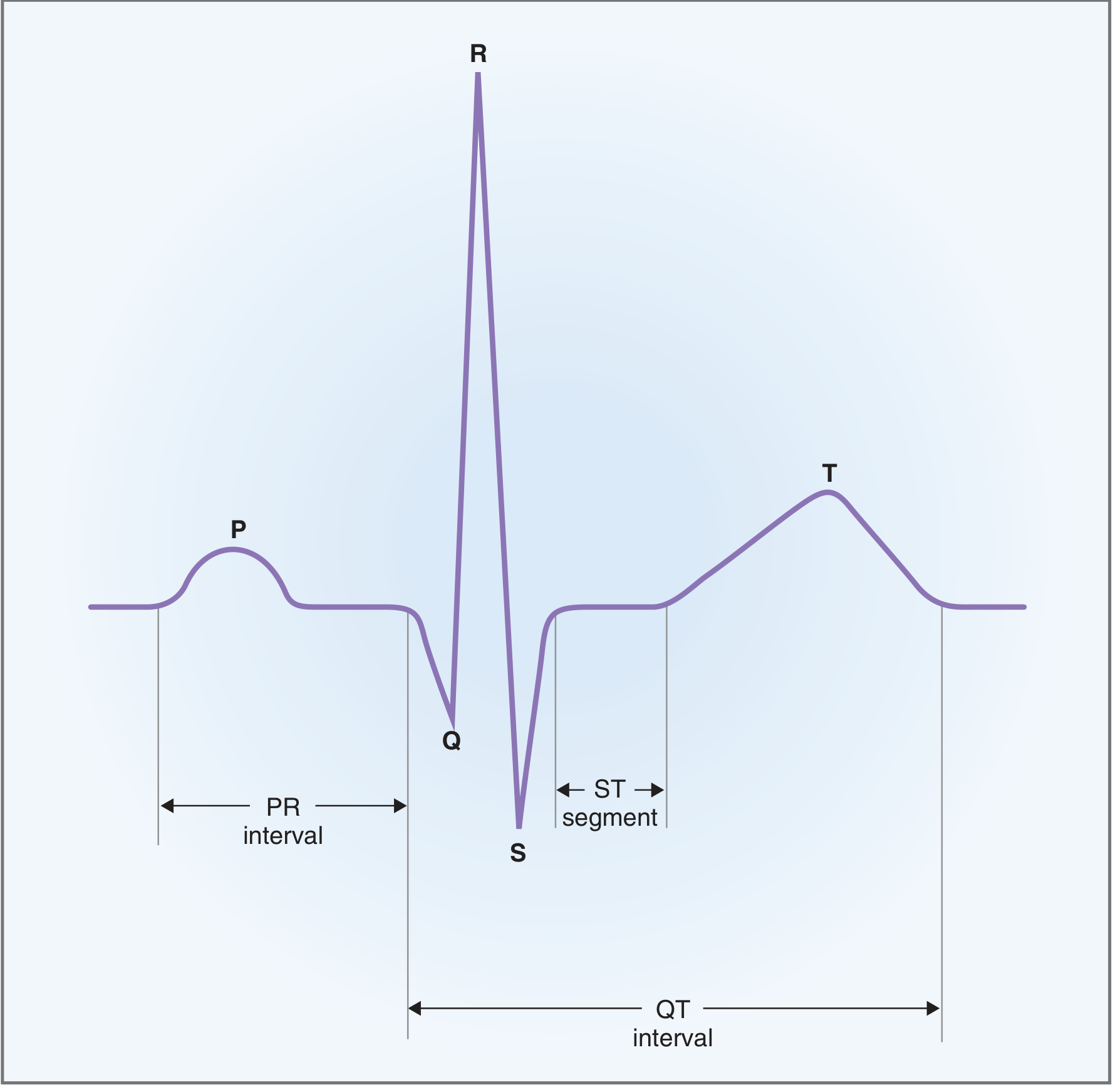
Key rule: Intervals include waves; segments do not
| Component | Represents | Normal Value |
|---|---|---|
| P wave | Atrial depolarization (SA node → atria) | Duration < 0.12 s |
| PR interval | Onset of atrial depol. → onset of ventricular depol. (includes AV node delay) | 0.12–0.20 s (120–200 ms) |
| PR segment | Isoelectric segment = AV nodal conduction delay | — |
| QRS complex | Ventricular depolarization (His-Purkinje → myocardium) | 0.06–0.10 s |
| ST segment | Isoelectric; corresponds to plateau phase of ventricular AP | At baseline |
| T wave | Ventricular repolarization | Upright in most leads |
| QT interval | From start of QRS → end of T wave (ventricular depol. + repol.) | < 0.44 s (corrected) |
| U wave | Repolarization of Purkinje fibers (sometimes seen) | Small, same direction as T |
Note: Atrial repolarization is not seen on the ECG — it is buried within (and masked by) the large QRS complex. (Goldman-Cecil Medicine)
ECG Leads — 12-Lead System
The standard 12-lead ECG uses 10 electrodes (4 limb + 6 precordial) to produce 12 views of the heart.
A. Limb Leads (Frontal Plane)
Bipolar leads (record potential difference between two electrodes):
| Lead | Positive Pole | Negative Pole |
|---|---|---|
| Lead I | Left arm (LA) | Right arm (RA) |
| Lead II | Left leg (LL) | Right arm (RA) |
| Lead III | Left leg (LL) | Left arm (LA) |
These form Einthoven's triangle. Einthoven's Law: Lead II = Lead I + Lead III.
Augmented unipolar limb leads (Goldberger, 1942 — compare single electrode vs. combined reference):
- aVR — Right arm
- aVL — Left arm
- aVF — Left foot (inferior)
B. Precordial (Chest) Leads — V1–V6
Unipolar leads compared against the Wilson central terminal (average of RA + LA + LL). Positioned on specific chest wall points:
| Lead | Position |
|---|---|
| V1 | 4th intercostal space, right sternal border |
| V2 | 4th intercostal space, left sternal border |
| V3 | Between V2 and V4 |
| V4 | 5th ICS, midclavicular line |
| V5 | Anterior axillary line (same horizontal level as V4) |
| V6 | Mid-axillary line (same level) |
(Goldman-Cecil Medicine, 2 Vol. Set)
Correlation of ECG Events with Cardiac Physiology
| ECG Event | Cardiac Event |
|---|---|
| SA node firing | Not seen on ECG (too small) |
| P wave onset | SA node → atrial depolarization begins |
| P wave end | Atrial depolarization complete → atrial contraction |
| PR interval | AV nodal conduction delay |
| Q wave onset | Ventricular depolarization begins (septal activation, L → R) |
| R wave peak / end of QRS | Ventricular systole begins; AV valves close (S1) |
| ST segment | Ventricular plateau (all cells depolarized, no current flow) |
| T wave | Ventricular repolarization → relaxation begins |
| After T wave | Diastolic filling begins |
Heart Rate Calculation
Heart rate = 1 / R-R interval (in seconds) × 60
On standard ECG paper (25 mm/s):
- 1 small square = 0.04 s; 1 large square = 0.20 s
- 300 ÷ number of large squares between R-R = heart rate (beats/min)
Normal heart rate: 60–100 beats/min
Clinical Significance of ECG
| Finding | Clinical Significance |
|---|---|
| Prolonged PR (>0.20 s) | First-degree heart block |
| Wide QRS (>0.12 s) | Bundle branch block or ventricular origin |
| ST elevation | Acute MI (STEMI), pericarditis |
| ST depression | Ischemia, NSTEMI |
| Peaked T waves | Hyperkalemia |
| Prolonged QT | Risk of torsades de pointes (drugs, hypocalcemia) |
| Absent P waves + irregular rhythm | Atrial fibrillation |
Summary
The ECG is a non-invasive, inexpensive tool that records cardiac electrical activity. The sequence — P → PR interval → QRS → ST segment → T wave — maps directly to the physiological sequence of atrial depolarization → AV node delay → ventricular depolarization → ventricular repolarization. The 12-lead system (6 limb + 6 precordial leads) provides spatial information about the heart in both the frontal and transverse planes, making it indispensable for diagnosing arrhythmias, conduction defects, myocardial ischemia/infarction, and electrolyte disorders.
Sources: Costanzo Physiology 7e; Goldman-Cecil Medicine 2 Vol. Set; Miller's Anesthesia 10e
This is a shared conversation. Sign in to Orris to start your own chat.