
Differentiate IUGR with premature body chart presentation
I'll look up the medical library skill first, then retrieve detailed content on IUGR vs premature infant body characteristics.
Reading File
Now let me search the library in parallel for IUGR and premature infant body characteristics:
Finding Sources
Finding Sources
Finding Sources
Finding Sources
Finding Sources
Reading File
Finding Sources
Finding Sources
Finding Sources
Finding Sources
Reading File
Reading File
I now have excellent source material. Let me also fetch the Ballard score image for visual reference and do a quick web search to supplement:
Loading Image
Searching the Web
IUGR vs premature infant physical features body chart differentiation SGA preterm
I now have comprehensive information to provide a detailed, well-structured comparison. Here is the full answer:
Differentiating IUGR from Premature (Preterm) Infant - Body Chart Presentation
The key clinical challenge is that both IUGR and preterm infants are small and may weigh less than 2500 g, but their body morphology, maturity markers, and physical features differ significantly. The New Ballard Score physical maturity chart is the standard tool used to assess gestational age and helps distinguish these two groups.
Definitions First
| Feature | IUGR (Intrauterine Growth Restriction) | Premature / Preterm |
|---|---|---|
| Definition | Fetus fails to achieve its growth potential; birth weight <10th percentile for GA with features of malnutrition | Born before 37 completed weeks gestation, regardless of weight |
| Gestational Age | Can be term, post-term, or preterm | By definition, <37 weeks |
| Problem | Pathological growth failure (placental insufficiency, infection, genetic factors) | Physiological immaturity - organs/systems not yet fully developed |
| Weight | Low for gestational age (SGA) | May be appropriate for gestational age (AGA) though physically small |
Body Chart Comparison - New Ballard Physical Maturity Score
Here is the Ballard physical maturity chart used clinically:
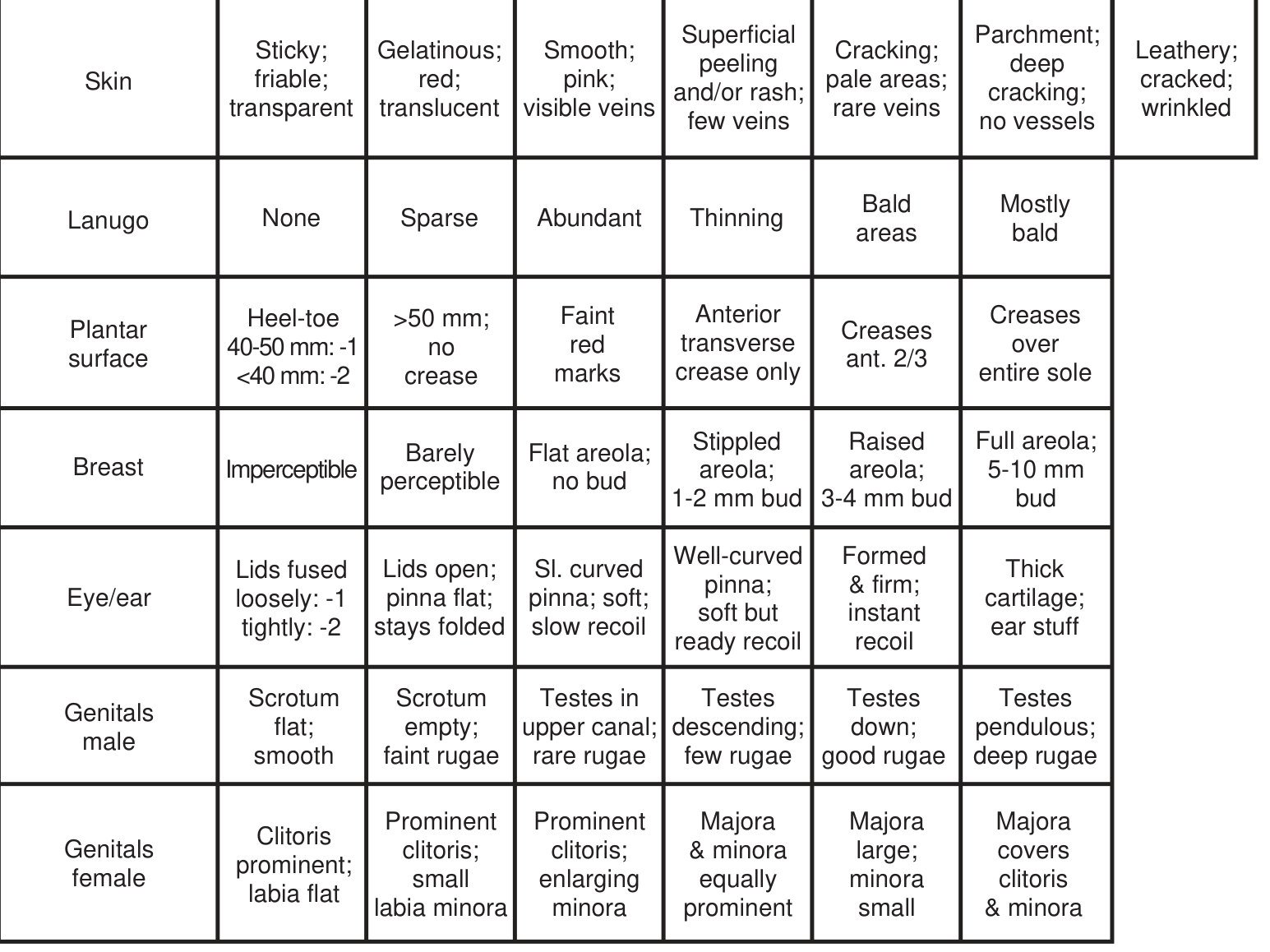
| Physical Feature | IUGR Infant (at/near Term) | Premature Infant (<37 wks) |
|---|---|---|
| Skin | Loose, dry, wrinkled, peeling; parchment-like or leathery; decreased turgor; little subcutaneous fat | Smooth, pink with visible veins; gelatinous/sticky in extreme prematurity; translucent |
| Lanugo | Mostly absent (shed appropriately) | Abundant lanugo (grows ~24-28 wks, shed near term) |
| Plantar (sole) creases | Creases cover the entire sole (mature creasing pattern) | Few or no creases; only faint red marks or anterior transverse crease only |
| Breast tissue | Breast bud usually present (raised areola, 3-5 mm bud) | Imperceptible or barely perceptible breast bud; flat areola |
| Ear cartilage | Well-formed pinna with instant recoil; thick cartilage | Pinna flat, soft; stays folded (no or slow recoil); ear cartilage not developed |
| Genitalia (male) | Testes fully descended; good to deep rugae on scrotum | Testes undescended or in upper canal; faint or no rugae; flat smooth scrotum |
| Genitalia (female) | Labia majora covers labia minora and clitoris | Prominent clitoris; labia minora enlarge relative to majora; clitoris exposed |
| Subcutaneous fat | Greatly reduced - "old man" wasted appearance, loose skin folds | Reduced relative to term but proportionate to gestational age |
| Head circumference | Depends on type (see below) | Proportionately small, consistent with gestational age |
| Muscle tone | May be reduced; low or flaccid | Reduced (hypotonic), posture more extended |
| Vernix caseosa | Reduced or absent | Present and abundant in moderate prematurity |
IUGR Subtypes - Additional Distinction
| Feature | Asymmetric IUGR (late onset, most common) | Symmetric IUGR (early onset) |
|---|---|---|
| Head circumference | Normal (brain sparing) | Reduced proportionally |
| Abdominal circumference | Markedly reduced (small liver - nutrient deprivation) | Reduced proportionally |
| HC:AC ratio | Elevated | Normal |
| Body proportions | Disproportionate - big head, thin body | Proportionate smallness |
| Ponderal index | Low (thin, wasted) | Normal |
| Cause | Placental insufficiency, late uteroplacental disease | Chromosomal, infection (TORCH), early teratogen exposure |
| Femur length | Normal (parallels gestational age) | Reduced |
Neuromuscular Maturity (Ballard) - Premature vs IUGR at Term
| Neuromuscular Sign | Premature Infant | IUGR at Term |
|---|---|---|
| Posture | Extended limbs (hypotonic) | Flexed (term-like maturity) |
| Square window (wrist) | Wide angle (>90°) - soft, immature | Narrow angle (~0°) - term maturity |
| Arm recoil | Slow or absent | Brisk recoil |
| Popliteal angle | Wide (>90-110°) | Narrow (80-90°) |
| Scarf sign | Arm crosses to opposite shoulder easily | Elbow does not reach midline |
| Heel to ear | Easy (very flexible) | Resistance felt |
Key rule: In an IUGR term baby, neuromuscular and physical maturity scores are appropriate for gestational age (mature), but weight/nutrition markers are poor. In a preterm baby, ALL maturity scores are immature regardless of weight.
Other Clinical Differentiating Features
| Feature | IUGR | Premature |
|---|---|---|
| Birth weight | Low for GA (<10th percentile) | Appropriate for (low) GA |
| Length | Often normal or near-normal (asymmetric) | Short but proportionate for GA |
| Alertness | Often alert, hungry, vigorous | Lethargic, poor suck |
| Cry | High-pitched (may indicate hypoglycemia or CNS issue) | Weak cry |
| Complications | Hypoglycemia, polycythemia, hypothermia, meconium aspiration, perinatal asphyxia | RDS, apnea of prematurity, NEC, IVH, PDA, temperature instability |
| Placenta | Small, calcified, infarcted | Usually normal (delivery before placental aging) |
| Amniotic fluid | Often oligohydramnios | Variable |
| Umbilical cord | Thin, reduced Wharton's jelly | Normal caliber for gestational age |
The "Wasted" Look - Classic IUGR vs Premature
- IUGR (asymmetric): The baby has a relatively large head, prominent eyes, sparse buccal fat, loose hanging skinfolds over buttocks/thighs, thin limbs, and visible ribs. This "wizened old man" appearance is the hallmark.
- Preterm: The baby looks uniformly small with a proportionate but underdeveloped body, abundant lanugo, translucent skin, undescended testes, and absent sole creases - all consistent with immaturity rather than malnutrition.
Quick Memory Aid
| Clue | Think IUGR | Think Premature |
|---|---|---|
| Sole creases | Cover whole foot | Absent or just anterior crease |
| Lanugo | Absent (shed) | Abundant |
| Ear recoil | Instant | Slow/none |
| Testes | Descended | Undescended |
| Skin | Wrinkled, peeling | Translucent, smooth |
| Body proportions | Wasted (thin body, normal-ish head) | Proportionately small |
| Neuromuscular | Mature for GA | Immature for GA |
Sources:
- Textbook of Family Medicine 9e, Table 21-3 (New Ballard Score for gestational age assessment), p. 527-528
- Creasy & Resnik's Maternal-Fetal Medicine, Intrauterine Growth Restriction section
- PMC - Antenatal and Postnatal Aspects of IUGR (Sharma et al.)
- Osmosis - SGA Infant Nursing
This is a shared conversation. Sign in to Orris to start your own chat.