
ATP7A defect
ATP7A encodes a copper-transporting P-type ATPase. Defects cause Menkes disease (X-linked recessive), a severe neurodegenerative disorder of copper deficiency due to failure of copper export from intestinal cells and other tissues. Features include kinky/steely hair, progressive neurodegeneration, connective tissue abnormalities, and early death. A milder allelic variant is Occipital Horn Syndrome.
Searching sources...
Reading File
Searching the Web
ATP7A defect Menkes disease pathophysiology clinical features
Finding Sources
Searching PubMed
"Menkes disease" AND ATP7A
Reading File
Reading File
Reading File
Now let me get the Fitzpatrick's dermatology section and Harrison's content on Menkes disease:
Reading File
Finding Sources
Reading File
Reading File
I now have comprehensive information from multiple authoritative textbooks. Let me also fetch the hair image for visual illustration.
Loading Image
Here is a comprehensive overview of ATP7A defects, synthesized from multiple authoritative medical textbooks.
ATP7A Defect - Menkes Disease (and Allelic Variants)
Gene and Protein
ATP7A (Xq21.1) encodes a P-type ATPase copper transporter - a 1500-amino acid transmembrane protein located on the trans-Golgi membrane. Its roles are:
- Export dietary copper from enterocytes into the portal circulation
- Deliver intracellular copper to cuproenzymes within the Golgi apparatus
- Efflux of excess copper from most cells (except hepatocytes, which rely on the homologous ATP7B)
Loss-of-function mutations in ATP7A impair copper egress from intestinal epithelial cells, causing copper to accumulate in enterocytes while systemic tissues suffer profound copper deficiency. - Emery's Elements of Medical Genetics and Genomics, p. 294; Andrews' Diseases of the Skin, p. 4002
Allelic Spectrum
| Disorder | Severity | Key Features |
|---|---|---|
| Classic Menkes disease | Severe | Neurodegeneration, kinky hair, early death |
| Occipital Horn Syndrome (OHS) | Moderate | Connective tissue > neurological |
| ATP7A-related distal motor neuropathy | Mild | Adult-onset, Charcot-Marie-Tooth-like |
Classic Menkes Disease
Inheritance and Epidemiology
- X-linked recessive - affects males almost exclusively
- Prevalence: ~1 in 35,000 live male births (possibly as high as 1:8,664 by genome-based ascertainment)
- Typically presents after a normal 6-12 week honeymoon period
Pathophysiology
Because ATP7A is absent or non-functional, copper cannot be exported from intestinal enterocytes. Most cuproenzymes are therefore deprived of their cofactor:
| Enzyme | Normal Function | Effect of Deficiency |
|---|---|---|
| Cytochrome C oxidase | Mitochondrial electron transport | Neurodegeneration, energy failure |
| Lysyl oxidase | Cross-linking collagen/elastin | Connective tissue laxity, vascular fragility, kinky hair |
| Dopamine beta-hydroxylase | Norepinephrine synthesis | Autonomic dysfunction |
| Tyrosinase | Melanin synthesis | Depigmented hair |
| Superoxide dismutase | Free radical defense | Oxidative damage |
| Ceruloplasmin | Copper/iron transport | Low serum ceruloplasmin |
| Peptidylglycine alpha-amidating monooxygenase (PAM) | Neuroendocrine peptide processing | Hormonal dysregulation |
Lysyl oxidase requires copper to oxidatively deaminate lysyl residues, forming the cross-links essential for collagen and elastin integrity - this explains both the connective tissue findings and the twisted, brittle hair. - Harper's Illustrated Biochemistry 32e, p. 2888
Clinical Features
Prodrome (0-6 weeks): Normal birth and early development.
Early presentation (2-3 months):
- Feeding difficulties, vomiting, poor weight gain
- Seizures (often infantile spasms / hypsarrhythmia on EEG)
- Hypothermia
Characteristic features:
- Kinky/steely hair (pili torti + trichorrhexis nodosa + monilethrix) - ivory-white, wiry, sparse, twisted, brittle; resembles steel wool or copper-deficient sheep's wool
- Facies: pudgy face, exaggerated "Cupid's bow" upper lip
- Skin: pale, lax
Neurological:
- Progressive hypotonia
- Psychomotor regression / severe developmental delay
- Uncontrollable seizures progressing to status epilepticus
- Neuropathology: neovascularization of cerebral arteries, cystic medial degeneration, cerebellar hypoplasia, focal cortical dysplasias, profound Purkinje cell loss
Connective tissue:
- Osteoporosis, joint laxity
- Vascular anomalies (arterial tortuosity)
Ophthalmology: Ocular abnormalities
Prognosis: Death usually by 2-3 years from recurrent respiratory infections and neurological deterioration. - Bradley and Daroff's Neurology in Clinical Practice; Andrews' Diseases of the Skin
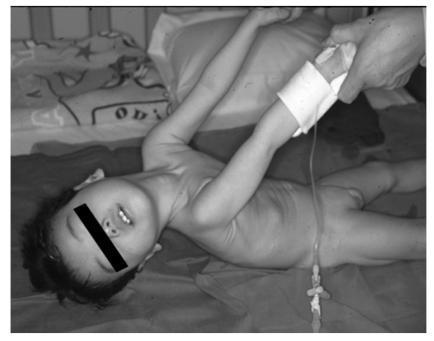
Occipital Horn Syndrome (OHS)
A milder allelic variant - hypomorphic ATP7A mutations preserve some protein function. Predominantly a connective tissue disorder presenting in early-to-middle childhood:
- Occipital horns (wedge-shaped bony exostoses at skull base - sites of trapezius/sternomastoid attachment)
- Skin and joint laxity (cutis laxa phenotype)
- Bladder diverticula, inguinal hernias
- Minimal neurological involvement
- Patients survive into adulthood
ATP7A mediates copper transport into the Golgi for lysyl oxidase activation - reduced activity preferentially impacts connective tissue cross-linking. - Fitzpatrick's Dermatology, p. 3510
ATP7A-Related Distal Motor Neuropathy
- Adult-onset, progressive distal motor neuropathy resembling Charcot-Marie-Tooth disease
- Pes cavus, distal muscle wasting
- No copper/ceruloplasmin abnormalities
- Caused by missense mutations preserving partial copper transport
Genetics and Mutation Spectrum
- Gene locus: Xq21.1 (X-linked, so affected females are very rare - reported with X-autosome translocations disrupting the gene)
- ~15-20% large deletions (usually classic severe phenotype)
- Point mutations: 23% splice-site, 21% nonsense, 17% missense, 39% small deletions/insertions
- Variable expressivity even with identical mutations within a family
Diagnosis
| Test | Finding |
|---|---|
| Serum copper | Very low |
| Serum ceruloplasmin | Very low |
| Catechol ratio (DOPA/DHPG) | High DOPA, dopamine, DOPAC; low DHPG - reflects dopamine beta-hydroxylase deficiency |
| Hair microscopy | Pili torti, trichorrhexis nodosa, monilethrix |
| Skin fibroblast copper egress studies | Abnormal |
| Molecular: ATP7A gene sequencing | Confirms mutation |
The catechol metabolite ratio (reflecting impaired dopamine-beta-hydroxylase) is a sensitive early biomarker for neonatal diagnosis. - Andrews' Diseases of the Skin, p. 4002
Treatment
- Copper-histidine (subcutaneous or IV): Partially bypasses the intestinal block. Restores serum copper and ceruloplasmin. Best results when started before neurological deterioration (neonatal period). - Bradley and Daroff's Neurology
- Pamidronate: Improves bone mineral density
- Gene therapy / antisense oligonucleotides: Experimental (promising results in zebrafish models and early human trials with viral-mediated ATP7A gene therapy)
- L-threo-DOPS (L-threo-dihydroxyphenylserine): Corrects neurochemical abnormalities in mouse models
Comparison with Wilson Disease (ATP7B)
| Feature | Menkes (ATP7A) | Wilson (ATP7B) |
|---|---|---|
| Gene | ATP7A (Xq21.1) | ATP7B (13q14) |
| Inheritance | X-linked recessive | Autosomal recessive |
| Primary organ | Intestine (efflux) | Liver (biliary excretion) |
| Copper result | Systemic deficiency | Systemic accumulation |
| Onset | Infancy | Childhood/young adult |
| Serum copper/ceruloplasmin | Low | Low (despite accumulation) |
| Treatment | Copper supplementation | Chelation (D-penicillamine, trientine) |
Sources: - Emery's Elements of Medical Genetics and Genomics, p. 294 | - Harper's Illustrated Biochemistry 32e, p. 2888 | - Bradley and Daroff's Neurology in Clinical Practice | - Andrews' Diseases of the Skin, p. 4002-4004 | - Fitzpatrick's Dermatology, p. 3510 | - Dermatology 2-Volume Set 5e | - GeneReviews: ATP7A-Related Copper Transport Disorders
This is a shared conversation. Sign in to Orris to start your own chat.