
Histology of tonsils
Reading File
Now let me search for tonsil histology in the library — heading and paragraph searches in parallel with an image search:
Finding Sources
Finding Sources
Searching Images
tonsil histology lymphoid tissue crypts
The histology textbook has a dedicated plate on the palatine tonsil. Let me read that section and the detailed descriptions in parallel:
Reading File
Finding Sources
Let me read further in the file for the full detailed histological descriptions:
Reading File
Loading Image
Loading Image
Let me also fetch the higher-magnification micrograph:
Loading Image
Loading Image
I now have comprehensive textbook content and high-quality histological images. Here is a complete account of tonsil histology:
Histology of the Tonsils
Overview & Waldeyer's Ring
The tonsils are aggregates of lymphoid tissue forming a protective ring — Waldeyer's ring — at the entrance to the oropharynx. The ring has three main components:
| Tonsil | Location |
|---|---|
| Palatine tonsils (paired) | Lateral walls of the oropharynx |
| Pharyngeal tonsil (adenoids) | Roof of the nasopharynx |
| Lingual tonsil | Base of the tongue |
All share the same fundamental histological architecture but differ in epithelial covering and crypt morphology.
Low-Power Architecture (H&E ×47)
The orientation micrograph below shows the essential features at low magnification:
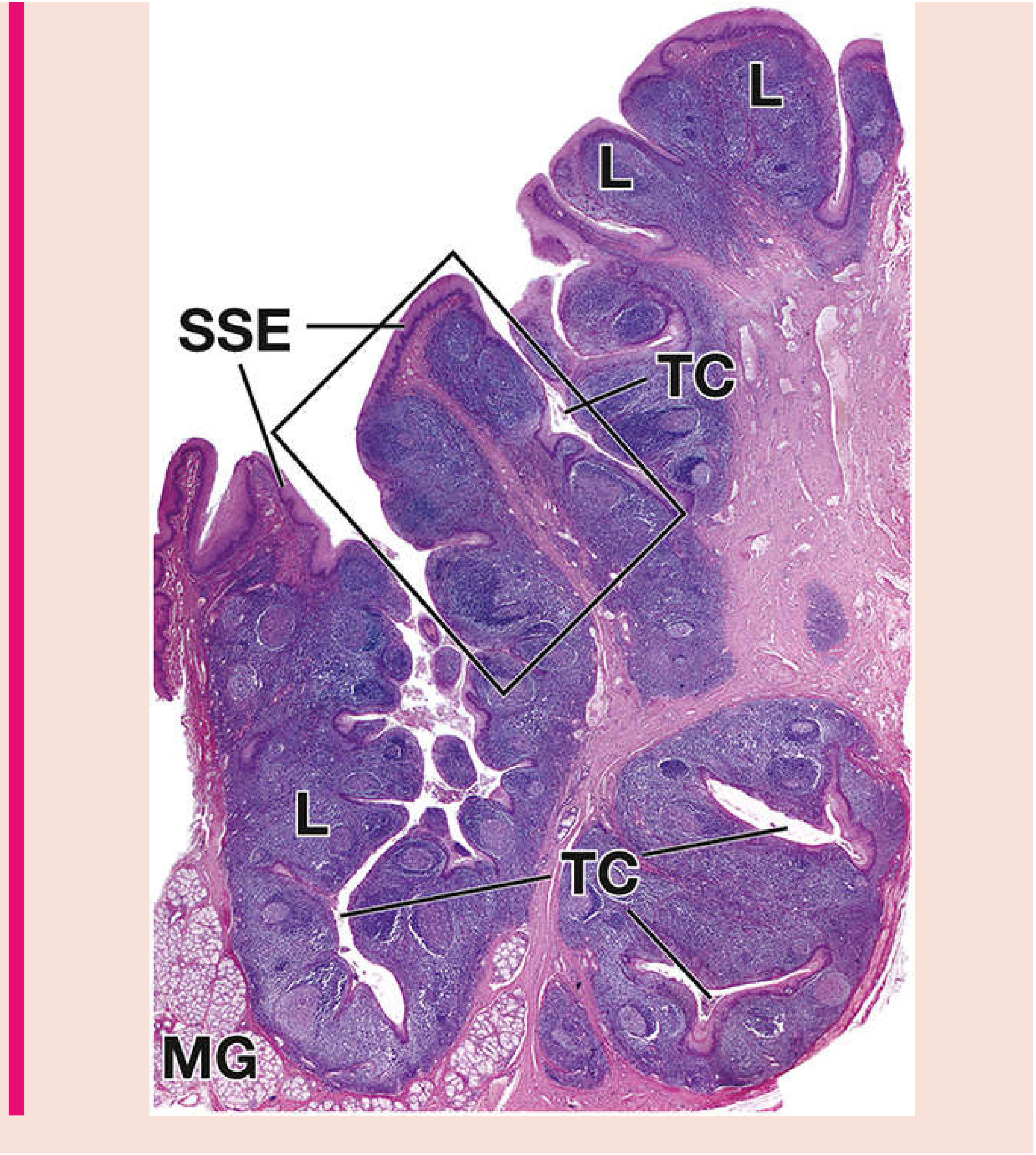
Key structures visible:
- SSE — stratified squamous epithelium covering the free surface
- TC — tonsillar crypts (deep invaginations of the epithelium into the connective tissue)
- L — masses of lymphatic tissue occupying the mucosa
- MG — mucus-secreting glands at the base of the crypts
Layer-by-Layer Histological Description
1. Surface Epithelium
- The palatine and lingual tonsils are covered by non-keratinized stratified squamous epithelium (SSE).
- The pharyngeal tonsil is covered by pseudostratified ciliated columnar (respiratory) epithelium with patches of stratified squamous epithelium.
2. Tonsillar Crypts
- The surface epithelium dips deep into the underlying connective tissue, forming branching, invaginated pockets called tonsillar crypts.
- The palatine tonsil has 10–20 primary crypts; these expand surface area enormously for antigen sampling.
- Crypt epithelium is characteristically heavily infiltrated by lymphocytes — so densely, in fact, that the epithelium may be almost impossible to identify. This is called lymphoepithelium or reticulated epithelium.
- The lamina propria–epithelial boundary is disrupted in these areas; the collagen band at the interface appears as small fragments, and lymphoid nodules appear to have literally grown into the epithelium.
3. Lymphoid Nodules (Follicles)
- Beneath and between the crypts lie numerous lymphatic nodules (follicles) within the lamina propria/mucosa.
- The nodules are so numerous and closely packed that they tend to merge with one another.
- Many nodules have germinal centers (GC) — pale, eosinophilic zones containing activated B lymphocytes (centroblasts and centrocytes), follicular dendritic cells, and macrophages (tingible-body macrophages).
- The dark-staining mantle zone (corona) of small, resting lymphocytes surrounds the germinal center.
4. Interfollicular (Parafollicular) Zone
- Between the nodules lies the interfollicular (T-cell–rich) zone, containing:
- Small T lymphocytes
- Postcapillary high endothelial venules (HEVs) — specialized vessels that facilitate lymphocyte recirculation into the tissue
- Plasma cells and occasional eosinophils
5. Submucosa
- Deep to the lymphoid tissue is a layer of dense irregular connective tissue (submucosa, labeled S in the micrograph).
- Mucous and seromucous glands are present here, with ducts opening at the base of the crypts; their secretions help flush debris from the crypts.
- There is no capsule on the free (mucosal) surface; a fibrous pseudocapsule forms only on the deep/lateral aspect, separating the tonsil from surrounding muscle.
6. Blood & Lymphatic Vessels
- Afferent lymphatic vessels are absent — antigens arrive directly via the overlying epithelium/crypts, not via afferent lymphatics (unlike lymph nodes).
- Efferent lymphatic vessels drain lymph away from tonsillar tissue.
- A rich blood supply enters through the pseudocapsule.
Higher-Magnification Detail (H&E ×47 and ×365)
The composite micrograph below shows nodules (N) with germinal centers (GC), lymphocytes (Ly) infiltrating the epithelium (SE), the submucosa (S), and islands of isolated epithelial cells (Ep) surrounded by infiltrating lymphoid tissue:
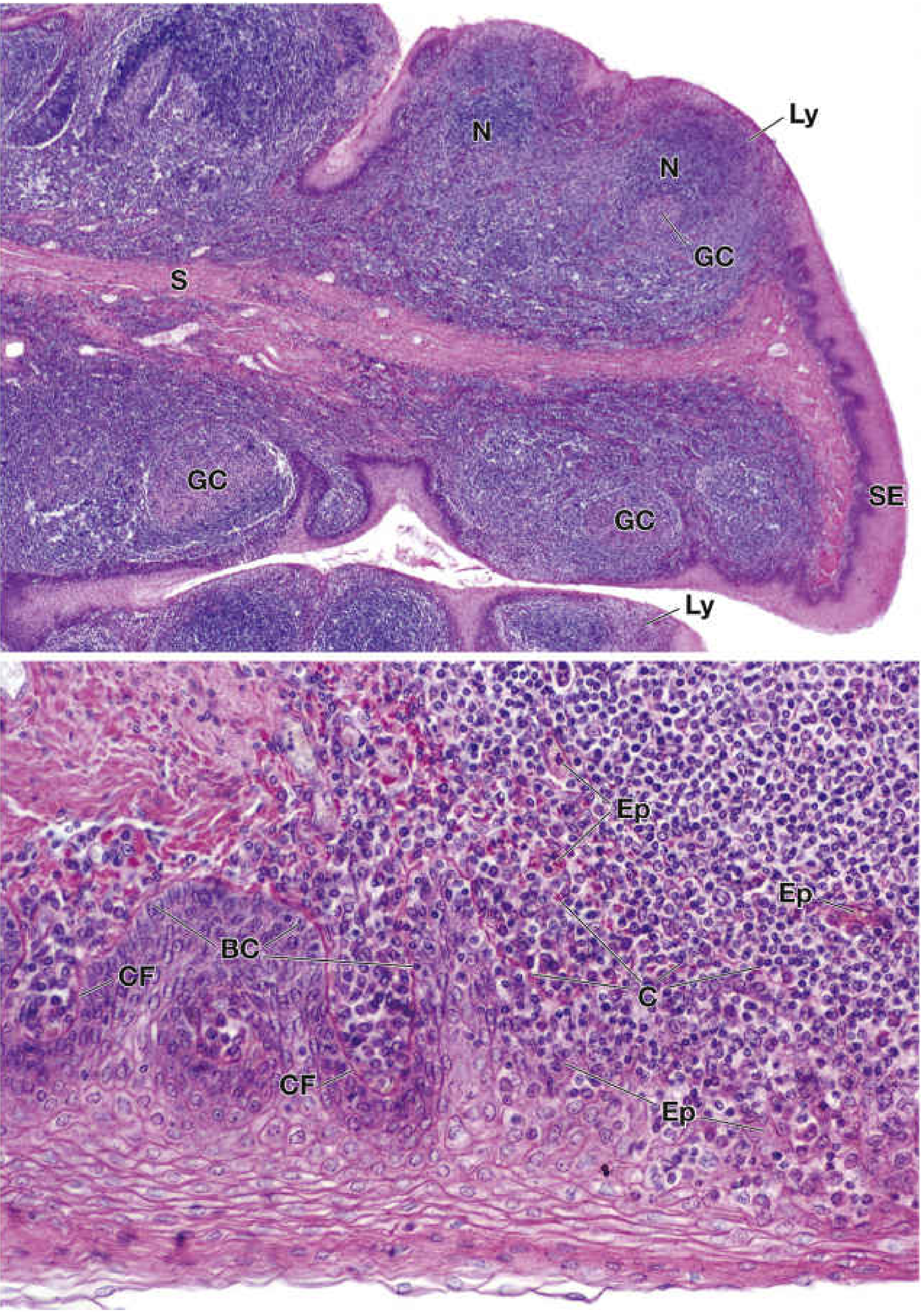
At high magnification (×365):
- The left side shows a clear boundary between epithelium and lamina propria, with a thin band of collagen fibers (CF) at the interface and only a few lymphocytes entering the epithelium.
- The right side demonstrates the striking lymphocytic invasion: isolated islands of epithelial cells (Ep) appear completely surrounded by lymphocytes; the collagen band is disrupted into fragments, and the nodule has grown into the epithelium, obliterating the normal boundary.
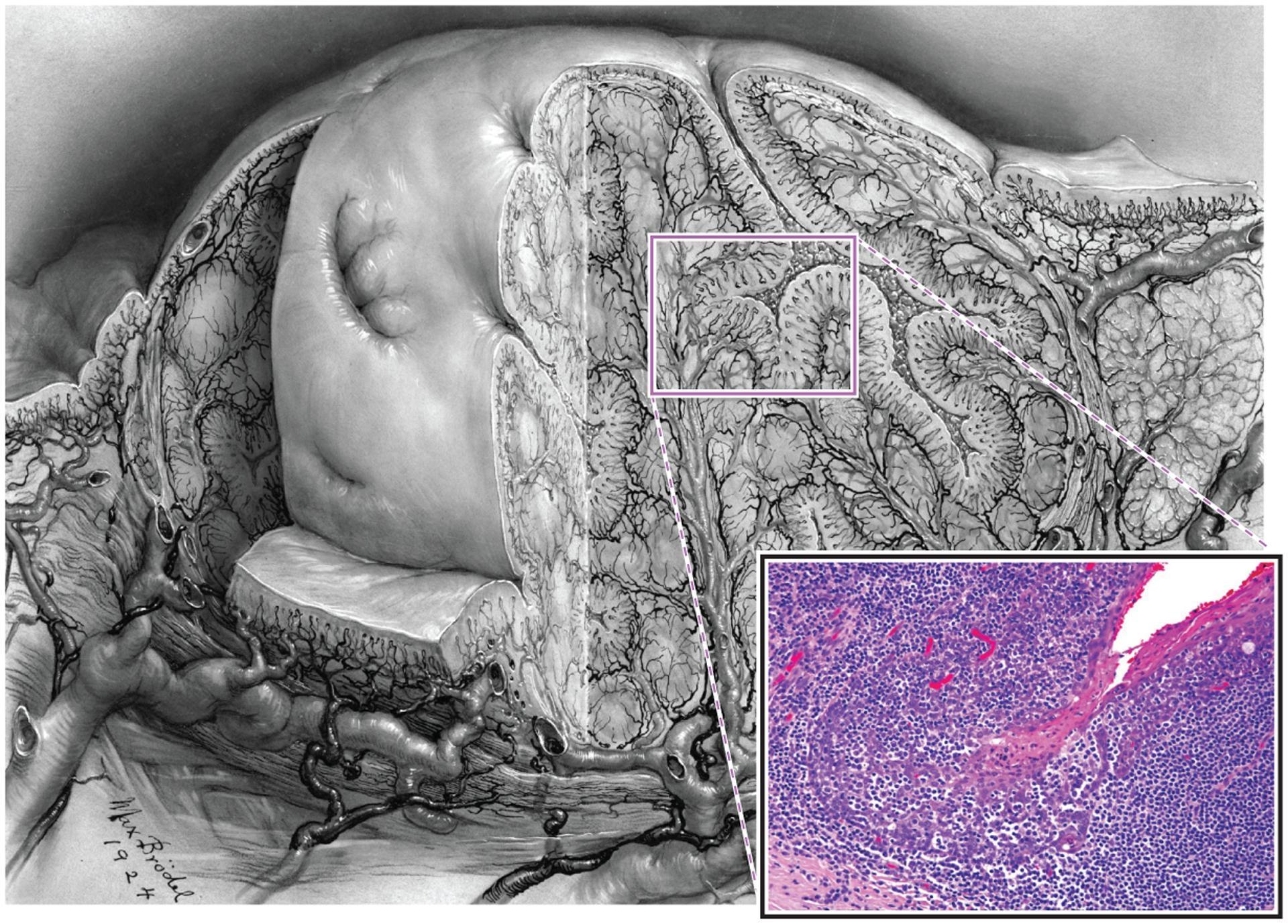
Gross-to-Microscopic Anatomy
The Brodel-illustrated diagram with inset H&E shows the deep, branching crypt architecture and the corresponding microscopic picture of the reticulated crypt epithelium:
Comparison: Tonsils vs Lymph Nodes
| Feature | Tonsils | Lymph Nodes |
|---|---|---|
| Capsule | Partial (pseudocapsule, deep only) | Complete |
| Afferent lymphatics | Absent | Present |
| Efferent lymphatics | Present | Present |
| Surface epithelium | Yes (SSE or respiratory) | No |
| Crypts | Yes | No |
| Location in immune circuit | Mucosal first line | Downstream filtration |
Functional Significance
The unique architecture — with crypts dramatically increasing surface area and lymphoepithelium facilitating direct antigen sampling — positions the tonsils as first-line mucosal immune sentinels. Antigens from inhaled or ingested material contact the lymphoepithelium, are processed by dendritic cells and macrophages within the lamina propria, and trigger B-cell responses in the germinal centers (antibody production) and T-cell responses in the interfollicular zones.
Source: Histology: A Text and Atlas with Correlated Cell and Molecular Biology (Pawlina), Plate 14.1 — Palatine Tonsil, pp. 1256–1259.
This is a shared conversation. Sign in to Orris to start your own chat.