
Classify gypsum product . Write details about manufacturing theories setting of gypsum product also discuss diff bw impression plaster and dental plaster in 12 to 15 marks long note
gypsum products classification types manufacturing setting reaction dental materials
https://dypds.com/study-materials/Prostho%20Study%20Material…
gypsum products types classification dental plaster stone
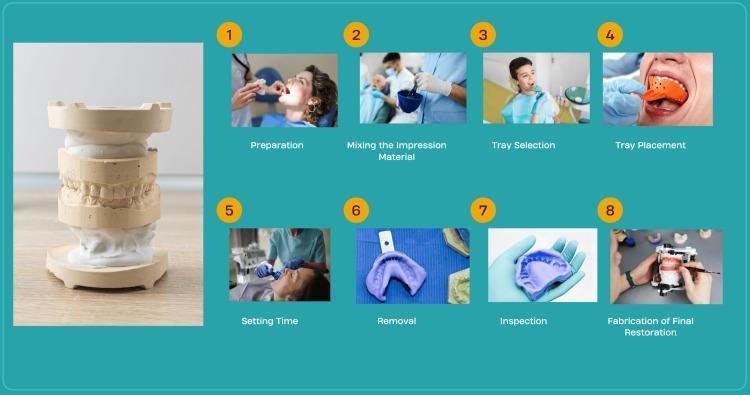
This infographic illustrates the eight clinical and laboratory steps of the traditional dental impression and restoration process. A primary vertical image shows a completed gypsum plaster model (stone cast) of human dentition mounted for articulation. The procedural sequence is divided into numbered panels: 1) Clinical preparation of the patient; 2) Manual mixing of impression material (e.g., alginate or polyvinyl siloxane) in a rubber bowl; 3) Selection of an appropriate maxillary/mandibular arch tray; 4) Intraoral tray placement and seating; 5) Setting time during which the material undergoes polymerization or gelation; 6) Removal of the set impression from the oral cavity; 7) Inspection for clinical accuracy, voids, or tears; and 8) Fabrication of the final restoration, showing a technician using an articulator and dental ceramics. The visual provides a comprehensive overview of prosthodontic workflows, emphasizing the transition from clinical chairside procedures to dental laboratory fabrication.
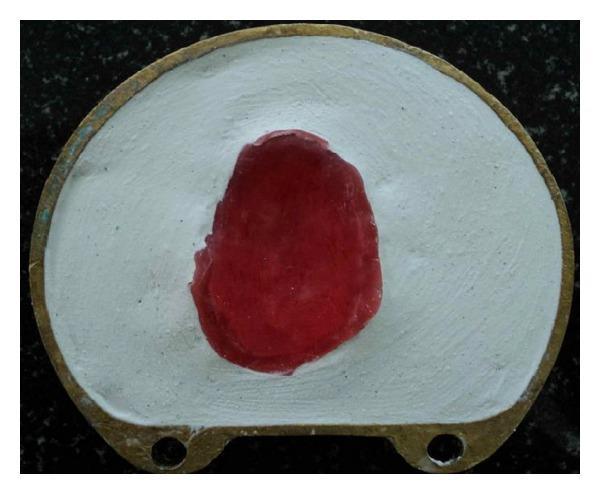
A clinical laboratory photograph showing the flasking stage of a dental obturator prosthesis fabrication. The image depicts a white dental plaster (Type II or III gypsum) cast held within a circular brass or gold-colored dental flask. Centrally, a reddish-pink baseplate wax bulb is adapted into a defect area, representing the 'waxed-up bulb' for a maxillectomy patient. The wax exhibits a smooth, reflective surface and irregular, rounded contours, contrasting with the matte, slightly granular texture of the surrounding dental stone. Two symmetrical orientation holes are visible at the base of the metal flask. This step is critical in the direct investment technique, where the wax pattern is encased in a mold to be later replaced by heat-polymerizing acrylic resin. The educational focus is on the laboratory procedures for fabricating a hollow bulb obturator to rehabilitate speech and mastication in post-surgical maxillary defect cases.
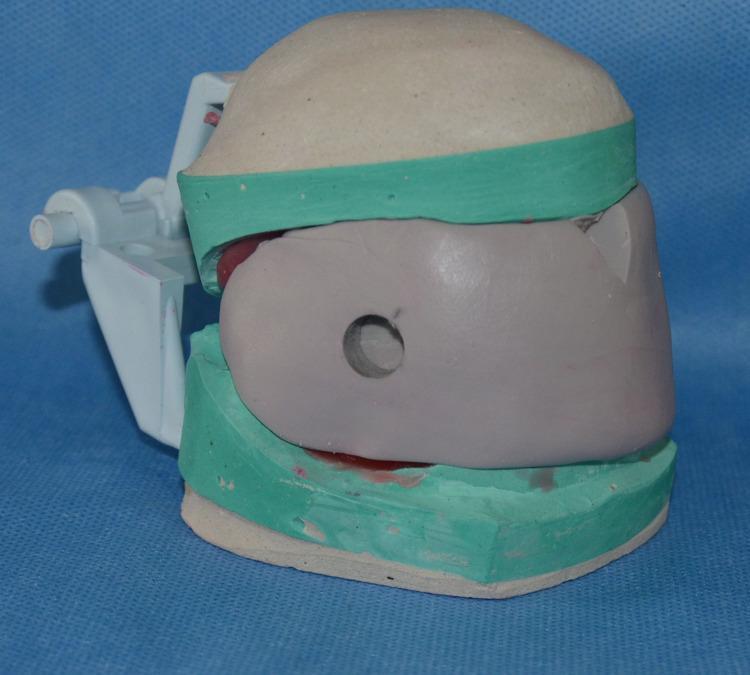
A clinical photograph illustrating a laboratory stage of dental appliance fabrication, specifically a Mandibular Advancement Device (MAD). The image shows a dental stone cast assembly featuring a grey addition silicone putty index. This putty index is positioned over the labial and buccal surfaces of the wax-up to facilitate accurate dewaxing and mold preservation. Key features include carved orientation grooves on the putty surface and a central circular opening on the labial aspect. The assembly is stabilized within green Type II gypsum (dental plaster) compartments, which provide a supporting framework and further orientation guides. The setup is mounted on a white plastic hinge articulator, maintaining the vertical and horizontal relationship between the maxillary and mandibular components. This process is essential for creating a precise mold for heat-cure clear denture base resin during the manufacturing of appliances used in treating obstructive sleep apnea.
GYPSUM PRODUCTS - Comprehensive Long Note
I. INTRODUCTION
II. CLASSIFICATION OF GYPSUM PRODUCTS
According to ADA Specification No. 25 (ISO Standard):
| Type | Name | Also Called |
|---|---|---|
| Type I | Impression Plaster | Plaster of Paris (impression use) |
| Type II | Dental Plaster (Model Plaster) | Plaster of Paris (model use) |
| Type III | Dental Stone | Medium-strength / Class I stone |
| Type IV | Dental Stone, High Strength, Low Expansion | Die stone, Densite, Improved stone, Class II stone |
| Type V | Dental Stone, High Strength, High Expansion | High-expansion die stone |
III. MANUFACTURE OF GYPSUM PRODUCTS
Calcination Pathway:
CaSO₄·2H₂O  --110-120°C-->  CaSO₄·½H₂O  --200-1000°C-->  CaSO₄ (anhydrite)
  (Gypsum/          (Hemihydrate -         (Dead-burned
  Dihydrate)        Plaster/Stone)          Anhydrite)
- CaSO₄·½H₂O = Plaster or Stone (most used in dentistry)
- CaSO₄ (hexagonal anhydrite) at 110-300°C
- CaSO₄ (orthorhombic anhydrite) at 1300-2000°C
- CaSO₄ (dead-burned) at 2000-10000°C
A. Manufacture of Dental Plaster (Type I & II) - β-Hemihydrate
- Gypsum is heated to 110-120°C (230-250°F) in an open container (dry heat/calcination in air)
- This rapid, uncontrolled heating in open air shatters the crystal structure
- Water is driven off rapidly, leaving irregular, porous, sponge-like particles with many internal capillary pores
- The product is called β-hemihydrate (beta-hemihydrate)
- Because of the irregular, porous particle shape, it requires a high water/powder ratio (0.45-0.75) to wet all surfaces and fill pores
- The excess water that does not participate in the chemical reaction remains in the set mass as free water, creating microscopic voids and porosity, which reduces final strength
- Irregular, porous, sponge-like particles
- High water requirement
- High porosity after setting
- Low compressive strength (~4-9 MPa)
- Inexpensive
B. Manufacture of Dental Stone (Type III) - α-Hemihydrate
- Gypsum is heated under steam pressure (autoclaving) at 120-130°C in a closed container (autoclave)
- The controlled, moist heat allows slow, orderly loss of water, preserving crystal integrity
- Result: dense, regular, prismatic/cleavage-type particles with smooth surfaces and minimal porosity - called α-hemihydrate (alpha-hemihydrate)
- Requires much less water (0.28-0.30 W/P ratio) because smooth particles pack efficiently
- Less free water = less porosity = higher strength (~20.7 MPa)
C. Manufacture of Type IV & V (Improved Stone / Die Stone) - α-Hemihydrate (Modified)
- Produced by boiling gypsum in a 30% calcium chloride (CaCl₂) solution or by autoclaving with special chemicals
- This produces the most dense, uniform, cuboid/cleavage particles with minimal surface area
- Alternatively, produced by calcining in the presence of sodium succinate or similar chemicals that adsorb onto crystal surfaces and reduce water requirement further
- W/P ratio: 0.22-0.24 (Type IV) and 0.18-0.22 (Type V)
- Highest density = minimum porosity = maximum strength (34.5-48.3 MPa)
- Type V has increased setting expansion (0.1-0.3%) to compensate for metal casting shrinkage
| Type | Manufacturing Method | Crystal Form | Particle Shape |
|---|---|---|---|
| Plaster (I, II) | Open-pan calcination (dry heat, 110-120°C) | β-hemihydrate | Irregular, porous, sponge-like |
| Dental Stone (III) | Autoclaving under steam pressure | α-hemihydrate | Dense, regular, prismatic |
| Die Stone (IV, V) | Boiling in CaCl₂ solution / Autoclave + additives | α-hemihydrate (modified) | Dense, cuboid, smooth, uniform |
IV. SETTING REACTION OF GYPSUM PRODUCTS
V. THEORIES OF SETTING REACTION
1. Dissolution-Precipitation Theory (Le Chatelier's Theory) - Most Widely Accepted
- Proposed by Le Chatelier (1887)
- The hemihydrate dissolves in the mixing water to form a supersaturated solution
- Since dihydrate is less soluble than hemihydrate, it precipitates out as tiny crystals of calcium sulfate dihydrate
- This lowers the concentration of calcium and sulfate ions in solution
- More hemihydrate dissolves to restore equilibrium - the process continues
- Crystals grow and interlock with each other, forming a rigid, hard mass
- Setting is essentially a crystallization process driven by differential solubility
- The solubility of hemihydrate (~8 g/L) is greater than dihydrate (~2 g/L)
- Addition of dihydrate crystals (gypsum) accelerates setting (seed crystals)
- Temperature changes affect solubility, altering setting time
- The process is exothermic - consistent with crystallization from solution
2. Colloidal Theory (Michaelis Theory)
- Proposed as an alternative explanation
- Suggests that the hemihydrate forms a colloidal gel first upon mixing with water
- This gel then gradually crystallizes to form the hard dihydrate mass
- Less widely accepted today but explains some intermediate stages of setting behavior
3. Hydration Theory
- A simpler, older concept
- States that water molecules directly combine with hemihydrate particles through solid-solid or solid-liquid diffusion
- Does not fully explain the crystal interlocking mechanism
- Largely replaced by the dissolution-precipitation theory
Stages of Setting:
- Mixing stage - Hemihydrate + water forms a paste/slurry
- Working time - Paste remains workable and can be poured/shaped
- Initial setting time - Loss of gloss (surface appears dull), paste begins to stiffen (no longer workable; measured by Vicat needle - penetrates 1mm)
- Final setting time - Material becomes rigid and can be separated from the impression (measured by Gillmore needle)
- Setting expansion - Slight outward expansion (0.0-0.3%) occurs due to crystal growth pushing against each other
- Post-setting hardening - Strength continues to increase as excess water evaporates
VI. WATER/POWDER (W/P) RATIO
- Higher W/P = more free water = more porosity = weaker, softer product, longer setting time
- Lower W/P = less free water = denser set = stronger, harder product
| Product | W/P Ratio | Compressive Strength |
|---|---|---|
| Impression Plaster (I) | 0.40-0.75 | 4.0 MPa |
| Model Plaster (II) | 0.45-0.50 | 9.0 MPa |
| Dental Stone (III) | 0.28-0.30 | 20.7 MPa |
| Type IV Die Stone | 0.22-0.24 | 34.5 MPa |
| Type V Die Stone | 0.18-0.22 | 48.3 MPa |
VII. IMPRESSION PLASTER vs. DENTAL PLASTER - COMPARISON
| Feature | Impression Plaster (Type I) | Dental Plaster / Model Plaster (Type II) |
|---|---|---|
| ADA Type | Type I | Type II |
| Purpose/Use | Taking dental impressions of edentulous arches; bite registration | Making study models, diagnostic casts, mounting casts on articulators |
| W/P Ratio | 0.50-0.75 (higher) | 0.45-0.50 |
| Setting Time | 4 ± 1 minutes (shorter) | 12 ± 4 minutes (longer) |
| Setting Expansion | 0.00-0.15% (minimal, less than 0.15%) | 0.00-0.30% (up to 0.30%) |
| Compressive Strength (1 hr) | 4.0 MPa (580 psi) - lower | 9.0 MPa (1300 psi) - higher |
| Porosity | Very high (more free water) | Moderately high |
| Color | Usually white or with coloring agent | Usually white or cream colored |
| Modifiers | Higher content of accelerators (K₂SO₄) and retarders (borax) to control short working/setting time | Moderate accelerators and retarders |
| Consistency | Very fluid/thin slurry - flows easily into impression | Moderately fluid - pourable but less thin |
| Surface detail | Good surface reproduction of soft tissue | Good, but strength more important |
| Rigidity | Rigid/non-elastic on setting - must be fractured to remove from undercuts | Rigid/non-elastic |
| Disadvantage | Very brittle, low strength; must be fractured and reassembled from undercuts; largely replaced by elastic impression materials | Less suitable for die fabrication; not strong enough for precision work |
| Clinical significance | Setting expansion undesirable (causes inaccuracy); controlled at ≤0.15% | Setting expansion also undesirable for mounting; should be ≤0.30% |
| Historical note | One of the earliest impression materials in dentistry | Widely used in laboratory work |
| Typical applications | Impressions of edentulous ridges, bite registration | Study models, diagnostic casts, articulator mounting |
Key Distinguishing Points:
-
Impression plaster has a shorter setting time (4 min) because it needs to set quickly inside the patient's mouth; dental plaster has a longer setting time (12 min) to allow time for pouring and manipulation in the laboratory.
-
Impression plaster has lower setting expansion (max 0.15%) because any expansion inside the mouth would distort the impression; dental plaster allows slightly more expansion (up to 0.30%) since casts are less precision-critical than dies.
-
Dental plaster is stronger (9 MPa vs. 4 MPa) because the cast needs to withstand handling and articulation, while impression plaster only needs to hold together briefly to be removed.
-
Both are β-hemihydrate made by the same calcination method; the difference lies in their additive content and W/P ratio optimized for their specific clinical roles.
-
Setting expansion is undesirable in both - Type I's expansion is minimized to ensure accurate impressions; Type II's expansion is minimized to prevent distortion of occlusal relationships when mounting casts.
VIII. TYPICAL PROPERTIES TABLE - ALL 5 TYPES
| Type | W/P Ratio | Setting Time (min) | Setting Expansion (%) | Compressive Strength |
|---|---|---|---|---|
| I (Impression Plaster) | 0.40-0.75 | 4 ± 1 | 0.00-0.15 | 4.0 MPa (580 psi) |
| II (Model Plaster) | 0.45-0.50 | 12 ± 4 | 0.00-0.30 | 9.0 MPa (1300 psi) |
| III (Dental Stone) | 0.28-0.30 | 12 ± 4 | 0.00-0.20 | 20.7 MPa (3000 psi) |
| IV (High Strength, Low Exp.) | 0.22-0.24 | 12 ± 4 | 0.00-0.10 | 34.5 MPa (5000 psi) |
| V (High Strength, High Exp.) | 0.18-0.22 | 12 ± 4 | 0.10-0.30 | 48.3 MPa (7000 psi) |
IX. SETTING EXPANSION - CLINICAL SIGNIFICANCE
- Setting expansion is undesirable for impression plasters, dental plasters, and stones as it results in an inaccurate cast or change in occlusal relation when used for mounting
- Setting expansion is desirable in Type V die stone and investment materials to compensate for metal shrinkage during casting
- Type V has its expansion increased (0.1-0.3%) specifically to compensate for base metal alloy shrinkage during solidification
Follow a mixture of Philips material of dental sciences and manapalli
Phillips Science of Dental Materials gypsum products classification manufacturing setting theories
Manappallil dental materials gypsum products impression plaster dental plaster setting reaction
https://uomus.edu.iq/img/lectures21/MUCLecture_2023_1333139.…
GYPSUM PRODUCTS
(As per Phillips' Science of Dental Materials & Manappallil's Clinical Dental Materials)
I. INTRODUCTION
- Alabaster - pure white, fine-grained, translucent
- Satin spar - fibrous, needle-like, silky lustre
- Selenite - colorless, crystalline, transparent
- Cast and model preparation
- Die fabrication
- Impression material (Type I)
- Bite registration
- Dental investments (with refractory fillers)
- Articulator mounting
II. CLASSIFICATION OF GYPSUM PRODUCTS
ADA Specification No. 25 (ISO Standard) - Five Types:
| Type | Name | Common Trade Names |
|---|---|---|
| Type I | Impression Plaster | Plaster of Paris (impression) |
| Type II | Dental Plaster (Model Plaster) | Laboratory / Model Plaster |
| Type III | Dental Stone (Medium Strength) | Class I Stone, Hydrocal |
| Type IV | Dental Stone, High Strength, Low Expansion | Die Stone, Densite, Vel-Mix, Improved Stone |
| Type V | Dental Stone, High Strength, High Expansion | High-expansion die stone |
Phillips' Note: ADA Specification No. 25 classifies five types of gypsum products with specific property requirements for each type in terms of setting time, setting expansion, and compressive strength.
III. CHEMICAL AND PHYSICAL NATURE
- Gypsum rock is chemically calcium sulfate dihydrate: CaSO₄·2H₂O
- All dental gypsum products are chemically calcium sulfate hemihydrate: CaSO₄·½H₂O - produced by heating (calcination) of gypsum
- On heating, gypsum loses 1½ mol of water from its 2 mol:
CaSO₄·2H₂O → CaSO₄·½H₂O + 1½ H₂O (Calcination)
- When mixed with water, the reverse reaction occurs:
CaSO₄·½H₂O + 1½ H₂O → CaSO₄·2H₂O + 3900 cal/g mol (Setting)
IV. MANUFACTURE OF GYPSUM PRODUCTS
Calcination Stages (Temperature Pathway):
CaSO₄·2H₂O ──(110-120°C)──► CaSO₄·½H₂O (Hemihydrate - Plaster/Stone)
                ──(200-300°C)──► CaSO₄ (Hexagonal anhydrite - soluble)
                ──(1100-1300°C)──► CaSO₄ (Orthorhombic anhydrite)
                ──(1300-2000°C)──► CaSO₄ (Dead-burned / insoluble anhydrite)
A. Manufacture of Dental Plaster (Types I & II) - β-Hemihydrate
- Gypsum is ground into fine powder and heated at 110-120°C (230-250°F) in an open container exposed to air
- The rapid, uncontrolled heating drives water off quickly and shatters the crystal structure
- Result: β-hemihydrate (beta-hemihydrate) - particles that are irregular, porous, and sponge-like with numerous internal capillary pores
- Particles require large amounts of water to wet all surfaces and fill all pores → high W/P ratio (0.45-0.75)
- Excess water that does not react chemically remains in the set mass as free water → evaporates to leave micropores and voids
- High porosity → low compressive strength (4-9 MPa)
- Inexpensive and widely available
B. Manufacture of Dental Stone (Type III) - α-Hemihydrate
- Gypsum is heated in a closed vessel (autoclave) under steam pressure at 120-130°C (250-265°F)
- The controlled, moist heat allows slow, orderly loss of water from the crystal
- The crystal structure is preserved, yielding α-hemihydrate (alpha-hemihydrate) - particles that are dense, regular, and prismatic/cleavage-shaped with smooth surfaces and minimal internal porosity
- Smooth, dense particles pack efficiently → less water needed (W/P ratio 0.28-0.30)
- Less free water → less porosity → higher compressive strength (~20.7 MPa / 3000 psi)
- More expensive than plaster
C. Manufacture of Type IV Die Stone (Improved Stone) - Modified α-Hemihydrate
- Gypsum is boiled in a 30% calcium chloride (CaCl₂) solution at ~100°C
- The CaCl₂ solution acts as a dehydrating agent - removes water without steam pressure but in a controlled liquid environment
- Result: even denser, more uniform, cuboid/cleavage-shaped particles with minimal surface area
- The residual CaCl₂ is then washed away with hot water
- Alternatively: autoclaving in the presence of <1% sodium succinate yields shorter, thicker hemihydrate crystals - called modified α-hemihydrate
- Very low W/P ratio (0.22-0.24)
- Very high density → near-zero porosity → maximum compressive strength (~34.5 MPa / 5000 psi)
- Highest abrasion resistance - used for precision dies
D. Manufacture of Type V Die Stone (High-Strength, High-Expansion)
- Produced similarly to Type IV but with addition of chemicals (e.g., sodium succinate, NaCl) to increase setting expansion
- W/P ratio: 0.18-0.22
- Setting expansion deliberately increased (0.1-0.3%) to compensate for metal alloy shrinkage during casting
- Compressive strength: ~48.3 MPa (7000 psi) - highest of all types
Summary of Manufacturing - Crystal Comparison (Manappallil):
| Property | β-Hemihydrate (Plaster) | α-Hemihydrate (Stone) |
|---|---|---|
| Method | Dry calcination (open pan, 110-120°C) | Wet calcination (autoclave/CaCl₂ boiling) |
| Crystal shape | Irregular, sponge-like | Dense, prismatic/cuboid |
| Porosity | High (45%) | Low (10-15%) |
| W/P ratio | High (0.45-0.75) | Low (0.19-0.30) |
| Setting expansion | Higher | Lower |
| Compressive strength | Low | High |
| Abrasion resistance | Low | High |
V. SETTING REACTION
2 (CaSO₄·½H₂O) + 3H₂O → 2 CaSO₄·2H₂O + Heat (exothermic)
- The heat evolved equals approximately the heat used for original calcination (~3900 cal/g mol)
- The reaction is exothermic - perceptible warmth is felt during setting
- Phillips' note: Set gypsum products probably never attain 100% conversion unless exposed to high humidity for a long time; therefore, unreacted hemihydrate remains in the set material
- Solubility of hemihydrate in water: ~8 g/L (relatively soluble)
- Solubility of dihydrate in water: ~2 g/L (relatively insoluble)
- This difference in solubility is the thermodynamic driving force for the entire setting reaction
VI. THEORIES OF SETTING REACTION
1. Dissolution-Precipitation Theory (Le Chatelier / Crystalline Theory) - ⭐ Most Widely Accepted
- CaSO₄·½H₂O (hemihydrate) dissolves in the mixing water to form a supersaturated solution of Ca²⁺ and SO₄²⁻ ions
- Since CaSO₄·2H₂O (dihydrate) is far less soluble than the hemihydrate, it immediately precipitates out of solution as tiny dihydrate crystal nuclei
- Precipitation lowers the Ca²⁺/SO₄²⁻ concentration in solution
- More hemihydrate dissolves to restore equilibrium - the cycle repeats continuously
- Dihydrate crystals grow and elongate into long, needle-like shapes
- Crystals from neighboring hemihydrate particles eventually interlock with each other
- This interlocking network of dihydrate crystals forms the hard, rigid set mass
- Solubility difference between hemihydrate and dihydrate is well-established
- Adding ground set gypsum (dihydrate) to fresh mix accelerates setting (acts as crystal nuclei - "Terra alba" effect)
- Temperature changes that affect solubility also alter setting time predictably
- Exothermic nature is consistent with crystallization from solution
- Increased W/P ratio slows setting (less concentrated, fewer nuclei)
2. Colloidal Theory (Gel Theory / Michaelis Theory)
- When hemihydrate is mixed with water, it does not simply dissolve - instead, it forms a colloidal sol (hemihydrate particles are hydrated and dispersed in water in a colloidal state)
- In the sol state, the hydrated hemihydrate particles are in an "active state"
- As the measured water is progressively consumed by hydration, the colloidal sol gradually converts to a solid gel
- The gel then rigidifies to form the set mass
Phillips' note: "The colloidal theory proposes that when mixed with water, hemihydrate enters into the colloidal state through a sol-gel mechanism. In the sol state, hemihydrate particles are hydrated to form dihydrate, thereby entering into an active state. As the measured amount of water is consumed, the mass converts to a solid gel."
3. Hydration Theory
- The simplest theory - proposes that water molecules directly combine with hemihydrate particles through hydrogen bonding with sulfate (SO₄²⁻) groups
- The rehydrated hemihydrate particles then unite through hydrogen bonding to form the set material
Phillips' note: "The hydration theory suggests that rehydrated plaster particles unite through hydrogen bonding with sulfate groups to form the set material."
Comparison of Theories:
| Theory | Proposed By | Mechanism | Acceptance |
|---|---|---|---|
| Dissolution-Precipitation | Le Chatelier | Dissolve → supersaturate → crystallize → interlock | Most widely accepted |
| Colloidal (Gel) | Michaelis | Sol → gel → rigid mass | Partially accepted |
| Hydration | - | H-bonding of hydrated particles | Largely discredited |
VII. STAGES OF SETTING (Manappallil)
- Mixing stage - Hemihydrate + water forms a smooth, homogeneous slurry (paste)
- Working time - Paste remains workable and can be poured, shaped, or spatulated
- Initial setting time - Loss of surface gloss (dull appearance); paste can no longer be worked; measured by Vicat needle penetrating 1 mm into the mix
- Final setting time - Material becomes hard and rigid; can be removed from impression without distortion or fracture; measured by Gillmore needle
- Setting expansion - Slight linear outward expansion (0.0-0.3%) due to crystal growth pressure
- Post-setting strength gain - Compressive strength increases rapidly as the material dries; "dry strength" (after 24 hr drying) is ~twice the "wet strength" (at 1 hr)
Key: Mixing time = 20-30 seconds (mechanical) or ≥1 minute (hand spatulation)
VIII. WATER/POWDER (W/P) RATIO - Clinical Significance
| Product | W/P Ratio | Setting Time (min) | Setting Expansion (%) | Compressive Strength |
|---|---|---|---|---|
| Type I (Impression Plaster) | 0.40-0.75 | 4 ± 1 | 0.00-0.15 | 4.0 MPa (580 psi) |
| Type II (Model Plaster) | 0.45-0.50 | 12 ± 4 | 0.00-0.30 | 9.0 MPa (1300 psi) |
| Type III (Dental Stone) | 0.28-0.30 | 12 ± 4 | 0.00-0.20 | 20.7 MPa (3000 psi) |
| Type IV (High Str., Low Exp.) | 0.22-0.24 | 12 ± 4 | 0.00-0.10 | 34.5 MPa (5000 psi) |
| Type V (High Str., High Exp.) | 0.18-0.22 | 12 ± 4 | 0.10-0.30 | 48.3 MPa (7000 psi) |
IX. DIFFERENCE BETWEEN IMPRESSION PLASTER (TYPE I) AND DENTAL PLASTER (TYPE II)
| Feature | Impression Plaster (Type I) | Dental / Model Plaster (Type II) |
|---|---|---|
| ADA Type | Type I | Type II |
| Chemical form | β-calcium sulfate hemihydrate | β-calcium sulfate hemihydrate |
| Primary Use | Making dental impressions of edentulous arches; mounting casts on articulators | Study models, diagnostic casts, flasking in denture construction, articulator mounting |
| W/P Ratio | 0.50-0.60 (very fluid/thin) | 0.45-0.50 (moderately fluid) |
| Consistency | Very fluid slurry - "mucostatic" (records soft tissue in uncompressed state) | Moderately fluid - pourable |
| Setting Time | Short: 4 ± 1 min (sets quickly in the mouth) | Longer: 12 ± 4 min (allows lab manipulation) |
| Setting Expansion | Very low: 0.00-0.15% (must be minimal to avoid intraoral distortion) | Slightly higher: 0.00-0.30% (less critical as used ex-vivo) |
| Compressive Strength (1 hr) | 4.0 MPa (580 psi) - low; only needs to hold together for impression removal | 9.0 MPa (1300 psi) - higher; needs to resist handling forces |
| Porosity | Very high (most excess water) | High |
| Additives | K₂SO₄ (potassium sulfate) as anti-setting expansion agent; borax as retarder to counterbalance K₂SO₄ acceleration; alizarin red pigment (to contrast with model) | Accelerators + retarders for longer working time; usually marketed in natural white color |
| Rigidity | Rigid and non-elastic (brittle) - must be fractured from undercut areas | Rigid and non-elastic |
| Impression technique | "Puddling" technique; custom tray needed (stock tray cannot retain the very fluid mix); compound wash technique possible | Poured into laboratory flasks |
| Advantages | Records soft tissue in uncompressed (mucostatic) state; good surface detail reproduction; historically one of the earliest impression materials | Inexpensive; easy to trim; good for study casts; sufficient strength for general lab use |
| Disadvantages | Brittle; fractures on removal from undercuts (pieces must be reassembled); largely replaced by elastic materials (hydrocolloids, elastomers) | Not strong enough for precision dies; setting expansion may distort occlusal records |
| Clinical significance of expansion | Expansion is undesirable - any intraoral expansion = inaccurate impression | Expansion is undesirable for mounting - may alter occlusal relationship |
| Current status | Rarely used now due to replacement by elastic impression materials | Widely used for study casts, flasking, mounting |
| Special use (Phillips) | Suggested for preliminary impressions or splinting transfer copings for long-span implant-supported prostheses due to rigidity | Used to fill flasks in denture construction when setting expansion is not critical |
Key Points to Remember (Manappallil):
-
Both Type I and Type II are β-hemihydrate - their physical particle structure is identical; differences arise purely from additives and W/P ratio tailored to clinical purpose.
-
Type I has a shorter setting time (4 min) because it must set inside the patient's mouth before removal - longer setting time inside the mouth causes discomfort and risks movement.
-
Type I must have minimal expansion (≤0.15%) because any expansion inside the mouth would distort the impression against surrounding hard/soft structures.
-
Type II is stronger because it must survive laboratory handling, trimming, and articulation - Type I only needs to survive momentary impression removal.
-
Setting expansion is undesirable in both - Type I's is more tightly controlled (≤0.15%) vs Type II (≤0.30%). Neither is used as a die material where accuracy is paramount.
-
Pigment difference: Impression plaster typically contains alizarin red or similar pigment to distinguish it from the subsequently poured model. Model plaster is typically natural white.
X. SETTING EXPANSION - Clinical Significance
- Undesirable in Types I, II, and III → causes inaccurate casts/models and distortion of occlusal relations when mounting on articulators
- Desirable in Type V → setting expansion is deliberately increased to 0.1-0.3% to compensate for metal alloy shrinkage during solidification in casting procedures
- Control of setting expansion (Phillips):
- Mechanical mixing decreases expansion
- Longer mixing time increases expansion
- Higher W/P ratio reduces expansion
- Adding NaCl in small concentration - increases expansion and shortens setting time
- Adding 1% K₂SO₄ - decreases setting time but no effect on expansion
- Hygroscopic expansion - if gypsum is immersed in water during setting, expansion significantly increases (used in hygroscopic investment technique)
XI. STRENGTH OF GYPSUM (Phillips)
- Compressive strength is inversely proportional to W/P ratio
- At high W/P ratio: diametral tensile strength = up to 25% of compressive strength
- At low W/P ratios: diametral tensile strength = less than 10% of compressive strength
- Dry strength (after 24 hr drying at 37°C) is approximately twice the wet strength (at 1 hr), as evaporation of excess water reduces porosity
- Surface hardness of set gypsum is related to compressive strength
- Surface hardness of Type IV/V is improved by impregnating with epoxy resins (increases abrasion resistance by 15-41%) or mixing stone with a colloidal silica hardening solution
Definition of gypsum
Definition of Gypsum
Phillips' Science of Dental Materials (Anusavice):
"Gypsum (CaSO₄·2H₂O; calcium sulfate dihydrate) is a mineral mined in various parts of the world, but it is also produced as a by-product of flue gas desulfurization in some coal-fired electric power plants."
Manappallil's Clinical Dental Materials:
"Gypsum is a naturally occurring, white powdery mineral with the chemical name calcium sulfate dihydrate (CaSO₄·2H₂O)."
Expanded Definition (Combined):
| Property | Detail |
|---|---|
| Chemical name | Calcium sulfate dihydrate |
| Chemical formula | CaSO₄·2H₂O |
| Molecular appearance | White, crystalline powder |
| Origin | Naturally mined OR synthetic (industrial by-product) |
| Dental active form | CaSO₄·½H₂O (after calcination) |