
Explain epidemiology
Epidemiology is the study of how diseases and health conditions are distributed in populations, what causes them, and how to control them. It forms the scientific backbone of public health. Key concepts include incidence (new cases over time), prevalence (existing cases at a point in time), risk factors, and measures of association like relative risk and odds ratios.
Searching sources...
Reading File
Searching the Web
epidemiology definition principles key concepts
Finding Sources
These results are all from Fitzpatrick's dermatology (disease-specific epidemiology sections), not a general epidemiology textbook. Let me search for the broader concept directly.
Finding Sources
Finding Sources
The library has "Park's Textbook of Preventive and Social Medicine" - that's exactly the right source for epidemiology fundamentals. Let me also pull the relevant passage from Campbell Walsh Urology that gave a definition.
Finding Sources
Reading File
Excellent. Now let me pull the dedicated epidemiology chapters from Park's Textbook of Preventive and Social Medicine - the gold standard for this topic.
Reading File
Reading File
Reading File
Reading File
Reading File
Reading File
I now have rich, authoritative content from Park's Textbook of Preventive and Social Medicine. Let me fetch the study design diagrams while composing the final answer.
Loading Image
Loading Image
I now have everything needed for a thorough answer. Here is the full explanation:
Epidemiology
Definition
Epidemiology is "the study of the distribution and determinants of health-related states or events in specified populations, and the application of this study to the prevention and control of health problems." Three components are common to almost all definitions:
- Disease frequency - measuring how often disease occurs (rates, ratios, proportions)
- Distribution - who gets the disease, when, and where
- Determinants - the causes and risk factors driving that distribution
The unit of study is a defined population, not an individual patient. As Park's Textbook puts it: "the clinician is interested in cases with the disease; the statistician with the population from which cases are derived; and the epidemiologist is interested in the relationship between cases and the population, in the form of a rate."
- Park's Textbook of Preventive and Social Medicine, p. 63-65
Three Aims (International Epidemiological Association)
- Describe the distribution and magnitude of health and disease in human populations
- Identify aetiological (causal) factors and risk factors in disease pathogenesis
- Provide data essential for planning, implementing, and evaluating prevention and treatment services
Basic Measurements
Epidemiology quantifies disease using rates, ratios, and proportions:
| Measure | Definition |
|---|---|
| Incidence rate | Number of new cases per 100,000 population per year |
| Prevalence rate | Number of existing cases per 100,000 population at a given point in time |
| Mortality rate | Number of deaths per 100,000 population per year |
| Fatality rate | Number of deaths per number of diseased persons |
| Relative Risk (RR) | Incidence in exposed group / incidence in unexposed group |
| Odds Ratio (OR) | Used in case-control studies as a proxy for RR |
| Attributable risk | Proportion of disease attributable to a given exposure |
Prevalence vs. Incidence - For rapidly fatal diseases, incidence is the key measure. For chronic, benign conditions, prevalence matters more (e.g., hypertension, BPH).
- Campbell Walsh Wein Urology, p. 4356
Types of Epidemiological Studies
1. Descriptive Epidemiology
The first phase of investigation. It asks:
- When is the disease occurring? (time distribution)
- Where is it occurring? (place distribution)
- Who is getting it? (person distribution - age, sex, occupation, lifestyle)
Descriptive findings generate hypotheses but cannot prove causation. Study types include cross-sectional studies (one-time snapshot) and ecological studies (population-level correlations).
2. Analytical Epidemiology
Tests the hypotheses generated by descriptive work. The subject of interest shifts from the population to the individual within the population. Two main designs:
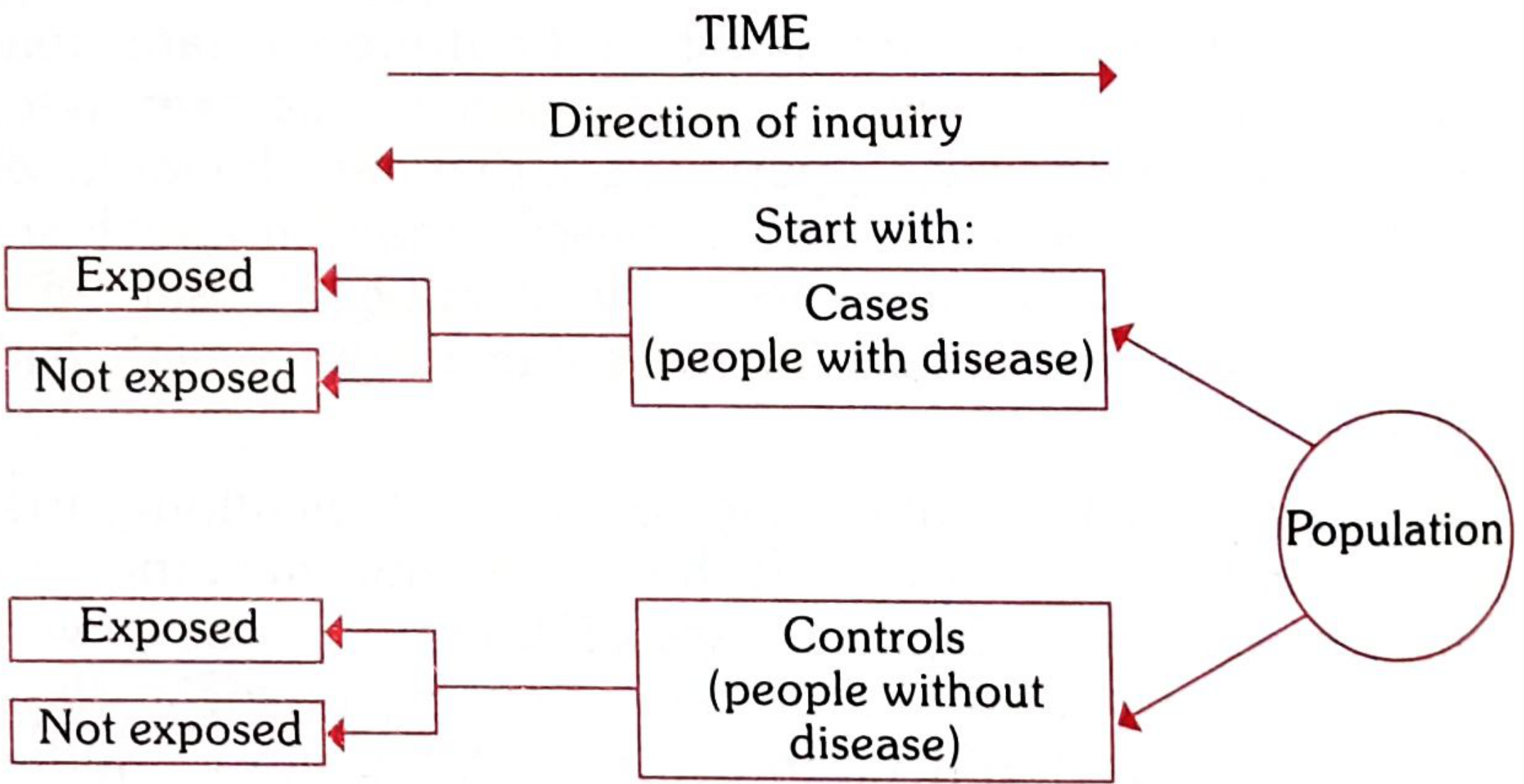
a) Case-Control Study (retrospective)
- Starts with cases (people who already have the disease) and controls (people without)
- Looks backwards in time to compare their exposure histories
- Direction of inquiry runs backward from effect to cause
- Quick, cheap, good for rare diseases
- Measures association using the Odds Ratio
b) Cohort Study (prospective)
- Starts with disease-free people, divides them into exposed and unexposed groups, then follows them forward in time
- Direction of inquiry runs forward from cause to effect
- Measures association using the Relative Risk
- More expensive and time-consuming but stronger evidence for causation
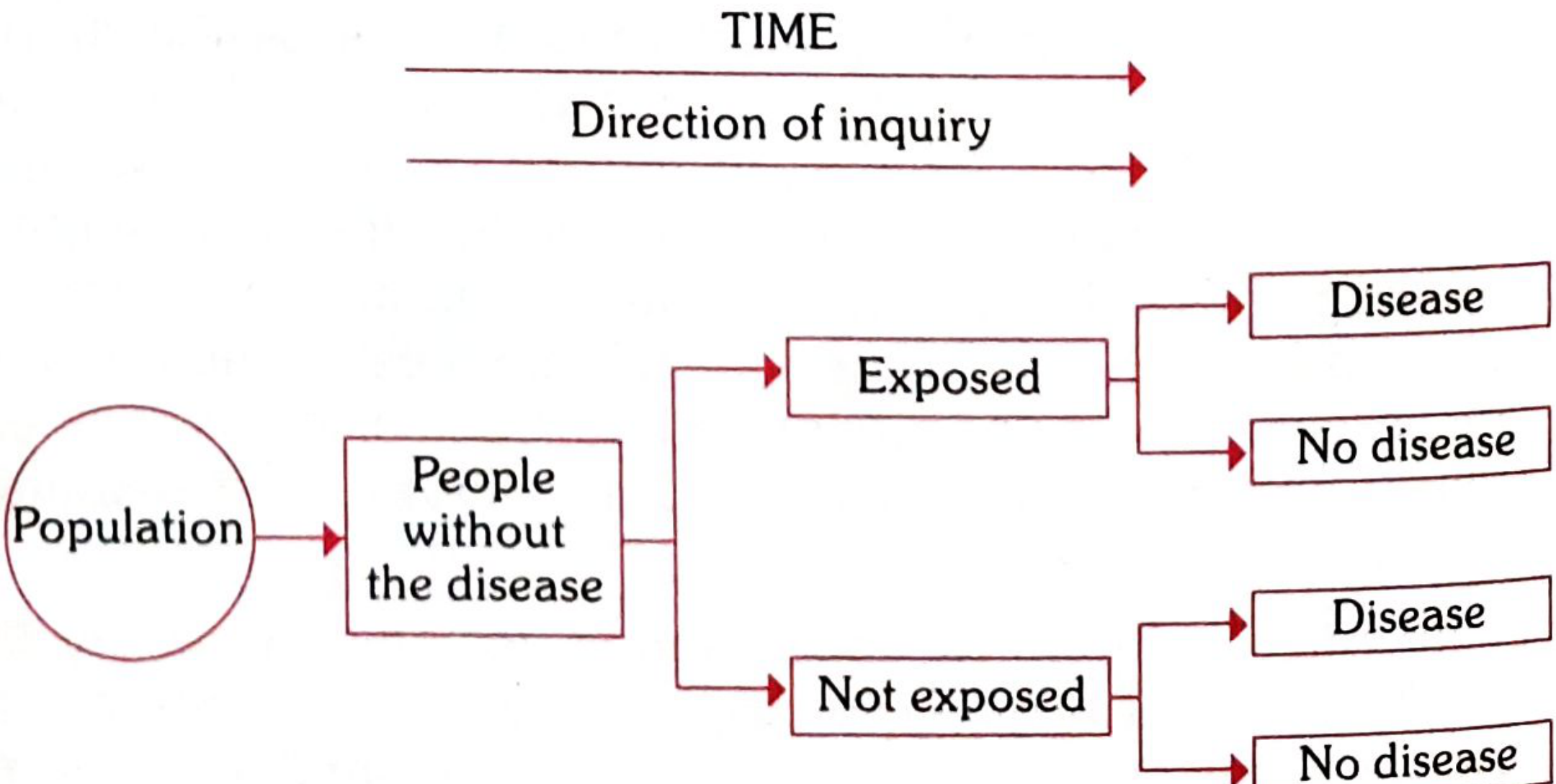
Source: Park's Textbook of Preventive and Social Medicine, p. 83
3. Experimental (Intervention) Epidemiology
The investigator actively manipulates exposure or treatment, rather than merely observing. Modern experimental epidemiology is largely synonymous with Randomized Controlled Trials (RCTs):
- An intervention is applied to the experimental group; the control group receives no change
- Results are compared to measure effectiveness
- Goals: prove aetiological factors, evaluate health service effectiveness
- Challenges: cost, ethics, feasibility
Animal studies also fall under this category and have been historically important (e.g., testing vaccines before human trials).
- Park's Textbook of Preventive and Social Medicine, p. 93
Descriptive Epidemiology: The "Person-Place-Time" Triad
| Variable | Examples |
|---|---|
| Person | Age, sex, race, occupation, socioeconomic status, behaviour |
| Place | Country, urban vs. rural, geographic clustering |
| Time | Secular trends, seasonal patterns, point-source epidemics |
Epidemiology vs. Clinical Medicine
| Feature | Clinical Medicine | Epidemiology |
|---|---|---|
| Unit of study | Individual patient | Defined population |
| Goal | Diagnose and treat | Identify causes and control disease |
| Method | Biomedical examination | Rates, surveys, statistical analysis |
| Subject matter | "Perceived" (labs, exams) | "Conceptual" (tables, graphs) |
| Who comes to whom | Patient comes to the doctor | Investigator goes to the community |
The two are complementary, not competing. Epidemiology cannot function without clinical definitions of disease, and clinical medicine is guided by epidemiological evidence.
Uses of Epidemiology in Practice
- Track historical disease trends and make projections
- Identify causes and risk factors of disease
- Describe the natural history of a disease
- Compare effectiveness of treatments and preventive interventions
- Evaluate the impact of health services and inform policy
- Differentiate natural disease occurrence from intentional events (e.g., bioterrorism)
- Prioritize public health interventions
Causation vs. Association
Epidemiology establishes associations between exposures and outcomes. Not every association is causal. The classic framework for judging causality is Bradford Hill's criteria (1965), which includes: strength of association, consistency, specificity, temporal relationship, biological gradient (dose-response), plausibility, coherence, experiment, and analogy.
A relative risk of 1.0 means no difference between groups. RR > 1 means increased risk with exposure; RR < 1 means protective effect.
Epidemiology is the scientific foundation on which public health decisions rest - from vaccine schedules and screening programmes to smoking bans and pandemic responses.
This is a shared conversation. Sign in to Orris to start your own chat.