
From Guyton and Hall textbook of medical physiology, 4th South Asia edition, write a 10 mark LONG ANSWER of -.Menstrual Cycle-phases, hormonal control
Reading File
Finding Sources
Finding Sources
Finding Sources
Finding Sources
Finding Sources
Reading File
Reading File
Reading File
Reading File
Reading File
Reading File
Reading File
Finding Sources
Reading File
Reading File
Loading Image
Loading Image
I now have all the content needed from Guyton and Hall to write a comprehensive 10-mark long answer. Let me compose it.
THE MENSTRUAL CYCLE - PHASES AND HORMONAL CONTROL
(10 Marks Long Answer - Based on Guyton and Hall Textbook of Medical Physiology, 4th South Asia Edition)
INTRODUCTION
The female monthly sexual cycle (commonly called the menstrual cycle) is a rhythmic, self-regulating cycle of hormonal and structural changes in the ovaries and uterus that repeats approximately every 28 days (range: 20-45 days). It has two major objectives: (1) release of a single ovum from the ovaries each month, and (2) preparation of the uterine endometrium for implantation of the fertilized ovum.
The cycle involves a three-tier hormonal hierarchy:
- Hypothalamic GnRH (gonadotropin-releasing hormone)
- Anterior pituitary hormones - FSH (follicle-stimulating hormone) and LH (luteinizing hormone)
- Ovarian hormones - estrogen (estradiol) and progesterone
THE OVARIAN CYCLE
The ovarian cycle has two phases separated by ovulation on day 14.
PHASE 1: FOLLICULAR PHASE (Days 1-13)
Follicular Growth:
At birth, each ovum is surrounded by a single layer of granulosa cells, forming the primordial follicle. An oocyte maturation inhibiting factor keeps the ovum in suspended prophase of meiosis. At puberty, rising FSH and LH trigger follicular growth.
At the beginning of each cycle, slightly rising FSH (with a lesser rise in LH) stimulates 6 to 12 primary follicles to begin accelerated growth. FSH drives rapid proliferation of granulosa cells. Concurrently, stromal cells form the theca around the granulosa layer - the theca interna secretes sex steroids (estrogen, progesterone), while the theca externa becomes a vascular connective tissue capsule.
The granulosa cells secrete follicular fluid rich in estrogen, forming a fluid-filled cavity called the antrum - these are now called antral (vesicular) follicles. Three amplifying mechanisms then drive further growth:
- Estrogen stimulates more FSH receptors on granulosa cells (positive feedback within follicle)
- FSH + estrogen together promote LH receptors on granulosa cells, adding LH stimulation
- LH acts on theca cells to stimulate androgen secretion, which is converted to estrogen by granulosa cells (two-cell, two-gonadotropin theory)
Follicle Selection - "Dominant Follicle": Normally one follicle grows faster than the others due to greater estrogen accumulation. The rising local estrogen further sensitizes it to FSH/LH, creating a positive intra-follicular feedback loop. The remaining follicles undergo atresia (degeneration) due to insufficient gonadotropin stimulation. The dominant follicle grows to 1.0-1.5 cm diameter just before ovulation - the Graafian (mature) follicle.
Estrogen secretion rises progressively during the follicular phase, peaking just before ovulation. This rising estrogen:
- Exerts negative feedback on FSH/LH during most of the follicular phase (keeping other follicles in check)
- Switches to positive feedback (preovulatory LH surge trigger) when it exceeds a critical threshold near day 12-13
OVULATION (Day 14)
About 2 days before ovulation, LH secretion increases 6-fold to 10-fold (the preovulatory LH surge), peaking ~16 hours before ovulation. FSH also rises 2-3 fold simultaneously.
Mechanism of ovulation:
- LH causes granulosa and theca cells to shift from estrogen to progesterone secretion - estrogen levels thus fall just before ovulation while progesterone begins to rise.
- LH triggers follicular cells to release proteolytic enzymes from lysosomes, which digest the follicular capsule wall, causing degeneration of the stigma (a nipple-like protrusion on the follicular surface).
- LH stimulates prostaglandin secretion, causing local vasodilation, plasma transudation into the follicle, and swelling.
- The stigma ruptures widely, releasing the viscous follicular fluid along with the ovum surrounded by the corona radiata (thousands of granulosa cells).
Without the preovulatory LH surge, ovulation does not occur.
PHASE 2: LUTEAL PHASE (Days 15-28)
After ovulation, the remaining granulosa and theca cells of the ruptured follicle undergo luteinization under continued LH influence - they enlarge, accumulate lipid droplets, and turn yellowish due to lutein pigment. This forms the corpus luteum.
The corpus luteum begins secreting large quantities of progesterone and estrogen (progesterone dominates). These reach peak levels about 1 week after ovulation (~day 21).
Involution of the corpus luteum: The high levels of progesterone + estrogen exert strong negative feedback on the anterior pituitary, suppressing FSH and LH to their lowest levels. Additionally, the corpus luteum secretes inhibin, which further suppresses FSH. This fall in gonadotropins deprives the corpus luteum of its trophic support, and by the 26th day, the corpus luteum degenerates completely - involution of the corpus luteum.
The sudden fall in estrogen, progesterone, and inhibin removes negative feedback, and FSH/LH begin rising again - initiating a new follicular phase. The fall in progesterone and estrogen also causes menstruation (see below).
The corpus luteum has a fixed lifespan of ~12 days regardless of cycle events.
THE ENDOMETRIAL (UTERINE) CYCLE
Running in parallel with the ovarian cycle, the endometrium passes through three phases:
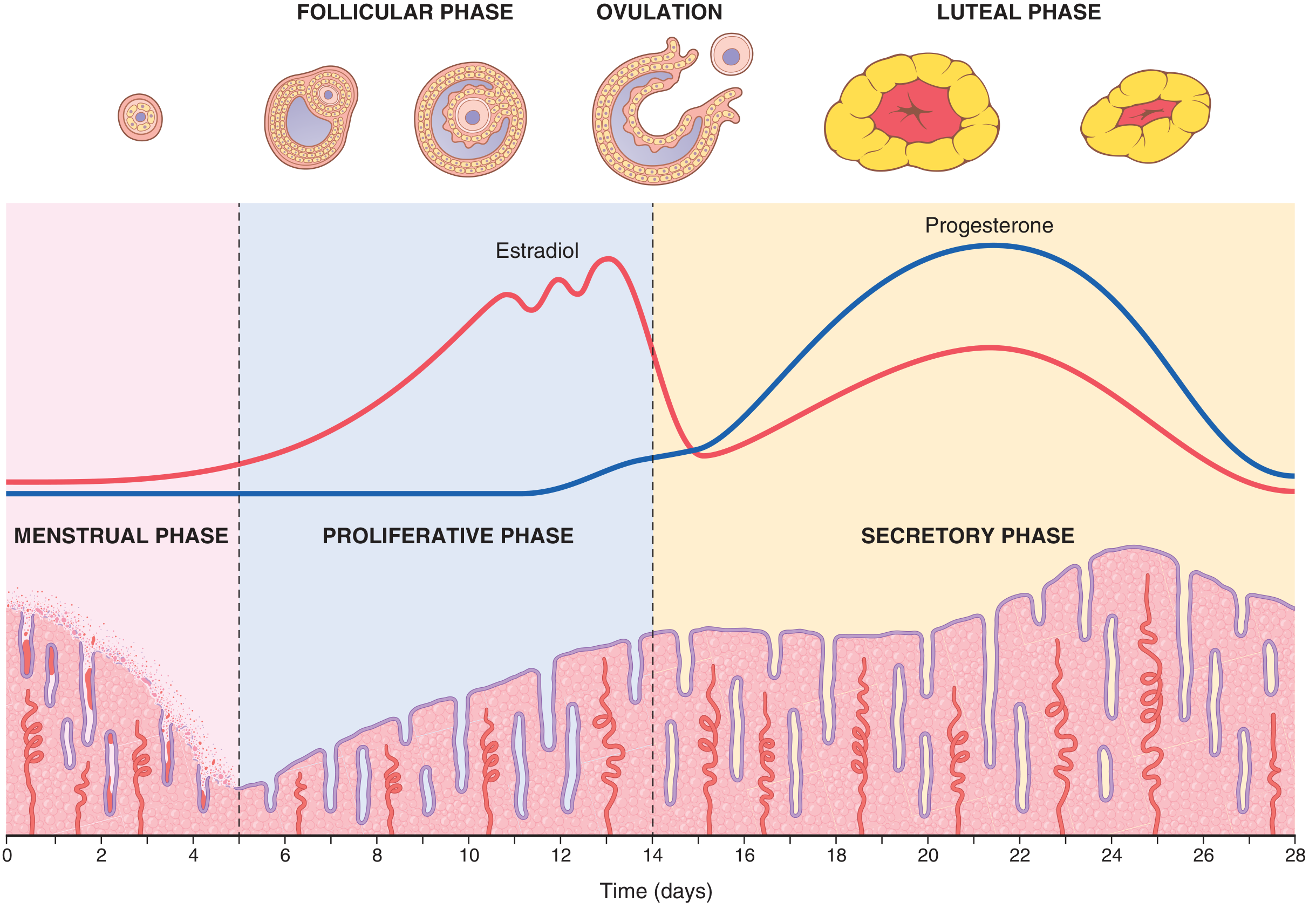
1. Menstrual Phase (Days 1-5)
This is the visible shedding of the endometrium with which the calendar cycle begins. The sudden withdrawal of estrogen and progesterone (due to corpus luteum involution) causes vasospasm of the spiral arteries supplying the endometrium. Ischemia leads to necrosis and desquamation of the functional layer of the endometrium, with ~40-200 mL of blood + tissue fluid + mucus lost over 4-5 days.
Blood coagulation is prevented locally by fibrinolysin released from the endometrial tissue. By day 4-7, the endometrium begins reepithelialization.
Notably, large numbers of leukocytes are released during menstruation, making the uterus highly resistant to infection despite the denuded endometrial surface.
2. Proliferative Phase / Estrogen Phase (Days 5-14)
Under the influence of rising estrogen from growing ovarian follicles, the endometrium rebuilds from the remaining deep glands and crypts. Key changes:
- Stromal cells and epithelial cells proliferate rapidly
- Endometrial thickness increases from ~0.5 mm to 3-5 mm by the time of ovulation
- Endometrial glands grow and elongate; cervical glands secrete thin, stringy mucus that aligns in the cervical canal to guide sperm toward the uterine cavity
- New blood vessels grow into the endometrium
3. Secretory Phase / Progestational Phase (Days 15-28)
After ovulation, both progesterone and estrogen (from the corpus luteum) act on the endometrium:
- Estrogen causes slight additional proliferation
- Progesterone causes marked swelling, tortuosity of glands, and secretory development
- Glands become highly tortuous and packed with secretory substances
- Stromal cells accumulate lipid and glycogen
- Blood vessels become tortuous (spiral arteries develop)
- Endometrial thickness reaches 5-6 mm at the secretory peak (~day 21)
The secretions ("uterine milk") provide nutrition to the early dividing ovum from when it enters the uterine cavity (~day 17-18) until implantation (~day 21-23). If the ovum does not implant, the corpus luteum degenerates, progesterone and estrogen fall, and menstruation follows.
HORMONAL CONTROL - THE HYPOTHALAMIC-PITUITARY-OVARIAN AXIS
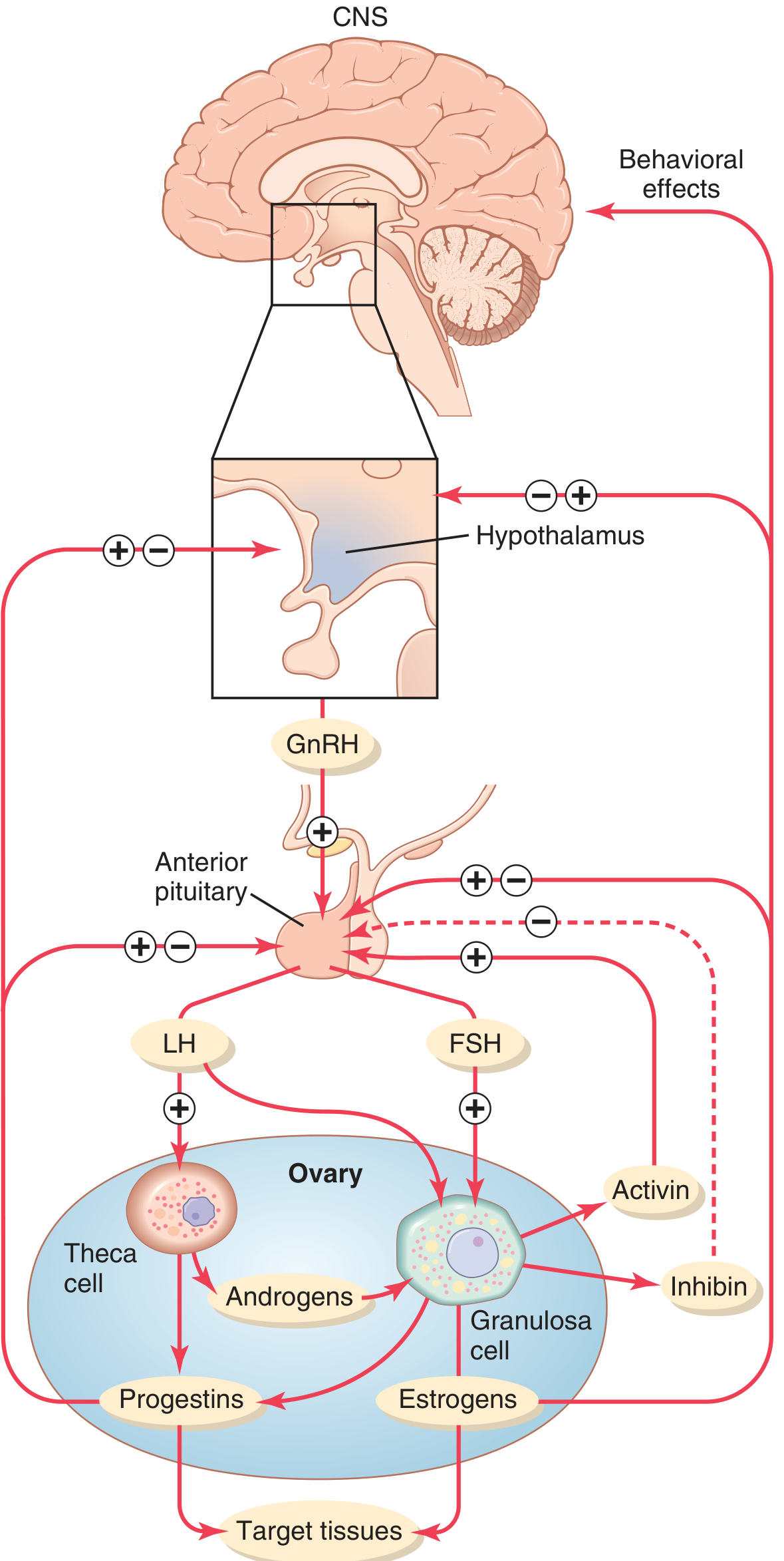
GnRH - The Master Regulator
GnRH is a decapeptide (Glu-His-Trp-Ser-Tyr-Gly-Leu-Arg-Pro-Gly-NH2) secreted in intermittent pulses every 1-2 hours from GnRH neurons in the arcuate nuclei, paraventricular nuclei, and infundibulum of the hypothalamus. Pulsatile secretion is essential - continuous GnRH infusion abolishes LH/FSH release. A GnRH pulse generator driven by KNDy-kisspeptin neurons projecting to GnRH neurons maintains this pulsatility.
Feedback Oscillation - The 3-Event Sequence
Event 1 - Postovulatory negative feedback (Luteal phase):
The corpus luteum secretes high progesterone + estrogen + inhibin → combined strong negative feedback on anterior pituitary → FSH and LH suppressed to lowest levels → corpus luteum deprived of support → degenerates by day 26.
Event 2 - Rebound rise of FSH/LH (Start of new cycle):
Fall in corpus luteum hormones removes negative feedback → FSH and LH rise again → new follicles begin growing → estrogen begins rising.
Event 3 - Positive feedback preovulatory LH surge:
When rising estrogen exceeds a critical level for 2-3 continuous days (~days 12-13), it switches from negative to positive feedback on the anterior pituitary, causing an abrupt 6-8 fold surge in LH and a 2-fold surge in FSH. This triggers ovulation. The granulosa cells also begin secreting small amounts of progesterone just before the LH surge, which may contribute to triggering it.
Role of Inhibin and Activin
- Inhibin (secreted by corpus luteum's lutein cells and granulosa cells): specifically suppresses FSH secretion from anterior pituitary - important for follicle selection (dominant follicle continues growing while others are deprived of FSH)
- Activin: has the opposite effect - stimulates FSH secretion
Summary of Hormonal Concentrations Across the Cycle
| Phase | FSH | LH | Estrogen | Progesterone |
|---|---|---|---|---|
| Early follicular (day 1-5) | Rising (↑) | Low | Low | Low |
| Late follicular (day 6-13) | Falling slightly | Low-moderate | Rising (↑↑) | Low |
| Mid-cycle surge (day 13-14) | 2× spike | 6-10× spike | Peak then falls | Starts rising |
| Luteal (day 15-26) | Low (inhibited) | Low (inhibited) | Moderate (↑) | Peak (↑↑) |
| Late luteal (day 27-28) | Rising again | Rising again | Falling (↓) | Falling (↓) |
ANOVULATORY CYCLES
If the preovulatory LH surge is insufficient in magnitude, ovulation does not occur - the cycle is anovulatory. This results in:
- No corpus luteum formation → virtually no progesterone secretion in the second half of the cycle
- The cycle shortens by several days
- Menstruation still occurs (driven by estrogen withdrawal)
The first few cycles after puberty and cycles near menopause are commonly anovulatory.
SUMMARY TABLE
| Cycle Component | Days | Ovarian Event | Uterine Event | Dominant Hormone |
|---|---|---|---|---|
| Menstrual phase | 1-5 | Follicle begins growing | Desquamation + bleeding | FSH rising; E+P low |
| Proliferative phase | 6-14 | Follicular growth, maturation | Endometrial proliferation | Estrogen (FSH-driven) |
| Ovulation | ~14 | Follicle rupture, ovum released | Cervical mucus peaks | LH surge |
| Secretory phase | 15-28 | Corpus luteum active | Secretory development, 5-6 mm thick | Progesterone + Estrogen |
| Premenstrual | 27-28 | CL involution | Spiral artery spasm begins | All hormones fall |
CLINICAL SIGNIFICANCE
- Oral contraceptives work by supplying exogenous estrogen + progesterone to suppress FSH/LH via negative feedback, preventing the LH surge and thus ovulation.
- Polycystic ovarian syndrome (PCOS) involves failure of dominant follicle selection, with multiple cystic follicles persisting.
- Menopause results from ovarian follicle depletion → no estrogen feedback → massive rise in FSH and LH (especially FSH).
- Luteal phase deficiency - inadequate progesterone from a defective corpus luteum - impairs endometrial preparation and is a cause of early pregnancy loss.
Source: Guyton and Hall Textbook of Medical Physiology, 4th South Asia Edition - Chapter 82 (Female Physiology Before Pregnancy and the Female Hormones)
This is a shared conversation. Sign in to Orris to start your own chat.