
Radiation from chapter environment from Park textbook of spm
Reading File
Searching sources...
Finding Sources
Finding Sources
Finding Sources
Reading File
Reading File
Reading File
Reading File
Reading File
Reading File
Now I have all the content from Park's textbook. Let me also fetch the diagram image mentioned in the text.
Loading Image
Here is the complete chapter on Radiation from the Environment section of Park's Textbook of Preventive and Social Medicine (SPM):
RADIATION
(Park's Textbook of Preventive and Social Medicine)
1. Sources of Radiation Exposure
Radiation is part of man's environment. Sources are divided into two groups:
A. Natural Sources
(a) Cosmic Rays
- Originate in outer space; weakened as they pass through the atmosphere
- At ordinary living altitudes: ~35 mrad/year
- A commercial jet pilot receives ~300 mrad/year from cosmic radiation
- Above 20 km, cosmic radiation becomes important
(b) Environmental
- Terrestrial radiation: Radioactive elements (thorium, uranium, radium, K⁴⁰) present in soil, rocks, buildings - ~50 mrad/year
- In Kerala (India), rock formations with uranium can deliver up to 2,000 mrad/year
- Atmospheric radiation: Radioactive gases radon and thoron - ~2 mrad/year (small)
(c) Internal Radiation
- Radioactive matter stored in body tissues: uranium, thorium, K⁴⁰, Sr⁹⁰, C¹⁴
- Inflicts ~25 mrad/year (may be as high as 70-80 mrad/year)
- Total natural radiation: ~0.1 rad/year for the average person
B. Man-Made Sources
| Natural | Man-Made |
|---|---|
| Cosmic rays | Medical and dental: X-rays, Radioisotopes |
| Terrestrial | Occupational exposure |
| Atmospheric | Nuclear: radioactive fall-out |
| Internal (K⁴⁰, C¹⁴) | Miscellaneous: TV sets, radio-active dial watches, luminous markers |
(a) X-rays - Greatest man-made source for the general population
- Skin dose from a single X-ray film: 0.02 to 3.0 rad
(b) Radioactive Fallout
- Nuclear explosions release important isotopes: C¹⁴, I¹³¹, Cs¹³⁷, Sr⁹⁰
- Cs¹³⁷ and Sr⁹⁰ are most important (released in large amounts, remain radioactive for years)
- Half-life of Sr⁹⁰: ~28 years; Cs¹³⁷: ~30 years
(c) Miscellaneous - TV sets, luminous wrist watches (currently too small to be important)
2. Types of Radiation
Ionizing radiation - has the ability to penetrate tissues and deposit energy within them. Divided into:
- Electromagnetic radiations - X-rays and gamma rays
- Corpuscular radiations - alpha particles, beta particles (electrons), protons
Non-ionizing radiation - electromagnetic radiation of wavelengths longer than ionizing radiation (less energy)
Penetrating Ability of Common Environmental Radiations
| Type | Air | Tissue | Lead |
|---|---|---|---|
| Alpha particles | 4 cm | 0.05 mm | 0 |
| Beta particles | 6-300 cm | 0.06-4.0 mm | 0.005-0.3 mm |
| Gamma rays | 400 metres | 50 cm | 40 mm |
| X-rays | 120-240 metres | 15-30 cm | 0.3 mm |
| Cosmic rays | - | Some components very high | - |
Key points:
- Alpha particles are 10 times as harmful as X-rays, beta particles, or gamma rays
- Alpha particles have little penetrating force, but dangerous if inhaled or ingested
- Gamma rays and X-rays have short wavelengths - deep penetrating radiations
- X-rays are man-made; gamma rays are emitted spontaneously by radioactive elements during disintegration
- No material difference between gamma rays and X-rays otherwise
3. Radiation Units
Activity:
- Becquerel (Bq) = 1 disintegration per second (SI unit)
- Old unit: Curie (Ci); 1 Bq ≈ 27 picocuries
Potency is measured in three ways:
| Old Unit | SI Unit | Measures |
|---|---|---|
| Roentgen | Coulomb/kg (C/kg) | Exposure (ions in 1 ml air); 1 R = 2.58 × 10⁻⁴ C/kg |
| Rad | Gray (Gy) | Absorbed dose (energy/gram tissue); 1 rad = 0.01 Gy |
| Rem | Sievert (Sv) | Dose equivalent (potential danger); 1 Sv = 100 rem |
Dose Equivalent (H):
H = D × Q
- H = dose equivalent (Sieverts)
- D = absorbed dose (Grays)
- Q = quality factor (depends on ionization density in tissue)
- Q for X-rays, gamma rays, electrons = 1
- Q for alpha particles = 20
4. Biological Effects of Radiation
Two categories:
- High dose / Short-term - acute effects (cell killing, organ damage)
- Low dose over extended period - chronic/long-term effects
Effects are Somatic or Genetic:
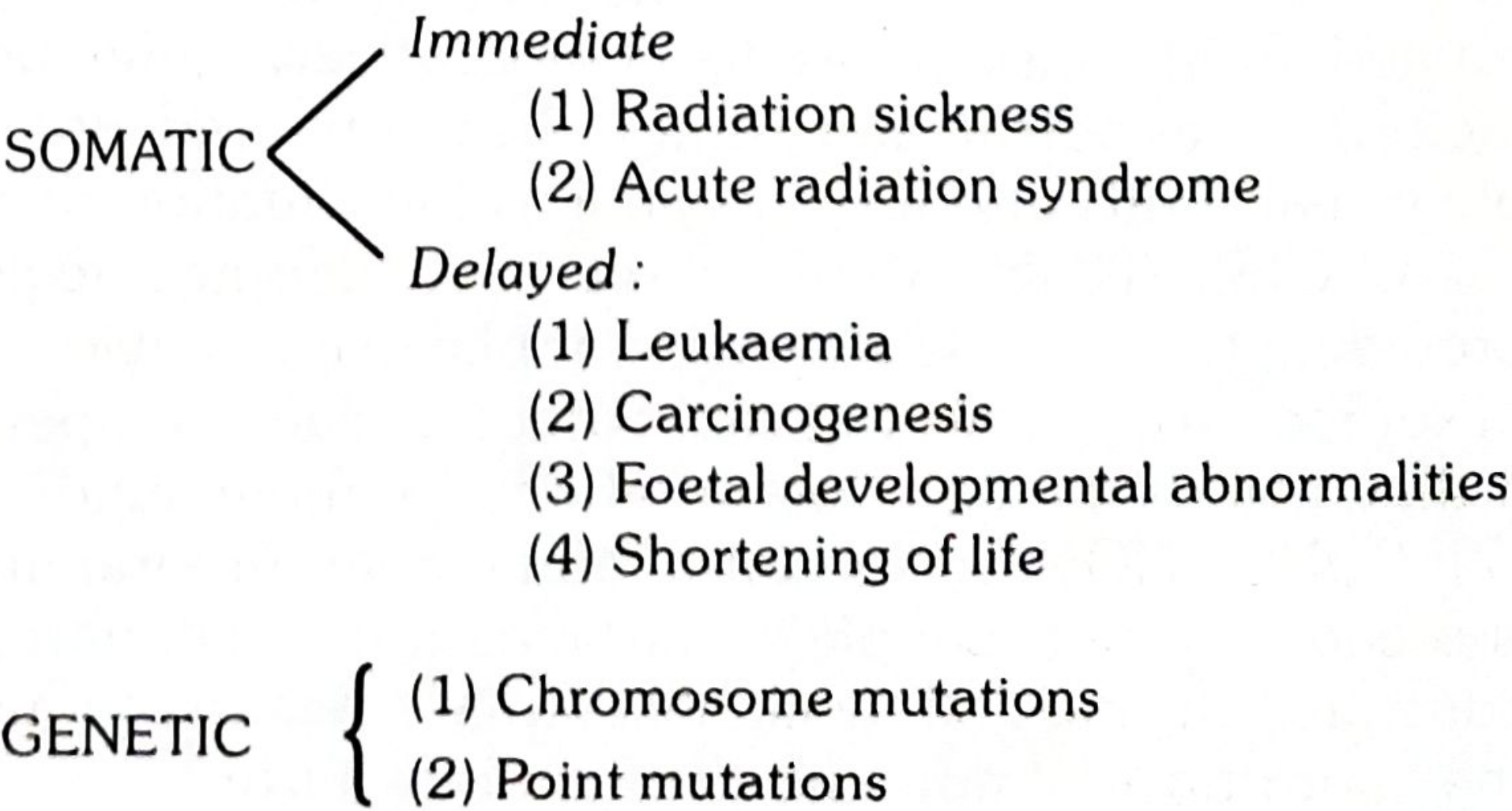
Dose-Response Relationship (High Dose):
| Dose | Effect |
|---|---|
| < 5 rad | No immediate observable effects |
| 5-50 rad | Slight blood changes detectable on medical evaluation |
| 50-150 rad | Blood changes noted; nausea, fatigue, vomiting likely |
| 150-1,100 rad | Severe blood changes; symptoms appear immediately. At 300-500 rad, up to half the people die within 60 days without intensive care. Death due to destruction of blood-forming organs (bone marrow). |
| 1,100-2,000 rad | 100% probability of death within 1-2 weeks. GI system destroyed; once this fails, nothing can be done. |
| >2,000 rad | Death certain. Above 5,000 rad, CNS (brain and muscles) can no longer control body functions. |
Somatic effects:
- Immediate: Radiation sickness, Acute radiation syndrome
- Delayed: Leukaemia, Carcinogenesis, Foetal developmental abnormalities, Shortening of life
Genetic effects (manifest in offspring):
- Chromosome mutations (associated with sterility)
- Point mutations (affect genes)
5. Radiation Protection
- Natural background radiation: ~0.1 rad/year - no current hazard
- Permissible additional dose from man-made sources: should not exceed 5 rad/year
- X-rays constitute the greatest man-made hazard
- In routine fluoroscopy, 4 rad is delivered to a body part in ~1 minute
Protective Measures:
- Avoid unnecessary X-ray examinations, especially in children and pregnant women
- Adequate control and surveillance of X-ray installations
- Lead shields and lead rubber aprons (0.5 mm lead reduces scattered X-rays by over 90%)
- Workers must wear a film badge or dosimeter (shows accumulated radiation exposure)
- Periodic medical examinations, regular working hours, recreation, and holidays for workers
International Recommendations:
- ICRP, IAEA, WHO are active in setting standards
- ICRP recommendation: genetic dose to whole population from all additional sources should not exceed 5 rems over 30 years
- WHO has published permissible radiation levels in drinking water
- This field is called Radiation Hygiene - the youngest branch of hygiene
6. Radiation Hazards (Occupational - from Chapter on Occupational Health)
Industries at risk: radium painting, luminous dial manufacture, radioactive ore mining (monazite sand), medical/industrial X-ray, arc welding (UV rays), glass blowing and foundry work (infrared rays)
Effects of Occupational Radiation Exposure:
- Acute: Burns, dermatitis, blood dyscrasias
- Chronic: Malignancies, genetic effects
- Lung cancer in uranium mine workers (radioactive dust inhalation)
Preventive Measures (Occupational):
- Avoid inhalation, swallowing, or direct skin contact
- X-ray shielding of adequate thickness and material
- Employee monitoring every 6 months with film badge or pocket electrometer
- Protective clothing to prevent contact
- Adequate ventilation of workplace
- Medical examination of workers every 2 months; if harmful effects found, transfer to non-radiation work
- Pregnant women should not work where there is continuous radiation exposure
Park's Textbook of Preventive and Social Medicine, pp. 844-847
This is a shared conversation. Sign in to Orris to start your own chat.