
Psvt
I'll look up PSVT (Paroxysmal Supraventricular Tachycardia) from the medical library for you.
Searching sources...
Reading File
Finding Sources
Searching PubMed
"paroxysmal supraventricular tachycardia" management
Reading File
Reading File
Reading File
Finding Sources
Loading Image
Reading File
Reading File
Loading Image
Here is a comprehensive overview of PSVT from multiple authoritative textbooks:
Paroxysmal Supraventricular Tachycardia (PSVT)
Definition
PSVT is a clinical syndrome characterized by a rapid, regular tachycardia with abrupt onset and termination. It encompasses all tachyarrhythmias that originate from or incorporate supraventricular tissue (above the bundle of His) in a reentrant circuit.
- Fuster and Hurst's The Heart, 15th Edition
Mechanisms / Types
| Type | Frequency |
|---|---|
| AV Nodal Reentrant Tachycardia (AVNRT) | ~65-80% of cases |
| AV Reentrant Tachycardia (AVRT) via accessory pathway (e.g., WPW) | ~15-30% |
| Atrial tachycardia (ectopic atrial focus) | ~5% |
- AVNRT: Reentry within the AV node using a slow and fast pathway. The most common mechanism.
- AVRT (orthodromic): Antegrade conduction via the AV node; retrograde via an accessory pathway - produces narrow QRS.
- AVRT (antidromic): Antegrade via accessory pathway - produces wide QRS (preexcited tachycardia).
- Harrison's 22E; Fuster and Hurst's The Heart
Epidemiology
- Incidence ~35 cases per 100,000 person-years; prevalence ~2.25 per 1,000
- More frequent in females (2:1 ratio for AVNRT)
- Peak onset in late teenage and young adult years (emergency medicine) or beyond the 4th decade for AVNRT specifically
- Majority of patients have no active cardiovascular disease
- Fuster and Hurst's The Heart; Tintinalli's Emergency Medicine
ECG Features
ECG of PSVT - regular narrow-complex tachycardia:

Key ECG findings (from Tintinalli's Emergency Medicine):
- Absence of normal sinus P waves (no normal P wave with normal PR interval)
- Narrow QRS complex (<100 ms) - unless aberrant conduction
- Rate: typically 170-180 bpm; range 130-300 bpm
- P waves buried within the QRS in ~70% of cases
- Retrograde P waves (inverted, immediately adjacent to QRS) in ~30%
- Regular rhythm
Clinical Presentation
- Palpitations (most common), lightheadedness, dyspnea
- Abrupt onset and termination - patients can often identify the exact moment it starts and stops
- Usually hemodynamically stable, but can cause presyncope/syncope
- Associated with WPW syndrome in some cases (up to 50% of WPW patients develop paroxysmal tachyarrhythmias)
Acute Management
Treatment algorithm:
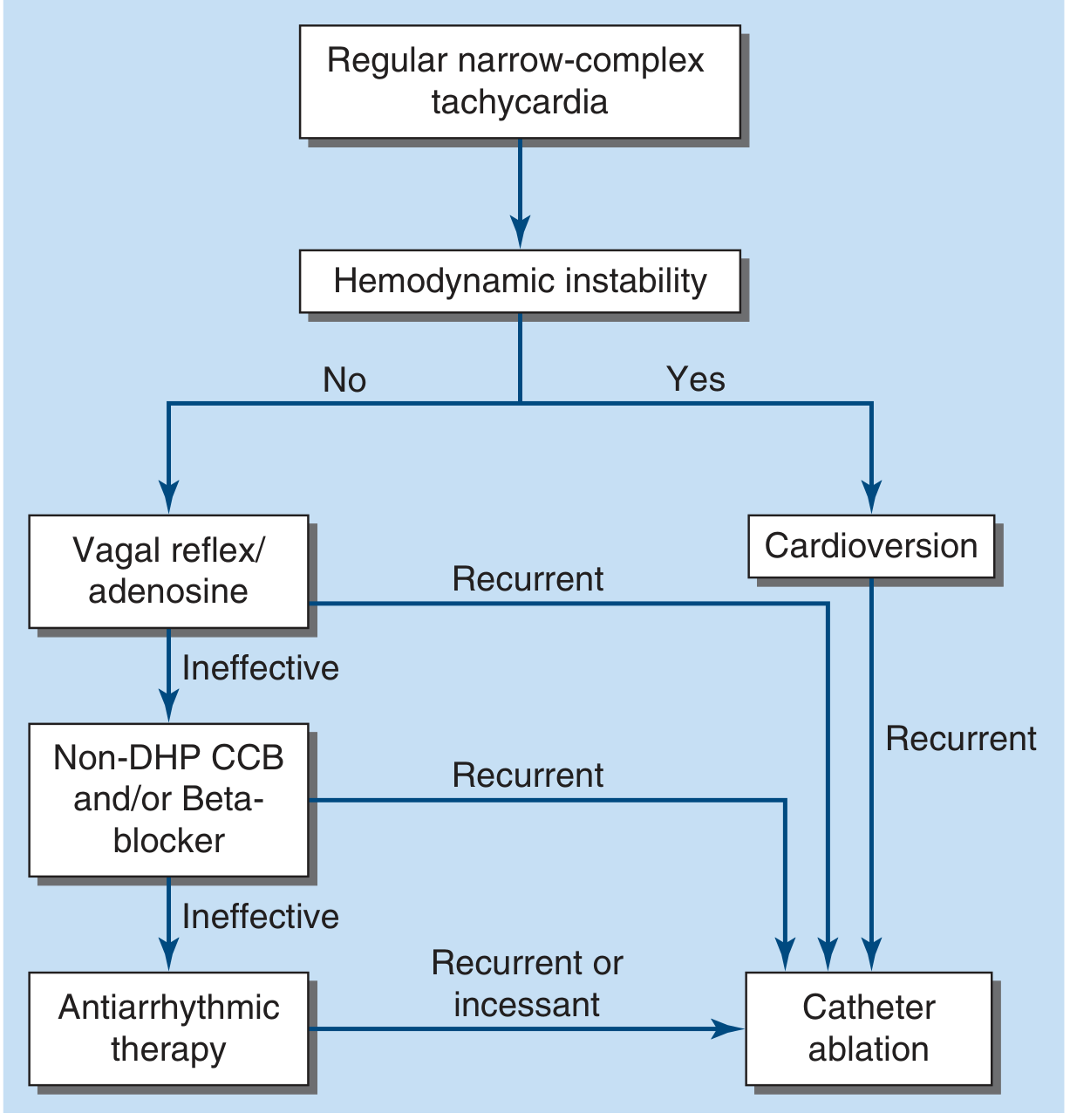
Step 1: Assess hemodynamic stability
- Unstable (hypotension, unconsciousness, respiratory distress): Synchronized DC cardioversion immediately
- For PSVT/atrial flutter: initial energy 50-100 J
Step 2: Stable patient - Vagal Maneuvers
- Carotid sinus massage - only if no carotid bruits or prior stroke history
- Valsalva maneuver - effective and patient can be taught self-administration
- Apply early in the dysrhythmia for best results
Step 3: IV Adenosine (first-line drug)
- Terminates the vast majority of PSVT by transiently blocking AV nodal conduction
- Side effects: transient chest pain, dyspnea, anxiety (very short half-life ~10 sec)
- Contraindicated in prior cardiac transplant (hypersensitivity due to denervation)
- Use caution in WPW - adenosine can precipitate AF in up to 15% of patients, which may cause hemodynamic instability in WPW
- Use caution in asthma/bronchospasm
Step 4: If adenosine fails - AV nodal blocking agents
- IV beta-blockers or non-DHP calcium channel blockers (verapamil, diltiazem)
- Effective but may cause hypotension; longer duration of action
- Can also be given orally on an as-needed basis ("pill in pocket") combined with Valsalva
Wide-Complex PSVT
- Differential: ventricular tachycardia (VT), PSVT with bundle branch block aberrancy, preexcited tachycardia
- Default: treat as VT until proven otherwise
- If regular, patient stable, trial of IV adenosine is reasonable
- Very irregular wide-complex tachycardia = likely preexcited AF/flutter → manage with cardioversion, IV procainamide, or ibutilide
- Harrison's 22E
Long-Term / Chronic Management
- Most patients with recurrent PSVT are candidates for catheter ablation
- Success rates very high (>95% for AVNRT)
- Antiarrhythmic drug therapy for patients unwilling or unsuitable for ablation
- Harrison's 22E; Fuster and Hurst's The Heart
Summary Table
| Feature | PSVT |
|---|---|
| Rate | 130-300 bpm (typically ~170-180) |
| Rhythm | Regular |
| QRS | Narrow (<100 ms); wide if aberrancy or preexcitation |
| P waves | Buried or retrograde |
| Onset/offset | Abrupt |
| Most common mechanism | AVNRT (65-80%) |
| First-line acute Rx | Vagal maneuvers → Adenosine |
| Unstable Rx | Synchronized cardioversion |
| Long-term Rx | Catheter ablation |
Sources: Harrison's Principles of Internal Medicine 22E (2025) | Tintinalli's Emergency Medicine | Fuster and Hurst's The Heart, 15th Ed. | Medical Physiology (Boron & Boulpaep)
This is a shared conversation. Sign in to Orris to start your own chat.