
how to have good sex
Here are some evidence-based principles for a satisfying sexual experience:
Communication
- Talk openly with your partner about desires, boundaries, and what feels good
- Check in during sex - verbal and non-verbal feedback matters
- Discuss contraception and STI prevention beforehand
Physical factors
- Prioritize foreplay - arousal takes longer for many people, especially women
- Explore different types of stimulation (not just penetration)
- Pay attention to your partner's responses and adjust accordingly
- Lubrication reduces discomfort and increases pleasure for all genders
Emotional connection
- Feeling safe and comfortable with your partner significantly improves experience
- Reduce performance anxiety - sex isn't a performance, it's shared experience
- Be present; minimize distractions
Health basics
- Regular exercise improves cardiovascular function, stamina, and body image
- Adequate sleep and stress management affect libido and performance
- Limit alcohol - small amounts may reduce inhibition, but more impairs function
For specific concerns
- Pain during sex (dyspareunia) warrants a doctor visit - it's common and treatable
- Erectile dysfunction or low libido can have medical causes worth investigating
- A sex therapist or couples counselor can help with relational or psychological factors
Consent
- Enthusiastic, ongoing consent from all parties is non-negotiable
The most consistent finding in sexual health research is that open communication with a partner is the single strongest predictor of sexual satisfaction. There's no universal template - what works is what both partners enjoy and feel comfortable with.
Plasmodium for 2 nd bds microbiology
This is a medical/microbiology question. Let me read the medical library skill first, then search for comprehensive Plasmodium content.
Reading File
Now let me search for Plasmodium content in the library simultaneously:
Finding Sources
Finding Sources
Excellent! Found great sources. Let me read the microbiology textbook (Sherris & Ryan's) and the Henry's Clinical Diagnosis section in parallel:
Reading File
Reading File
Now let me read more detailed content from Sherris Ryan's microbiology - the life cycle and morphology sections:
Reading File
Reading File
Let me now get the key life cycle section and morphology from Sherris Ryan's:
Reading File
I now have excellent content. Let me also fetch the apicomplexan cell diagram image:
Loading Image
Finding Sources
Now let me get the life cycle content from the microbiology book:
Reading File
I now have all the material I need for a comprehensive 2nd BDS microbiology answer on Plasmodium. Let me compile the full response.
Plasmodium - 2nd BDS Microbiology
Sources: Sherris & Ryan's Medical Microbiology, 8th Ed.; Henry's Clinical Diagnosis and Management by Laboratory Methods
1. Classification
| Feature | Detail |
|---|---|
| Kingdom | Protista |
| Phylum | Apicomplexa (obligate intracellular protozoa) |
| Class | Sporozoa |
| Genus | Plasmodium |
| Disease | Malaria |
The name "Apicomplexa" refers to the apical complex - a set of organelles (rhoptries, micronemes, polar ring, conoid, subpellicular microtubules) at the apical end of the parasite, used for penetrating host cells.
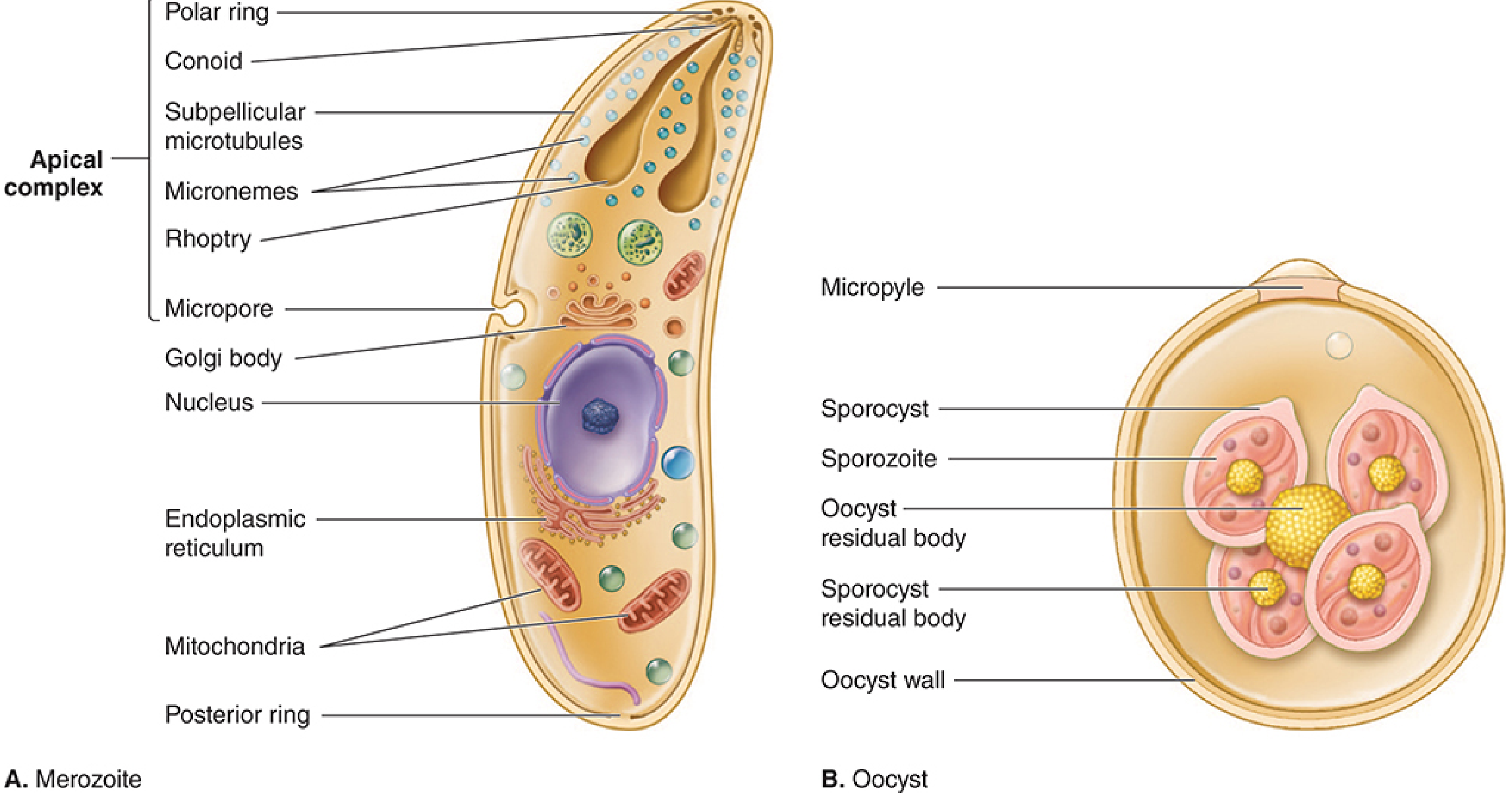
2. Species Causing Human Malaria (5 Species)
| Species | Fever Periodicity | RBCs Invaded | Unique Features |
|---|---|---|---|
| P. vivax | Tertian (every 48 hrs) | Reticulocytes only | Schüffner's dots; can relapse (hypnozoites) |
| P. falciparum | Malignant tertian (irregular/36-48 hrs) | All ages of RBCs | Most dangerous; cerebral malaria; no relapse |
| P. malariae | Quartan (every 72 hrs) | Senescent (old) RBCs | Recrudescence (not true relapse) |
| P. ovale | Tertian (48 hrs) | Reticulocytes | Schüffner's dots; can relapse; only species never introduced to Americas |
| P. knowlesi | 24-hr cycle | - | Zoonosis from Old World monkeys; SE Asia; life-threatening; microscopically resembles P. malariae |
3. Life Cycle
The life cycle alternates between two hosts:
- Definitive host (sexual phase): Female Anopheles mosquito
- Intermediate host (asexual phase): Humans
Phase 1 - In the Mosquito (Sexual/Sporogony)
- Mosquito ingests blood containing gametocytes
- In mosquito gut: gametocytes form male (microgamete) and female (macrogamete)
- Fertilization forms a zygote → motile ookinete
- Ookinete penetrates gut wall → oocyst
- Oocyst undergoes sporogony → thousands of sporozoites
- Sporozoites migrate to mosquito salivary glands - ready for transmission
Phase 2 - In Humans (Asexual)
A. Pre-erythrocytic (Hepatic/Exoerythrocytic) Cycle:
- Infected mosquito bites → injects sporozoites into bloodstream
- Sporozoites travel to liver and invade hepatocytes
- In liver: exoerythrocytic schizogony → hepatic schizont
- Schizont bursts → releases merozoites into blood
- Prepatent period (liver phase): Species-specific; no symptoms during this phase
Key note on relapse: P. vivax and P. ovale form dormant liver stages called hypnozoites that can reactivate months/years later causing true relapse. P. falciparum and P. malariae do NOT form hypnozoites.
B. Erythrocytic Cycle (causes symptoms):
- Merozoites enter RBCs → become ring-stage trophozoites
- Trophozoite → erythrocytic schizont (erythrocytic schizogony)
- Schizont matures → merozoites burst out of RBC (causing the fever paroxysm)
- Merozoites infect new RBCs → cycle repeats
- Some merozoites differentiate into gametocytes (sexual forms)
4. Fever Paroxysm
The malarial paroxysm is the hallmark clinical feature, caused by synchronous rupture of RBCs releasing merozoites. It has 3 stages:
- Cold stage - Shaking chills (15-60 min)
- Hot stage - High fever up to 40°C+ (2-6 hrs)
- Sweating stage - Profuse diaphoresis; fever breaks; exhaustion
The cycle repeats according to the erythrocytic cycle duration (48 hrs or 72 hrs), giving characteristic tertian or quartan periodicity.
5. Pathogenesis
RBC Invasion Specificity
- P. vivax & P. ovale invade only reticulocytes → limited parasitemia (1-2%)
- P. falciparum invades all RBCs → very high parasitemia → severe disease
- P. malariae invades only senescent RBCs
- Duffy blood group antigen (Fy^a, Fy^b) is the receptor for P. vivax - Duffy-negative individuals (most West Africans) are resistant to vivax malaria
- Glycoprotein A (sialoglycoprotein) is the RBC receptor for P. falciparum
RBC Changes
- P. vivax & P. ovale: produce Schüffner dots (caveolae-vesicle complexes visible in stained smears)
- P. falciparum: forms electron-dense knobs/excrescences on RBC surface → express PfEMP1 (P. falciparum Erythrocyte Membrane Protein 1) → binds endothelium of brain/placenta/organs → capillary obstruction and microinfarcts
Protective Hemoglobinopathies
| Genetic Factor | Protection Against | Mechanism |
|---|---|---|
| Sickle cell trait (HbAS) | P. falciparum | Parasite starves in sickling cells (reduced O2 tension); cells more susceptible to phagocytosis |
| Thalassemia | P. falciparum | Fetal Hb retards parasite maturation |
| G6PD deficiency | P. falciparum | Increased oxidant stress in RBCs |
| HbC, D, E | P. falciparum | Similar oxidant mechanisms |
6. Complications of P. falciparum (Malignant/Pernicious Malaria)
Complications occur when parasitemia exceeds 100,000 organisms/mm³:
| Complication | Features |
|---|---|
| Cerebral malaria | Delirium, convulsions, coma, paralysis; ~80% mortality if pulmonary involvement |
| Acute pulmonary insufficiency | Frequently accompanies cerebral malaria |
| Acute renal failure | Blackwater fever (massive hemolysis + hemoglobinuria) |
| Jaundice | Hemolytic |
| Splanchnic involvement | Vomiting, abdominal pain, diarrhea ± bloody stools |
| Algid malaria | Circulatory collapse, septicemia |
Most deaths occur within 3 days of onset.
7. Laboratory Diagnosis
Gold Standard: Blood Smear
- Thick smear - RBCs lysed before staining; concentrates parasites; best for detecting infection (mild parasitemia)
- Thin smear - Preserved morphology; best for species identification
- Stain: Giemsa or Wright's stain
- May need multiple specimens before parasites are detected
Other Methods
| Method | Details |
|---|---|
| QBC (Quantitative Buffy Coat) | Acridine orange fluorescence; rapid; less reliable speciation |
| RDT - ParaSight F | Detects HRP-2 (Histidine-Rich Protein-2) of P. falciparum; sensitivity >95%; field use |
| RDT - OptiMAL | Detects parasite lactate dehydrogenase; distinguishes P. falciparum from P. vivax |
| PCR | High sensitivity and specificity; distinguishes P. knowlesi from P. malariae |
| Serology | Epidemiological purposes only; not for acute diagnosis |
8. Treatment Principles
Complete treatment requires destruction of:
- Erythrocytic schizonts (clinical cure) - Chloroquine, Artemisinin-based combinations (ACTs)
- Hepatic schizonts (prevents relapse in P. vivax/ovale) - Primaquine (kills hypnozoites)
- Gametocytes (prevents transmission) - Primaquine
Key drugs by indication:
- P. falciparum (chloroquine-sensitive): Chloroquine
- P. falciparum (chloroquine-resistant): ACT (artemether + lumefantrine)
- P. vivax/ovale (radical cure): Chloroquine + Primaquine (to eradicate hypnozoites)
- P. malariae: Chloroquine (no hypnozoites, so no primaquine needed)
- Severe malaria: IV Artesunate (drug of choice)
Important: Primaquine causes hemolytic anemia in G6PD-deficient patients - always screen before use.
9. Key Exam Points Summary
| Fact | Answer |
|---|---|
| Definitive host | Female Anopheles mosquito |
| Infective form for humans | Sporozoite |
| Infective form for mosquito | Gametocyte |
| Fever every 48 hrs | P. vivax, P. ovale, P. falciparum (tertian) |
| Fever every 72 hrs | P. malariae (quartan) |
| True relapse (hypnozoites) | P. vivax & P. ovale |
| Recrudescence (no hypnozoites) | P. falciparum & P. malariae |
| Most dangerous species | P. falciparum |
| Stain used | Giemsa |
| Schüffner's dots | P. vivax & P. ovale |
| Cerebral malaria | P. falciparum (PfEMP1-mediated capillary obstruction) |
| Duffy antigen receptor | P. vivax |
| West Africans resistant to | P. vivax (Duffy-negative) |
| Drug killing hypnozoites | Primaquine |
Sherris & Ryan's Medical Microbiology, 8th Ed., pp. 1684-1705; Henry's Clinical Diagnosis and Management by Laboratory Methods, Ch. 65
This is a shared conversation. Sign in to Orris to start your own chat.