
Fibrous dysplasia
I'll look this up in the medical library for a thorough answer.
Searching sources...
Reading File
Finding Sources
Searching PubMed
"fibrous dysplasia"[MeSH Terms]
Good - multiple rich sources found. Let me read the key sections in parallel.
Reading File
Reading File
Reading File
Good content. Let me read more from Rheumatology and Campbell's Orthopaedics for treatment details, plus the radiology section.
Reading File
Reading File
Reading File
Reading File
Reading File
Now let me fetch the key images - the X-ray showing ground-glass appearance and the histology image.
Loading Image
Loading Image
Excellent - I have enough comprehensive information now. Let me compile the full answer.
Fibrous Dysplasia
Definition
Fibrous dysplasia (FD) is a benign skeletal lesion arising from a localized developmental arrest in which normal bone and marrow are replaced by fibro-osseous tissue - disorganized, inadequately mineralized woven bone embedded in a cellular fibrous stroma. All skeletal components are present but fail to mature into normal lamellar bone. It accounts for approximately 7% of benign bone tumors.
- Robbins & Kumar Basic Pathology; Robbins, Cotran & Kumar Pathologic Basis of Disease
Pathogenesis
All forms result from somatic gain-of-function mutations in GNAS1 (encoding the stimulatory Gs-protein alpha subunit), acquired during fetal development. The same gene is mutated in pituitary neuroendocrine tumors.
-
The mutation causes constitutive activation of Gs-protein, elevating intracellular cAMP
-
Elevated cAMP alters Wnt signaling, promoting cellular proliferation and inhibiting osteoblast differentiation
-
The phenotype depends on:
- The stage of embryogenesis when the mutation occurs
- The proportion and location of mesenchymal cells carrying the mutation
-
Very early embryonic mutation → McCune-Albright syndrome; later mutation in a single osteoblast precursor → monostotic FD
-
Robbins, Cotran & Kumar Pathologic Basis of Disease, p. 1102
Forms / Classification
| Form | Description |
|---|---|
| Monostotic | Single bone involved (~80% of cases) |
| Polyostotic | Multiple bones involved |
| McCune-Albright syndrome | Polyostotic FD + café-au-lait spots + endocrine abnormalities (especially precocious puberty in girls) |
| Mazabraud syndrome | FD (usually polyostotic) + soft-tissue myxomas |
- Grainger & Allison's Diagnostic Radiology
Epidemiology & Sites
-
No gender predilection
-
75% of cases present before age 30; ~25% diagnosed after age 30
-
Monostotic - most common sites: ribs (28%), proximal femur (23%), craniofacial bones (20%)
-
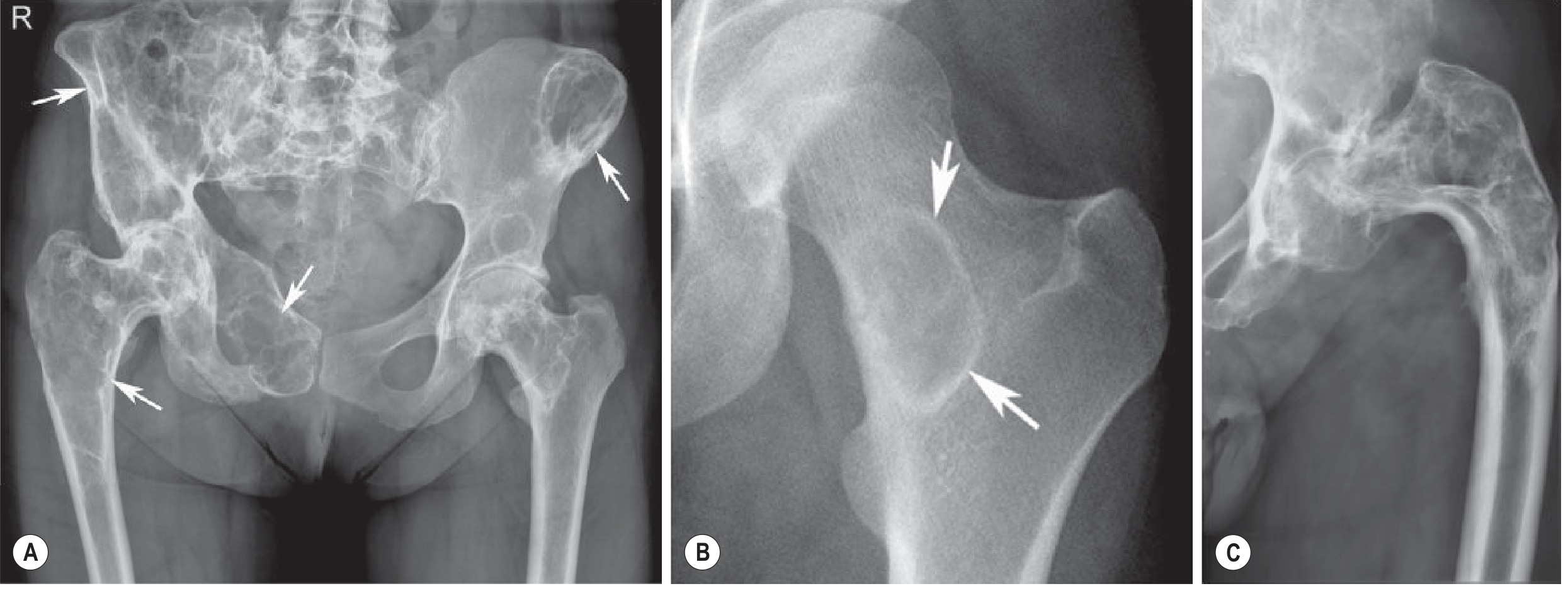
Polyostotic - femur, tibia, and pelvis most often affected; may involve up to 75% of the skeleton
-
Can affect epiphysis, metaphysis, or diaphysis; metadiaphyseal region is typical in long bones
-
Grainger & Allison's Diagnostic Radiology; Rheumatology 2-Volume Set
Morphology
Gross: Tan-white, gritty intramedullary lesional tissue; may cause cortical expansion, thinning, and bowing.
Microscopy (key features):
-
Curvilinear ("C"- or "S"-shaped) trabeculae of woven bone - often described as resembling "Chinese letters" or letters of the alphabet, arranged around vessels
-
No osteoblastic rimming (absent rim of osteoblasts around trabeculae - a hallmark distinguishing FD from ossifying fibroma)
-
Moderately cellular fibroblastic stroma with loose collagen
-
Cystic degeneration, hemorrhage, and foamy macrophages may be present
-
No periosteal reaction (unless fracture is present)
-
Robbins & Kumar Basic Pathology; Rheumatology 2-Volume Set
Radiological Features
Plain X-ray:
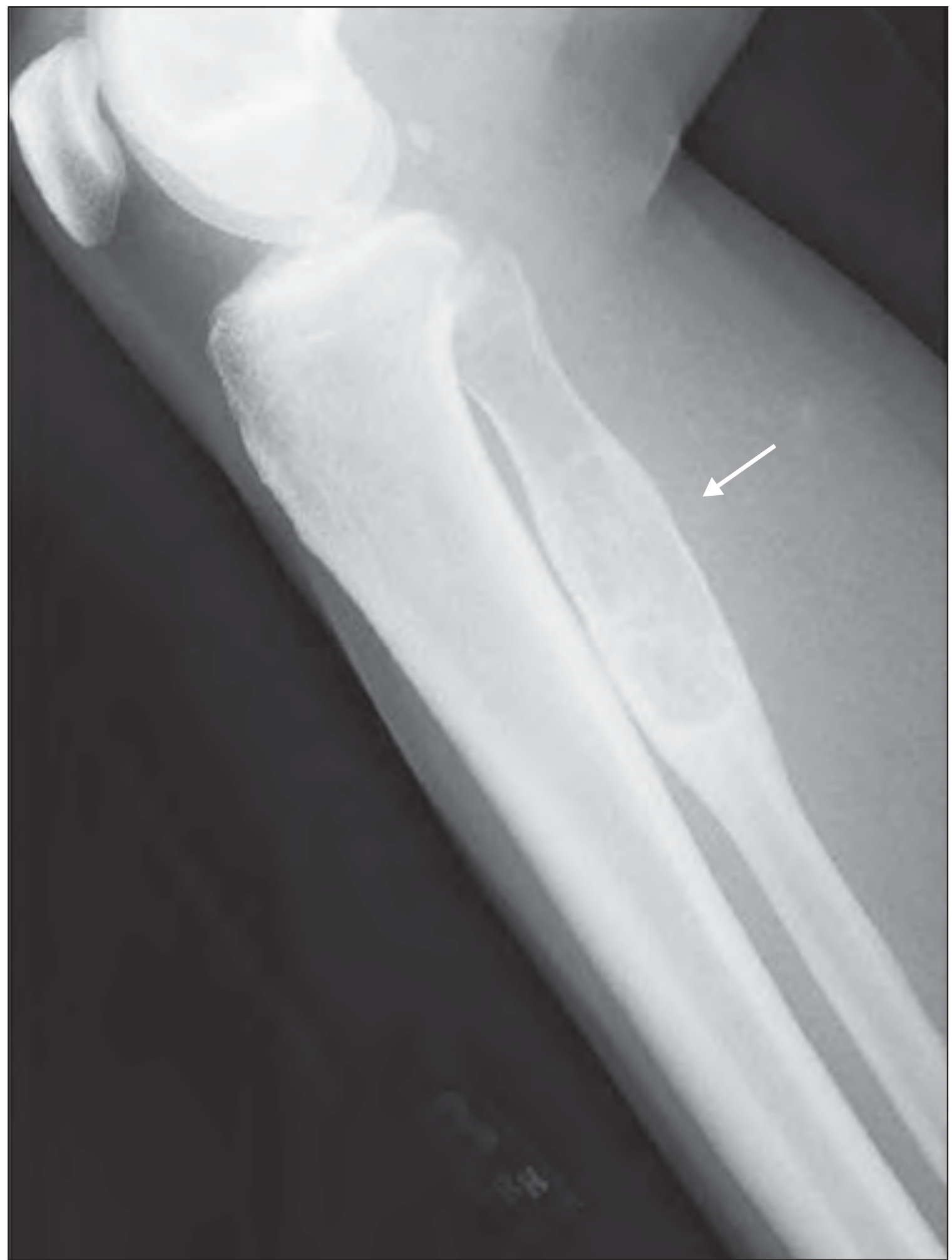
- "Ground-glass" appearance - most characteristic; caused by mineralized woven bone spicules within fibrous tissue
- Elongated lesion causing symmetric cortical thinning and expansion - classic "long lesion in a long bone"
- Geographic lytic lesion; thick sclerotic margin ("rind sign") is characteristic
- Purely lytic variants reflect extensive cystic degeneration
- Periosteal reaction is absent unless fracture has occurred
Polyostotic FD - pelvis and hip:
Clinical Features
- Often asymptomatic - discovered incidentally on X-ray
- May present with: pain, pathologic fracture, and bone deformity
- Monostotic FD frequently stops enlarging at growth plate closure
- Polyostotic FD with weight-bearing bone involvement leads to deformity from repeated fractures - the classic "shepherd's crook" deformity of the proximal femur
- In severe polyostotic disease, FD may produce FGF-23 causing secondary osteomalacia
- Malignant transformation is extremely rare but recognized (with or without prior radiotherapy)
Syndromes Summary
McCune-Albright Syndrome
- Polyostotic FD (typically unilateral) + ipsilateral café-au-lait spots + endocrine dysfunction
- Most common endocrine abnormality: precocious puberty (girls)
- Other endocrine manifestations: hyperthyroidism, Cushing syndrome, acromegaly
- Usually symptomatic before age 10
- Not inherited - mosaic activating GNAS1 mutation acquired in early embryogenesis
Mazabraud Syndrome
- FD (usually polyostotic) + intramuscular myxomas
Treatment
-
Asymptomatic monostotic FD: observation; often stabilizes after skeletal maturity
-
Symptomatic lesions: curettage (recurrence is common)
-
Extensive polyostotic disease: pain management + surgery + bone-strengthening measures
-
Bisphosphonates (e.g., pamidronate, zoledronic acid): used for pain control and to reduce fracture risk, particularly in polyostotic and McCune-Albright cases
-
Surgical stabilization for impending or actual pathologic fractures; intramedullary rodding for shepherd's crook deformity
-
Rheumatology 2-Volume Set; Campbell's Operative Orthopaedics 15th Ed 2026
Key Summary Table
| Feature | Detail |
|---|---|
| Mutation | GNAS1 gain-of-function (somatic, mosaic) |
| Pathology | Woven bone trabeculae, no osteoblast rimming, fibrous stroma |
| X-ray | Ground-glass, rind sign, long lesion in long bone |
| Hallmark deformity | Shepherd's crook (proximal femur) |
| Associated syndromes | McCune-Albright, Mazabraud |
| Malignant potential | Extremely rare |
| Treatment | Curettage, bisphosphonates, surgical stabilization |
This is a shared conversation. Sign in to Orris to start your own chat.